Media Tumbling Service
Last updated on Nov 26, 2026
- Media Tumbling Overview
- Process Principle
- Inherent Process Limitations
- Metal Tumbling vs Standard Polishing
- Order Specifications & Dimensional Limitations
- Precautions
- FAQs about Media Tumbling
Media Tumbling Overview
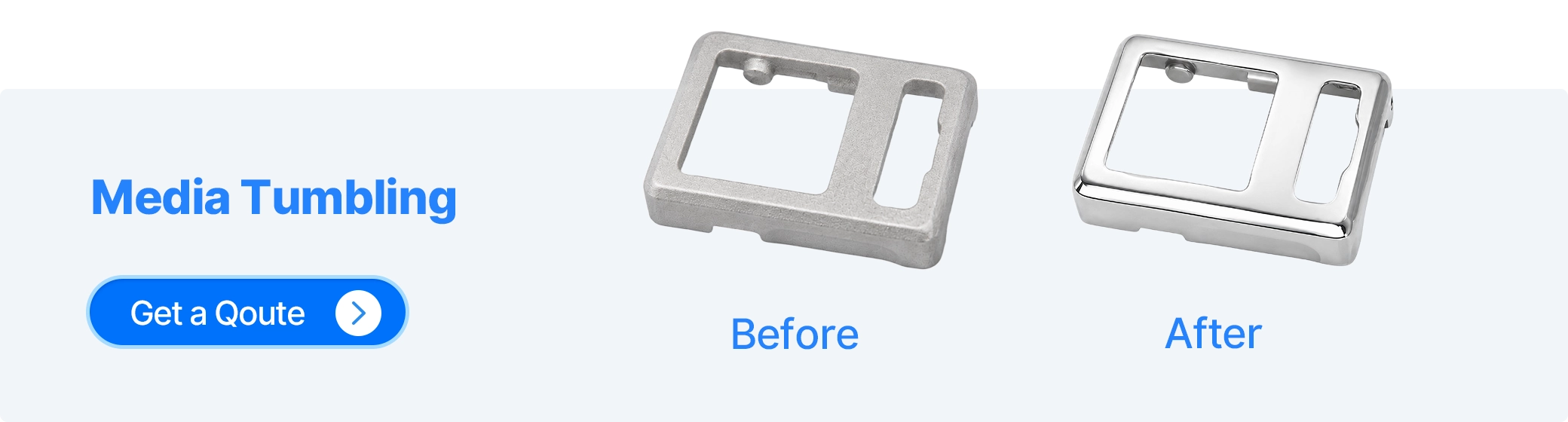
Media Tumbling is an effective 3d printing post-processing method for metal parts. Parts are placed in a barrel loaded with abrasive media. Gentle grinding generated by barrel rotation removes residual surface roughness and burrs, yielding a near-mirror, high-gloss surface.
JLC3DP now offers online Media Tumbling for BJ-316L stainless steel parts, achieving a near-mirror, high-gloss finish with Ra ≤ 0.5 μm on flat surfaces. Ideal for decorative parts where appearance matters.
• Applicable Material: BJ-316L
• Surface Roughness: Ra ≤ 0.5 μm on flat surfaces
Process Principle
Preparation: First, select suitable abrasive media according to the required surface finish and material of the 3D printed parts. Ensure parts are clean and free of loose debris.
Loading: Place the metal parts and abrasive media into the barrel. Maintain a balanced ratio of parts to media to achieve effective grinding and avoid excessive material removal on parts.
Tumbling: Set the barrel to the recommended rotational speed and duration. Rotation causes the abrasive media and parts to tumble and collide, effectively removing roughness, burrs and surface defects.
Inspection during process: Periodically verify normal barrel operation, and stop the machine at intervals to release high-pressure steam inside the barrel.
Completion: Once the grinding cycle finishes, carefully take the parts out of the barrel. Separate parts from abrasive media using a sieve or screen.
Cleaning: Clean the parts after Media Tumbling to remove leftover abrasive grains and debris.
Iteration: Replace with finer-grade media and repeat the above procedure. The Media Tumbling is carried out in three successive stages with progressively finer media.
Quality inspection: Perform a full inspection on parts to confirm compliance with required quality standards and specifications. Check for uniform surface finish, absence of burrs and overall surface smoothness.
Inherent Process Limitations
- Holes, hollowed-out structures and semi-enclosed cavities: Abrasive particles are prone to being trapped in tiny holes, mesh structures and semi-closed inner cavities and cannot be completely removed. Deep blind holes and dense grid structures are not recommended unless the risk of residual abrasives is acceptable.
- Inconsistent polishing effect on different curved surfaces: Polishing priority: convex surface > flat surface > concave surface. External convex areas achieve excellent mirror effect, while the gloss of inner concave surfaces and deep cavity inner walls decreases obviously.
- Right-angle sharp edges: Sharp 90° right angles will be naturally rounded during processing, and perfectly sharp edges cannot be maintained.
- Abrupt step structures: Steps with sudden depth changes and inner concave dead corners may have insufficiently polished areas.
Metal Tumbling vs Standard Polishing
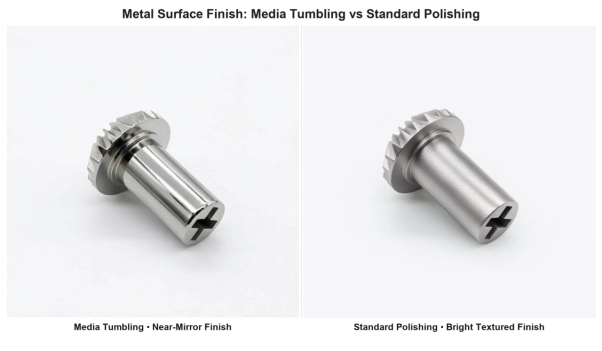
JLC3DP offers two metal surface finishing options for BJ-316L stainless steel parts: Media Tumbling and Standard Polishing. Although both processes improve surface quality and appearance, they differ a lot. The following comparison helps you understand their differences and choose the right finishing process for your project.
| Comparison Item | Media Tumbling | Standard Polishing |
|---|---|---|
| Optimal Flat Surface Roughness | Ra ≤ 0.5 μm, near-mirror high gloss | Ra 0.8-2.4 μm, bright satin finish with slight grainy texture |
| Material Removal & Wear | Maximum 0.3mm | Lower material removal rate |
| Batch Processing Capacity | Suitable for medium and large batch production | Limited batch production capability |
| Edge Performance | Sharp corners will be rounded | Better sharp corner retention |
| Inner Cavity Performance | Weak polishing effect on concave surfaces; risk of abrasive trapping in holes | Good polishing effect on simple inner holes without particle trapping |
| Visual Appearance | Near-mirror-grade high gloss finish | Bright metallic texture |
| Applicable Scenarios | Decorative cosmetic parts, art ornaments, and components requiring a near-mirror-grade high gloss finish | Burr removal and assembly parts requiring sharp corner retention |
| Process Restrictions | Not recommended for dense lattice structures, deep blind holes and semi-enclosed cavities | Limited gloss upper limit, unable to achieve near-mirror effect |
How to Choose the Right Finishing Process
- Choose Media Tumbling if surface appearance is the priority. It delivers a superior finishing result, achieving a near-mirror, high-gloss surface on flat external areas. It is ideal for decorative metal parts, art ornaments, and components requiring a refined, near-mirror finish.
- Choose Standard Polishing if burr removal and edge retention are the main priorities. It is better suited for assembly parts that require burr removal while preserving sharp corners and edges.
Order Specifications & Dimensional Limitations
| Item | Parameter |
|---|---|
| Maximum Overall Dimension | 300 × 100 × 100mm |
| Minimum Overall Dimension | 10 × 10 × 10mm |
| Minimum Wall Thickness | 1mm |
Precautions
- Dimensional Allowance: Reserve a maximum polishing allowance of 0.3mm for critical mating surfaces, tight tolerances are not recommended for cosmetic polishing surfaces.
- Structural Suggestions: Avoid tiny blind holes, dense grids and semi-enclosed cavities. If such structures are necessary, please acknowledge the risk of residual abrasive retention.
- Effect Expectation: Convex surfaces deliver the best mirror effect; the gloss of concave surfaces and inner cavities cannot reach the level of external surfaces.
- Process Restriction: Media Tumbling surface treatment is only applicable to BJ-316L materials and does not currently support SLM-manufactured parts.
FAQs about Media Tumbling
Q: Is there a difference in surface effect between Media Tumbling and Standard Polishing?
They are two distinct surface treatment processes that differ in working principle, final finish and applicable scenarios. Standard Polishing produces a bright metallic satin finish via abrasive finishing, typically with a roughness of Ra 0.8–2.4 μm and a subtle granular texture. Media Tumbling uses a staged abrasive media barrel finishing process to deliver higher surface smoothness. On flat external surfaces, it achieves a near-mirror high-gloss effect with a more delicate and refined visual quality.
Q: Will Media Tumbling remove material from parts? Will it affect the part’s appearance and dimensions?
Media Tumbling is a material-removal surface process that improves surface quality through micron-level grinding, so it will result in controllable dimensional change.
Under standard conditions, the maximum total stock removal does not exceed 0.3 mm. For appearance, sharp right angles and edges of the part will be naturally rounded and blunted, giving the overall profile a softer finish. It is recommended to reserve a polishing allowance on critical mating surfaces in advance to avoid compromising assembly accuracy.
Q: What surface roughness can Media Tumbling achieve? What is the final Media Tumbled surface effect?
On flat external surfaces, Media Tumbling consistently reaches Ra ≤ 0.5 μm, delivering a near-mirror high-gloss metallic appearance.
Due to varying contact levels of the abrasive media, the finishing effect naturally differs across part geometries. The effect ranks in this order: convex surfaces > flat surfaces > concave surfaces. External convex areas achieve the strongest mirror effect, while the gloss and smoothness of inner concave surfaces and deep cavity walls are inferior to external surfaces. Extremely deep internal cavities cannot match the finish quality of external surfaces.
Q: What part structures are not suitable for Media Tumbling?
The following two categories of structures are not recommended for Media Tumbling:
- Structures prone to media entrapment: small blind holes, dense lattice grids, semi-enclosed cavities, etc. Abrasive particles can easily become lodged in gaps and are difficult to fully remove, carrying a risk of residual media.
- Structures with finishing blind spots: sharply stepped features, narrow inner recessed dead corners, deep narrow grooves, etc. The media cannot make sufficient contact, leaving areas with inadequate finishing.
Q: How long does Media Tumbling take? Will it affect my order lead time?
The full Media Tumbling workflow for a single batch of parts takes approximately 7–8 hours. Compared with conventional post-processing, choosing a Media Tumbled finish will extend the overall order lead time, usually by around 1 working day. The exact duration may vary slightly based on batch size and the structural complexity of the parts.
Q: Is Media Tumbling Available for SLM 3D Printed Parts?
No. JLC3DP currently offers Media Tumbling only for BJ-316L stainless steel parts. SLM-manufactured parts are not supported by this finishing process.