3D-Printed Meat: Types, Ingredients, and How It Works
18 min
- What Is 3D-Printed Meat?
- What Are the Main Types of 3D-Printed Meat?
- How Does 3D-Printed Meat Work?
- What Is 3D-Printed Meat Made Of?
- Does 3D-Printed Meat Taste Like Real Meat?
- Is 3D-Printed Meat Safe to Eat?
- Is 3D-Printed Meat Available to Consumers?
- How Much Does 3D-Printed Meat Cost?
- The Benefits and Challenges of 3D-Printed Meat
- Is 3D-Printed Meat More Sustainable?
- 3D-Printed Meat Frequently Asked Questions
- Final Thoughts on 3D-Printed Meat
3D-printed meat is food shaped with a 3D printing process. A printer deposits edible ingredients according to a digital design, building the product layer by layer. The term describes how a food is shaped, not what it is made of: a printed meat-like product may use plant ingredients, cultivated animal cells, or processed conventional meat.
That distinction matters. Plant-based meat is not cultivated meat, and cultivated meat does not have to be 3D-printed. This guide explains the main production routes, ingredients, printing process, safety considerations, and current commercial status.
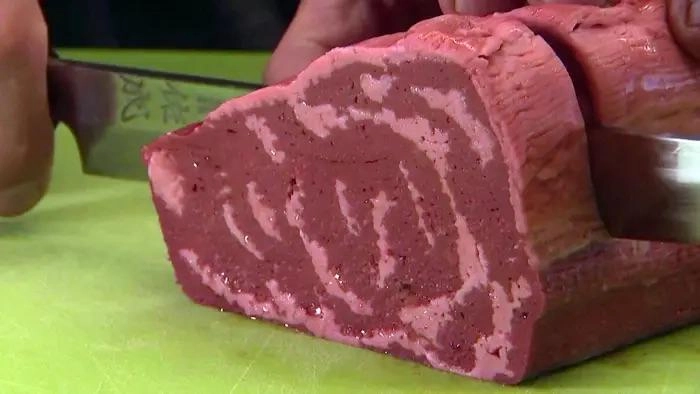
(soruce: nag.co.za)
Note: JLC3DP is a professional industrial 3D printing platform specializing in on-demand manufacturing. We currently do not offer 3D-printed meat or food 3D printing services. This article is for informational purposes only.
Key Takeaways
- 3D-printed meat is a production method, not a single type of food.
- Plant-based meat, cultivated meat, and restructured conventional meat differ in their source materials and production processes.
- Cultivated meat does not necessarily require 3D printing.
- Regulatory status, commercial launches, and retail availability vary by product and region.
What Is 3D-Printed Meat?
3D-printed meat is a meat or meat-alternative product formed by depositing edible material along a programmed path. Food printers often use extrusion: a paste or other printable mixture moves through a nozzle and is placed in layers to build a chosen shape.
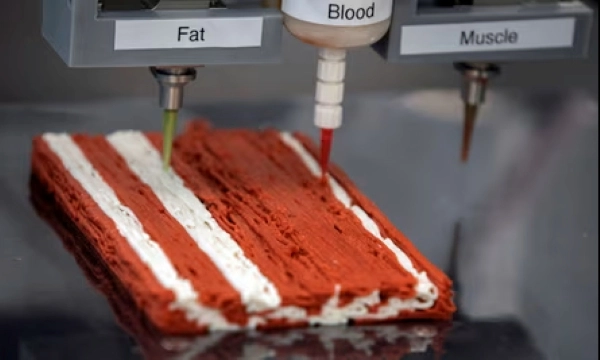
The printed food may be intended to resemble meat’s appearance, texture, or structure. Some systems can deposit different materials in different regions—for example, formulations designed to create contrasting protein-rich and fat-like areas.
However, appearance does not identify the ingredients. A steak-shaped plant-based product is still plant-based, while cultivated meat is made from animal cells. The feedstock determines what the product contains; printing determines how it is formed.
What Are the Main Types of 3D-Printed Meat?
Three production routes help explain what manufacturers mean by 3D meat printing.
| Comparison factor | Plant-based meat | Cultivated meat | Restructured conventional meat |
|---|---|---|---|
| Main feedstock | Plant proteins, fats, water, and other food ingredients | Animal cells and product-specific supporting materials | Conventional meat processed into a printable mixture |
| Uses animal cells? | No animal cells in the plant-based formulation | Yes | Yes, as part of conventional meat |
| Role of printing | Builds shape, layers, and meat-like structure | May arrange cell-containing materials into designed structures | Forms processed meat into selected shapes |
| Additional processing | May include heating, cooling, or other product-specific treatments | Depends on cell growth, scaffold design, maturation, and processing | May include cooking, chilling, or other food-processing steps |
| Commercial status | Commercial products exist, including selected whole-cut alternatives | Commercial availability depends on product and jurisdiction; printing is not required | Research and development exist, but broad retail availability of printed products is not established |
The table describes the routes in general. Ingredients, equipment, and finishing steps vary by product.
Plant-Based 3D-Printed Meat
Ingredients used in 3D-printed meat from plants include soy protein, pea protein, wheat protein, plant oil, and appropriate binders or structural components. The manufacturer combines these ingredients into a blend that can be smoothly extruded through the printer’s nozzle with a retained shape.
The goal is to copy some features of meat, including muscle-like fibers, fat distribution, and how the entire piece breaks apart upon biting or cutting. Multi-material printing could be used to position protein-rich and fat-rich blends in different parts of the product.
For instance, Steakholder Foods introduced the Perfecta line of plant-based meat products for retail sales throughout the northeast of the United States in September 2026. The line includes marbled plant-based steak, filet mignon, chicken breast, salmon patties, and white fish patties. These are plant-based products, not cultivated meat produced from animal cells.
Not all plant-based meat products are 3D printed. Many use traditional mixing, extrusion, molding, or other manufacturing techniques.
Cultivated Meat and 3D Bioprinting
Cultivated meat begins with animal cells grown under controlled conditions. These cells can develop into animal-derived material without the need to raise and slaughter an animal for that harvest.
3D bioprinting may help arrange cells and supporting materials into structures intended to resemble muscle and fat. Cells can be given a framework by a bioink or scaffold, but the materials and methods vary depending on the research or production system.
An important distinction is that cultivated meat doesn't have to be 3D-printed. Cell cultivation is the production route, and printing is one way to organize the material.
Research on extrusion-based bioprinting looks at how materials with cells can be deposited while keeping the cells in suitable conditions. Building a steak-like structure is only part of the problem. The cells must also survive and develop the desired tissue properties.
3D-Printed Restructured Conventional Meat
Traditional meat can also be converted into a printable mixture. Traditional meat is not cultured in the lab but is preprocessed in such a way that it can be printed layer by layer via a printer.
Meat formulations contain proteins, fats, water, and other components that affect printability. Sometimes, the meat does not flow smoothly from the nozzle or keep its printed shape, and therefore there are studies of how to make the meat more printable.
This method may be helpful for creating certain shapes or textures of meat products. The resulting structure may differ from the muscle-fiber architecture of conventional steak.
How Does 3D-Printed Meat Work?
(source: Freepik)
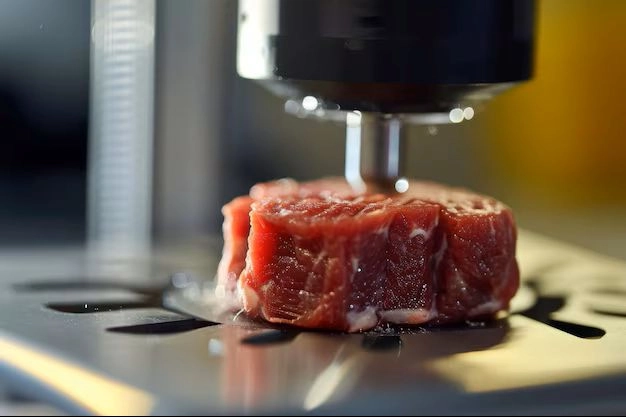
The exact production process depends on the ingredients and whether the product is plant-based, cultivated, or made from conventional meat. A typical extrusion-based process follows five stages.
- Prepare the feedstock. Ingredients are mixed, processed, or cultured as required. Cultivated products also need a suitable process for growing and harvesting animal cells.
- Formulate a printable material. The mixture needs suitable flow properties. It must move through the nozzle without excessive pressure and hold its shape after deposition.
- Set up the digital design. The manufacturer defines the product's geometry and the paths the printer will follow. Multi-material systems may assign different formulations to different regions.
- Deposit the material. The printer places successive layers according to the programmed path. Nozzle size, extrusion rate, temperature, and layer spacing can affect the result.
- Finish and inspect the product. Depending on the formulation, the printed food may require cooking, cooling, curing, maturation, or other processing. Manufacturers must also check consistency, storage conditions, and food safety.
The main engineering challenge is the relationship between flow and shape retention. A mixture that is too fluid may spread or collapse after deposition. One that is too stiff may extrude unevenly or damage the intended structure. The material must behave differently under the force of extrusion and once that force is removed.
Research reviews identify viscosity, yield stress, shear-thinning behavior, and interlayer adhesion as important factors in meat printing. These properties help determine whether the material can be deposited consistently and whether the printed shape survives subsequent handling.
Can a Regular Industrial 3D Printer Print Meat?
Not directly. Industrial FDM, SLA, SLS, and metal 3D printers use materials and processes designed for manufacturing parts, not edible food. Food 3D printing requires suitable edible ingredients, food-contact components, and proper hygiene controls.
Learn more about potential risks in our guide to 10 Things You Should Never 3D Print.
What Is 3D-Printed Meat Made Of?
There is no single recipe for 3D-printed meat. The ingredients depend on the production route, and proprietary commercial formulations should not be assumed from the appearance of the finished food.
| Production route | Main ingredients or feedstock | Functional role | Example or source |
|---|---|---|---|
| Plant-based | Soy, pea, or wheat proteins; plant fats; water; formulation-specific binders | Provides protein, moisture, fat distribution, flow, and structure | Research on pea-protein food inks and multi-material plant-based meat |
| Cultivated | Animal cells, growth-medium components used during cultivation, and any supporting scaffold materials | Supports cell growth and may help organize tissue-like structures | FDA's inventory of completed premarket consultations for foods made with cultured animal cells |
| Restructured conventional meat | Processed meat, water, and formulation-specific ingredients | Adjusts consistency, extrusion behavior, and shape retention | Research on 3D printing with conventional meat materials |
Sources: 2026 review of pea-protein meat analogues, review of multi-material plant-based meat printing, and the FDA cultured animal cell food inventory.
In plant-based products, proteins help form the main structure. Fats contribute to lubrication, flavor release, and juiciness. Water affects consistency and moisture retention, while binders and other structural ingredients may help the mixture retain its printed shape.
Cultivated products have a different starting point. Their animal cells are grown through a controlled biological process, and any supporting materials depend on the product's design. Not every cultivated product uses a scaffold or a 3D printer.
Restructured conventional meat starts with animal-derived meat. Its formulation must be adjusted for the printing process without losing the desired food properties. Exact recipes and ingredient proportions are product-specific. If a manufacturer has not disclosed a formulation, it is more accurate to say so than to infer it from a product photograph.
Does 3D-Printed Meat Taste Like Real Meat?
It can be designed to resemble conventional meat, but the eating experience depends on the formulation and processing. The fact that a product looks like a steak does not establish that it tastes or behaves like one.
Texture, Flavor, and Juiciness
Appearance is only one part of the comparison. A plant-based printed steak may use contrasting materials to imitate muscle fibers and fat marbling. That can improve the visual resemblance, but the texture still depends on the protein structure, moisture, and how the ingredients respond during cooking.
Bite and chewiness depend on how the structure deforms under pressure. Juiciness is affected by moisture retention and fat distribution. Flavor and aroma depend on the ingredients and the chemical changes that occur during heating.
A 2024 review of multi-material plant-based meat printing discusses protein-rich, lipid-rich, and flavor-related formulations, while noting that further work is needed on printability, sensory performance, nutrition, safety, and economics. Read the research review.
Cultivated meat has a different challenge: producing tissue with the desired biological and structural properties. Printing can help position cells or supporting materials, but it does not by itself guarantee the texture of a conventional whole cut.
How Does Cooking Affect the Final Product?
Cooking can change moisture content, shape, firmness, and flavor. The direction and extent of those changes depend on the food's composition.
For a plant-based printed steak, the proteins and fats must respond to heat in a way that preserves a desirable bite. A restructured conventional meat product must be handled and cooked according to its ingredients and food-safety requirements. Cultivated products require product-specific processing and validated cooking instructions.
There is no single cooking temperature or time that applies to every 3D-printed meat product. Follow the product label and the relevant food-safety guidance rather than assuming that a printed steak cooks exactly like conventional beef.
Is 3D-Printed Meat Safe to Eat?
(source: TheGuardian)
Safety of 3D printed meat depends on the ingredients, manufacturing process, hygiene controls, storage, and cooking requirements.
Food Safety and Hygiene
Food printers handle edible materials, so the equipment and production environment must be suitable for food processing. Ingredients need appropriate handling and storage, and the printer's food-contact surfaces must be cleaned and maintained according to the process requirements.
Printing can also create processing considerations that do not apply in exactly the same way to every conventional product. For example, a meat paste may have different contamination risks and cooking requirements from an intact cut. The manufacturer must validate the process rather than rely on appearance or a general claim that printing is precise.
For a related explanation of food-contact risks in 3D printing, see JLC3DP's guide to food-safe 3D printing. That article concerns printed objects and their suitability for food contact, which is different from manufacturing edible food itself. To read about other 3D printed foods, see All about 3D printed foods.
Allergens and Ingredients
Plant-based meat may contain common allergens, including soy or wheat, depending on the formulation. Other ingredients may also need to be declared under the applicable labeling rules. Consumers should check the product's ingredient list and allergen statement rather than assume that a plant-based label means allergen-free.
Cultivated and conventional meat products have different ingredient profiles and potential risks. A product's production route does not replace the need for ingredient disclosure, appropriate hygiene, and food-safety controls.
Regulatory Status
Regulatory clearance is specific to the product, jurisdiction, and intended use. Approval or completion of a review for one cultivated-cell food does not authorize every cultivated meat product, and it does not establish that a particular 3D-printing process has been approved.
As of October 2026, the U.S. Food and Drug Administration's inventory lists completed premarket consultations for cultured-cell foods from companies including UPSIDE Foods, GOOD Meat, Mission Barns, Wildtype, and Believer Meats. The FDA consultation process is one part of the U.S. regulatory framework; applicable meat and poultry products also fall under USDA Food Safety and Inspection Service oversight and labeling requirements. These records should not be interpreted as proof that every listed product is broadly available in stores.
Is 3D-Printed Meat Available to Consumers?
Yes, some 3D-printed plant-based products have reached retail. That does not mean cultivated 3D-printed animal meat is widely available.
| Product or company | Production route | Market | Availability status as of October 20, 2026 |
|---|---|---|---|
| Perfecta by Steakholder Foods | 3D-printed plant-based meat alternatives | Northeastern United States | Retail launch announced on September 3, 2026. The company has not provided a verified store-by-store list in the cited announcement. |
| Cultivated-cell food products listed by the FDA | Cultivated animal cells; printing is not necessarily used | United States | Several products have completed FDA premarket consultations, but this does not establish retail availability or use of 3D printing. |
| Restructured conventional meat made by 3D printing | Conventional animal-derived meat | Product-specific | Research and development exist; broad consumer retail availability is not established by the sources cited here. |
Sources: Perfecta retail launch and FDA cultured animal cell food inventory.
Perfecta is a useful example because the company announced an actual retail launch rather than only a prototype or planned release. Its range includes plant-based marbled steak, filet mignon, chicken breast, salmon patties, and white fish patties. The company describes these as plant-based products. Its announcement confirms the regional launch, but not a particular store's current stock. Check the company's product site for current consumer information.
For cultivated meat, a completed regulatory consultation and commercial retail sales are separate milestones. A product can have completed a regulatory step without being broadly distributed, and the presence of animal cells does not mean a product was 3D-printed.
How Much Does 3D-Printed Meat Cost?
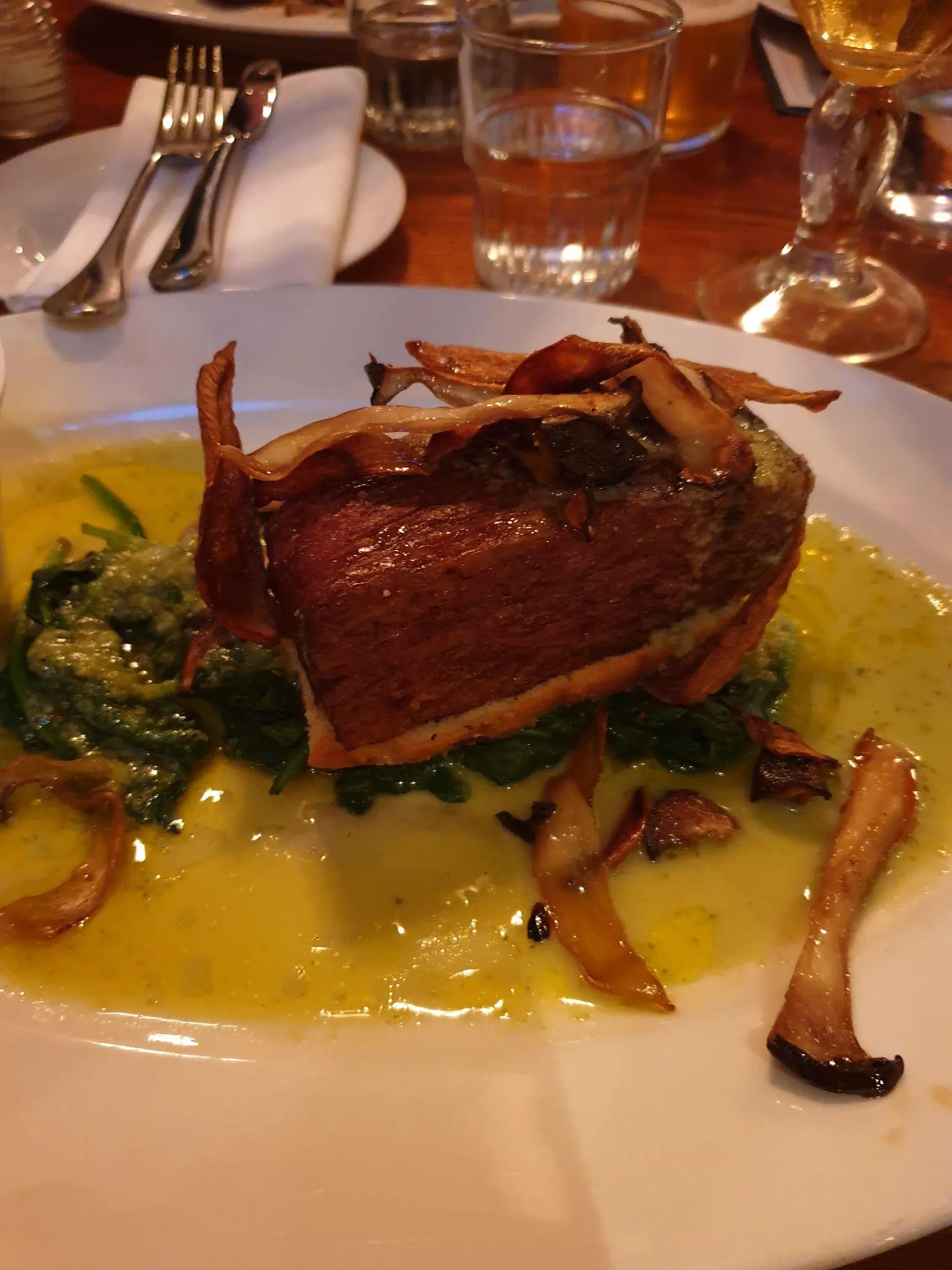
(source: Reddit) Plate of 3D printed meat dish served at Mr.White’s
There is not enough comparable public pricing data to establish a reliable average price for 3D-printed meat. Prices vary by product type, market, package size, and sales channel.
Some reported figures provide context, but they are not directly comparable. For example, a Reddit user reported prices of around £30–£35 for dishes at Mr. White’s and other London restaurants, including plant-based options. In 2021, researchers also reported producing 3D-printed synthetic beef with a cost estimate of approximately $200 per pound. However, a research-stage cost estimate is not equivalent to the retail price of a commercially available product.
Note: retail prices reflect the finished product and its associated manufacturing, distribution, and sales costs, while research and pilot-production estimates may include laboratory work, equipment development, and testing.
As of October 2026, Stakeholder Foods’ announced retail launch of its Perfecta plant-based meat range does not provide a confirmed retail price or a complete list of participating stores. For a meaningful comparison with conventional meat or other plant-based alternatives, check prices for the same product category, market, package weight, and date. Current public data do not support a reliable general price per kilogram for 3D-printed meat.
The Benefits and Challenges of 3D-Printed Meat
The main advantage of food printing is control over where material goes. Whether that translates into a better product or a commercially useful process depends on the feedstock and production system.
Potential Benefits
- Control over shape: A digital design can define the product’s geometry.
- Material placement: Some printers can deposit different formulations in selected regions.
- Design flexibility: Digital files can be changed without manufacturing a new mold for every shape.
- Product development: Printing can help researchers and producers test new food structures and formulations.
These are potential capabilities, not guarantees that a product will taste better, cost less, or be more sustainable.
Technical and Commercial Challenges
- Printability: A formulation must flow through the printer and retain shape after deposition.
- Consistency: Ingredient variation and process settings can affect texture and product quality.
- Scale and speed: Printing a complex shape is not automatically more efficient than established food-processing methods.
- Cost: Equipment, ingredients, labor, cleaning, and production yield all affect commercial viability.
- Cultivated-meat requirements: Cell growth and tissue development introduce biological challenges beyond the printing step.
Is 3D-Printed Meat More Sustainable?
Not by definition. Sustainability depends on the production route, ingredients, energy use, manufacturing yield, and the conventional product used for comparison.
A plant-based printed product, cultivated meat, and printed conventional meat have different production systems. Even products in the same category may differ by ingredient source and manufacturing process.
A meaningful comparison needs product-level lifecycle data with a clear scope—for example, emissions, land use, water use, and energy per kilogram of product or per serving. Until comparable data are available, broad claims that all 3D-printed meat is more sustainable should be treated cautiously.
3D-Printed Meat Frequently Asked Questions
Q: Is 3D-printed meat real meat?
It depends on the production route. Plant-based printed meat is made from plant ingredients and contains no animal muscle. Cultivated meat is made from animal cells. Restructured conventional meat uses existing animal-derived meat. The printer describes how the food is shaped, not what it is made from.
Q: Is 3D-printed meat being sold in the US?
Yes. Steakholder Foods announced the retail launch of its Perfecta plant-based meat range in the northeastern United States on September 3, 2026. That announcement confirms a regional retail launch, not nationwide availability or the current stock of any individual store.
Q: What is 3D-printed meat made of?
Ingredients vary by product. Plant-based versions may use soy, pea, or wheat proteins, fats, water, and formulation-specific binders. Cultivated versions use animal cells and may use supporting materials. Restructured conventional meat starts with processed animal-derived meat and ingredients chosen to make it printable.
Q: Can you 3D-print meat at home?
Food printers can deposit certain edible pastes and mixtures, but printing a meat-like product requires a formulation that flows through the equipment and retains its shape. Producing a convincing steak-like structure is more demanding than printing a simple food shape. Any home process also needs appropriate food-contact equipment and hygiene controls.
Q: Is 3D-printed meat healthier than conventional meat?
There is no universal answer. Nutritional content depends on the ingredients and formulation, including protein, fat, sodium, and other components. A plant-based product is not automatically healthier, and a cultivated or restructured product cannot be assessed from the printing method alone. Compare the nutrition label and ingredients of specific products.
Q: Does 3D-printed meat taste like steak?
Some products are designed to resemble steak in appearance, texture, and juiciness, but results vary. Ingredient composition, the arrangement of protein and fat, and cooking all affect the final experience. Visual similarity alone does not establish that a product has the same flavor or texture as conventional beef.
Final Thoughts on 3D-Printed Meat
3D-printed meat is best understood as a way to shape food, not as one new type of meat. The material may be plant-based, cultivated from animal cells, or made from processed conventional meat—and those categories have different ingredients, production requirements, and regulatory considerations.
Printing can provide control over shape and material placement, but it does not by itself guarantee meat-like taste, food safety, lower cost, or greater sustainability. To evaluate a specific product, check its ingredients, manufacturing information, regulatory status, price, and availability in your market.
Keep Learning
3D-Printed Meat: Types, Ingredients, and How It Works
3D-printed meat is food shaped with a 3D printing process. A printer deposits edible ingredients according to a digital design, building the product layer by layer. The term describes how a food is shaped, not what it is made of: a printed meat-like product may use plant ingredients, cultivated animal cells, or processed conventional meat. That distinction matters. Plant-based meat is not cultivated meat, and cultivated meat does not have to be 3D-printed. This guide explains the main production route......
All About 3D Printed Food
(source: Freepik) 3D printing food works a lot like traditional 3D printing, but instead of thermoplastics and resin, it uses edible materials, think purées, pastes, doughs, and even proteins. These food-grade materials are fed into a printer cartridge and extruded layer by layer to form a final product. Want a pizza shaped like your logo? Done. Need a custom-textured meal for someone with dysphagia? You got it. Why Are People Printing Their Meals? (source: Freepik) The real power of 3D printed food i......
How to Make 3D Printed Safe Items for Food
Using your 3D printer to create custom cookie cutters, cake toppers, or maybe even unique 3D printed utensils opens exciting possibilities in the kitchen. But before you start printing your next culinary gadget, ask yourself this question: Is it safe to use these printed items with food? Getting this wrong could pose health risks, so understanding the process for different printing technologies is key. This article explains how to approach making food safe 3D print objects. We will cover: ·Why 3D prin......
Chocolate 3D Printer: Realize Your Food Creativity
3D printing is already common in the food industry. The emergence of chocolate 3D printers means that chocolate is no longer limited to the form of traditional molds. Instead, it can print various complex patterns, shapes and structures according to the designer's creativity, providing food designers with greater freedom and creative space. This article introduces the working principle and advantages of chocolate 3D printers, as well as several popular chocolate printers on the market to help you unde......