The Complete B2B Buyer’s Guide to Large Scale 3D Printing Services
18 min
- What Is a Large Scale 3D Printing Service?
- Applications of Large Scale 3D Printing
- How Much Does Large Scale 3D Printing Cost?
- Technologies Used in Large Scale Additive Manufacturing
- Which Large-Format Printing Technology Is Best for Your Project?
- Common Challenges in Large Scale 3D Printing
- How to Evaluate Large Scale 3D Printing Companies
- Overseas vs Local Large Scale 3D Printing Services
- Common Mistakes When Choosing a Large Scale 3D Printing Supplier
- How JLC3DP Supports Large Scale 3D Printing Projects
- FAQ About Large Scale 3D Printing Service
Most buyers discover the hard way that large format 3D printing is more complicated than just finding a company with a big machine. A supplier may provide a confident quote but still deliver a warped part late. When that happens, both time and budget are wasted.
Large scale 3D printing enables manufacturers to produce oversized prototypes, tooling, molds, and end-use parts that are difficult or costly to manufacture using traditional methods. According to Wohlers Report 2026, the global additive manufacturing industry reached $24.2 billion in revenue in 2025, highlighting the growing adoption of additive manufacturing across industrial applications.
This guide covers what actually separates reliable large scale 3D printing companies from the ones that look fine until something goes wrong.
A large scale 3D printing service produces parts or assemblies that exceed the build volumes of standard desktop or benchtop equipment, typically parts with at least one dimension above 300mm, requiring industrial-grade equipment, validated materials, and process controls that smaller machines don't need.
If you're reading this, you already know you need it. What you need to figure out is who to trust with it. Alternatively, if you are looking to produce oversized parts on your own equipment, check out our comprehensive guide on how to 3D print large objects beyond your printer's size.
What Is a Large Scale 3D Printing Service?
A large scale 3D printing service uses industrial additive manufacturing equipment to produce oversized parts, large format components, or high-volume builds that standard 3D printing equipment physically cannot accommodate.
The definition is about the engineering discipline behind producing large parts correctly.
Large format additive manufacturing introduces challenges that small-part printing doesn't face, thermal gradients across large build volumes cause warping, layer adhesion at scale behaves differently than on small parts, post-processing of large components requires different equipment, and dimensional accuracy over 500mm requires active calibration and environmental controls that most desktop machines don't have.
A genuine industrial large-scale 3D printing service has addressed all of these.
A service that bought a large printer without the process knowledge to go with it produces large failures as reliably as it produces large parts.
Common technologies include MJF, SLS, SLA, Binder Jetting,SLM and large format additive manufacturing (LFAM) systems for oversized industrial components.
- up to $123 coupons for new users
- DFM review + Large-format manufacturing quote
Applications of Large Scale 3D Printing
Aerospace
Lightweight tooling, molds, and functional components.
Automotive
Prototypes, jigs, fixtures, and low-volume production parts.
Manufacturing
Assembly fixtures, end-of-arm tooling, and custom equipment.
Architecture
Large visual models and display components.
How Much Does Large Scale 3D Printing Cost?
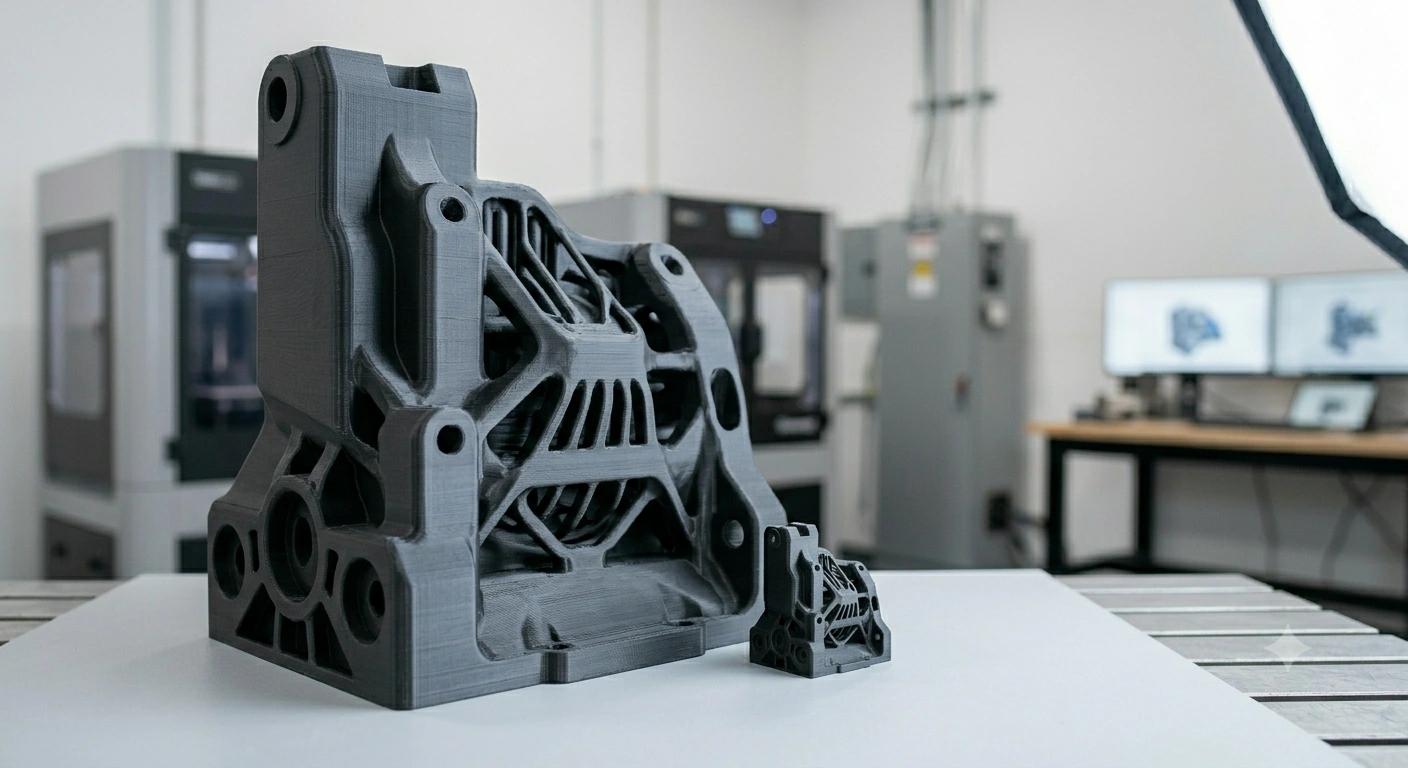
It varies more than any other manufacturing process, and quotes from different suppliers for the same file can vary significantly . Here's why, and what the numbers actually look like.
What drives large part 3D printing cost:
Material volume is the primary driver. Large scale additive manufacturing uses significantly more material than standard printing..
A 600mm x 400mm x 200mm part in SLS nylon might consume several kilograms of powder depending on infill and geometry. At $60-120/kg for industrial nylon, that's $480-1,800 in material alone before machine time.
Machine time scales with part height and layer count, not just volume. A tall thin part takes longer than a flat wide part of the same volume. Industrial machine operating costs vary significantly depending on process, equipment, and region in machine cost depending on process and equipment tier.
Post-processing is often ignored in initial quotes and then appears as a separate line. Large parts need support removal, surface finishing, and often infiltration or sealing, all of which take proportionally more time than on small parts.
Rough cost ranges by process:
Large scale 3D printing costs vary significantly depending on technology, material, part size, and post-processing requirements.
- Large Format FDM: Typically $200–1,500 per part. Best suited for large prototypes, tooling, fixtures, and manufacturing aids where cost efficiency is the primary concern.
- Large Format SLS: Typically $400–3,000 per part. Commonly used for functional nylon components with complex geometries and no support structures.
- Multi Jet Fusion (MJF): Typically $300–2,500 per part. Offers production-quality nylon parts with good accuracy and consistent mechanical properties.
- Large Format SLA / DLP: Typically $500–4,000 per part. Ideal for large visual models, patterns, and applications requiring smooth surface finishes and fine detail.
- Large Format Metal Printing (Binder Jetting): Typically $800–8,000+ per part depending on material, sintering requirements, and part volume. Often selected for complex metal components without support structures.
- SLM / DMLS Metal Printing: Typically $1,500–15,000+ per part. Used for high-performance aerospace, medical, and industrial components where mechanical properties are critical.
- Industrial Large Scale 3D Printing Projects: Large assemblies, production tooling, and oversized components can range from $1,000–10,000+ depending on size, material, tolerances, and finishing requirements.
These ranges are wide because part geometry, material selection, required tolerances, and post-processing needs all have dramatic effects. The best way to understand what your specific project will cost is to get quotes with your actual files, not to estimate from industry averages.
Pro-Tips to Reduce Large Part 3D Printing Costs:
- Hollow Out Your Design: Use appropriate wall thicknesses and internal honeycomb structures instead of solid infills.
- Split-and-Bond: Design the part to be printed in optimized sub-components and assemble them post-print. This maximizes build-chamber density and minimizes failure risks.
- Accept As-Printed Finishes: Avoid costly manual sanding or painting if the part is for internal industrial tooling.
Technologies Used in Large Scale Additive Manufacturing
Large Format additive manufacturing (LFAM) uses several additive manufacturing technologies, each offering different advantages in build size, materials, accuracy, and cost.
Large Format FDM
Builds parts by extruding thermoplastic materials layer by layer. Commonly used for large prototypes, tooling, fixtures, and manufacturing aids.
Large Format SLS
Uses a laser to fuse nylon powder into strong functional parts without support structures. Ideal for complex geometries and end-use components.
Multi Jet Fusion (MJF)
Produces durable nylon parts with consistent mechanical properties and high production efficiency, making it suitable for low-volume manufacturing.
Large Format SLA
Uses photopolymer resin to create highly detailed parts with excellent surface quality and dimensional accuracy.
Large Format MSLA / DLP
Cures resin using projected light to produce accurate parts with smooth surfaces and fine details.
Binder Jetting (Metal)
Creates metal parts without support structures by depositing binder onto metal powder before sintering.
SLM / DMLS (Metal)
Uses lasers to fully melt metal powder and produce dense metal components with high strength and precision.
Multi-Material FDM
Combines build and support materials to produce complex geometries, internal channels, and difficult overhangs more efficiently.
Which Large-Format Printing Technology Is Best for Your Project?
The most common large-scale and industrial 3D printing technologies differ significantly in build volume, material options, surface quality, accuracy, and cost. There are a technology comparison and best recommended materials table.(Note: While not all technologies are considered true large-format systems, they are commonly evaluated alongside large-scale 3D printing for industrial production. )
| Technology | Max Build Volume (Typical) | Best Materials | Dimensional Accuracy | Surface Finish | Best For | Relative Cost |
|---|---|---|---|---|---|---|
| Large Format FDM | 900 × 600 × 900 mm+ | ABS, ASA, PC, ULTEM, Nylon | ±0.5–1.5 mm | Visible layer lines | Large structural parts, tooling, jigs, fixtures | Low–Medium |
| Large Format SLS | 500 × 500 × 500 mm | PA12, PA11, TPU, Glass-filled Nylon | ±0.3–0.5 mm | Matte, slightly rough | Functional parts, complex geometry, no support structures | Medium |
| Large Format SLA | Up to 800 × 800 × 550 mm+ | Standard and engineering resins | ±0.1–0.3 mm | Smooth, fine detail | Visual models, patterns, detailed functional parts | Medium–High |
| Large Format MSLA / DLP | 600 × 330 mm+ | Engineering resins | ±0.1–0.2 mm | Smooth | Detailed large parts, medical, dental, prototype applications | Medium–High |
| Multi Jet Fusion (MJF) | 380 × 284 × 380 mm | PA12, PA11 | ±0.2–0.4 mm | Fine matte finish | Production-grade nylon parts and low-volume manufacturing | Medium–High |
| Binder Jetting (Metal) | 800 × 500 × 400 mm | 316L, 17-4PH, Inconel | ±0.3–0.5 mm (post-sinter) | Matte metallic | Metal parts with complex geometries and no support structures | High |
| SLM / DMLS (Metal) | Up to 800 × 800 × 600 mm | Stainless Steel, Titanium, Aluminum Alloys | ±0.1–0.3 mm | Fine metallic finish | High-performance aerospace and industrial metal components | Very High |
| Multi-Material FDM | 600 × 600 mm+ | ABS/ASA with soluble support materials | ±0.3–0.8 mm | Moderate | Complex geometry with internal channels and support-intensive designs | Medium |
Pro-Tips: How to Choose the Right Large-Format Printing Technology
Large Format FDM
Best for cost-effective large prototypes, tooling, and manufacturing aids.
Large Format SLS
Best for strong nylon parts with complex geometries and no support requirements.
Resin-Based Technologies (SLA / MSLA / DLP)
Best for applications requiring fine details and smooth surface finishes.
Metal 3D Printing (Binder Jetting & SLM)
Best for functional metal components, with SLM offering higher mechanical performance and Binder Jetting providing better scalability.
Not sure which technology is right for your project? Upload your CAD file and receive material and process recommendations from JLC3DP engineers.
Common Challenges in Large Scale 3D Printing
Warping
Large parts cool unevenly and may distort.
Layer Separation
Poor thermal control can reduce layer adhesion.
Shrinkage
Material contraction can affect dimensional accuracy.
More details look at our blog:3d printing common problem
How to Evaluate Large Scale 3D Printing Companies
Most buyers evaluate on price and lead time. Those matter, but they're the last things to evaluate, not the first. A cheap quote with a short lead time from a supplier who can't actually hold tolerances on large parts is a waste of time and money.
Machine size and actual capability
Ask specifically about maximum build volume for the process you need. Ask whether the stated volume is achievable in a single build or whether oversized parts are split and bonded. Splitting is legitimate, but it needs to be disclosed upfront and executed correctly, a bond line in a structural large format part that's quoted as a single build is a quality problem, not a creative solution.
Verify that the equipment is capable of producing your specific material in the required build size. Some large format 3D printing companies own large machines but only validate certain material-size combinations. A machine that can theoretically print a 500mm SLS part may not have validated that build size in carbon-filled nylon, which behaves differently from standard PA12 at scale.
Material validation and certifications
Industrial large scale 3D printing for engineering applications requires material validation, documented mechanical properties from specimens printed on the actual equipment, at relevant build sizes and orientations. Supplier-provided material datasheets that come from the resin or powder manufacturer don't tell you what the material does on that specific machine with that specific process.
For regulated applications, aerospace, medical, automotive, ask for material traceability documentation, batch certification, and whether the supplier's quality system is certified to relevant standards (AS9100 for aerospace, ISO 13485 for medical devices). Large scale 3D printing companies serving these industries have this documentation. Suppliers who don't serve these industries may not.
Post-processing capability at large format scale
Finishing a 600mm part requires different equipment than finishing a 100mm part. Bead blasting cabinets need to accommodate the part size. Curing ovens for large SLA parts need appropriate volume. Painting, coating, and surface treatment facilities need to handle large format components. Confirm that post-processing capabilities match the part size, not just the printing capability.
Engineering support quality
Design for additive manufacturing (DFAM) matters more at large scale than at small scale. Features that print reliably at 100mm may fail at 500mm because thermal gradients, residual stress, and layer adhesion behave differently. Suppliers who offer DFAM review before production start catch these problems before they become expensive reprints. Suppliers who just run files as submitted discover them after.
Overseas vs Local Large Scale 3D Printing Services
This question comes up constantly in B2B purchasing, and the answer is less about where the supplier is located than most buyers assume.
What local suppliers actually offer:
Faster turnaround on urgent projects. Easier communication for technical questions and design iteration. No customs, import duties, or international shipping considerations on large parts. Direct facility visits if the application requires supplier qualification audits.
What overseas large scale 3D printing companies offer:
Significantly lower per-part cost on most processes, labor and operational cost differences produce 30-60% cost reductions on equivalent work. Larger facility capacity at major suppliers. Competitive lead times on standard orders when shipping transit time is factored in correctly.
The actual decision factors:
For one-off urgent parts with complex requirements and active design iteration, local is usually worth the premium. For production quantities of validated large format 3D printing designs with stable specifications, the cost difference from overseas suppliers is significant enough to justify the logistics management overhead.
JLC3DP provides large scale 3D printing service with engineering support, competitive lead times, and transparent quoting, combining the cost advantage of an international supplier with engineering communication that most overseas services don't offer. Large part 3D printing projects across SLS, SLA, and FDM are handled with DFAM review, dimensional reporting, and material certification on request.
Common Mistakes When Choosing a Large Scale 3D Printing Supplier
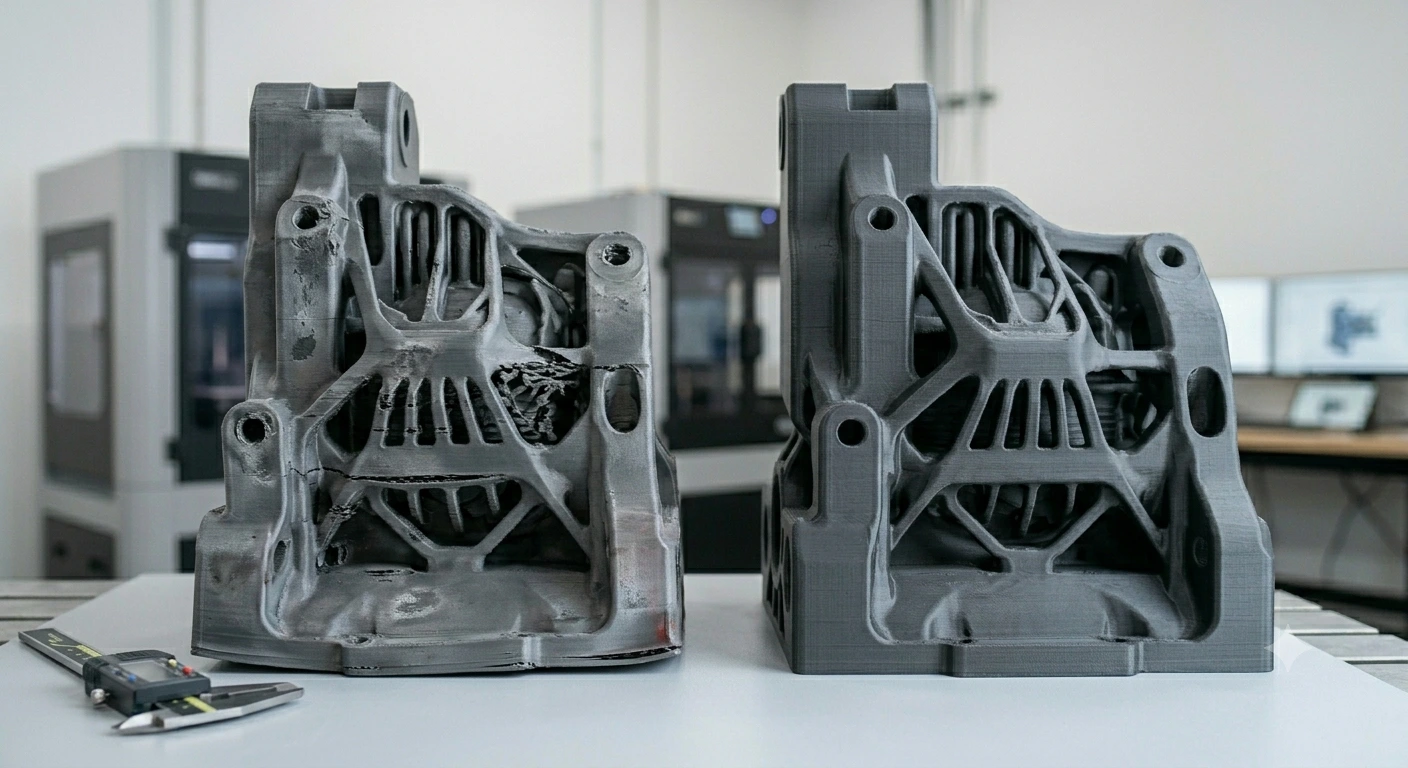
These patterns show up repeatedly in projects that don't go well. Most of them are avoidable.
Evaluating on price before evaluating on capability. A quote that's 40% cheaper than competitors means nothing if the supplier can't hold dimensional accuracy on your part size in your material. Verify capability first, negotiate price second.
Not asking about split-and-bond policies upfront. Some suppliers quote large parts as single prints and then produce them as bonded assemblies without disclosure. Ask directly: "Will this part be printed as a single piece or assembled from multiple prints?" Get the answer in writing.
Assuming all large format 3D printing is the same process. Buyers who don't distinguish between FDM, SLS, SLA, and binder jetting often select the wrong process for their application based on whoever quotes fastest or cheapest. Process selection should be driven by the part's functional requirements, not by which process the first supplier happens to offer.
Skipping the sample or first article. For large parts with significant material cost and lead time, ordering a first article or scaled test piece before committing to a full production run catches process problems at one-part cost rather than full-run cost. Suppliers who resist first article inspection for large orders are a yellow flag.
Not specifying post-processing requirements in the initial quote. "Print only" and "finished part ready for use" are completely different deliverables with different costs. Specifying finish requirements, tolerance requirements, and surface finish requirements in the initial RFQ prevents surprises when the invoice arrives.
Choosing a supplier who doesn't understand your application. A large scale 3D printing service that produces architectural models and a service that produces aerospace structural components may own similar equipment but have completely different process capability and quality systems. The supplier's experience in your industry matters.
How JLC3DP Supports Large Scale 3D Printing Projects
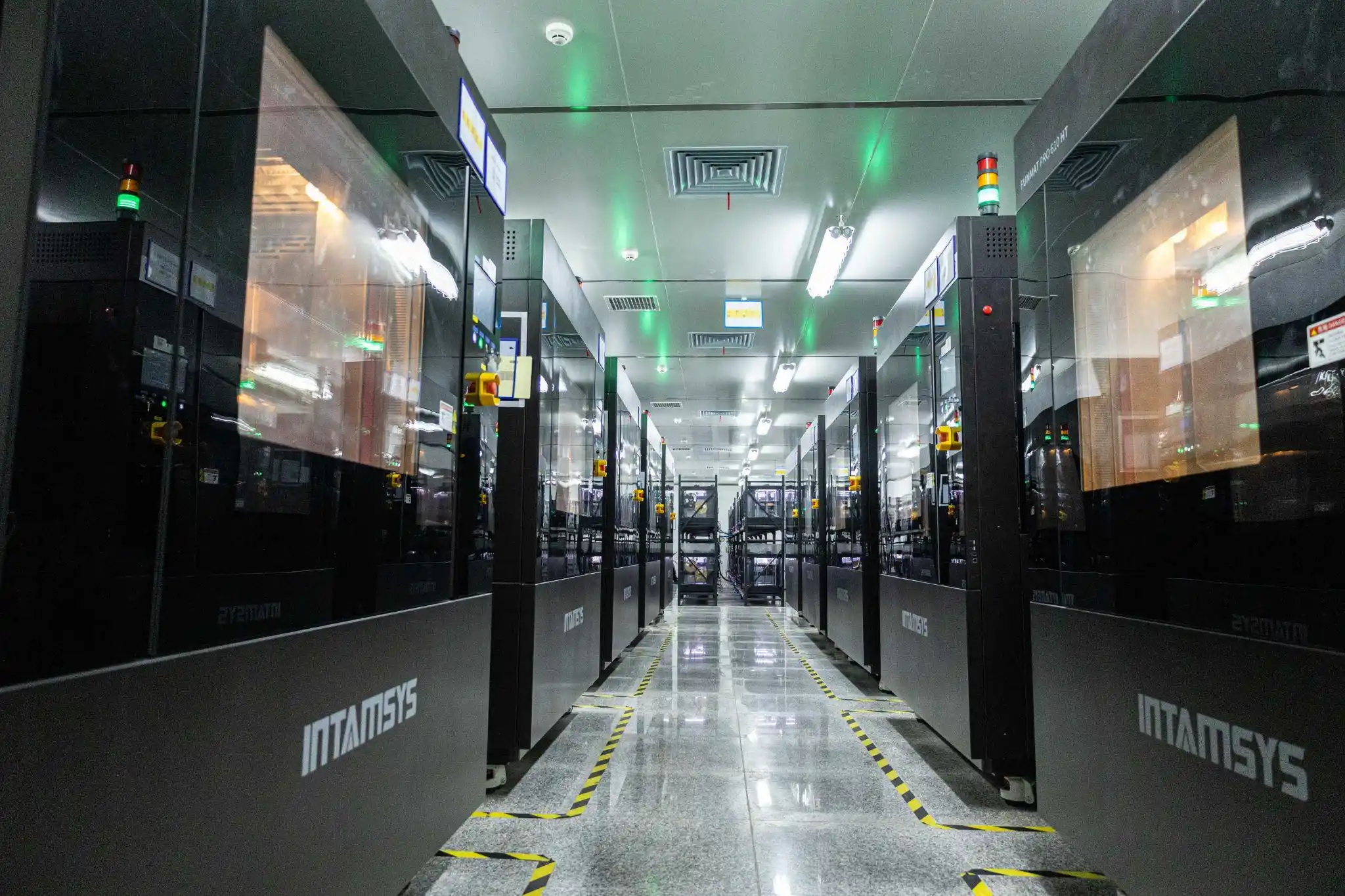
JLC3DP handles large format 3D printing across SLS, SLA and FDM with engineering review built into every project rather than bolted on as an optional add-on.
For large scale additive manufacturing projects, the process starts before production. Files are reviewed for printability at the requested scale, material recommendations are provided if the specified material isn't the best fit for the application, and build orientation is optimized for dimensional accuracy and surface finish on large parts before the job is queued.
Industrial large-scale 3D printing capability at JLC3DP covers single parts up to 800mm in key dimensions on select processes, with split-and-bond assembly available for oversized parts beyond single-build capacity, disclosed and quoted transparently, with bond line location and method specified before production starts.
Material options cover engineering-grade nylon, glass-filled and carbon-filled variants, high-temperature resins, flexible materials, and metal binder jetting in 316L stainless and 17-4PH. Material certifications and mechanical property documentation are available for production and regulated applications.
Post-processing for large parts, bead blasting, painting, clear coating, dyeing, and dimensional inspection, is handled in-house rather than outsourced, which means one supplier contact manages the complete deliverable rather than coordinating between multiple vendors.
What Information Should You Provide for a Quote?
A quote request that provides complete information gets an accurate quote back. A vague request gets a vague estimate that usually changes when the real requirements emerge.
File format: STEP is preferred for all large scale 3D printing quotes. STL is acceptable but loses dimensional precision on complex geometry. Native CAD formats from major platforms are usually acceptable, confirm with the supplier.
Part dimensions and quantity: State the maximum dimensions explicitly. "Large part" means different things to different people. 450 x 200 x 150mm is a specific statement that lets the supplier confirm machine capability immediately.
Material requirement: If you have a specific material requirement, state it. If you're open to recommendations, say so, the supplier's DFAM feedback may suggest a better material for the application than your initial specification.
Functional requirements: Is this a visual model, a functional prototype, or an end-use production part? What load, temperature, or chemical exposure does it need to survive? This information drives process and material selection more than the part geometry alone.
Surface finish and tolerance requirements: As-printed, standard post-process, or specific Ra and dimensional tolerance requirements. Be specific, "good finish" is not a specification.
Lead time requirements: Standard lead time vs expedited. For large format 3D printing, standard lead times run five to fifteen business days depending on part size and process. Expedited options exist but at a premium.
Quantity: Single prototype, small batch, or production quantity. Cost per part changes substantially with quantity even in 3D printing.
FAQ About Large Scale 3D Printing Service
Q: What counts as large scale 3D printing?
Parts with at least one dimension above 300mm are generally considered large scale for 3D printing. Industrial large format 3D printing typically handles parts from 300mm to 800mm+ in key dimensions depending on the process and equipment.
Q: How do large scale 3D printing companies handle parts bigger than their build volume?
Most large scale 3D printing services split oversized parts into sections and bond them post-print using structural adhesive or mechanical fastening. This is a legitimate production method when executed correctly, the key is knowing upfront whether your part will be printed as one piece or assembled, where the bond lines will be, and how that affects the mechanical performance of the finished part.
Q: What tolerances can large format 3D printing achieve?
Depends on the process. Large format FDM holds ±0.5-1.5mm on large dimensions. Industrial SLS holds ±0.3-0.5mm. Large format SLA holds ±0.1-0.3mm. These tolerances are achievable on well-maintained equipment with proper calibration, they're not guaranteed from all suppliers.
Q: Is large scale additive manufacturing cost-effective vs traditional manufacturing?
For complex geometry at low-to-medium volumes, usually yes. For simple geometry at high volume, traditional manufacturing (casting, machining) is typically more economical. The break-even depends on complexity, volume, and material, large part 3D printing eliminates tooling cost entirely, which changes the economics significantly at low quantities.
Q: How long does large format 3D printing take?
Build time for large parts runs 12-100+ hours of machine time depending on part height, process and size. Total lead time including post-processing and quality inspection typically runs five to fifteen business days from file approval to shipment on standard orders.
Q: What's the difference between large format and standard 3D printing services?
Beyond machine size, industrial large-scale 3D printing requires more sophisticated process controls, active temperature management in the build chamber, calibrated leveling across large build surfaces, validated material behavior at scale, and post-processing capability for large components. Suppliers who simply own large machines without the process knowledge produce inconsistent results at large scale that they don't encounter at standard scale.
Popular Articles
Keep Learning
Best 3D Prints to Sell Right Now: Top Selling Items & Ideas
If you’ve got a 3D printer at home and you’ve been thinking, “Hmm… could I actually make money with this?”, the answer is yes. But here’s the thing: not every cool print idea is a good business idea. Some designs look amazing but take forever to print (and customers won’t pay enough to make it worth it). Others are quick to print but nobody wants to buy them. The sweet spot? Items that are useful, in-demand, quick to produce, and easy to ship. In this guide, We’ll walk you through the most profitable ......
The Complete B2B Buyer’s Guide to Large Scale 3D Printing Services
Most buyers discover the hard way that large format 3D printing is more complicated than just finding a company with a big machine. A supplier may provide a confident quote but still deliver a warped part late. When that happens, both time and budget are wasted. Large scale 3D printing enables manufacturers to produce oversized prototypes, tooling, molds, and end-use parts that are difficult or costly to manufacture using traditional methods. According to Wohlers Report 2026, the global additive manuf......
How to Market and Sell 3D Printed Items
Cosplay helmets, phone stands, custom tools, even chess sets, people are paying real money for clever 3D prints every single day. The question isn’t can you sell your prints, it’s how you’ll stand out. Of course, it’s not just about owning a printer. The difference between a passion project and a profitable one often comes down to how strategically you approach it. In this guide, we’ll look at how to sell 3D prints effectively, the niches that actually make money, and the first steps you should take b......
How to Make More Money with a 3D Print Business Plan
You can have the best printer and still make zero profit. Most people dive in without a plan and end up with shelves full of unsold parts and a lot of frustration. Making real money with 3D printing isn't about working harder. It's about working smarter, choosing the right products, the right pricing, and setting up a system that doesn't rely on luck. In this guide, we'll show you the proven steps to turn your 3D printer from a hobby into a real business. Without burning out, without guessing, and wit......
How to make money by selling 3D printed products?
With the popularity of 3D printing technology, more and more creators are realizing their sideline business or even starting their own business full-time by selling personalized 3D printed products. However, market competition is becoming increasingly fierce. If you also want to enter this industry, formulating a reasonable business strategy will help your 3D printing business grow healthily. This article will discuss how to accurately find the niche market of 3D printing, formulate a reasonable prici......
3D Print Business Ideas to Help You Start Your 3D Printing Venture
In recent years, the 3D printing industry has developed rapidly, creating many job opportunities in the market. Whether you have extensive 3D printing experience or are just starting out, anyone who is willing to learn and try has great potential. If you are passionate about 3D printing and want to enter this industry, this article will introduce you to some promising 3D printing business ideas to help you find the right entry point and start your own 3D printing business. 1. Sell 3D printable designs......