TPU vs PLA: Properties, Differences & 3D Printing
10 min
- Introduction
- PLA vs TPU at a Glance
- What Is PLA?
- What Is TPU?
- PLA vs TPU: Material Properties and Applications
- Heat Resistance
- Cost and Typical Applications
- Flexible TPU vs PLA: Which Is Better for Flexible Parts?
- 3D Printer TPU vs PLA: Printing Differences
- TPU Filament vs PLA Filament
- Does TPU Need an Enclosure?
- Which Should You Choose: PLA or TPU?
- Frequently Asked Questions About TPU vs PLA
- Conclusion
Key Takeaways
- PLA is generally easier to print and is a practical choice for rigid models and early prototypes.
- TPU offers flexibility and elastic recovery for grips, protective covers, and cushioning components.
- Printing TPU often requires more care with filament feeding, speed, moisture, and retraction.
- Strength, heat resistance, and durability vary by material grade, printing orientation, and part design.
- If you do not have compatible equipment, a professional printing service can help you evaluate available material options.
TPU vs PLA: Which Is Better for 3D Printing?
Introduction
Choosing between TPU and PLA comes down to what your printed part must do. PLA usually makes more sense for rigid models, display pieces, and straightforward prototypes. TPU is designed for parts that must bend, compress, or recover their shape. Neither is universally stronger or better: a bracket that needs stiffness and a protective sleeve that needs elasticity have different requirements.
For anyone comparing 3D printer TPU vs PLA, this guide looks beyond the filament label. It covers material behavior, print settings, common problems, and practical use cases so you can choose based on a part's function rather than a single advertised property.
PLA vs TPU at a Glance
Quick Material Comparison
| Factor | PLA | TPU |
|---|---|---|
| Material type | Relatively rigid thermoplastic polyester | Flexible thermoplastic elastomer |
| Flexibility | Low in standard grades | High; varies with Shore hardness |
| Best suited for | Models, fixtures, visual prototypes | Grips, sleeves, pads, flexible parts |
| Printing difficulty | Usually easier | Often more demanding |
| Typical challenge | Heat-related softening or brittle failure | Feeding, stringing, and moisture |
| Main design priority | Maintaining shape and detail | Controlling flex and recovery |
The TPU vs PLA comparison is a starting point, not a substitute for a material datasheet. Check the load and geometry before committing. JLC3DP offers both PLA-P Plastic and TPU for FDM printing, so customers can review options before requesting a quote.
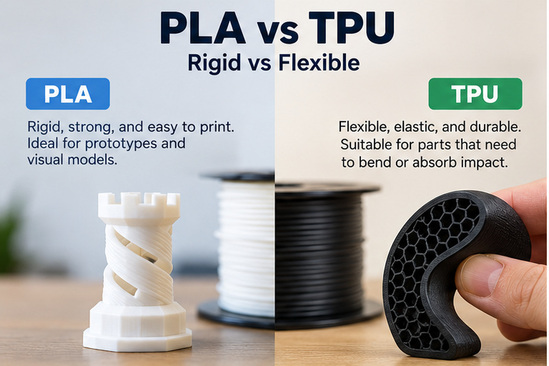
Figure 1. PLA vs TPU RIGIDITY comparison – AI-generated illustrative visualization.
What Is PLA?
PLA stands for polylactic acid. It is a thermoplastic polyester often produced from plant-derived feedstocks. As a 3D printing material, standard PLA is valued for predictable processing, relatively low warping, and the ability to reproduce clean visual detail. That makes it useful for scale models, educational projects, fit-check prototypes, and parts that need to hold a relatively rigid shape.
PLA is not ideal everywhere: some grades are brittle under impact, and common formulations may soften in warm conditions. Actual performance depends on grade and part design.
What Is TPU?
TPU means thermoplastic polyurethane, a family of elastomeric plastics that can be processed by FDM printing. A TPU part can flex or compress and then recover more readily than a typical rigid PLA part. Its toughness and abrasion resistance make it attractive for tool grips, protective sleeves, pads, flexible covers, and other components that experience contact or repeated movement.
TPU performance depends on Shore A hardness: softer grades conform more, while firmer grades often feed more reliably. JLC3DP lists a 95A FDM TPU. See its existing guide, How to Print TPU Filament, for setup details.
PLA vs TPU: Material Properties and Applications
Flexibility, Elasticity, and Rigidity
The clearest TPU vs PLA difference is how the part behaves under deformation. PLA generally resists bending and helps a model keep its shape. TPU bends and compresses, and suitable grades can recover after the load is removed. This distinction matters for anything that must grip, cushion, or conform to another surface.
Flexibility is not superior strength. TPU may cushion an impact that cracks rigid PLA, yet may fail to stabilize a mounting plate.
| PLA | TPU | |
|---|---|---|
| Rigid thermoplastic | Material type | Flexible thermoplastic elastomer |
| Low | Flexibility | High |
| Generally easier | Printing difficulty | Usually more challenging |
| Can be brittle and may soften with heat | Main trade-off | Flexible parts may take longer to print |
| Prototypes, models, decorative parts | Typical applications | Grips, seals, flexible covers, wearable parts |
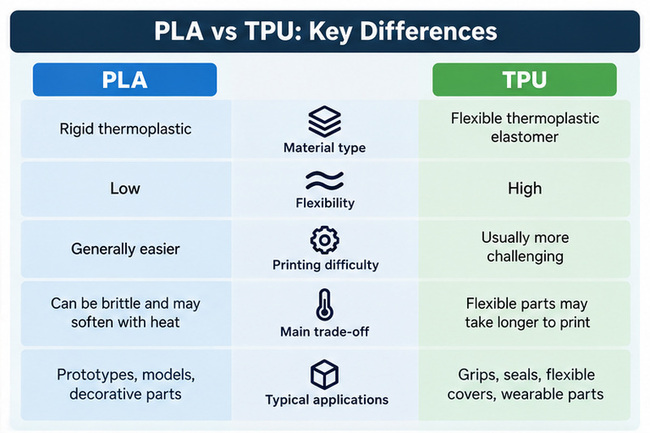
Figure 2. Qualitative differences between PLA and TPU – AI-generated infographic.
Strength, Durability, and Impact Resistance
"Stronger" may mean tensile, impact, tear, or flex-fatigue performance—not the same thing. PLA can resist deformation; TPU may withstand repeated bending. Layer direction, wall thickness, infill, and geometry also affect printed-part strength.
Strength (resisting load). At equal wall thickness and infill, PLA usually bends less under a given load because it is substantially stiffer. It suits brackets that must maintain precise shape; TPU stretches or compresses more easily and suits yielding grips. However, stiffness is not the same as ultimate tensile strength. JLC3DP reports 36 ± 1 MPa XY tensile strength for PLA-P but provides no directly comparable TPU tensile result on its public material page.
Durability (repeated use). TPU is generally better suited to repeated bending or compression because suitable grades can flex and recover. Rigid PLA hinges are more likely to develop fatigue cracks. TPU is not indestructible, however: wear, creep, or permanent set can eventually limit its service life.
Impact resistance (sudden knocks). At the same geometry, wall thickness, and infill, TPU can deform to absorb impact energy and then rebound, making it useful for protective covers, pads, and dampers. PLA may crack when a hard knock exceeds its allowable strain. These are qualitative comparisons: an impact-strength ratio requires matched samples, material grades, print conditions, and test methods.
Heat Resistance
A melting-point comparison cannot establish operating temperature. PLA can deform under sustained warmth or load. TPU heat behavior varies widely by formulation. Check the exact grade's service-temperature or heat-deflection data and test conditions.
Heat deflection temperature (HDT) is useful for comparing rigid plastics: it records when a loaded test specimen bends by a specified amount. JLC3DP's current English PLA-P page lists an HDT of 65°C, but does not identify the test load, so this is not a guaranteed service temperature. PLA may lose stiffness and distort when it remains warm under load.
TPU is already a flexible elastomer, so its normal bending is not evidence of heat damage and a rigidity-based HDT is not always directly comparable. An appropriate TPU grade may remain useful for elastic parts at temperatures where standard PLA loses rigid shape retention. However, TPU can still soften, creep, acquire compression set, or age at elevated temperatures. Check the specific TPU formulation, service temperature, load, and exposure time.
Cost and Typical Applications
PLA is often economical and straightforward to print, making it useful for prototypes. TPU may cost more and take longer because it needs careful feeding and speed control. Service pricing also depends on dimensions, quantity, and processing.
Detailed Properties Comparison
| Consideration | PLA | TPU | Why It Matters |
|---|---|---|---|
| Flexibility and elasticity | Low in standard grades | Typically high; grade-dependent | Determines bending, sealing, and recovery |
| Rigidity | Generally high | Generally lower | Affects shape retention and fit |
| Impact and flex fatigue | May fracture under repeated flexing | Often more suited to repeated flex | Important for clips, bumpers, and sleeves |
| Heat resistance | May soften under warmth/load | Highly formulation-dependent | Confirm service conditions in datasheets |
| Printability | Usually forgiving | Feed-path and moisture sensitive | Changes machine setup and print time |
| Typical uses | Models, prototypes, displays | Grips, pads, protective covers | Match material behavior to function |
These descriptions concern typical behavior, not standardized test results on identical samples. Use material datasheets when numerical strength or thermal limits matter.
Flexible TPU vs PLA: Which Is Better for Flexible Parts?
For a part that must bend or rebound, TPU is generally the better starting point: consider protective cases, cushions, and cable sleeves. For rigid stands or reference jigs, PLA is often more useful. Shore hardness, wall thickness, and geometry control actual flexibility.
3D Printer TPU vs PLA: Printing Differences
Printability and Setup
Stiff PLA is generally easy to feed into an FDM hot end. Soft TPU can compress or buckle between gears and nozzle, especially along a long, unsupported path. A short, guided filament path and dry material help produce consistent extrusion.
Nozzle Temperature, Print Speed, and Bed Adhesion
Print settings are not universal. For context, Prusa lists PLA nozzle temperatures of 185–235°C, while its 95A TPU guide lists 220–240°C. These are examples for Prusa's materials and printers, not JLC3DP factory settings. Follow the appropriate filament and printer profile.
TPU often needs more conservative speed and retraction settings. Build-surface selection matters too: flexible filament can adhere too strongly, requiring a suitable release layer. Follow the maker's guidance.
Print Quality and Common Issues
PLA often produces clean visual detail but can still show warping, stringing, or weak layers. TPU may string or extrude inconsistently if damp or poorly fed. Check moisture, feed resistance, and baseline settings before changing multiple variables.
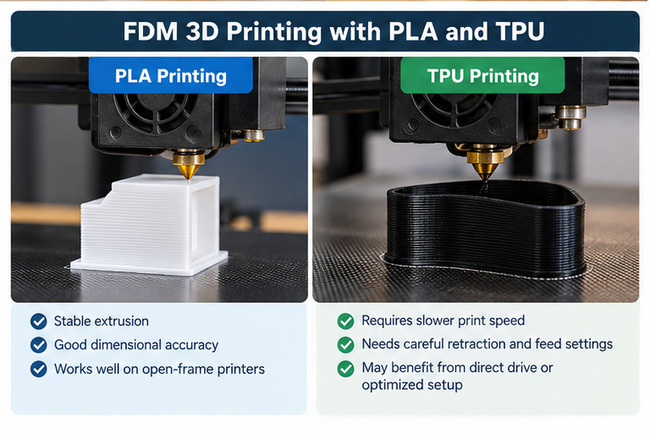
Figure 3. FDM printing with PLA and TPU – AI-generated illustrative visualization.
TPU Filament vs PLA Filament
PLA filament is a relatively firm strand; TPU is pliable and more easily deformed in the feeder. Keep TPU dry and reduce sharp bends and friction along its path. Switching from PLA to TPU usually requires more than changing nozzle temperature.
Does TPU Need an Enclosure?
Usually not. Common TPU grades often print on open-frame FDM machines with suitable settings. An enclosure is more important for materials such as ABS. For specialty TPU grades, follow manufacturer advice on ventilation and chamber conditions; an enclosure will not fix damp filament or feeding problems.
Which Should You Choose: PLA or TPU?
For TPU vs PLA selection, start with the job rather than the material name. Decide whether the part must stay stiff or flex, whether it sees repeated contact, and whether heat or loads could affect its performance. Then check geometry and available processes.
Practical Material Selection
| If Your Part Needs... | Consider |
|---|---|
| Rigid shape, decorative detail, or quick visual prototypes | PLA |
| Flexibility, cushioning, grip, or repeated bending | TPU |
| Specific heat resistance, loads, or certified performance | Review grade-specific datasheets and test |
| Parts manufactured without tuning a compatible printer | A professional 3D printing service |
Frequently Asked Questions About TPU vs PLA
Q: Is TPU Stronger Than PLA?
Not in every sense. PLA is often stiffer, while TPU can offer better flexibility and resilience under repeated deformation. Check the specific grade and the type of load before comparing strength figures.
Q: Is TPU Harder to Print Than PLA?
Often yes. Flexible TPU may need slower printing, controlled retraction, a suitable feed path, and dry filament. Firmer TPU grades can be easier than very soft grades.
Q: Can a 3D Printer Print Both PLA and TPU?
Many FDM printers can, but compatibility depends on the extruder, feed path, hot end, build surface, and supported filament profiles. Confirm your model's manufacturer guidance.
Q: Does TPU Need an Enclosure?
An enclosure is not usually required for common TPU printing, but check the specific filament and machine instructions, especially for unusual grades or tightly controlled applications.
Q: Which Material Is Better for Flexible 3D Printed Parts?
TPU is usually the better choice when elastic movement, cushioning, or recovery is central to the design. The finished flexibility still depends on Shore hardness and part geometry.
Conclusion
A TPU vs PLA decision begins with the part's function: PLA favors rigidity and simpler printing; TPU favors bending, compression, and recovery. Verify heat, fit, load, and grade-specific requirements. For custom parts, review JLC3DP's current PLA-P and TPU materials and request a quote.
Keep Learning
TPU vs PLA: Properties, Differences & 3D Printing
Key Takeaways PLA is generally easier to print and is a practical choice for rigid models and early prototypes. TPU offers flexibility and elastic recovery for grips, protective covers, and cushioning components. Printing TPU often requires more care with filament feeding, speed, moisture, and retraction. Strength, heat resistance, and durability vary by material grade, printing orientation, and part design. If you do not have compatible equipment, a professional printing service can help you evaluate......
Common Heat-Resistant 3D Printing Plastics
Thermoplastics are already very common in 3D printing. In some application scenarios that require high temperature stability, high temperature resistant 3D printing plastics play an important role. This article will introduce several common heat-Resistant 3D printing plastic materials and their characteristics, and explore how to deal with overheating problems that may occur in the 3D printing plastic process. Common Heat-Resistant 3D printing plastic materials 1. ABS (Acrylonitrile Butadiene Styrene)......
Hardness: The critical parameter in 3D printing materials
In the field of 3D printing, the performance of materials directly affects the quality and application effect of printed parts. Among them, hardness, as an important mechanical performance index, measures the ability of materials to resist local deformation. Understanding and optimizing the hardness of 3D printing materials is crucial to ensure the strength, wear resistance and adaptability of printed parts in specific environments. This article will introduce the hardness index in 3D printing in deta......
Elongation at break in 3D printing materials
Elongation at break refers to the percentage of the elongation length of a material before it breaks when subjected to tension to its original length. In 3D printing materials, elongation at break is a key parameter that not only reflects the ductility of the material, but also affects the strength and reliability of the printed parts. Materials with high elongation usually have better toughness and can deform without breaking when subjected to load. This is particularly important for many application......