Mass Customization Manufacturing: Benefits, Costs & 3D Printing
22 min
- Introduction
- What Is Mass Customization?
- Why Is Mass Customization Growing?
- What Is the Difference Between Mass Customization, Mass Personalization, and Mass Production?
- What Are the Benefits of Mass Customization?
- Can 3D Printing Be Used for Mass Production?
- How Are Custom Printed Products Mass Produced?
- Real-World Examples of Mass Customization
- What Is the Cost of Mass Customization?
- What Are the Challenges of Mass Customization?
- Is Mass Customization Right for Your Product?
- How JLC3DP Supports Mass Customization Manufacturing
- FAQ about Mass Customization
- Final Takeaway: Is Mass Customization the Future of Manufacturing?
Key Takeaways
- Mass customization lets manufacturers produce unique or personalized products at near-mass-production costs.
- Unlike traditional manufacturing that requires expensive tooling upfront, mass customization, especially through 3D printing, skips that entirely.
- You get flexibility without the usual price penalty.
- The technology making this possible today includes parametric CAD design, 3D printing farms, and digital supply chains that can handle thousands of different configurations without retooling.
- It's not right for every product, but for the right ones it's a genuinely different business model.
Introduction
Factories used to make one thing really well and make a lot of it. That worked until customers started wanting different things. Mass customization is the answer to that problem, and 3D printing is what makes it actually affordable.
Historically, traditional manufacturing relied on rigid, expensive tooling, making low-volume personalization financially impossible. However, mass customization has surged recently, driven by shifting consumer demands for unique products and advancements in digital design data.
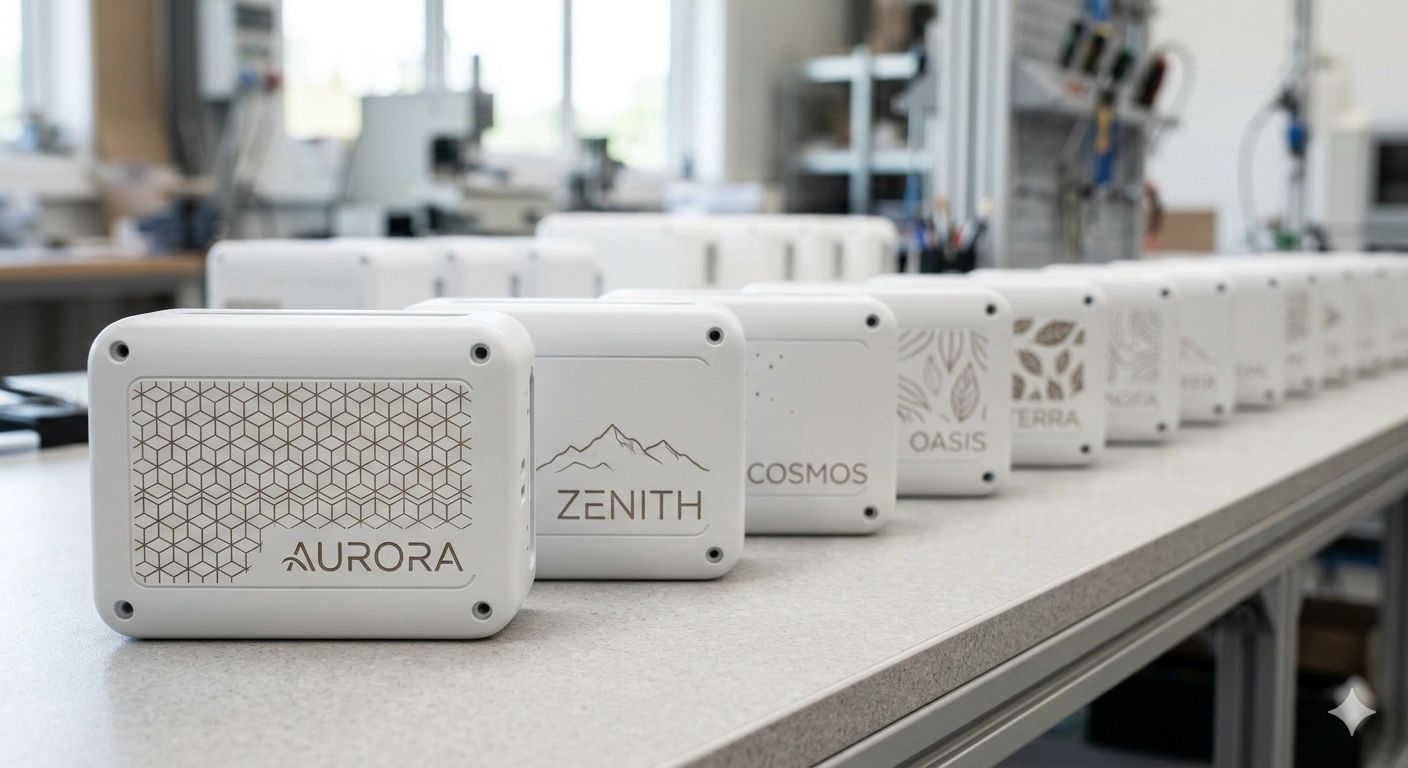
This guide explores mass customization, its benefits, costs, and how 3D printing makes scalable customized manufacturing possible. You'll also learn whether it is the right manufacturing approach for your product.
What Is Mass Customization?
According to manufacturing research from arxiv, the definition of mass customization refers to delivering products tailored to individual customer requirements while maintaining efficiencies similar to mass production. This approach relies on flexible manufacturing systems, digital workflows, and scalable production technologies.
The key insight behind mass customization is that you don't have to choose between cheap and personalized. Traditional manufacturing forces that trade-off: you either make one thing efficiently at high volume, or you make custom things slowly at high cost. Mass customization uses digital design and flexible production, especially 3D printing, to break that trade-off.
A shoe company that lets customers pick sole type, upper color, and fit profile and ships within a week is doing mass customization. A dental lab that prints patient-specific implants from a digital scan the same day is doing mass customization. The product is unique to the customer, but the production system handles thousands of unique orders without reconfiguring the factory.
Common Types of Mass Customization
| Type | Description | Example |
|---|---|---|
| Collaborative | Customer chooses features before production | Custom prosthetics |
| Adaptive | User adjusts after purchase | Adjustable furniture |
| Cosmetic | Appearance changes only | Logo engraving |
| Transparent | Company customizes automatically | Personalized recommendations |
In modern manufacturing, collaborative customization is the model most commonly enabled by industrial 3D printing.
Why Is Mass Customization Growing?
The shift toward mass customization is a structural response to deep macroeconomic changes. As rigid production models struggle with volatile markets, advanced digital tools have matured to make agile, on-demand fabrication highly profitable.
The global expansion of customization manufacturing is driven by two primary macro forces:
1. The Explosion of Demand for Personalization
Modern buyers increasingly reject one-size-fits-all commodities. Driven by digital-first experiences, they expect physical products to match their exact specific needs, ergonomic profiles, and performance scenarios. From personalized consumer goods to patient-specific medical devices, the accelerating demand for mass personalization gives an immediate competitive advantage to brands that offer tailored product variations.
2. The Escalating Financial Risk of Traditional Tooling
Legacy mass production requires massive upfront investments in rigid steel molds and dedicated factory tooling. In an era of shorter product lifecycles and rapid trend shifts, this approach introduces extreme financial risk. If a design requires an urgent update, that expensive tooling becomes obsolete. Embracing mass production 3d printing removes this liability by eliminating upfront tooling costs entirely, allowing manufacturers to adapt designs instantly.
What Is the Difference Between Mass Customization, Mass Personalization, and Mass Production?
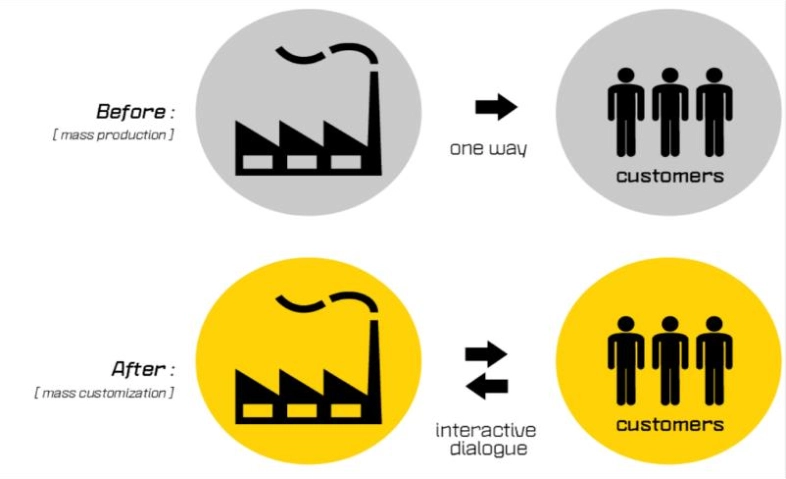
(Source:ResearchGate)
These three models sit on a spectrum from cheapest-and-least-flexible to most-flexible-and-most-expensive. Most people use the terms loosely, but in manufacturing they mean different things.
Mass production makes identical products at scale.
Mass customization makes products with customer-selected variations at moderate cost.
Mass personalization creates truly unique products for each individual, the most flexible but also the most expensive.
| Manufacturing Model | Customization Level | Minimum Order Quantity (MOQ) | Lead Time | Upfront Tooling | Volume Capacity | Cost per Unit | Industrial Baseline Example |
|---|---|---|---|---|---|---|---|
| Mass Production | Low / None Entirely standardized, single-SKU outputs | High Typically 5,000 to 10,000+ units minimum | Long (Upfront) 4–8 weeks for mold design, fabrication, and tuning | Very High Requires $10k–$100k+ initial capital for hard steel molds | Extremely High Best suited for hundreds of thousands to millions of units | Lowest Unit costs drop significantly once tooling capital is amortized | Traditional Injection Molding |
| Mass Customization | Medium to High User-configured variations within defined parametric boundaries | 1 Unit Hardware remains uniform; variation is purely digital | Extremely Short Seamless digital routing; typically 2–5 business days | None / Very Low Eliminates physical tooling; driven directly by CAD data | Medium Optimized for high-mix, low-to-medium batches (1–10,000 units) | Medium Predictable cost structure; highly competitive at low-to-medium scale | Industrial 3D Printing (SLS / MJF) |
| Mass Personalization | Very High Fully bespoke design driven by unique individual data | 1 Unit Every component is a 1:1 absolute geometric unique asset | Moderate Requires upfront biological/3D scanning and data alignment) | None Completely toolless layer-by-layer digital fabrication | Low Discrete, highly individualized production per user profile | High Includes custom algorithm processing; commands a high market premium | Scan-to-Print Medical Devices (Clear Aligners / Hearing Aid Shells) |
Mass customization sits in the middle, and that's exactly where most product businesses actually want to be. Full mass personalization sounds great until you price it. Pure mass production sounds efficient until customers stop buying a product that doesn't fit their needs.
The rise of 3D printing vs injection molding comparisons in product development reflects this shift. More teams are asking whether mass customization makes more sense for their product than committing to tooling for a fixed design.
What Are the Benefits of Mass Customization?
Customization manufacturing merges digital workflows with toolless production (like industrial 3D printing) to eliminate the traditional trade-off between scale and personalization. It de-risks your business model by shifting production from rigid capital expense to an agile digital loop.
1. Improved Customer Satisfaction & Brand Loyalty
- Exact Fit & Performance: Products adapt to precise ergonomic or mechanical specs (e.g., scan-to-print medical devices or tailored robotic grippers), vastly outperforming standard commodities.
- Premium Pricing: Solving exact user problems elevates perceived value, allowing companies to capture higher margins and exit low-margin price wars.
- Deepened Engagement: Turning buyers into co-designers transforms a basic transaction into a sticky, long-term brand relationship.
2. Reduced Inventory & Obsolescence Risk (On-Demand Pull System)
- Zero Dead Stock: Production triggers after an order is placed. This eliminates speculative forecasting and the financial risk of holding unsold warehouse inventory.
- Freed-Up Capital: Shifting to just-in-time manufacturing slashes physical storage overhead, unlocking cash flow for active business growth.
- Instant Design Updates: To optimize a part, you simply update the master digital CAD file. The improved version prints on the next run, without leaving you stuck with obsolete inventory.
3. Faster Time-to-Market with Greater Design Freedom
- No Tooling Bottlenecks: Skipping the weeks or months required for traditional mold making compresses your time-to-market from months to days.
- Complex Geometries for Free: Additive fabrication easily prints lightweight internal lattices, organic cooling channels, and consolidated multi-part assemblies that are physically unmachinable using legacy methods.
Can 3D Printing Be Used for Mass Production?
Yes, 3D printing is one of the key technologies enabling scalable mass customization and low-to-medium volume production today because it removes the financial and physical barriers of traditional tooling. However, its feasibility depends entirely on your specific production goals.
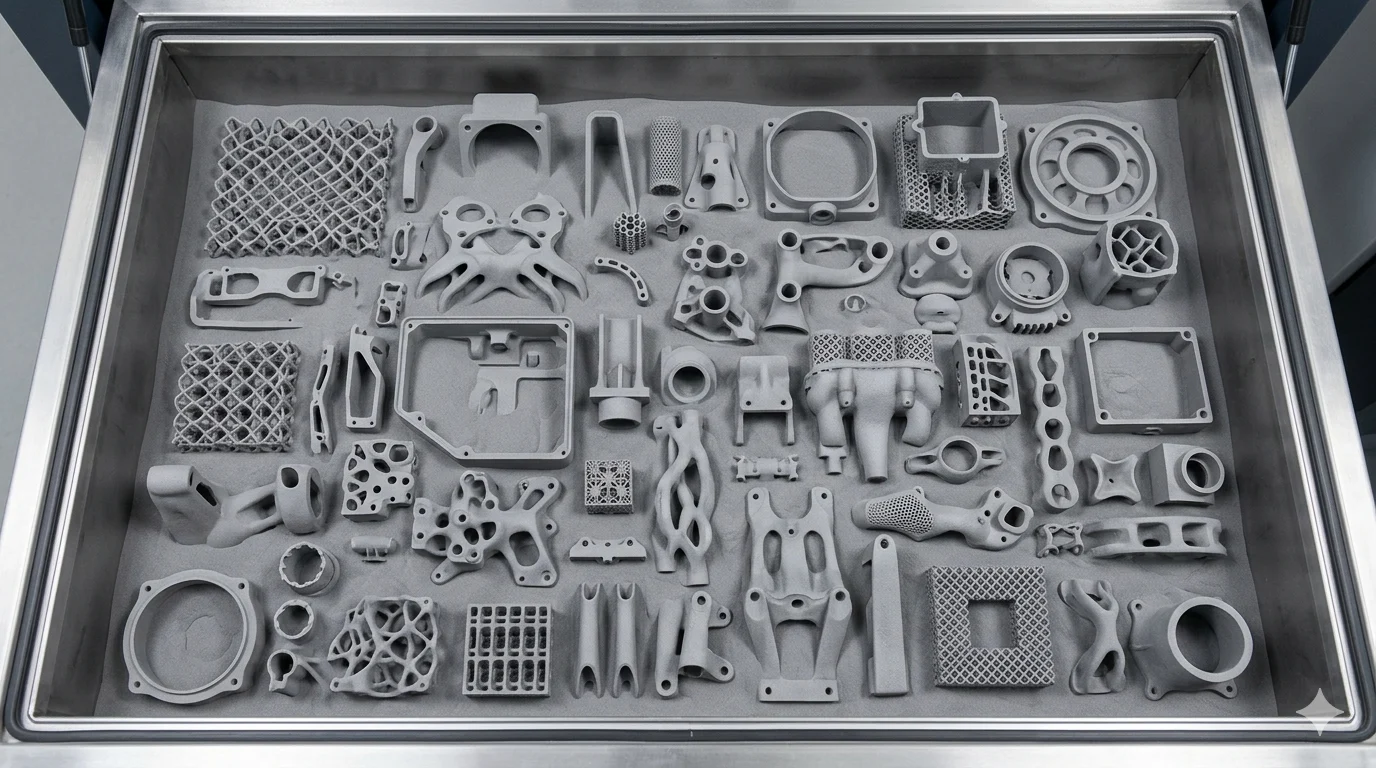
Advantages
- Zero Tooling Costs: Eliminate the $10,000–$100,000 upfront cost of injection molds, making low-to-medium volumes highly profitable.Understanding the factors behind [3D printing cost] allows you to make low-to-medium production volumes highly profitable.
- Infinite Design Freedom: Produce complex internal geometries, lightweight lattice structures, and personalized features at no extra cost per part.
- On-Demand Agility: Shift from high inventory risks to a digital-first, just-in-time supply chain.
Limitations
- Higher Unit Cost at Scale: For millions of identical, simple parts, traditional injection molding still offers a lower per-unit cost.
- Speed Boundaries: While 3D printing for production is faster for low-volume batches, it cannot compete with the cycle times of stamping or die-casting for extreme high-volume manufacturing.
Suitable Applications
The sweet spot for customization manufacturing via 3D printing lies in complex, high-value components, low-to-medium batch production (under 10,000 units), rapid product iterations, and patient-specific devices.
To achieve optimal performance, matching your application with the right industrial additive process is critical. You can explore and evaluate these technologies directly via the [JLC3DP Process & Manufacturing Service] such as:
- [SLS (Selective Laser Sintering)]: Best for durable, functional nylon components and complex batch production.
- [MJF (Multi Jet Fusion)]: Ideal for high-density, airtight parts with balanced mechanical properties in production environments.
- [SLA (Stereolithography)]: Perfect for high-detail, smooth-surface aesthetic parts and master patterns.
- [SLM (Selective Laser Melting)] / BJ (Binder Jetting) Metal 3D Printing: Engineered for high-strength, lightweight functional aerospace and automotive components.
How Are Custom Printed Products Mass Produced?
Custom products get mass produced by automating the digital design variation rather than relying on fixed physical tooling. Instead of building an expensive mold for each single version, advanced customization manufacturing utilizes a connected technology stack. A parametric design system generates a unique file per customer, and the digital workflow routes that file to advanced 3D printing for manufacturing systems that handle thousands of different configurations seamlessly.
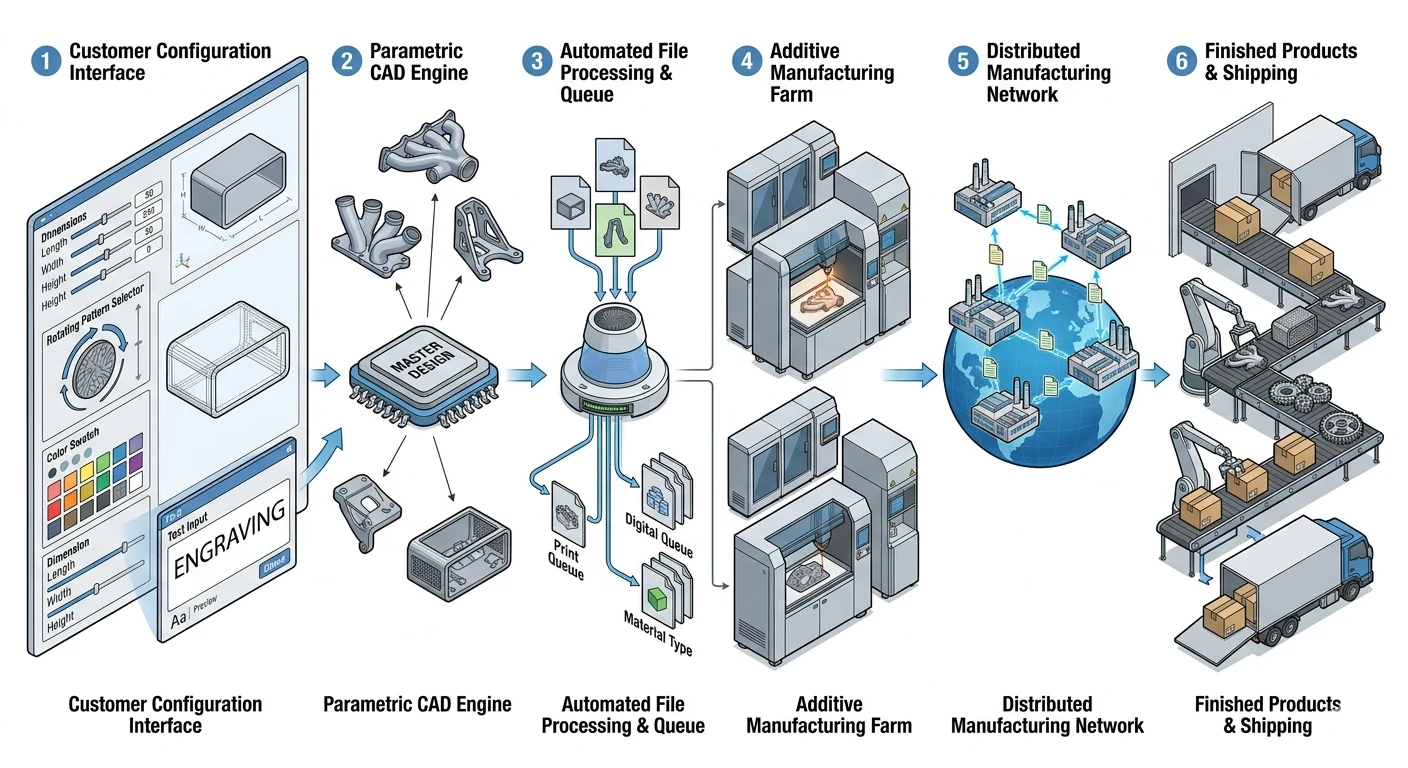
Here is how the modern tech stack enables mass customization from screen to physical product:
1. Digital Design Automation & Parametric CAD
Without parametric design, mass personalization and customization just mean someone manually modifying a design file for every single user—which simply doesn’t scale.
- Automated Variations: A parametric model embeds variation logic directly into the file. Variables like length, diameter, engraving text, color, and complex geometry modifications are set by customers through an interface.
- Direct to Production: The system automatically generates a ready-to-produce file without human designer intervention. A company could offer 10,000 configuration combinations and never touch a design file manually. When a customer finalizes their choice, the configurable 3D model connects directly to the print queue, making the economics of customised 3d printing (or customized 3D printing) viable at scale.
2. Additive Manufacturing (3D Printing) for Production
Once the file is generated, 3D printing for production takes over as the core technology that makes scalable custom manufacturing economically viable. It skips the traditional upfront price penalty of conventional manufacturing.
- Zero-Tooling Flexibility: Technologies like SLS (Selective Laser Sintering) nylon for durable parts, MJF (Multi Jet Fusion) for functional components, SLA for high-detail resin applications, and metal 3D printing (SLM/Binder Jetting) all share a common thread: zero tooling and infinite variation.
- Parallel Scaling: Production scales by adding machines rather than building new molds. A mass production 3d printing setup allows a single batch to contain dozens of entirely different, customized shapes simultaneously, matching the efficiency of traditional mass production without its rigid limitations.
3. Digital Supply Chains & Print Farms
The final step of how are custom printed products mass produced relies on the digital infrastructure that coordinates the hardware.
- Print Farm Automation: Industrial 3D printing for mass manufacturing operates through "3D printing farms"—running dozens or hundreds of machines in parallel. For example, a print farm of 50 SLS machines can simultaneously produce thousands of unique custom parts in a single production run, completely eliminating the need for injection mold changeovers.
- Distributed Manufacturing: Order management, file generation, routing, and tracking are fully automated. This allows for distributed production networks where parts are manufactured closer to end users. A customer in Germany gets their custom part printed locally, while a customer in Japan gets theirs printed in Japan—using the exact same digital file but lowering shipping costs and lead times.
Production Tip: Upload your design to test scalable custom production with no tooling required.

Real-World Examples of Mass Customization
Advanced 3D printing for mass manufacturing is no longer a concept for prototyping—it is actively transforming major industries by delivering tailored solutions at scale.
Healthcare
The medical industry was among the first to adopt mass personalization, driven by the unique anatomy of each patient.
- Clear Aligners: Millions of custom orthodontic aligners are printed daily. A digital scan of the patient's teeth creates a sequential series of unique 3D models, enabling precise dental correction without manual molding.
- Hearing Aids: Over 90% of the world's in-ear hearing aids are now custom-made using SLA 3D printing. A 3D scan of the patient's ear canal ensures a perfect, ergonomic fit that improves acoustic sealing and comfort.
- Prosthetics: 3D printing allows for the cost-effective creation of custom prosthetic limbs tailored perfectly to the wearer’s body proportions and activity levels, significantly lowering weight and cost compared to traditional custom crafting.
Consumer Products
Top brands leverage additive tech to offer performance-driven customization directly to consumers.- Adidas: Through the Futurecraft 4D initiative, Adidas uses advanced liquid resin printing to mass-produce midsoles tailored to different cushioning and performance profiles, proving that customized footwear technology can scale commercially.
- Nike: Nike utilizes 3D printing to create custom-tailored textile uppers (Vaporfly Flyprint) and specialized cleat geometries based on individual athlete performance data, optimizing traction and weight.
Automotive
Automotive giants use 3D printing to streamline high-mix production and offer high-end personalization.
- Volkswagen: VW incorporates industrial 3D printing for manufacturing to produce customizable interior accessories, personalized nameplates, and specialized gear knobs, moving away from rigid, one-size-fits-all components.
- BMW: BMW utilizes 3D printing farms to offer custom-designed accent trims and personalized components for luxury or limited-edition models, reducing the lead time for low-volume interior variations to days instead of months.
Industrial Manufacturing
On the factory floor, customization improves operational efficiency and keeps supply chains resilient.
- Jigs & Fixtures: Modern factories no longer machine standard holding tools. Using high-strength materials like PA12-CF on SLS or MJF setups, engineers can print application-specific robotic grippers, assembly alignment jigs, and inspection fixtures tailored perfectly to individual assembly line tasks.
- Spare Parts: Instead of storing massive inventories of rarely used parts, industrial manufacturers use digital blueprints to 3D print exact replacement components on demand, completely erasing traditional warehousing costs and down-time bottlenecks.
What Is the Cost of Mass Customization?
The honest answer is mass customization costs more per unit than mass production, but it eliminates the upfront tooling investment that makes mass production 3D printing expensive to start.
Tooling vs No Tooling
Traditional manufacturing requires tooling, molds, dies, fixtures, before a single product ships. An injection mold costs $10,000-100,000+ depending on complexity. That cost is fixed regardless of how many units you sell. If the design changes or doesn't sell, the tooling cost is gone.
Customisation manufacturing with 3D printing has no tooling cost. You pay for material and machine time per part. The break-even math is completely different.
Batch Size Impact
At low volumes, say under 500 units, 3D printing for mass manufacturing almost always wins on total cost because tooling isn't amortized over enough units. At 10,000+ units of an identical product, injection molding per-unit cost drops below 3D printing. The crossover point varies by part complexity, but it varies widely depending on part geometry, tooling complexity, material selection, and production volume.
Break-Even Logic
If you're selling 200 units per year of a customized product, the question isn't "is 3D printing cheaper per unit than injection molding?" It's "is $25 per custom 3D printed part cheaper than $15 per molded part plus $40,000 in tooling?" At 200 units the tooling adds $200 per unit before you've paid for a single part. The math favors mass customization significantly at these volumes.
Cost Comparison: Injection Molding vs Industrial 3D Printing
| Production Volume | Injection Molding | Industrial 3D Printing |
|---|---|---|
| 50 pcs | High upfront tooling investment makes production costly | Typically the most cost-effective option due to zero tooling |
| 500 pcs | Tooling costs are partially amortized; economics depend on part complexity | Often competitive, especially for customized or complex parts |
| 5,000 pcs | Lower per-unit cost after tooling amortization | May remain viable for customized, complex, or frequently updated products |
| 50,000 pcs | Typically offers the lowest cost per unit | Generally less cost-effective for identical high-volume production |
Calculate whether 3D printing or injection molding is more cost-effective for your production volume.
What Are the Challenges of Mass Customization?
Mass customization creates real operational complexity that's easy to underestimate when the business case looks good on paper.
Complexity management, Every unique order creates a unique production task. Managing thousands of unique configurations without errors requires robust systems. A mistake in a standard production run affects many identical parts. A mistake in mass customization affects one unique part, but you're making thousands of unique parts, so mistakes multiply differently.
Cost uncertainty, Custom orders are harder to cost accurately than standard products. Unusual configurations may require more material, longer print times, or additional post-processing. Pricing systems need to capture these variations without requiring manual cost estimation for every order.
UX issues, A mass customization interface that's confusing produces orders that don't match customer intent. Customers who can't visualize their configuration before ordering return more products and generate more support load.
Fake customization, Offering ten color choices and calling it mass customization isn't. Real mass personalization and mass customization require meaningful variation that affects the product's function or form, not just cosmetic options that could be handled by stocking ten SKUs.
Is Mass Customization Right for Your Product?
Mass customization is not the right solution for every product. While it offers significant advantages in flexibility, personalization, and faster product development, its value depends on your product requirements, production volume, and business goals.
The following criteria can help determine whether mass customization is the right manufacturing strategy for your application.
Mass Customization Is a Good Fit When…
Products Require Customer-Specific Variations
If customers need different sizes, geometries, configurations, or performance characteristics, mass customization can provide flexibility without requiring separate production lines for every variation.
Production Volumes Are Low to Medium
Mass customization is particularly effective when production volumes are too low to justify expensive tooling investments but high enough to benefit from scalable manufacturing workflows.
Typical scenarios:
- Prototype-to-production programs
- Low-volume manufacturing
- Bridge manufacturing
- Product launches and market validation
Product Designs Are Complex
Products with intricate geometries, lightweight structures, or multiple configuration options often benefit from digital manufacturing technologies such as 3D printing, which can produce complex parts without increasing tooling costs.
Examples:
- Lattice structures
- Lightweight components
- Customized enclosures
- Functional prototypes
Designs Change Frequently
If products require regular updates, engineering revisions, or market-driven modifications, mass customization reduces the risk of investing in tooling that may quickly become obsolete.
This is especially valuable for startups, rapidly growing companies, and industries with short product lifecycles.
Mass Customization May Not Be the Best Choice When...
Production Volumes Are Extremely High
For millions of identical parts, traditional manufacturing methods such as injection molding, stamping, or die casting often provide the lowest cost per unit once tooling costs are amortized.
Products Compete Primarily on Lowest Cost
If product differentiation is minimal and pricing is the primary purchasing factor, traditional mass production may provide better economics.
Customization Adds Little Customer Value
Not every product benefits from customization. If customers are satisfied with standardized products, introducing customization can add unnecessary complexity without generating additional revenue or competitive advantage.
Quick Assessment Checklist
Mass customization is likely a good fit if you answer "Yes" to several of the following questions:
- Do customers require different sizes, features, or configurations?
- Is production volume below traditional mass-production levels?
- Are product designs updated frequently?
- Would tooling costs significantly impact profitability?
- Does customization create measurable customer value?
- Do you need faster product development cycles?
Next Step: Evaluate Your Manufacturing Options
If your product meets several of these criteria, mass customization may help reduce tooling costs, accelerate development, and improve product differentiation.
JLC3DP supports mass customization projects through a range of manufacturing technologies, including SLS, MJF, SLA, FDM, and metal 3D printing, enabling everything from rapid prototyping to low-volume production and customized manufacturing.
Ready to evaluate your product? Upload your CAD file and receive an instant quote along with manufacturing recommendations tailored to your application.
How JLC3DP Supports Mass Customization Manufacturing
Successful mass customization requires more than just production capacity. It depends on flexible manufacturing technologies, engineering-grade materials, scalable workflows, and the ability to move efficiently from design validation to production.
JLC3DP supports mass customization projects across a wide range of industries, helping businesses develop customized products without the constraints of traditional tooling-based manufacturing.
Multiple Manufacturing Technologies
Different products require different manufacturing approaches. JLC3DP provides access to multiple production technologies, including SLS, MJF, SLA, FDM, Binder Jetting, and Metal 3D Printing. This flexibility allows manufacturers to select the most suitable process based on performance requirements, production volume, surface quality, and budget.
Whether producing functional nylon components, highly detailed resin parts, or metal end-use components, companies can choose the technology that best supports their customization strategy.
Engineering Materials for Diverse Applications
Material selection plays a critical role in mass customization. JLC3DP offers a broad portfolio of engineering materials, including PA12 Nylon, PA12-CF, resin materials, stainless steel 316L, aluminum alloys, and other industrial-grade options.
These materials support applications ranging from consumer products and medical devices to industrial equipment and customized production tooling.
Low-Volume and Bridge Manufacturing
Mass customization is often most effective in low-to-medium production volumes where tooling investment may not be economically justified.
JLC3DP supports rapid prototyping, bridge manufacturing, and low-volume production, enabling businesses to validate designs, launch products faster, and scale production without committing to expensive molds or tooling.
Fast Design Iteration
Product requirements frequently change during development. Digital manufacturing workflows allow design modifications to be implemented quickly without requiring tooling revisions.
This enables engineering teams to test multiple product variations, optimize designs, and respond to customer feedback with greater speed and flexibility.
Global Manufacturing and Fulfillment Support
Digital production workflows make it easier to manufacture customized products efficiently and consistently. JLC3DP's scalable production capabilities help businesses manage varying production volumes while maintaining quality and delivery performance.
This flexibility is particularly valuable for companies developing customized products for global markets or rapidly evolving product categories.
Start Your Mass Customization Project
Whether you're developing a personalized consumer product, a low-volume industrial component, or a customized manufacturing solution, JLC3DP provides the technologies, materials, and production capabilities needed to support scalable mass customization.
Upload your CAD file today to receive an instant quote and explore the most suitable manufacturing options for your project.
FAQ about Mass Customization
Q: Is mass customization the same as personalization?
No. Mass customization typically refers to configurable physical products, while personalization often applies to digital experiences and customer interactions.
Q: Can 3D printing be used for mass production?
Yes. Many manufacturers use industrial 3D printing for low-to-medium-volume production, customized products, and bridge manufacturing.
Q: What industries use mass customization?
Healthcare, consumer products, aerospace, automotive, and industrial manufacturing commonly use mass customization strategies.
Q: Is mass customization more expensive?
Per-unit costs are usually higher than traditional mass production, but tooling costs are significantly lower, making it economical for customized and lower-volume products.
Q: Is mass customization profitable?
Yes. Mass customization can be profitable because it allows companies to offer higher-value products, reduce inventory risk, and avoid expensive tooling. It is especially effective for customized, low-volume, or frequently updated products.
Q: Can injection molding support mass customization?
Yes, but only to a limited extent. Injection molding can offer configurable options, but design changes often require tooling modifications. For highly customized products, 3D printing is usually more flexible and cost-effective.
Q: What industries benefit most from mass customization?
Healthcare, consumer products, automotive, aerospace, and industrial manufacturing are among the industries that benefit most from mass customization. These sectors often require personalized, low-volume, or application-specific products.
Final Takeaway: Is Mass Customization the Future of Manufacturing?
For a significant portion of manufacturing, it already is. The future of mass customization isn't a single breakthrough technology, it's the continued maturation of the stack that makes it work: better parametric design tools, faster and cheaper 3D printing, more capable digital supply chains, and customers who've come to expect products that fit their needs rather than accepting what's cheapest to produce at scale.
Mass production isn't going away. For high-volume, fixed-design products, it's still the most economical approach and nothing currently changes that. But for the growing category of products where customer variation has real value, medical, industrial, consumer, aerospace, mass customization isn't the expensive alternative to mass production. It's the business model that makes those products viable.
3D printing is the technology that makes mass customization accessible at the scale most businesses actually operate at. Not because it's the cheapest per unit, but because it eliminates the tooling investment that would otherwise price most custom products out of existence.
The manufacturers who figure out mass customization now build a structural advantage that's hard for traditional manufacturers to replicate, because replicating it requires changing the production model, not just buying new equipment.
Keep Learning
3D Printing for Rapid Prototyping: Pick the Right Tech, Material & Budget
Rapid prototyping with 3D printing lets engineers turn a CAD file into a physical part in days instead of weeks. No tooling. No minimum order quantities. No waiting for a machine shop to fit your job into the schedule. Just a design file and a printed part you can hold, test, and iterate on before committing to expensive production tooling. That's the core value proposition. But additive manufacturing prototyping isn't a single process, it's a family of technologies, each suited to different prototype......
Functional 3D Printing for Real Parts: Design Rules, Materials & Uses
Functional 3D Printing for Real Parts: Design Rules, Materials & Uses Key Takeaways Functional 3D printing is used for real, load-bearing parts, not just prototypes. Design matters more than material — poor geometry or orientation causes most failures. SLS and MJF PA12 offer the most reliable performance for production-grade polymer parts. Metal 3D Printing (SLM/BJ) is essential when requirements exceed the thermal or mechanical limits of polymers. Success depends on the "Triple Threat": orientation, ......
Mass Customization Manufacturing: Benefits, Costs & 3D Printing
Key Takeaways Mass customization lets manufacturers produce unique or personalized products at near-mass-production costs. Unlike traditional manufacturing that requires expensive tooling upfront, mass customization, especially through 3D printing, skips that entirely. You get flexibility without the usual price penalty. The technology making this possible today includes parametric CAD design, 3D printing farms, and digital supply chains that can handle thousands of different configurations without re......
3D Printed Houses: the future of residential construction?
In recent years, 3D printed houses, as a new type of housing, have attracted a lot of attention. The news mentioned that this technology can complete the construction of houses in less than 24 hours, and it is more economical and environmentally friendly than traditional construction methods. What is the actual effect of 3D printed houses? This article will analyze the current status of this emerging construction technology and the problems it faces from multiple perspectives. Source: TODAY.com 1. The......
CES 2026 Hardware Trends: How Manufacturing Is Shaping AI and Robotics
CES 2026 Hardware Innovation Trends: From Prototypes to Industrial-Grade Manufacturing CES is widely regarded as the world’s leading technology showcase—and a real indicator of where global hardware innovation is heading. In 2026, CES revealed a clear shift: innovation is no longer about impressive demos. It’s about building products that can survive real-world environments, pass functional testing, and move toward scalable manufacturing. According to official data from the CES 2026 Innovation Awards:......
Exploring Green Construction Alternatives in Large-scale 3D Printing
Why Green Materials Matter in Construction The construction industry contributes approximately 37% of global greenhouse gas emissions, with cement production being one of the largest offenders. As the need for sustainable building practices intensifies, large-scale 3D printing offers a game-changing solution. This article explores how bio- and earth-based materials are becoming viable, eco-friendly alternatives to cement in additive manufacturing. Environmental Impact of Cement in 3D Printing Cement i......