PolyJet 3D Printing: How It Works & Where It Wins
11 min
- What Is PolyJet 3D Printing?
- How a PolyJet Printer Works
- PolyJet Full Color and Multi-Material: The Signature Trait
- PolyJet vs SLA vs FDM
- PolyJet, MultiJet, MJF: The Name Family
- Where PolyJet Wins — and Where It Doesn't
- FAQ about PolyJet 3D Printing Guide
- From Inkjet Roots to Full-Color Parts
Key Takeaways
- PolyJet 3D printing is the commercial form of material jetting: print heads spray micro-droplets of photopolymer exactly where the layer needs them, and a UV lamp cures each droplet on the spot.
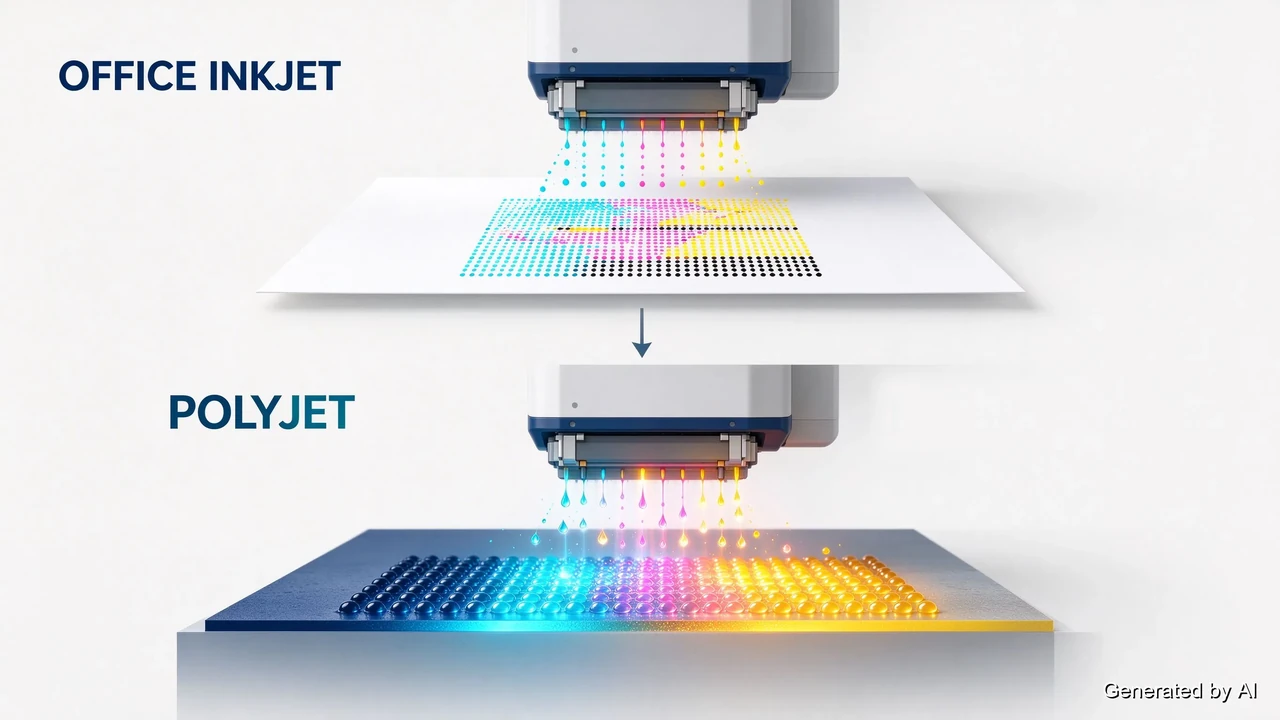
- It descends from office inkjet printing — the same droplet-on-demand idea, with cured resin standing in for ink. Material jetting is the only common 3D printing family that prints in full color and multiple materials in a single build, and PolyJet is its best-known brand implementation.
- Support structures are printed as a gel and removed with a water jet — no cutting, no snapping, no witness marks on the fine surfaces they protected.
- PolyJet wins where appearance and information matter: full-color prototypes, medical and teaching models, multi-hardness parts in one print. It is not the tool for load-bearing structural parts or very large builds.
- Its full-color industrial counterpart at JLC3DP is the WJP process, which brings the same jetting principles to production parts.
If you have ever watched an office inkjet printer sweep across a page and wondered whether the same idea could build objects, it can, and the result is PolyJet 3D printing. Instead of ink on paper, the print heads spray droplets of liquid photopolymer; instead of a flat image, each "page" is a cured cross-section of a real object, stacked layer upon layer into a part that can be full-color, multi-material, and detailed enough to pass for production output.
What Is PolyJet 3D Printing?
PolyJet 3D printing is a material jetting process: a print head sprays tiny droplets of liquid photopolymer exactly where the current layer needs material, and an ultraviolet lamp riding alongside the head cures each droplet into solid plastic on contact. The build platform then lowers, the head passes again, and layer by layer a physical object accumulates. Droplet by droplet, in whatever colors and materials the design calls for.
The lineage is worth knowing because it explains the machine. PolyJet descends directly from office inkjet printing (the droplet-on-demand principle, the sweeping head, even the multi-cartridge color mixing all migrate from paper to polymer). The approach was commercialized around 2000 under the PolyJet name — a Stratasys brand — and material jetting as a category now also includes WJP, the process behind JLC3DP's full-color service, along with comparable platforms from other makers.
Within the 3D printing family, PolyJet belongs to material jetting, the category where the print head *is* the patterning mechanism rather than a laser tracing a vat (SLA) or an extruder pushing thermoplastic (FDM). That family position explains most of its character: jetting brings color, material variety, and fine detail, while trading away raw mechanical strength.
How a PolyJet Printer Works
Inside the machine, a wide print head carries rows of hundreds of micro-nozzles. Guided by the layer's slice data, each nozzle fires or holds its droplet as the head sweeps across the build area, a photograph made of resin instead of ink, deposited in a single pass. A UV lamp follows immediately behind, curing the droplets into a solid layer the moment they land.
Where PolyJet quietly differs from every extrusion process is the support system. A second set of nozzles sprays a gel-like support material wherever the geometry needs it: under overhangs, inside cavities, around delicate features. After printing, the part goes to a water-jet station, the gel support is blasted away, and the fine surfaces it protected emerge untouched. There is no snapping, no cutting, no sanding away of witness marks. A genuine difference when the part carries painted-on color or micro-scale text.
Layer thickness runs as fine as roughly 14–16 micrometers on production machines — thinner than a human skin cell — which is what lets curvature and color transitions render smoothly instead of as visible stair-steps. Resolution this fine is also why the process is a favorite for parts that must look manufactured rather than printed.
PolyJet Full Color and Multi-Material: The Signature Trait
What separates PolyJet from every other common process is what the print head can spray. Standard inkjet printing taught the industry to mix color from multiple cartridges; PolyJet applies the same lesson in three dimensions. Cyan, magenta, yellow, black, and white photopolymers combine droplet-by-droplet, so a part emerges with its colors already in place — gradients, labels, textures, even photographic detail — with no painting and no post-processing.
The same head can spray more than colors. Digital materials blend two base resins in adjustable ratios at print time: rigid and elastomeric, opaque and translucent, in graded transitions or discrete zones. A single build can produce a housing with a rigid shell, integrated over-molded grips, and a flexible gasket — one print, three mechanical personalities.
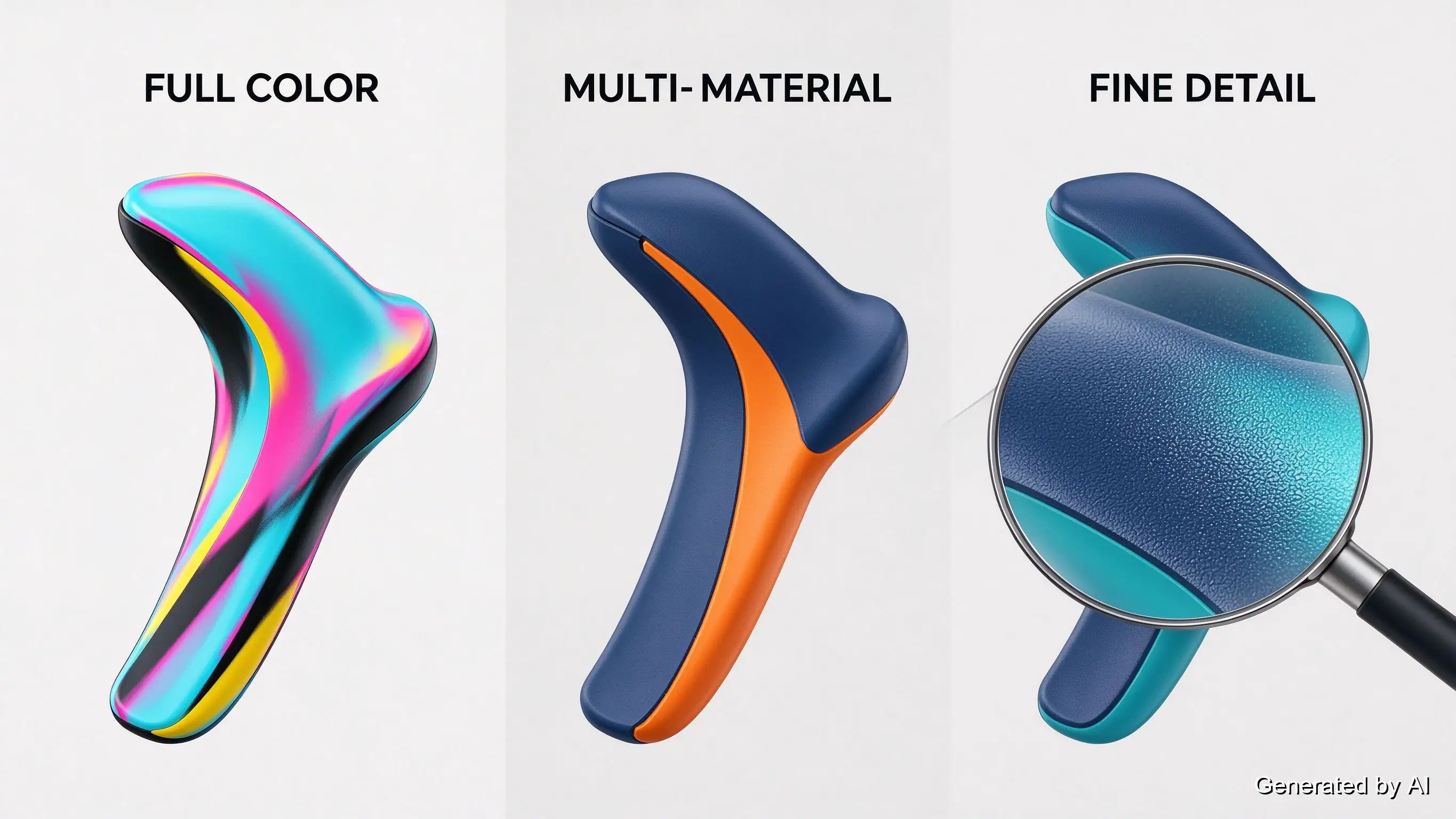
This is the capability no extrusion or laser process replicates, and it belongs to the material jetting family as a whole rather than to PolyJet alone. FDM prints one material per nozzle, with color limited to multi-filament or dual-nozzle units; SLA cures one resin per vat. Jetting architecture makes color and material variation a printing parameter, the way a document printer treats each page. JLC3DP's WJP full-color applications show where this capability goes in production: color-coded assemblies, patient-matched medical models, retail-finished prototypes.
PolyJet vs SLA vs FDM
All three processes produce accurate plastic parts, and all three live in different corners of the same workshop:
| PolyJet | SLA | FDM | |
|---|---|---|---|
| How a layer forms | Micro-droplets sprayed and UV-cured | Laser traces a resin vat | Thermoplastic extruded through a nozzle |
| Full color | Yes — CMYK mixing | Limited (special resins) | No (multicolor via filament swaps) |
| Multi-material in one build | Yes — digital materials | Limited | Limited (multi-color units, dual-extruder systems) |
| Layer thickness | As fine as ~14–16μm | ~25–100μm | ~100–300μm typical |
| Mechanical strength | Moderate (photopolymer) | Good (post-cured) | Functional-grade filaments |
| Typical build size | Compact to mid | Compact to mid | Small to very large |
| Finest use | Appearance, models, education | Functional detail, optics-like finishes | Prototyping to production tooling |
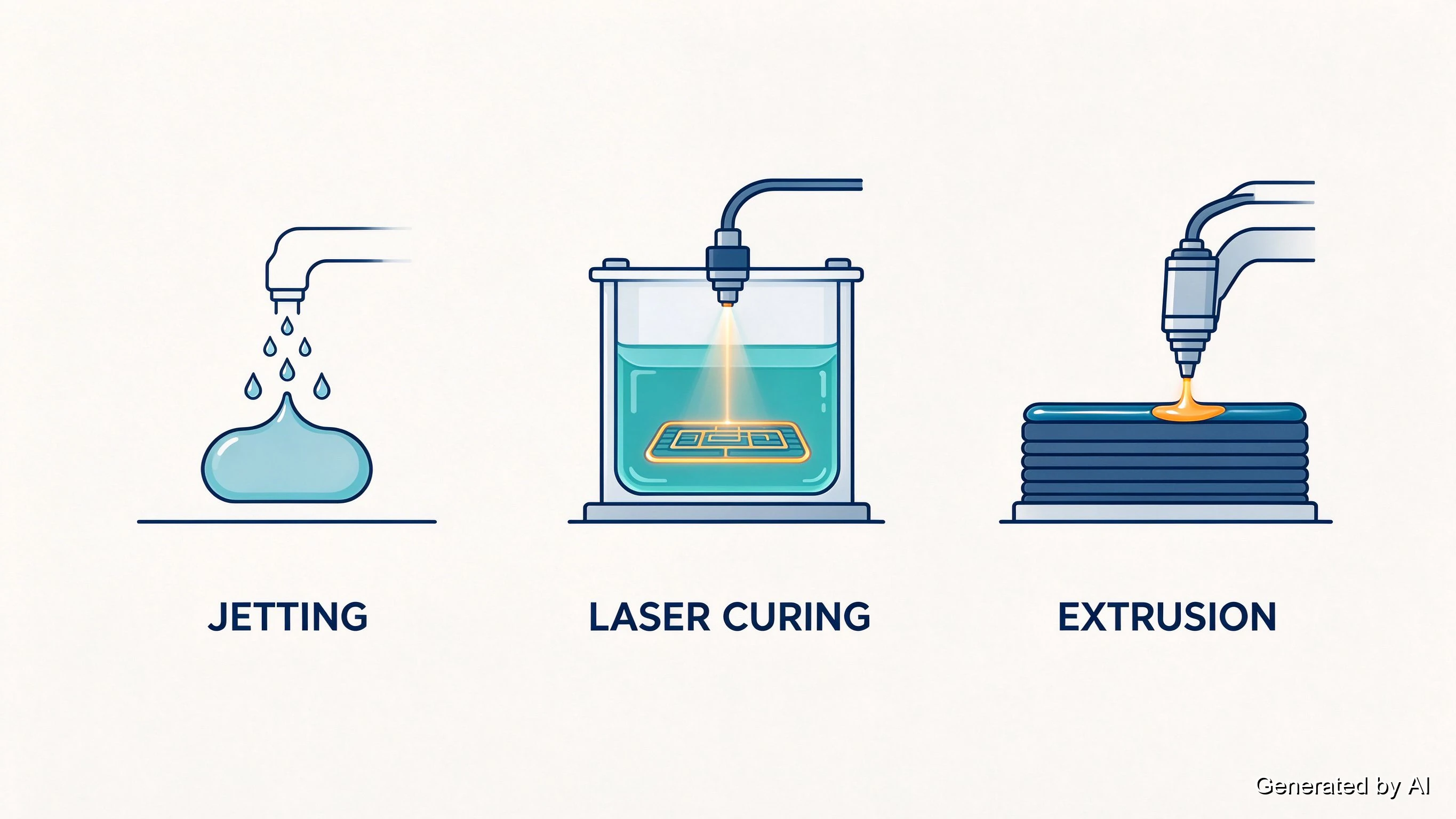
The rows that decide most purchases are the top three. If the part must show information — color, texture, branding, material transitions — material jetting is the only common process family that prints it directly, and PolyJet is its headline implementation. If the part must survive loads, SLA or FDM step forward instead. And when you are weighing PolyJet against the alternatives (other full-color routes, or processes that outperform it mechanically), our PolyJet alternatives comparison works through that decision in depth.
The comparison against SLA specifically comes up often, because both cure photopolymer and both deliver fine detail; the difference is that SLA's laser draws in a vat while PolyJet sprays from a head, and that single difference cascades into color capability, support removal, and throughput. The decision-level breakdown lives in our dedicated comparison; the short version for this page is that PolyJet owns appearance, SLA owns precision function.
PolyJet, MultiJet, MJF: The Name Family
The "jet" naming gets genuinely confusing, and the confusion costs people real shopping time. Three families use jetting-derived names, and they are not interchangeable:
- PolyJet (the Stratasys brand name for material jetting, the process described here): liquid photopolymer droplets, UV-cured, full color and multi-material.
- MultiJet Printing (MJP): 3D Systems' commercially established equivalent, the same material-jetting physics under a different brand. Treat MJP parts and PolyJet parts as close siblings.
- MJF (Multi Jet Fusion) — HP's powder-bed process. Despite the name, no liquid droplets are sprayed: an agent is fused into a bed of powder. It belongs to the powder family, not the jetting family.
The rule of thumb: if the machine sprays liquid resin through a head, it is jetting-family (PolyJet or MJP). If it spreads powder or cures a vat, it is not — whatever the brochure implies. Seeing "Multi Jet Fusion" means "powder-bed process", and the family tree resolves instantly.
Where PolyJet Wins — and Where It Doesn't
PolyJet earns its place wherever appearance, information, and material variety are the deliverable:
| Your priority | Pick | Why |
|---|---|---|
| Full-color, realistic prototypes | PolyJet | Color and texture printed in, not painted on |
| Medical & teaching models | PolyJet | Multi-material anatomy models: rigid bone, soft tissue in one print |
| Multi-hardness functional parts | PolyJet | Digital materials blend rigid and elastomeric zones in one build |
| Fine-detail display pieces | PolyJet | 14–16μm layers render micro-texture |
| Load-bearing structural parts | SLA or FDM | Photopolymer strength tops out below engineering filaments |
| Large parts | FDM or service | Build volumes are the jetting family's constraint |
The boundaries are as real as the wins. Photopolymer parts top out below engineering-filament strength, so load paths and long-term mechanical stress belong to other processes. Build volumes in the jetting family are compact to mid-size. Long-term outdoor exposure ages uncured-surface resins faster than engineering thermoplastics, so for weather, move up the material ladder.
FAQ about PolyJet 3D Printing Guide
Q: What is PolyJet 3D printing?
A material jetting process where print heads spray micro-droplets of liquid photopolymer and a UV lamp cures them instantly, layer by layer. It descends from office inkjet printing, and its family — material jetting — is the only common 3D printing family that delivers full color and multiple materials in a single build.
Q: Is PolyJet the same as SLA?
No. Both cure photopolymer, but PolyJet sprays droplets from a print head while SLA cures resin in a vat with a laser or screen. PolyJet adds full color and multi-material blending; SLA holds the edge in pure surface finish on functional parts.
Q: Can PolyJet print in full color?
Yes — cyan, magenta, yellow, black, and white resins mix droplet-by-droplet, producing gradients, labels, and textures directly in the print. It is the headline capability of the process and the reason display-grade prototypes come off the machine looking finished.
Q: Is PolyJet printing strong?
Moderately. Photopolymer parts handle handling, display, and light-duty function well, but their mechanical strength tops out below engineering filaments like ABS, ASA, or polycarbonate. For load-bearing parts, print the same geometry in tougher materials — many teams prototype in PolyJet and produce in stronger processes.
Q: What are PolyJet support structures like?
A gel-like support material is sprayed wherever geometry needs it and is removed with a water jet after printing. There is no snapping or cutting on the part itself, which protects fine color and texture — a cleaner support experience than most extrusion processes offer.
Q: How much does PolyJet 3D printing cost?
PolyJet sits in the premium tier: PolyJet 3D printers are engineering-grade machines, and full-color, multi-material capability is a value-add service rather than a commodity. For parts where color and material variety earn their keep, a service print is typically the sensible route — JLC3DP's WJP process delivers the same jetting-family full-color capability for production parts.
From Inkjet Roots to Full-Color Parts
PolyJet 3D printing took the most mature deposition system ever mass-produced — the office inkjet — and pointed it at a vat of photopolymer. The result is the only common process family where color, material, and geometry are all printing parameters. Know the family (PolyJet and MJP are liquid jetting; MJF is powder), know the wins (appearance, information, multi-material function), and know the boundary (photopolymer strength has a ceiling). When a part needs that full-color finish on production materials, the jetting family's industrial answer is one upload away.
Keep Learning
PolyJet 3D Printing: How It Works & Where It Wins
Key Takeaways PolyJet 3D printing is the commercial form of material jetting: print heads spray micro-droplets of photopolymer exactly where the layer needs them, and a UV lamp cures each droplet on the spot. It descends from office inkjet printing — the same droplet-on-demand idea, with cured resin standing in for ink. Material jetting is the only common 3D printing family that prints in full color and multiple materials in a single build, and PolyJet is its best-known brand implementation. Support s......
What is Binder Jetting? Process, Benefits, and Applications
Binder jetting (BJ) is a versatile additive manufacturing technology that is used to print polymer, metal, ceramic and sand parts. The Binder jetting 3d printing technology uses powdered materials upon which the print head selectively deposits a liquid binding agent (binder) to fuse adjacent powdered particles together to form a bond. It can be understood better by considering it a mix of powder bed fusion and material jetting technologies in a way that it uses powdered material and also uses a binder......
What is Material Jetting 3D Printing | The Complete Guide
So, what exactly is material jetting additive manufacturing? It’s like those office inkjets, only this one’s built for serious work. Instead of laying down ink on paper, it shoots out tiny drops of liquid photopolymer onto a flat platform. A quick flash of UV light locks each pass in place. Layer after layer, the shape takes form until you’re holding a finished part. What makes it shine are the little things, sharp edges, clean surfaces, and the ability to blend materials in a single build. Material J......
Binder Jet 3D Printing: Complete Technology Guide
What is Binder Jetting 3D Printing? Understanding the Basics Binder jetting is often compared to inkjet printing, but on steroids. Instead of spraying ink on paper, the machine lays down a liquid binder onto a thin layer of powder. Each sweep of the print head sticks particles together, one layer at a time, until you’ve got what’s called a “green part.” Once it’s out of the machine, the loose powder is blown or brushed away, and the part usually needs curing and then sintering or infiltration to get i......
Binder Jetting vs Material Jetting Key Differences
Jetting Technology in Additive Manufacturing Jetting has become one of the buzziest approaches in additive manufacturing, but the word itself causes headaches. Binder Jetting technology, Material Jetting, Multi Jet Fusion (MJF), even Metal Jet, they all sound like they’re versions of the same idea. They’re not. Each one works differently and serves very different needs. The roots of jetting-based 3D printing trace back to plain old inkjet printers. Engineers noticed: if you can shoot microscopic drops......
How Material Jetting 3D Printing Tech Works & When to Use it
Material jetting is one of the most precise and visually detailed 3D printing methods available today. If you imagine how inkjet printers work, layering ink dot by dot, material jetting 3D printing works similarly, but with droplets of photopolymer resin or wax that are cured layer by layer using UV light. This method shines in applications where ultra-smooth surface finish, high accuracy, and color realism are critical. But it’s not for everyone, costs, material options, and durability limitations ke......