Does 3D Printing Smell? Causes, Risks & How to Reduce It
22 min
- Odor, VOCs, UFPs, and Toxicity: What's the Difference?
- Why Does 3D Printing Smell?
- What Does 3D Printing Smell Like? PLA, PETG, ABS and Resin Compared
- Are 3D Printer Fumes Dangerous?
- Which 3D Printing Materials Have the Lowest Emissions?
- How to Reduce 3D Printer Smell and Emissions
- Is It Safe to 3D Print Indoors?
- What If Your 3D Printer Suddenly Smells Strong or Like Burning Plastic?
- How Long Do 3D Printer Fumes and Odors Last?
- FAQ About 3D Printer Smell
- Conclusion
Key Takeaways
- 3D printing can produce odors, VOCs, and ultrafine particles, but smell alone does not indicate exposure or toxicity.
- 3D printer fumes vary by material and printing conditions. PLA and PETG generally have lower emissions, while ABS and resin require greater emission control.
- Ventilation and source control are the most effective measures for reducing exposure to 3D printing emissions.
- Enclosures, HEPA filters, and activated carbon can provide additional control for particles, VOCs, and odors.
- Resin printing requires extra care, including proper ventilation, PPE, washing, and curing according to the manufacturer's instructions.
Introduction
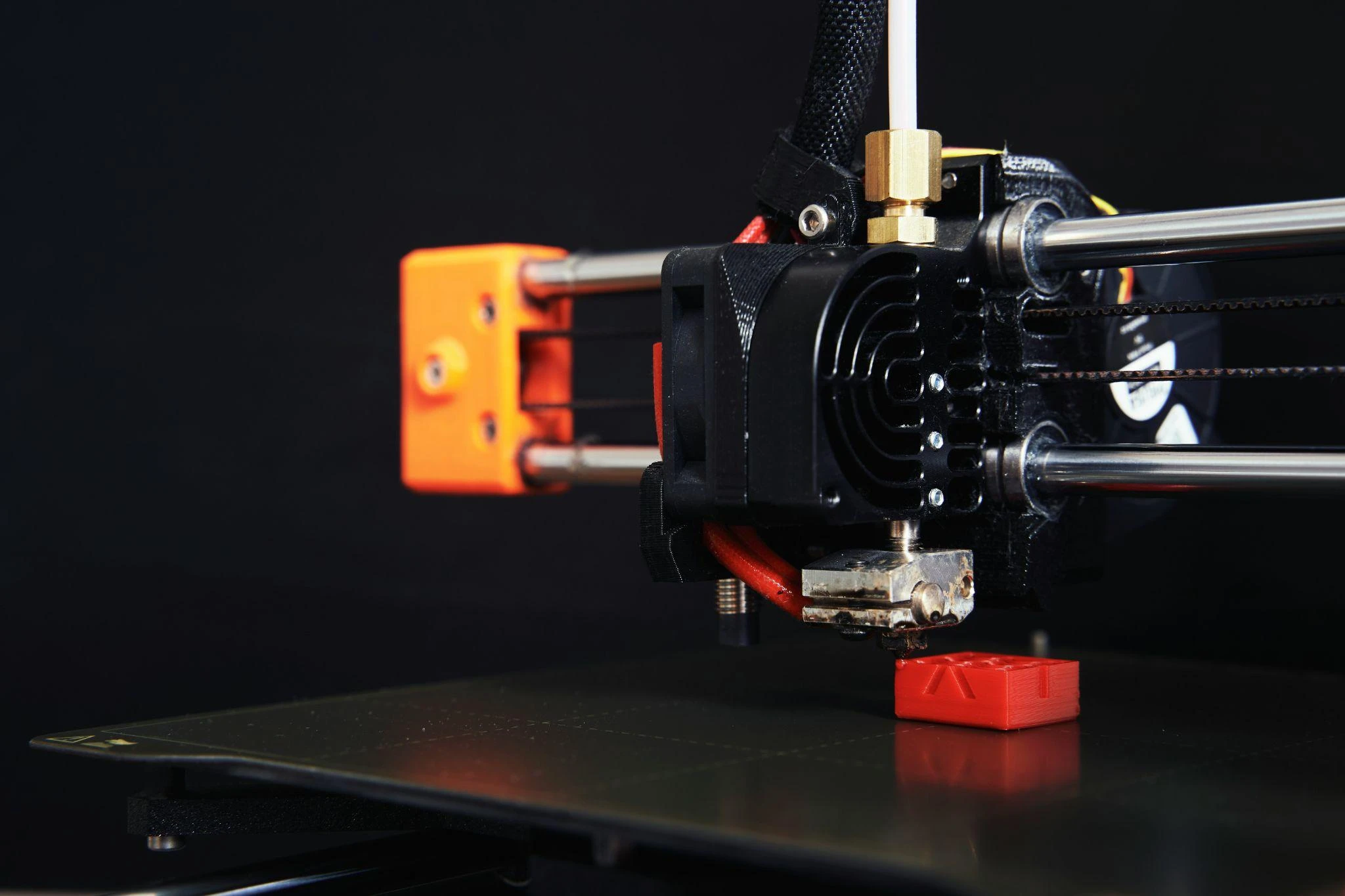
Yes, 3D printing smells. How much depends on what you're printing with, what temperature you're running, how good your ventilation is, and whether you're doing FDM or resin printing, because those are genuinely different situations. But a strong smell does not necessarily mean higher exposure, and little or no smell does not mean zero emissions.
(unsplash)
Actually, the smell you notice is only part of the story. Some of what gets released into the air during printing doesn't have much of an odor at all, and some things that smell fairly mild aren't necessarily the ones you'd be least concerned about. Odor and exposure don't map neatly onto each other, which is why the standard "PLA smells sweet so it's fine, ABS smells bad so it's toxic" framing misses a lot.
This guide tries to give you a more complete picture, what's actually happening chemically, how FDM and resin differ, what to be reasonably concerned about, and what you can actually do about it.
| Material | Typical Odor Level | Main Consideration |
|---|---|---|
| PLA | Low–Mild | Low odor doesn't mean zero emissions |
| PETG | Low–Mild | Formulation and temperature affect emissions |
| ABS | Moderate–Strong | Can emit styrene and ultrafine particles |
| Nylon | Low–Moderate | Emissions can occur even with mild odor |
| TPU | Low–Mild | Varies significantly by formulation |
| Resin | Noticeable–Strong | Formulation and handling requirements vary |
One thing to keep in mind while looking at this table. Low odor is not the same as low emissions, and nothing in this list should be read as safe or not safe based on smell alone.
Odor, VOCs, UFPs, and Toxicity: What's the Difference?
Before getting into specific materials, it's worth setting up a framework for thinking about this, because a lot of the confusion around 3D printer fumes comes from mixing up terms that mean different things.
| Term | What It Means | Can You Smell It? |
|---|---|---|
| Odor | A sensory perception caused by airborne substances | Sometimes |
| VOCs | Volatile organic compounds released into the air | Some can be smelled, others can't |
| UFPs | Ultrafine particles, generally under 100nm in diameter | No |
| Exposure | How much and for how long you're in contact with emissions | No |
| Health risk | Potential effects associated with a specific exposure | No |
Crucially, smell is not an air quality measurement. Some compounds are detectable by smell at very low concentrations, meaning you notice them before they've reached concerning levels. Others don't have much odor but still exist in the air. A printer that smells bad isn't automatically a health crisis, and a printer that smells fine isn't automatically producing nothing.
Actual risk assessment involves the material, what it actually emits, the concentration in the room, how long you're exposed, your ventilation situation, and your individual health circumstances. Odor tells you one small part of that.
Why Does 3D Printing Smell?
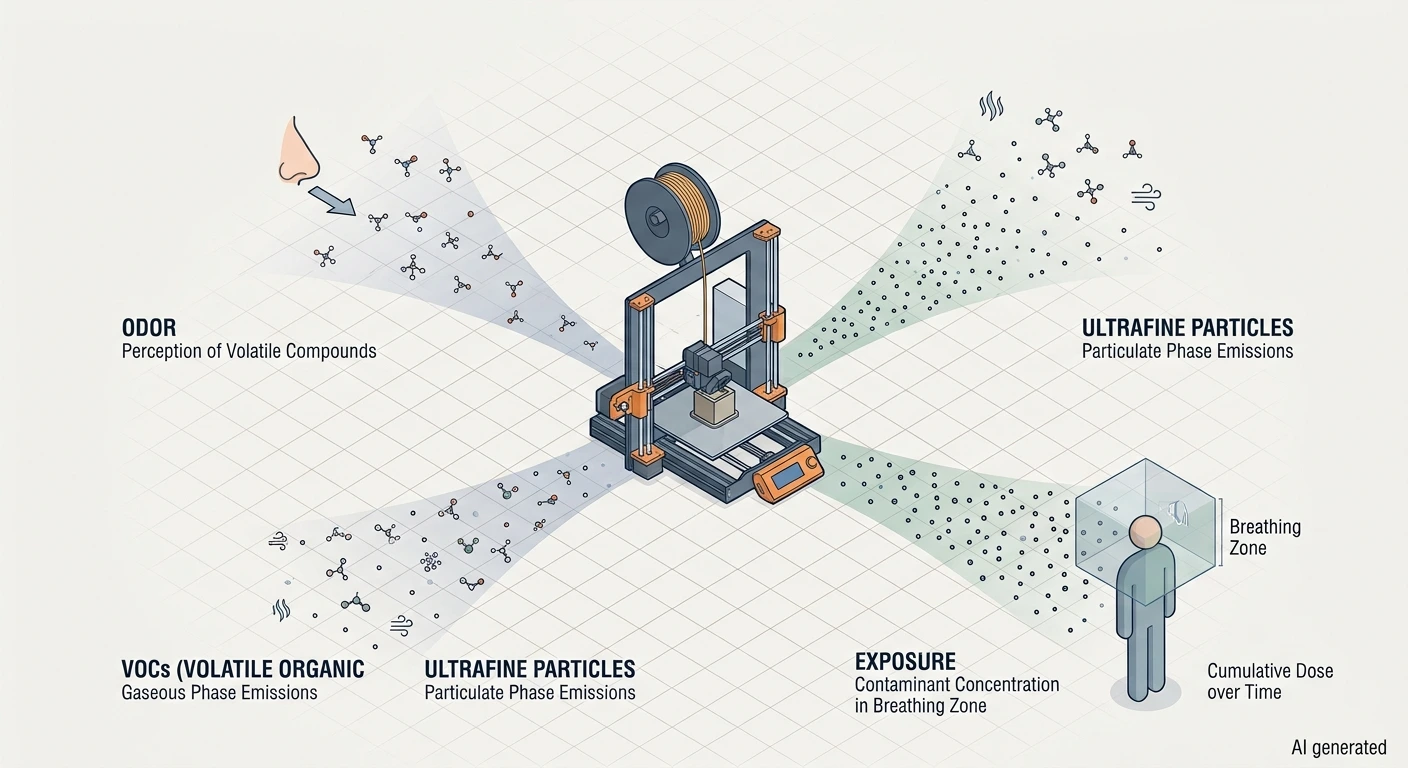
Two different 3D printing emission mechanisms
Thermal Processing Produces Emissions
With FDM printing, you're melting plastic. Heating polymer materials produces emissions, VOCs and ultrafine particles, because the heat breaks down or evaporates components of the filament. Different materials have different chemistries, so they produce different emission profiles. The specifics depend on the polymer itself, any additives or pigments, the printing temperature, and the condition of the nozzle and hotend.
Resin printing works differently. You're not melting anything, instead, UV light cures liquid photopolymer resin layer by layer. The odor there comes primarily from uncured resin components, which can include reactive compounds like acrylates and methacrylates. The formulation varies considerably between products, so the smell and emission profile of one resin isn't necessarily representative of another.
What Makes a 3D Printer Smell Stronger?
A few factors make a real difference:
The material itself is the biggest one. Some polymers emit more at typical printing temperatures. Additives, pigments, and flame retardants can affect emissions independently of the base polymer.
Temperature matters. Printing at higher temperatures generally increases emission rates, though the relationship isn't perfectly linear and depends on the specific material.
Print duration and material volume. A ten-hour print uses a lot more material than a thirty-minute one. More material processed means more cumulative emissions over that time.
Printer condition. A gunked-up nozzle with old filament residue burning off during a print can produce much stronger odors than a clean setup. Not just aesthetically worse, actually producing different combustion byproducts.
Room size and ventilation. A tiny bedroom with no airflow accumulates emissions that a large well-ventilated workshop disperses easily. The same printer, same material, completely different actual exposure.
What Are VOCs and UFPs?
VOCs are volatile organic compounds, carbon-containing chemicals that evaporate into the air at room temperature or during heating. The specific compounds depend heavily on the material. Styrene has been associated with some ABS printing conditions. Caprolactam has been associated with some nylon printing conditions. Acrylate and methacrylate compounds may be present in some resin formulations. This isn't a comprehensive list and doesn't mean every material produces every compound, the chemistry varies by product and formulation.
UFPs are ultrafine particles, generally defined as smaller than 100 nanometers. You can't see or smell them. FDM printing can generate significant quantities of ultrafine particles regardless of which filament you're using, including materials with relatively mild odors. This is one of the more relevant aspects of 3D printer emissions that often gets overlooked in discussions focused purely on odor.
What Does 3D Printing Smell Like? PLA, PETG, ABS and Resin Compared
1Does PLA Smell?
PLA has a relatively mild odor during printing. People describe it as vaguely sweet, warm, slightly toasty, not particularly unpleasant compared to other plastics. The specific smell varies by brand, color, and additives. Some PLA variants barely smell at all; others have a more noticeable warm-plastic character.
The important qualifier: PLA's mild odor doesn't mean it produces nothing. Research on 3D printing emissions has found that PLA generally produces lower VOC and particle emissions than higher-emission materials like ABS under comparable printing conditions, but it's not emission-free. UFP generation occurs with PLA printing. Ventilation is still a sensible precaution even with PLA, not just with ABS or resin.
Don't let mild odor be interpreted as a safety certificate. It isn't one.
2Does PETG Smell?
PETG is often described as having a very mild odor, some people notice a warm plastic smell, some don't notice much at all. It generally smells less than ABS. But again, mild odor doesn't tell you the full emissions story. Formulation, additives, and printing temperature all affect what's actually being released. Good ventilation when printing PETG is a reasonable practice regardless of how little you can smell.
3Does ABS Smell?
ABS smells noticeably. Most people describe it as a chemical or hot plastic smell, something clearly different from PLA. There's a reason people recommend enclosures and ventilation specifically for ABS printing, and the smell is part of it, but not the main concern.
Styrene is the compound most commonly discussed in relation to ABS emissions. The International Agency for Research on Cancer (IARC) has classified styrene as possibly carcinogenic to humans (Group 2A). What that classification means in practice, at what exposure levels, over what duration, and for what health outcomes, is more complex than simply saying ABS causes cancer. But it's why ABS shouldn't be printed in confined, unventilated spaces, and why source control matters for ABS specifically.
ABS also generates ultrafine particles during printing. If you're printing ABS regularly without an enclosure or ventilation, that's worth reconsidering.
4Does Resin Printing Smell?
Yes, often quite strongly. Resin printers have a distinctive chemical smell that's hard to miss, and it tends to linger more than FDM odors do. The smell comes from reactive compounds in uncured resin, which can include acrylate and methacrylate-based components depending on the formulation.
Here's the thing with resin: the variation between products is enormous. Some consumer resins have softer odor profiles; others are pretty intense. The smell is not the only concern, uncured resin on surfaces, in wash containers, and on printed parts before curing requires careful handling because skin sensitization is a recognized concern with some resin compounds. Always follow the manufacturer's Safety Data Sheet for the specific product you're using. That's not just a legal disclaimer, the SDS has the actual handling information.
5What About Nylon, TPU, ASA, and PC?
| Material | Typical Odor | Key Consideration |
|---|---|---|
| Nylon | Low–Moderate | Can release compounds like caprolactam; mild odor doesn't mean no emissions |
| TPU | Low–Mild | Varies significantly by formulation |
| ASA | Moderate–Strong | Similar emission-control considerations to ABS |
| PC | Moderate | Higher processing temperatures may affect emissions |
None of these are worth long individual sections. The pattern holds: odor level is a partial indicator at best. Anything requiring high processing temperatures or with a strong chemical smell warrants appropriate ventilation.
Need help choosing a material for your application? Explore JLC3DP's 3D printing materials selection guide to compare engineering properties, printing technologies, and available options.
Are 3D Printer Fumes Dangerous?
It depends, and "it depends" is genuinely more useful than a flat yes or no.
3D printer emissions can include VOCs and ultrafine particles. Whether those emissions present a meaningful health concern in your specific situation depends on what you're printing, what it actually emits at your printing parameters, how long you're running the printer, how big the room is, how well it's ventilated, whether you have an enclosure, and your individual health circumstances. Someone with respiratory conditions faces different considerations than a healthy adult printing occasionally in a garage with the door open.
For more detail on the research around 3D printing emissions specifically, see our guide to 3D printing toxic fumes which covers the relevant studies in more depth.
1Are PLA Fumes Toxic?
PLA produces lower emissions than higher-emission materials under comparable conditions. That's a meaningful difference. But "lower emissions" isn't the same as "no emissions", PLA still generates ultrafine particles, and VOC emissions occur even if they're less pronounced. Ventilation remains sensible even with PLA. The laboratory studies on PLA emissions show that it's not a zero-emission material, it just emits less than some alternatives.
Be careful with how research findings get interpreted here. Laboratory or cell studies showing effects from concentrated exposure aren't direct evidence of what happens to someone printing at home with reasonable ventilation. Hazard classification and actual risk under a specific set of conditions are different things.
2Are PETG Fumes Dangerous?
The evidence on PETG is less studied than PLA or ABS. Mild odor, generally lower emissions, but formulation-dependent behavior means you can't generalize across all PETG products. Reasonable ventilation and source control make sense. Claims that PETG is completely safe or inherently dangerous both go beyond what the evidence supports.
3Are ABS Fumes Toxic?
ABS is the one where the evidence for being more careful is strongest. Styrene emissions associated with ABS printing, ultrafine particle generation, and the generally stronger odor profile all point in the same direction: don't print ABS in a closed unventilated room regularly. The risk isn't "print one ABS part and you've harmed yourself", it's about prolonged regular exposure without source control. Enclosures with exhaust ventilation are the standard recommendation for a reason.
4Is Resin Toxic to Breathe?
Resin formulations vary too much for a blanket answer, but the category deserves more care than FDM in general. Uncured resin may contain reactive compounds that can cause respiratory irritation and skin sensitization in some individuals. The concern isn't just the fumes while printing, it's also during handling, washing, and curing. The specific risks depend on the specific product. Read the SDS for whatever resin you're using. That's the document written by the people who actually know what's in it.
Which 3D Printing Materials Have the Lowest Emissions?
| Material | Odor | Emission Consideration | Indoor Approach |
|---|---|---|---|
| PLA | Low | Lower than ABS in many studies | Ventilation |
| PETG | Low | Formulation-dependent | Ventilation |
| ABS | Higher | Styrene + UFP concern | Enclosure + exhaust |
| ASA | Higher | Similar control considerations | Enclosure + exhaust |
| Resin | Noticeable | VOCs + uncured resin handling | Containment (such as protective clothing, nitrile gloves, gas mask) + ventilation |
How to Reduce 3D Printer Smell and Emissions
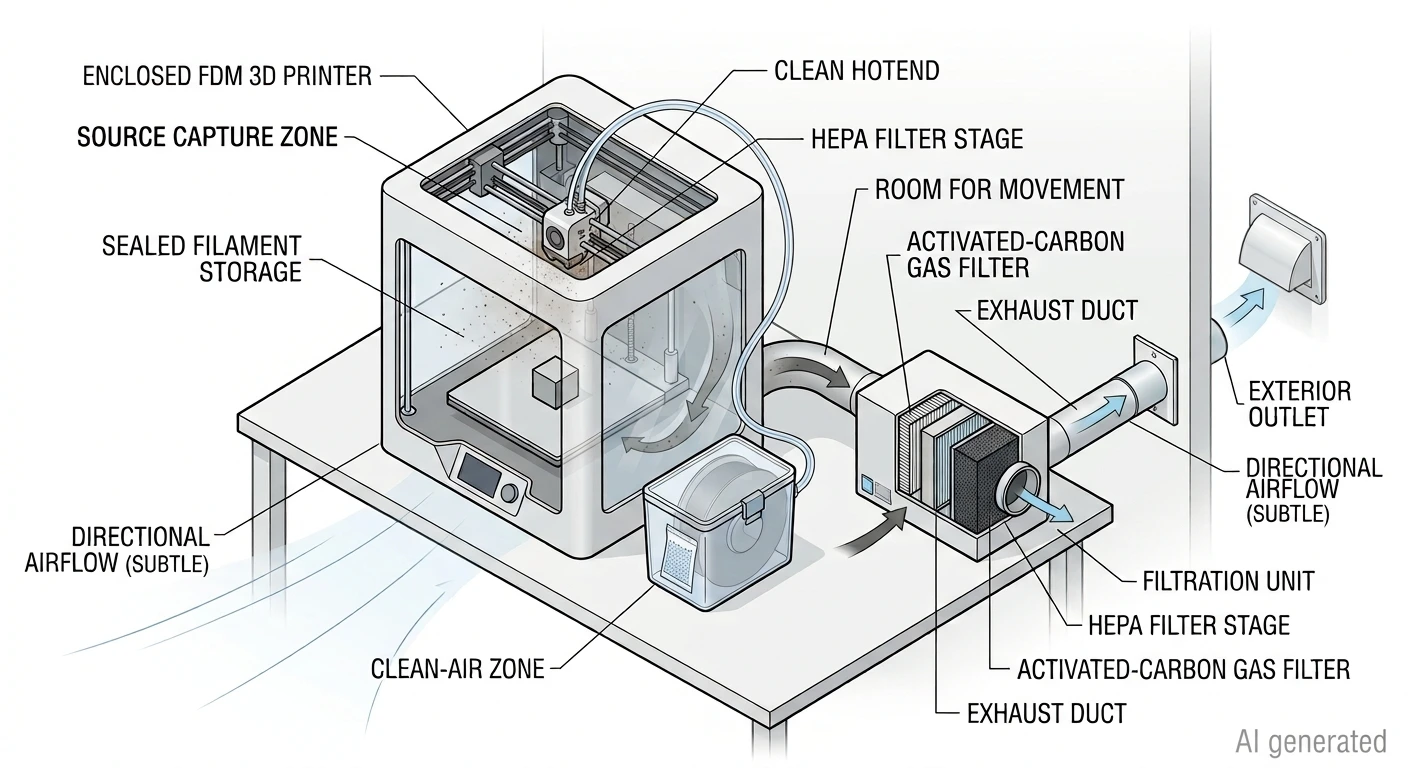
Properly controlled 3D printing workstation
-
Improve Workspace Ventilation
Fresh air moving through the space is the most effective single measure. Open windows on opposite sides of the room for cross-ventilation. An exhaust fan moving air out of the room, not just around it, is better than a fan that circulates air internally. If you're printing in a dedicated space with an enclosure, exhausting that enclosure to the outside is genuinely the most effective approach.
For more on ventilation setup specifically, see our guide on 3D printing ventilation.
-
Use an Enclosure With Source Exhaust
An enclosure helps contain emissions at the source rather than letting them disperse into the room. This matters most for ABS, ASA, and resin. The enclosure itself doesn't solve the problem, it just concentrates the emissions in a controlled location. That's only useful if the enclosure air is then exhausted somewhere (outdoors, or through appropriate filtration). Enclosure with no exhaust just delays the release into the room.
-
Choose Lower-Emission Materials Where Possible
For applications where PLA or PETG are functionally adequate, using them instead of ABS or ASA reduces the emissions you're dealing with. This is worth thinking about during material selection, not every print needs the properties that ABS provides. Low-odor resin products exist and may reduce the smell for resin applications, though they're not necessarily zero-emission.
Just remember: lower-emission doesn't mean zero-emission.
-
Print at Recommended Temperatures
Follow the manufacturer's recommended temperature range for your material. There's generally no benefit to printing hotter than needed, and higher temperatures tend to increase emission rates. Don't use unnecessarily high temperatures. That said, the relationship between temperature and toxicity isn't perfectly linear, it's not that a 10°C increase doubles the risk, it's just that optimal temperature for the material is optimal for emissions too.
-
Use HEPA Filtration for Particles
HEPA filtration can effectively reduce airborne particle emissions, including ultrafine particles, when properly designed and used. This is genuinely useful because UFPs are one of the more concerning emission categories and one that can't be addressed by smell alone. The important limitation: HEPA filters don't address gaseous VOCs. They do different jobs. A printer enclosure with HEPA filtration helps with particles but doesn't capture styrene or other volatile compounds.
-
Use Activated Carbon for Some VOCs
Activated carbon can adsorb some gaseous compounds, including some VOCs and odor compounds. The effectiveness depends significantly on the carbon quantity, the specific compounds present, airflow through the filter, and how fresh the carbon is. A small amount of carbon in a cheaply made filter isn't the same as a properly designed activated carbon filtration system. Don't treat a basic carbon filter as a complete VOC solution.
-
Maintain the Printer
A clean printer generally produces more predictable emissions than one with accumulated filament residue, partial clogs, and degraded components. Clean the nozzle regularly. Check hotend condition. Make sure you're not running old burned filament through the system. A burning smell during printing sometimes indicates equipment issues rather than normal material emissions, more on that in the troubleshooting section below.
Store filament in dry conditions. Degraded or moisture-damaged filament can exhibit different printing behavior, and in some cases this affects what's being produced during printing.
-
Handle and Cure Resin Properly
Follow the manufacturer's washing and curing instructions. Use the recommended cleaning solution rather than improvising. Fully cure resin parts according to the manufacturer's instructions. Until the part is properly washed and cured, avoid direct skin contact and use the PPE specified by the manufacturer. Store resin containers sealed and away from light. The SDS for your specific resin product is the document that tells you what it actually contains and how it should be handled.
Sunlight can partially cure resin but isn't a substitute for proper UV curing with adequate intensity and time. Don't just leave parts outside and assume they're properly cured.
See our 3D printing post-processing guide for more detail on resin handling procedures.
-
Use Appropriate PPE
For resin handling specifically: nitrile gloves, appropriate eye protection, and whatever additional PPE the SDS specifies. Resin sensitization is a real concern and worth taking seriously.
For FDM: a basic dust mask doesn't meaningfully address ultrafine particles or VOCs, and shouldn't be treated as a substitute for ventilation. Ventilation is the primary control measure. PPE can be part of the picture but shouldn't be the only thing you're relying on in a poorly ventilated space.
Is It Safe to 3D Print Indoors?
People print indoors all the time, and most of them are fine. But "generally okay" and "no considerations required" aren't the same thing. The answer depends on what you're printing, where specifically, and how you've set things up.
Can You 3D Print in a Bedroom?
A bedroom is a space you occupy for extended periods, often overnight, which is a different consideration from a workspace you're in for a few hours with the door open. It's not that any printer in a bedroom is automatically dangerous, it's that bedrooms typically have limited ventilation, you're in them for long uninterrupted stretches, and minimizing unnecessary exposure while you sleep seems sensible.
Resin printing in a bedroom especially doesn't make much sense. The chemical odor is significant, the containment requirements are more demanding, and the situation of running a resin printer in a sleeping space through the night isn't one worth accepting when alternatives exist.
Can You 3D Print in a Home Office?
The relevant factors: how long you're in the room while printing, what material you're using, whether you have an enclosure, and how well the space is ventilated. PLA in a reasonably ventilated home office with a window is a different situation from running ABS all day in a sealed room with no airflow. Think through those specifics rather than applying a blanket answer.
FDM vs. Resin for Indoor Printing
| Setup | General Approach |
|---|---|
| PLA + good ventilation | Lower-emission option for general indoor use |
| PETG + good ventilation | Generally manageable |
| ABS/ASA in open room without ventilation | Greater emission-control needs |
| Resin in occupied room | Requires careful ventilation and containment |
| Resin in a bedroom | Best avoided |
| Multiple printers in a small space | Requires stronger source control measures |
What If Your 3D Printer Suddenly Smells Strong or Like Burning Plastic?
There's a difference between the normal smell of whatever material you're printing and an unexpected burning smell that wasn't there before. That distinction matters.
Normal vs. Warning-Sign Odors
Expected printing odor is consistent with the material you're using, appears throughout the print without sudden changes, and isn't accompanied by smoke, unusual sounds, or abnormal hotend behavior.
Warning signs worth stopping for: a sudden strong odor that appears or intensifies unexpectedly, a burning-plastic smell that's different from normal, visible smoke from the nozzle or hotend area, an electrical smell, or any sign of overheating.
What to Check
If the smell seems abnormal: check the nozzle temperature against what you've set. Inspect the hotend for old filament residue burning off. Check whether the PTFE tube (if your printer has one) is degrading, overheated PTFE has its own distinct smell and is worth taking seriously. Look at whether the material profile matches what you're actually printing with. If there's any sign of electrical issues, stop the printer.
Don't continue printing through a smell that seems clearly wrong. The cost of pausing a print is much lower than the cost of a problem you ignored.
How Long Do 3D Printer Fumes and Odors Last?
There isn't a single answer to this, and any guide that gives you a specific time ("fumes clear in 30 minutes") is being more confident than the evidence supports.
How long emissions persist in a room depends on what material was printed, how much material was used, how long the print ran, the volume of the room, how well it's ventilated, whether an enclosure was used, and whether there's any filtration.
One important point: odor can disappear before airborne particles have fully cleared. The smell going away doesn't necessarily mean the air is back to baseline. If you've been printing something with higher emissions, running ventilation for a period after printing ends, not just during, is worth doing.
The practical takeaway is ventilate during and after printing, and don't assume the air is clear just because you can't smell anything anymore.
FAQ About 3D Printer Smell
Q: Does 3D printing give off toxic fumes?
3D printing can release VOCs and ultrafine particles depending on the material and printing conditions. Whether these represent a meaningful health concern depends on the specific emissions, concentration in the room, exposure duration, ventilation, and individual factors. Odor level alone isn't a reliable guide. Materials like ABS have more evidence supporting emission concerns; PLA generally produces lower emissions but isn't emission-free.
Q: Is it safe to 3D print indoors?
For most common materials with reasonable ventilation, many people print indoors without issues. The specifics matter: material choice, enclosure, room size, ventilation, and how long you're in the space during printing. Resin printing indoors requires more careful containment and ventilation than FDM. Printing ABS in a sealed unventilated room isn't a situation most emission guidance would support.
Q: Can I sleep in the same room as a 3D printer?
This is one of those situations where the convenience probably isn't worth the exposure uncertainty. Sleeping in a room with an active printer, especially resin, means extended uninterrupted exposure with no ability to respond if something goes wrong with the print. Resin printing in a bedroom overnight is worth avoiding. FDM with PLA in a ventilated bedroom is lower risk, but the precautionary case for printing while you're not there to monitor it is worth considering.
Q: How do I stop my 3D printer from smelling?
You can't eliminate emissions entirely but you can reduce exposure meaningfully: improve ventilation (exhaust air out of the space, not just circulate it), use an enclosure with exhaust for higher-emission materials, choose lower-emission materials where the application allows, print at the manufacturer's recommended temperature rather than higher, and keep the printer clean. Filtration, HEPA for particles, activated carbon for some VOCs, helps as a supplementary measure.
Q: How long do 3D printer fumes last?
Depends on the material, print volume, room size, and ventilation. No universal time applies. Odor may dissipate before airborne particles have fully cleared. Running ventilation after printing ends, not just during, is a sensible practice.
Q: Does an air purifier remove 3D printer fumes?
Partially, depending on the type. HEPA filtration captures airborne particles including ultrafine particles from printing. Activated carbon can adsorb some VOCs and odors. Neither alone addresses everything, and their effectiveness depends on the specific system, airflow, and contaminant concentrations. An air purifier with both HEPA and carbon filtration is better than either alone, but proper ventilation remains the primary control measure.
Q: Why does my 3D printer smell like burning plastic?
If it's sudden and stronger than the normal material odor, check the hotend temperature, look for old filament residue burning off the nozzle, check PTFE tube condition if applicable, and verify your material profile matches what you're actually printing with. If there's smoke or anything suggesting electrical issues, stop the printer and investigate before continuing.
Conclusion
3D printing does produce odors, and in some cases it produces emissions worth thinking carefully about. The material matters, the ventilation matters, how long you're printing matters, and what space you're printing in matters. Odor intensity isn't a reliable guide to any of those things.
The practical summary: ventilation and source control are your most effective tools. Enclosures help for higher-emission materials when the air is actually exhausted somewhere rather than just contained. HEPA filtration addresses particles; activated carbon addresses some VOCs. Resin requires more careful handling than FDM. And a burning smell that's out of character for your normal printing is worth investigating rather than continuing through.
Explore JLC3DP's 3D printing materials and manufacturing services to find the right material for your application, including lower-emission options and engineering materials for applications where PLA or standard resins aren't the right fit.

- Starting From $0.3 per part · No Minimum Order Quantity
- 24-Hour Lead Time · Up to $123 Welcome Coupons
Sources & References
- NIOSH — Safe 3D Printing
- EPA — 3D Printing Emissions Research
- IARC — Styrene, Volume 121
- Relevant peer-reviewed emission studies
Keep Learning
Does 3D Printing Smell? Causes, Risks & How to Reduce It
Key Takeaways 3D printing can produce odors, VOCs, and ultrafine particles, but smell alone does not indicate exposure or toxicity. 3D printer fumes vary by material and printing conditions. PLA and PETG generally have lower emissions, while ABS and resin require greater emission control. Ventilation and source control are the most effective measures for reducing exposure to 3D printing emissions. Enclosures, HEPA filters, and activated carbon can provide additional control for particles, VOCs, and od......
10 Things You Should Never 3D Print
(source: Freepik) 3D printing opens the door to creativity, customization, and convenience, but not everything should be on the print bed. While the tech keeps getting better, safer, and more accessible, there are still clear boundaries, legal, ethical, and material-based- that shouldn’t be crossed. The short answer to "what can't you 3D print?" is: anything illegal, anything safety-critical that you can't certify, and anything that the material simply can't handle. That covers “3D-printed firearms, c......
FDM 3D Printer Spaghetti: Causes, Fixes, and Tips
Every 3D printing enthusiast, from desktop hobbyists to enterprise hardware engineers, shares a common rite of passage: waking up expecting a flawless 14-hour prototype, and instead discovering a bowl of plastic modern art on the build plate. Welcome to the kitchen. You have just cooked a fresh batch of 3D printer spaghetti. While a spaghetti FDM 3D print failure is a running joke in the additive manufacturing community, resolving a recurring 3D print failure requires moving past the memes to evaluate......
How to Benefit from 3D Scanning Uses
The Diverse Application of 3D Scanning Methods 3D scanning has become a perfect tool in engineering, design, and manufacturing. By capturing the geometry, and surface texture of objects, 3D scanning techniques enable the creation of high-resolution 3D models with the best accuracy. While 3D scanning has existed for decades, recent advancements have made it faster, more precise, and accessible to both industry and enthusiasts. This article explores the main 3D scanning methods, their benefits, and the ......
Laser Scanning: Improving the accuracy and efficiency of 3D printing
Laser scanning works by emitting a laser beam to a target object or surface and measuring the time it takes for the laser pulse to reflect back. These time measurements, combined with angular information, allow the scanner to calculate the highly accurate distance and direction of each point on the surface of the object. Multiple laser beams are fired rapidly from all angles to capture a dense set of 3D coordinates, which in turn build a 3D model of the object. The advantage of this process is that it......
Is 3D Printing Food Safe? Best Materials & Coating Guide
In recent years, food safe 3d prints have captured significant attention. People are concerned about some questions, such as: Are 3d prints food safe? Are there any food safe 3d printing materials? How to make 3D Prints food-safe?…… The following guide answers these questions. Read on for an introduction to food safety, food safety 3D printing materials choices, and a variety of methods to make 3d prints food safe. Quick Answer — Are 3D Prints Food Safe? Most 3D-printed parts are not food-safe by defa......