3D Printer Filament Recycling: How to Recycle and Reuse Filament Waste
16 min
- Can You Recycle 3D Printer Filament?
- Which 3D Printer Filaments Can Be Recycled?
- Recycled Filament vs. Virgin Filament
- How to Recycle 3D Printer Filament at Home
- How to Recycle 3D Printer Filament Without a Recycling Machine
- How to Reuse 3D Printer Filament Waste
- Where Can You Recycle 3D Printer Filament?
- How to Check the Quality of Recycled Filament
- Filament Recycling Decision Matrix
- FAQ about 3D Printer Filament Recycling
- Get Production-Grade Parts Without the Recycling Headache
Key Takeaways
1. You can recycle 3D printer filament, but it's more involved than tossing it in the recycling bin.
2. Most common filament materials like PLA, PETG, and ABS can technically be recycled, though the quality of the recycled output depends heavily on how clean, dry, and uncontaminated the waste is.
3. Recycling 3D printer filament at home requires a shredder and extruder at minimum.
4. For most people without that equipment, the practical options are filament take-back programs, makerspaces, and specialized plastic recyclers.
5. Filament spools are a separate category and often recyclable through different channels than the filament itself.
Can You Recycle 3D Printer Filament?
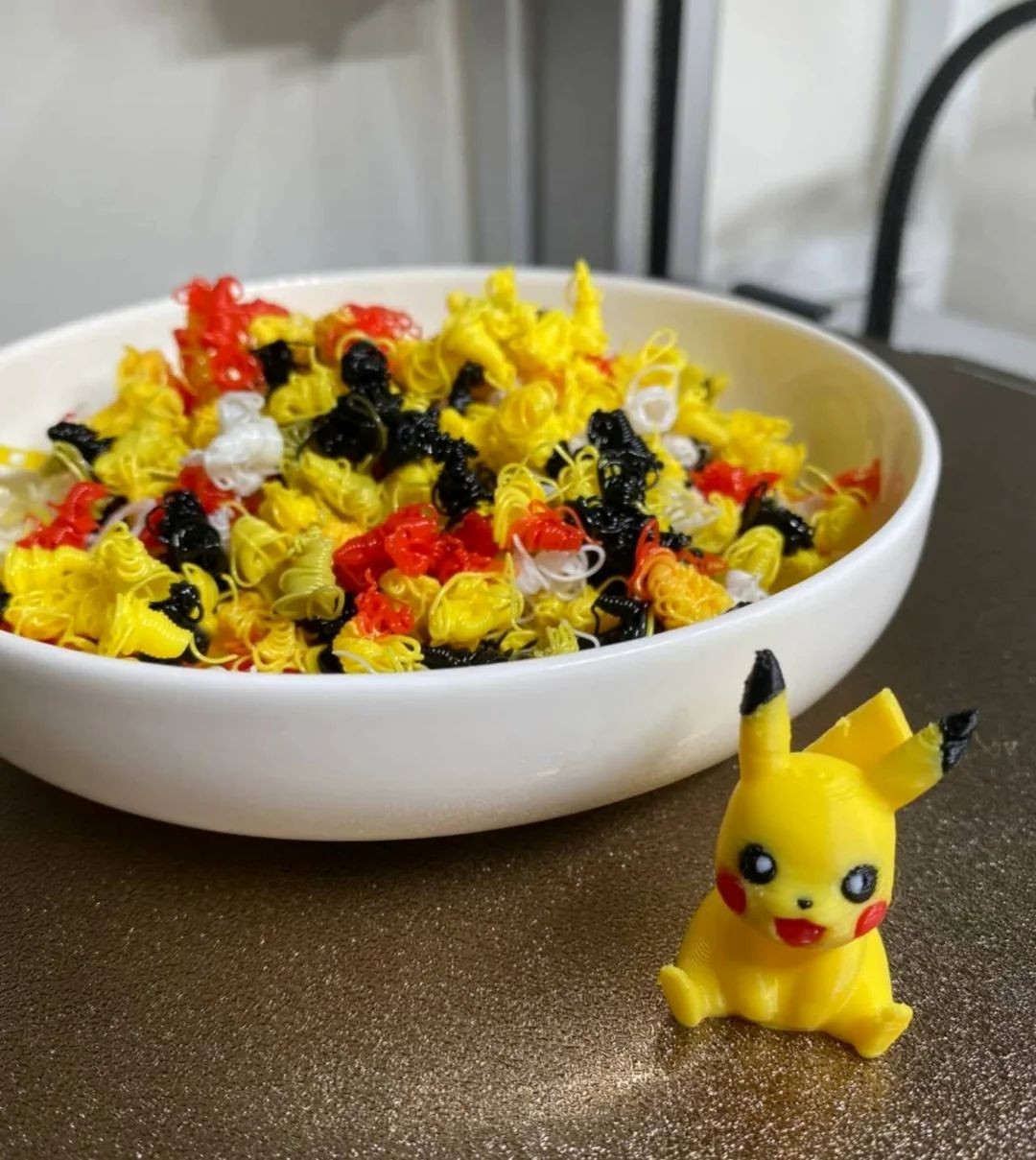
(Reddit) 3D printer filament waste recycled into Pikachu figurine
Yes - with caveats. Recycling means taking plastic waste from the print process and processing it back into usable material. Most of it is thermoplastic including PLA, PETG, ABS, and ASA, so it can be reprocessed, The caveats are about consistency, not possibility.
Yes — with caveats. Recycling means taking plastic waste from the print process and processing it back into usable material. Most of it is thermoplastic including PLA, PETG, ABS, and ASA, so it can be reprocessed. The caveats are about consistency, not possibility.
- Repeated thermal and mechanical processing can degrade some polymers and change their mechanical or flow properties. The extent depends on the material and processing conditions. According to 2024 research on 2024 research on PLA recycling, parts printed entirely from recycled filament saw their tensile and flexural strength drop by more than 15% relative to virgin filament. In contrast, mixing in virgin PLA yielded noticeably different results.
- Unintentional material or color mixing — inconsistent, unreliable filament.
- Moisture contamination = processing defects and weak prints.
Getting portable recycled filament is straightforward. Getting good recycled filament that matches fresh spool performance is the hard part that's where most home setups fall short.
For a broader look at how 3D printing waste can be collected, processed, and turned back into usable material, see our guide to 3D printing recycling.
What 3D Printer Waste Can Be Recycled?
Not all 3D printing waste is equally useful as recycling feedstock. The easiest material to process is generally clean, known, single-polymer waste.
Most waste in a printing workflow can be mechanically reprocessed, but practical recyclability depends on the polymer, contamination, additives, and available processing equipment. The better question is which streams are worth the effort.
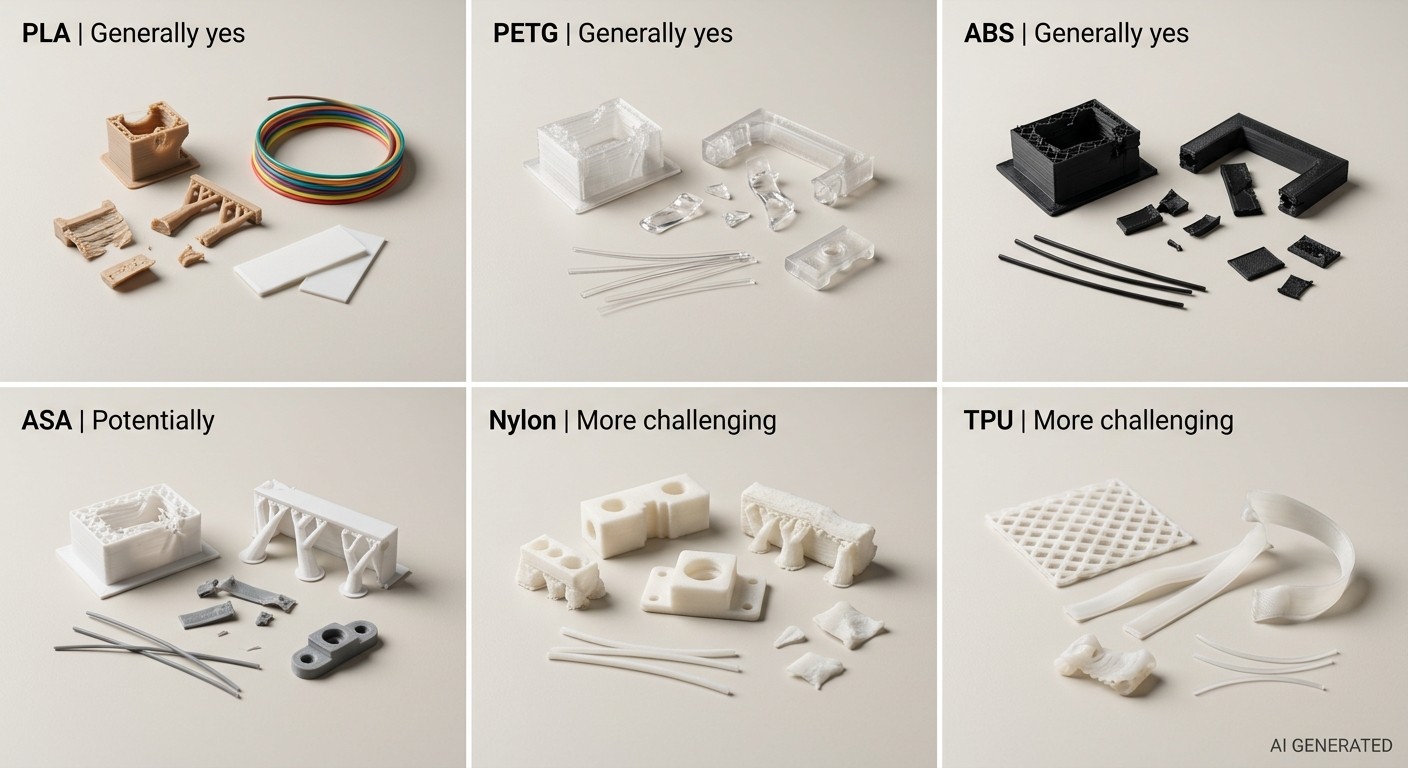
- Failed prints - the obvious one. A half-finished failure is usually clean, uncontaminated plastic (assuming it failed mechanically, not by picking up bed debris). Large failures are ideal: big volumes of one consistent material.
- Support structures - if you printed PLA supports on a PLA model, they're the same material and join the same batch. Watch out for PLA water-soluble supports: mixing them into PLA waste ruins the batch.
- Scraps and short ends - the last meters when a spool runs out. Sort by material and color, they process like anything else.
- Purge lines, purge towers, and \"filament poop\" - the extruded purge when changing colors or materials. Pure single-material purge is fine. Transitional purge (the blend between two different materials) is contaminated by definition - keep it out of clean batches.
Note
Contamination is the #1 enemy. A batch that's 95% PLA and 5% mystery plastic will behave unpredictably.
Rule of thumb: if you cannot identify the material composition, keep it out of a controlled recycling batch.
What Should Not Be Mixed?
For consistent recycled filament, keep waste streams clean and separate. Mixing incompatible materials or introducing contaminants can affect melt behavior, extrusion consistency, and the quality of the recycled output.
- Different polymers: Keep PLA, PETG, ABS, and other polymers in separate batches. Different plastics have different processing temperatures and material properties, so mixing them can produce unpredictable results.
- Unknown materials: Do not mix unidentified filament or plastic waste into a known-material batch. Without knowing its composition, you cannot reliably control processing conditions or predict the properties of the recycled filament.
- Contaminated waste: Remove dirt, tape, hair, support residues made from different materials, and other foreign substances before recycling. Heavily contaminated waste is generally unsuitable unless the contaminants can be removed effectively.
- Transitional purge: Keep purge waste generated when switching between different materials out of clean recycling batches. Unlike single-material purge, transitional purge contains a mixture of polymers and may compromise the consistency of the recycled filament.
Rule of Thumb
Recycle only clean, dry, identifiable waste that is separated by polymer. When in doubt, keep it out of the batch.
Which 3D Printer Filaments Can Be Recycled?
| Material | Recyclable? | Key Considerations | |||||||||||||||||||||||||||||||||
|---|---|---|---|---|---|---|---|---|---|---|---|---|---|---|---|---|---|---|---|---|---|---|---|---|---|---|---|---|---|---|---|---|---|---|---|
| PLA | Generally yes | Keep clean and dry; don't mix with PETG or ABS | |||||||||||||||||||||||||||||||||
| PETG | Generally yes | Higher processing temperature than PLA; keep separated | |||||||||||||||||||||||||||||||||
| ABS | Generally yes | Requires appropriate ventilation during processing | |||||||||||||||||||||||||||||||||
| ASA | Potentially | Keep separated from other plastics; similar to ABS processing | |||||||||||||||||||||||||||||||||
| Nylon | More challenging | Very sensitive to moisture; must be thoroughly dried before processing | |||||||||||||||||||||||||||||||||
| TPU | More challenging | Flexible material resists shredding and feeds inconsistently through extruders |
| Factor | Recycled Filament | Virgin Filament |
|---|---|---|
| Material consistency | Can vary | Generally more predictable |
| Color consistency | May vary significantly | Usually consistent |
| Diameter control | Depends on recycling equipment | Typically better controlled |
| Mechanical properties | May change after reprocessing | More predictable |
| Moisture management | Requires careful handling | Depends on material and storage |
| Processing effort | Higher | Lower |
| Qualification for critical parts | Requires validation | Easier to qualify |
How to Recycle 3D Printer Filament at Home
Recycling filament at home is genuinely possible. It's also genuinely involved. Here's the actual process.
1Sort by material and color
Separate waste by polymer first:
- PLA
- PETG
- ABS
- ASA
- Nylon
- TPU
Moisture is particularly important for hygroscopic materials such as nylon.
The appropriate drying temperature and duration depend on the polymer and should follow the filament manufacturer's recommendations. Proper drying can help reduce bubbles, inconsistent extrusion, and other moisture-related defects.
Within each material, sorting by color is optional if you're okay with inconsistent color output from the recycled filament, most people doing home recycling end up with something vaguely brownish anyway since colors mix unpredictably. If you want consistent color, sort color too.
2Remove contaminants and dry the material
Anything that's not plastic shouldn't go into the recycler. If a failed print has bits of tape, hair, or debris on it, remove them. Wash parts that have significant surface contamination and let them dry completely.
Drying the plastic before reprocessing matters more than most home recyclers acknowledge. Moisture in plastic causes bubbles, inconsistent extrusion, and weak layer adhesion in the recycled filament. Drying at the appropriate temperature for the material, PLA around 45-50°C for several hours, PETG around 65°C, before processing significantly improves output quality.
For drying temperatures, moisture problems, and proper filament storage, see our guide to storing and drying 3D printer filament.
3Shred the filament waste
Failed prints and other plastic waste generally need to be reduced into smaller pieces before extrusion.
A filament recycling shredder or granulator can produce pieces that feed more consistently into an extruder.
The goal is a relatively consistent particle size without excessive dust or oversized pieces.
For a more detailed look at turning failed prints and scraps into new filament, see our step-by-step guide to turning 3D printing waste into filament.
4Melt and extrude
The regrind feeds an extruder, which melts it and forces it through a die at your target diameter (usually 1.75 mm or 2.85 mm). Temperature control is critical: too hot → degradation; too cool → inconsistent extrusion. Holding a consistent diameter is the hardest part of home recycling — extruder speed, melt temp, and post-die cooling all interact. Most DIY rigs add a diameter sensor after the die that feeds back to the speed controller.
Two pro moves most guides skip:
- Blend 10–30% virgin pellets into your regrind. Recent 2026 findings from ScienceDirect show that a 20 wt% virgin PLA blend can alleviate property loss from repeated mechanical recycling. However, this is a context-dependent outcome and shouldn't be oversimplified into a general guideline—such as adding 20% virgin PLA—for every home recycling scenario. Pure recycled stock drifts in properties; a virgin top-up stabilizes melt flow and strength.
- Add a melt filter (screen pack) before the die to catch carbonized bits and contaminants that would otherwise clog the nozzle or scar the surface.
5Wind and store
Cooled filament winds onto a spool — automatically on some rigs, by hand on others. It must cool enough before winding that it doesn't deform or stick to adjacent layers. Store it like fresh filament: sealed with desiccant, away from light and heat. Recycled filament may require careful drying and storage, especially for moisture-sensitive materials such as nylon.
6Check diameter and quality
Don't skip verification (see the dedicated section below). Measure diameter, print a calibration part, and re-calibrate your printer before trusting recycled stock on real jobs.
What Equipment Do You Need?
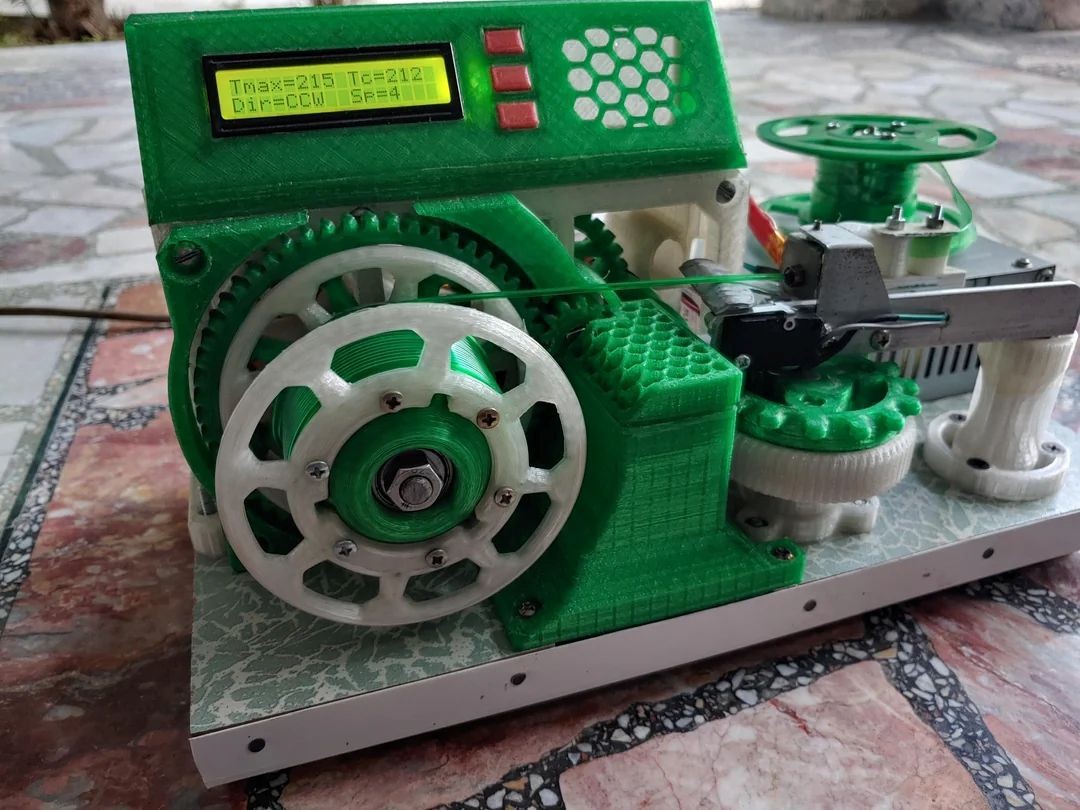
(Reddit) PET filament recycler
A basic filament recycling system includes five parts:
- Shredder — breaks failed prints and scraps into uniform pieces.
- Extruder — melts and reforms the plastic into filament.
- Cooling system — sets the diameter before winding.
- Diameter sensor — closed-loop feedback for consistent size.
- Winder — collects finished filament onto a spool.
Real desktop ecosystems you'll encounter: Filabot, Felfil, Recreator 3D (ProtoCycler+), Prusa's recycling accessories, and Polystruder. DIY builds are cheaper; commercial systems give more consistent output for higher volume. For most makers, the realistic question isn't which machine but whether investing in a recycling machine is worthwhile — see the decision matrix below.
How to Recycle 3D Printer Filament Without a Recycling Machine
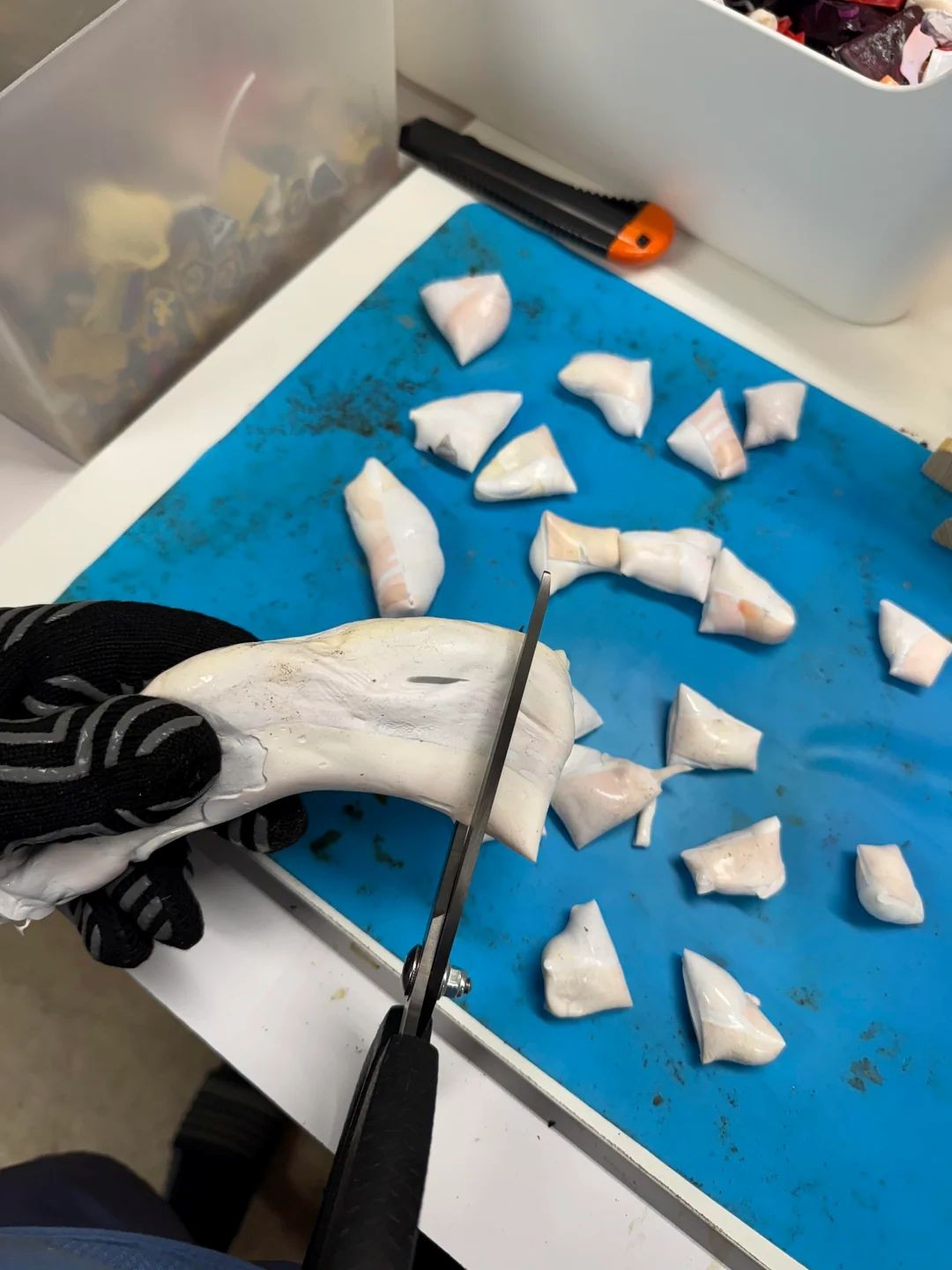
(Reddit) Cutting up melted filament waste
Most people don't have a shredder and extruder at home and aren't about to buy them for occasional filament waste. That's completely fine. There are other options.
- Local recycling facilities sometimes accept rigid thermoplastics, but this varies enormously by location and facility. Many curbside programs don't accept 3D printing waste specifically, filament and failed prints don't fit the resin code categories they process. Before putting 3D printer filament in household recycling, check with your local facility. Putting it in the wrong bin often means it ends up in landfill anyway after contaminating the sorting process.
- Specialized plastic recycling companies exist in most regions that handle materials outside the standard household recycling streams. These are worth finding if you generate a significant volume of filament waste. They're more likely to accept sorted batches of clean filament waste than general household recycling facilities.
- Manufacturer take-back programs vary by company. Some filament manufacturers have programs where you send back empty spools or failed prints, which they reprocess or handle disposal for. Worth checking with whatever brands you buy from.
- Community and makerspace recycling programs are probably the most accessible option for makers who don't want to invest in their own filament recycling system. Some makerspaces have collective filament recycling setups, shredders and extruders used by the community, where you bring sorted waste and it gets processed into new filament for communal use. If your local makerspace doesn't have this, it might be worth suggesting.
How to Reuse 3D Printer Filament Waste
Reusing and recycling filament waste are different things and it's worth keeping them distinct.
Reusing means finding a use for the material without fully reprocessing it. Leftover filament on a nearly empty spool can obviously continue to be printed with. Failed prints that are structurally intact can sometimes be used as-is for non-critical applications, a failed first layer calibration cube doesn't need to be recycled if it can serve as a weight or spacer somewhere.
Reusing filament poop and purge waste in its extruded form is limited. Some people collect purge material from color changes and use it as filler material for non-visible parts. The color will be inconsistent but the mechanical properties are generally fine for structural applications where appearance doesn't matter.
Re-extruding waste back into new filament is the recycling process described above, but reusing in the simpler sense, finding other purposes for waste without full reprocessing, can sometimes be the more practical option. A box of purge waste from hundreds of color changes isn't worth the effort to clean, sort, and reprocess at home for most people. But taking that same waste to a plastic recycler who handles it in bulk might be.
The practical question is: does the effort and equipment cost of recycling this waste make sense given the volume and quality of output? For large volumes of clean, sorted waste, potentially practical when waste volume is high and material streams are clean and consistent. For small volumes of mixed-color, mixed-material waste, finding a take-back program or recycler is usually more sensible.
Where Can You Recycle 3D Printer Filament?
If you do not want to recycle filament yourself, consider these options:
- Local recycling facilities — confirm whether they accept 3D printing plastics.
- Manufacturer take-back programs — check whether your filament supplier accepts waste or empty spools.
- Specialized plastic recyclers — useful for larger volumes of sorted waste.
- Makerspaces and community programs — may provide shared recycling equipment.
- Local 3D printing communities — some communities organize collection or reuse programs.
Always check the specific acceptance requirements before shipping or disposing of filament waste.
How to Check the Quality of Recycled Filament
This is the step that separates \"printable\" from \"trustworthy.\"
- Measure diameter. Use calipers or a laser gauge at multiple points along the strand. Target tolerance ≤ ±0.03 mm on 1.75 mm stock.
- Print a calibration part. A 20 mm calibration cube or a test tolerance piece reveals first-layer adhesion, stringing, and dimensional drift immediately.
- Re-calibrate your printer. Recycled stock has shifted melt flow / viscosity — re-tune temperature and flow before real jobs. Parts intended for load-bearing applications should be validated with appropriate mechanical testing.
- Dry and store properly. Recycled filament is more hygroscopic (shorter chains = more moisture-grabbing chain ends). Seal with desiccant; re-dry before printing if it's been open.
Safety Note (ABS / ASA)
Processing these releases styrene fumes. Run them only with local exhaust ventilation or activated-carbon filtration, and never in an unventilated room.
Filament Recycling Decision Matrix
| Waste situation | Practical option |
|---|---|
| Large volume + single material | Consider in-house recycling |
| Small volume + mixed materials | Take-back/recycling program |
| Clean failed prints | Sort and reprocess |
| Mixed purge waste | Usually unsuitable for filament recycling |
| Need production-grade parts | Use a professional 3D printing service |
FAQ about 3D Printer Filament Recycling
Q: Can you recycle 3D printer filament?
Yes, most common filament materials, PLA, PETG, ABS, ASA, are thermoplastics that can be melted and reprocessed. Whether you can do it at home, need to take it somewhere, or whether the effort is worthwhile depends on what you have and how much waste you're generating.
Q: Can you recycle filament poop and purge waste?
Single-material purge waste can go into a same-material recycling batch. Transitional purge from material changes where two different plastics are mixed should be discarded, that material is contaminated by definition and will cause problems in reprocessing.
Q: Can you recycle failed 3D prints?
Yes. Failed prints are often among the cleanest filament waste because they're uncontaminated and consist of a known material. Sort by material, remove any debris, and they're suitable for shredding and reprocessing.
Q: How many times can 3D printer filament be recycled?
There is no universal number of recycling cycles. Each heating, extrusion, and printing cycle can change the polymer's molecular structure and processing behavior. The practical limit depends on the material, processing temperature, residence time, moisture, contamination, and whether virgin material is blended in.
Q: Is recycled filament as strong as new filament?
Not necessarily. Recycled filament can retain useful mechanical performance, but repeated processing may reduce strength or change stiffness, toughness, and melt behavior. Results vary by polymer and processing conditions. For example, one 2024 study found that fully recycled PLA produced printed parts with tensile and flexural strength more than 15% lower than virgin filament under its test conditions.
Q: Can you recycle filament spools?
Cardboard spools can go in standard paper recycling. Plastic spools depend on the material and your local recycling facility, many aren't accepted in household recycling streams. Manufacturer take-back programs are often the most reliable option for plastic spools.
Get Production-Grade Parts Without the Recycling Headache
Managing shredders, extruders, drying, and diameter tolerance is a real commitment — and the output still won't match stabilized virgin stock without experience. If your goal is functional prototypes or production parts, JLC3DP's FDM, SLA, and SLS 3D printing services deliver tight-tolerance parts in a wide range of engineering materials, with process control handled for you.
Keep Learning
3D Printer Filament Recycling: How to Recycle and Reuse Filament Waste
Key Takeaways 1. You can recycle 3D printer filament, but it's more involved than tossing it in the recycling bin. 2. Most common filament materials like PLA, PETG, and ABS can technically be recycled, though the quality of the recycled output depends heavily on how clean, dry, and uncontaminated the waste is. 3. Recycling 3D printer filament at home requires a shredder and extruder at minimum. 4. For most people without that equipment, the practical options are filament take-back programs, makerspace......
3D Printing Recycling: For Sustainability
With the rapid development of 3D printing technology, how to effectively recycle and reuse waste generated during the printing process has become an important issue that needs to be solved in the industry. Reducing printing waste can not only reduce costs, but also is a key step to achieve sustainable development. This article will explore how to reduce waste in 3D printing and introduce some practical 3d printing recycling application cases. Source: https://www.3dnatives.com/en/10-reasons-why-3d-prin......
The Impact of 3D Printing on Sustainability
Introduction In recent years, 3D printing has emerged as a revolutionary technology with the potential to transform various industries. Its impact on sustainability has been a topic of increasing interest and debate. In this article, we will explore the ways in which 3D printing influences sustainability and discuss the potential benefits and challenges associated with this rapidly advancing technology. Reduced Waste Traditional manufacturing processes often result in significant material wastage. In ......
Enhancing Sustainability And Waste Reduction In 3D Printing
Enhancing sustainability and waste reduction in 3D printing is crucial for minimizing environmental impact, conserving resources, reducing waste, achieving cost efficiency, stimulating innovation, meeting consumer demands, and complying with regulations. By optimizing material usage, implementing recycling practices, and promoting sustainable materials, 3D printing can contribute to a more environmentally responsible and economically viable manufacturing industry while attracting environmentally-consc......