Filament Recycler Machines: Types, Costs & Buying Guide
17 min
- Types of Filament Recycler Machines
- How Much Does a Filament Recycler Machine Cost?
- What Should You Look for in a Filament Recycler Machine?
- Best Filament Recycler Machines (Our Top Picks)
- How Much 3D Printer Waste Do You Need to Justify a Recycler?
- Filament Recycler Machine vs. Filament Extruder
- Is a Filament Recycler Worth It?
- Filament Recycler Machine FAQs
A filament recycler machine is a system for converting compatible FDM 3D printing waste into reusable filament. The process typically involves shredding, drying, extrusion, cooling, diameter control, and spooling, although some systems require separate equipment for certain steps.
Key takeaway
If your printers throw out less than 1 kg of clean, single-material scrap a month, skip the machine and use a mail-in service. Between 1 and 5 kg a month, a desktop unit starts to make sense. Past 5 kg, the math is hard to argue with.
Look in your scrap bin. Failed first layers, a tangle of spaghetti, supports, rafts, purge lines from the last multicolor job. One busy printer can send 1 to 2 kg of plastic there every month. It adds up faster than most people admit.
A filament recycler machine tries to turn that bin back into spools. It shreds the scrap, dries the flakes, melts them, extrudes a 1.75 mm strand, and winds it onto a spool. Some machines handle every step. Others only do the middle, and you buy a shredder on top.
One limit before anything else. This only works for FDM and FFF thermoplastics like PLA, PETG and ABS. Resin from SLA and MSLA printers is a photo-cured thermoset. It can't be remelted. No machine fixes that.
Types of Filament Recycler Machines
Filament recycling systems can be grouped by their configuration, size, and level of integration. These categories may overlap, as some desktop systems also use a modular design.
Filament recycler machines vary in their level of integration, processing capacity, and equipment requirements. Some systems focus on extruding filament from prepared plastic pellets, while others combine shredding, drying, extrusion, and winding into a more complete recycling workflow.
Understanding these differences can help you choose a setup that matches your available space, technical experience, and recycling volume.
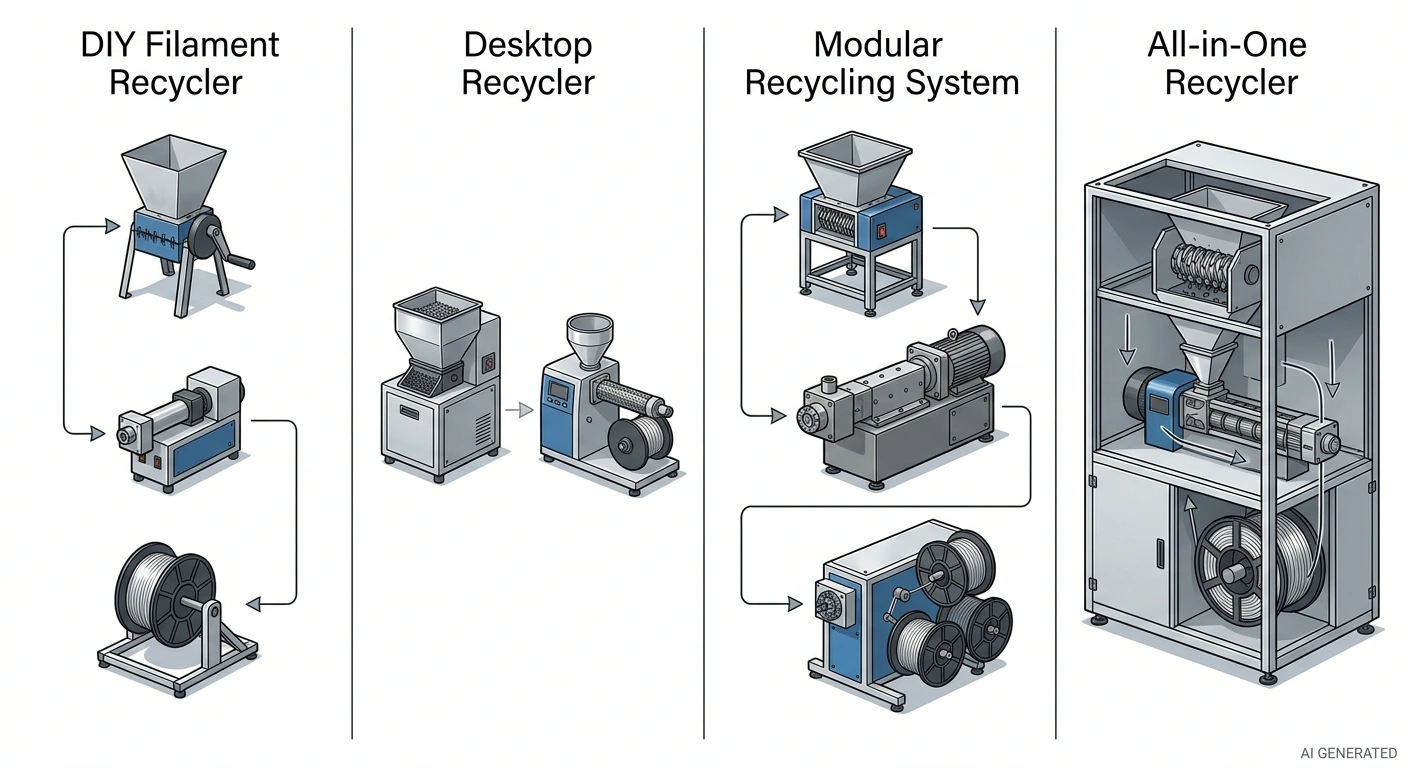
1DIY Filament Recycler
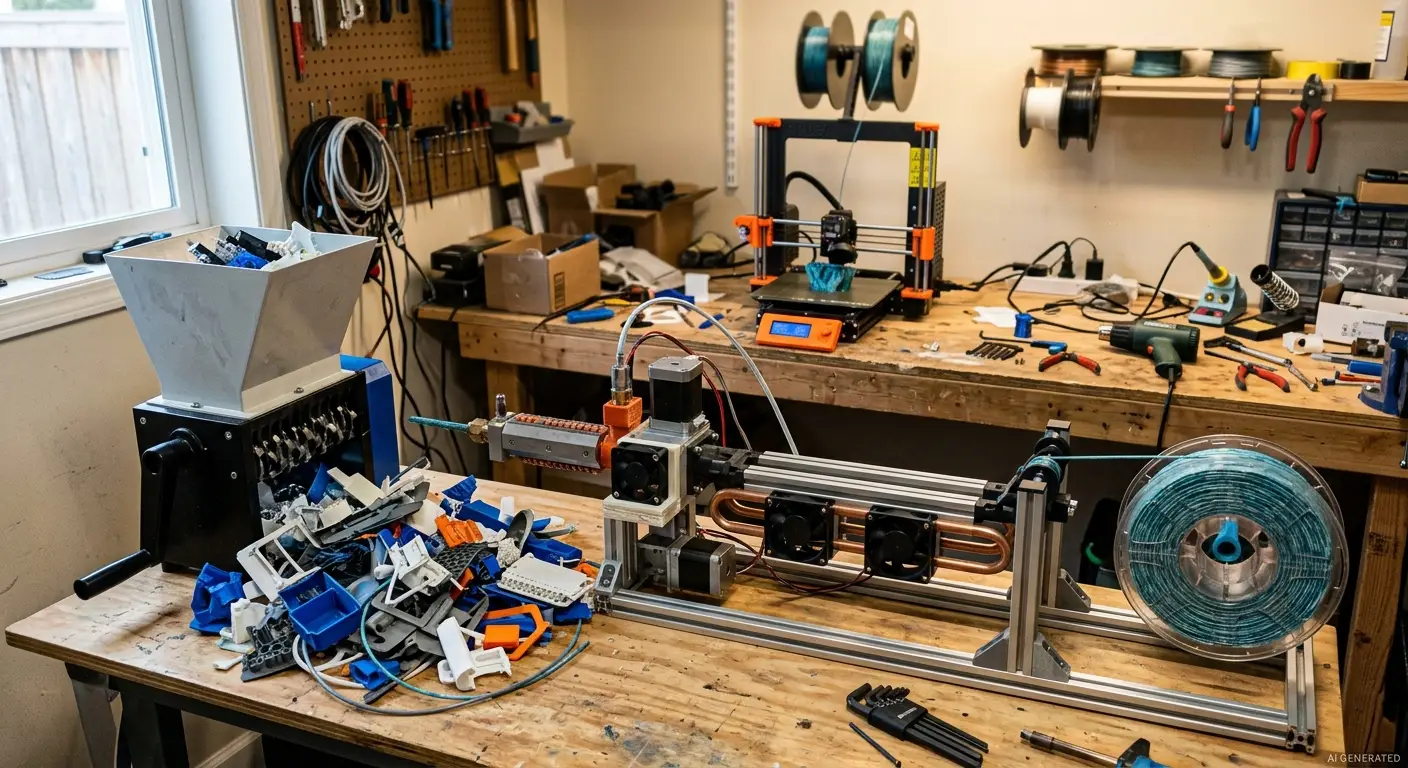
A DIY filament recycler is built from separately sourced components or assembled from a kit. Depending on the setup, it may include a plastic shredder, dryer, filament extruder, cooling system, and spool winder.
Pros
- Flexibility. Users can select individual components, customize the processing setup, and upgrade equipment as their needs change.
- DIY systems can have a lower cost.
Cons
- It requires some technical knowledge and skills. Users need to assemble the equipment, calibrate extrusion parameters, control filament diameter, and troubleshoot problems during production.
- Additional equipment for shredding and drying can also increase the total investment.
Best for: Hobbyists, makers, and technically experienced users who enjoy building and maintaining their own recycling equipment.
Planning to build your own recycling setup? See our guide on how to build a DIY filament recycler for the required components, estimated costs, assembly steps, and process considerations.
2Desktop Filament Recycler
Desktop filament recycling machines are designed for smaller workspaces and relatively low-volume production. They typically focus on compact extrusion equipment, with some models offering additional processing functions or accessories.
Pros
- Easier to install and operate. Quickly turning failed prints and plastic scraps into reusable filament.
Cons
- May not include a built-in shredder or dryer, requiring separate equipment for material preparation.
- Requires plastic waste to be properly sorted, shredded, and dried before extrusion.
- Limited processing capacity may not meet the needs of larger recycling operations.
Best for: Individual makers, home workshops, and small studios with a manageable amount of compatible plastic waste.
3Modular Filament Recycling System
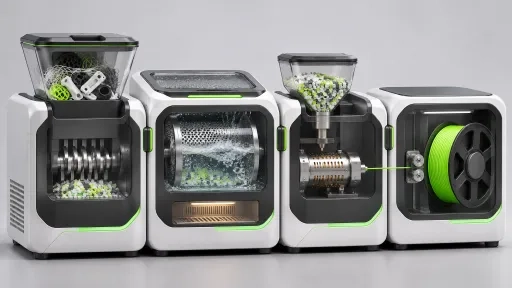
A modular filament recycling system uses separate machines or units for different processing stages. A typical setup may include a shredder, material dryer, filament extruder, cooling unit, diameter measurement system, and spool winder.
Pros
- Flexible configuration. Users can select equipment based on their material types, production volume, and output requirements.
- Easy to upgrade. Individual modules can be replaced or upgraded without changing the entire system.
- Greater process control. Separate units allow users to adjust individual processing stages.
Cons
- More complex workflow. Requires coordination between multiple machines and processing stages.
- Higher setup costs. Purchasing separate equipment can increase the total investment.
- More space and maintenance. Requires additional workspace and maintenance for multiple units.
Best for: Makerspaces, educational facilities, small recycling operations, and users who need greater control over individual processing stages.
4All-in-One Filament Recycler
An all-in-one filament recycler combines multiple processing stages into one integrated machine or system. Depending on the design, it may include material preparation, extrusion, cooling, diameter monitoring, and filament winding.
Pros
- Integrated workflow. Combines multiple processing stages in one system, reducing the need for separate machines.
- Simplified operation. Reduces manual handling and coordination between processing stages.
- Centralized control. Makes it easier to monitor and manage filament production.
Cons
- Higher upfront cost. Integrated systems generally require a larger initial investment.
- Limited upgrade flexibility. Individual components may be difficult to replace or upgrade independently.
- Feedstock preparation may still be required. Some systems do not include shredding or drying, so plastic waste must be prepared separately.
Best for: Users who prioritize a streamlined recycling workflow, simplified operation, and integrated equipment.
How Much Does a Filament Recycler Machine Cost?
Filament recycler machine prices vary widely depending on configuration and processing capacity.
| Tier | Typical hardware cost | Shredder included? | Best for |
|---|---|---|---|
| DIY | roughly $350 to $800 | No | Tinkerers, students |
| Desktop | roughly $900 to $3,000 | Sometimes | Home makers, small farms |
| Industrial | $7,000 and up | Usually separate | Labs, large farms, R&D |
At the top end, 3devo's Filament Maker ONE is listed at 7,277 euros, the Filament Maker TWO at 17,900 euros, and the GP20 industrial shredder at 10,800 euros. Prices shift by retailer and region, so treat these as ballparks.
The sticker price is only half of it. Total cost of ownership adds electricity, wear parts, and your time. Power is the small one: these machines pull a few hundred watts, so a kilo of filament costs well under a dollar in electricity. Blades dull. Nozzles wear. Screws wear. And every kilo needs shredding, drying for hours, feeding, and spool changes.
Compare that to the market. A typical spool runs about $15 to $25. Creality estimates a recycled roll costs around $5 to produce against roughly $15 on the shelf. Ten dollars saved per spool sounds good until you count the hours you spent making it.
What Should You Look for in a Filament Recycler Machine?
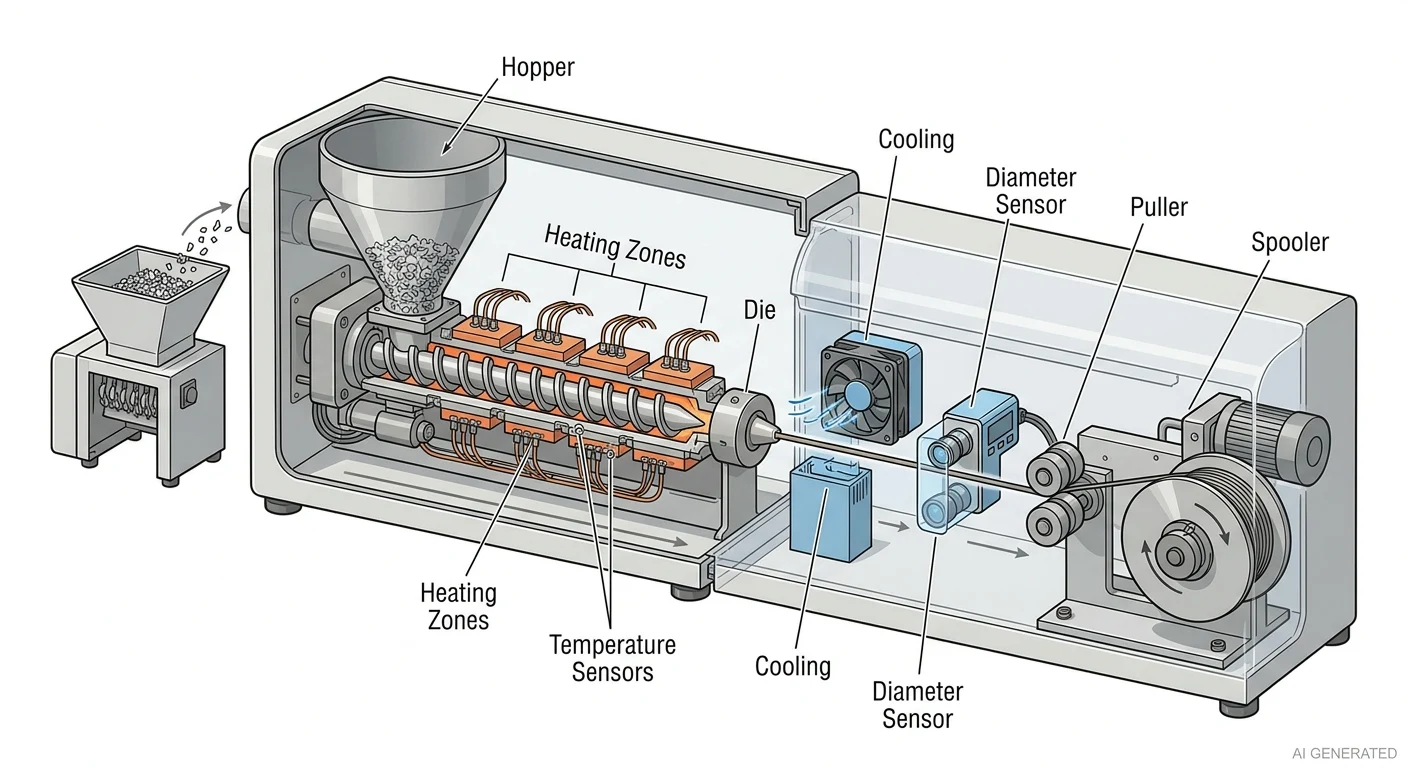
Material compatibility. Pure PLA, PETG, ABS, ASA, PA and PC are the usual list. One rule beats all others: never mix polymer types. Even Creality advises against mixing materials like PLA and PETG, because it hurts extrusion stability and final filament quality.
Output diameter and tolerance. Standard is 1.75 mm or 2.85 mm. Aim for ±0.05 mm. If a machine can't hold that, expect jams or slipping in the extruder.
Throughput. Match kg per hour to your scrap. A machine rated for 1 kg per hour is wasted on 200 g of scrap a month. Creality rates the M1 at up to 1 kg per hour, and it uses a three-zone heating system with eight cooling zones.
Temperature control. Zoned heating matters. PLA melts around 180 to 250℃. Engineering plastics like PA and PC need 350℃ or more, so check the ceiling before you buy.
Pre-extrusion drying. Wet flake makes bubbly, brittle filament. Typical targets are 45 to 50℃ for PLA, 65 to 70℃ for PETG, and about 80℃ for ABS. A machine without a drying step means a separate dryer.
For more on moisture, drying methods, and keeping filament dry before printing or recycling, see our guide to filament storage and drying.
Shredding and spooling. Good flake is 3 to 8 mm. Too fine and it clogs the hopper. Too chunky and it feeds unevenly. Automated tension on the spooler saves you from tangled coils.
Safety and ventilation. Melting plastic releases VOCs and ultrafine particles. Use an exhaust, or a HEPA and carbon filter, especially with ABS.
Best Filament Recycler Machines (Our Top Picks)
There’s no single winner. The best filament recycler machine depends on who's buying. The machines below represent different approaches to filament production and plastic waste recycling.
| Buyer | Pick | Why it fits | Watch out for |
|---|---|---|---|
| Budget builder | Felfil Evo kit or Filastruder | Lowest entry cost | Manual tuning, no shredder |
| Home maker | Creality M1 + R1 | Shred-to-spool in one workflow | Recycled filament has a wider published diameter range than virgin PLA |
| Print farm | Felfil modular set or ProtoCycler V3 | Scales with scrap volume | Maintenance, support quality |
| University lab | 3devo Filament Maker ONE or TWO | Research-grade control | Price |
Before comparing them, it is important to distinguish between a filament extruder and a complete recycling system. An extruder can turn prepared pellets into filament, but it does not necessarily shred, dry, or prepare discarded prints.
1Felfil Evo
Felfil Evo is a desktop filament extruder designed to produce custom filament from plastic pellets or prepared plastic waste. It is available in assembled and kit versions, giving users different levels of involvement in setup and assembly.
The machine supports both 1.75 mm and 2.85 mm filament diameters through interchangeable nozzles. Temperature and motor speed can be adjusted manually, allowing users to experiment with different materials and extrusion settings.
Its compact design makes it suitable for desktop use, but Felfil Evo is primarily an extrusion machine rather than a complete recycling line. Plastic waste must be properly prepared before extrusion, and users may need separate shredding, drying, and winding equipment depending on their feedstock and workflow.
Key considerations:
- Compact desktop design.
- Supports 1.75 mm and 2.85 mm filament.
- Manual temperature and extrusion speed adjustment.
- Compatible with several thermoplastics, subject to processing requirements.
- Additional equipment may be needed for shredding, drying, and material preparation.
Best for: Users who want a compact extruder for small-batch filament production and material experimentation.
2Filastruder
Filastruder is a filament extruder kit designed for users who want to produce filament from plastic pellets. Its relatively simple configuration makes it an option for DIY users who are comfortable assembling and adjusting equipment.
The manufacturer lists a typical extrusion rate of approximately 5–8 hours per kilogram, depending on the material, filament diameter, and processing temperature. The system requires users to manage filament collection and winding separately. Recycling failed prints is possible, but the feedstock must first be prepared appropriately.
One limitation is that the Filastruder is not a complete recycling system. It does not independently handle the entire process of collecting, shredding, drying, and winding plastic waste. Users should also check current product availability before considering it, as the manufacturer's product page may show stock limitations.
Key considerations:
- Kit-based extrusion system requiring assembly.
- Designed primarily for processing plastic pellets.
- Typical extrusion rate of 5–8 hours per kilogram.
- Separate filament winding and material preparation may be required.
- Recycling printed parts requires additional preparation and experimentation.
Best for: Technically inclined users who want a basic filament extruder and are comfortable managing the additional processing steps.
3Creality M1 + R1
Creality M1 and R1 form a two-unit filament recycling setup. The R1 handles plastic shredding and drying, while the M1 converts prepared material into filament through extrusion, cooling, diameter monitoring, and automatic spooling.
Unlike standalone extruders, this combination is designed to cover more stages of the recycling workflow. It can process suitable plastic waste into reusable filament, reducing the need to source every processing component separately.
Creality publishes different output rates depending on the feedstock composition: up to 1 kg/h with virgin PLA, 600 g/h with a 50/50 recycled-to-virgin blend, and 500 g/h with 100% recycled material.
Its published filament diameter specifications also distinguish between feedstock conditions. Virgin PLA is listed at 1.70–1.80 mm, while recycled material is listed at 1.65–1.80 mm. Creality also advertises a ±0.05 mm diameter tolerance, but this figure should not automatically be interpreted as independently verified performance for recycled filament.
Key considerations:
- Separate M1 extrusion and R1 shredding/drying units.
- Manufacturer-stated output varies with recycled material content.
- Different published diameter ranges for virgin and recycled feedstock.
- R1 requires suitable, properly sorted plastic waste.
- Material compatibility and preparation requirements should be checked for each polymer.
Best for: Users looking for a more integrated desktop recycling workflow without building a complete system from separate components.
4ProtoCycler V3
ProtoCycler V3, developed by ReDeTec, is a desktop filament extrusion system designed for custom filament production and recycling applications. It combines extrusion control, filament diameter monitoring, and spool handling in one system.
The manufacturer lists support for materials including PLA, ABS, PETG, HIPS, and Nylon 12. Its MixFlow technology and dual optical diameter sensors are designed to help regulate filament production and maintain dimensional consistency.
A grinder is available as an additional configuration, so buyers should check whether it is included in the selected package. Without suitable shredding equipment, users must prepare plastic waste before extrusion.
The system is positioned at a significantly higher price point than basic desktop extruders. Its features may be more relevant to users who need greater control over material experimentation and repeatable filament production.
Key considerations:
- Integrated extrusion and filament diameter control.
- Dual optical diameter measurement sensors.
- Manufacturer-stated maximum throughput of 500 g/h.
- Optional grinder configuration.
- Higher equipment investment than entry-level extruders.
Best for: Research groups, educational facilities, and advanced users who need controlled filament production and material experimentation.
53devo Filament Maker ONE
3devo Filament Maker ONE is a desktop filament extrusion system developed for material research, testing, and small-scale filament production. It offers adjustable extrusion parameters and multiple heating zones, allowing users to work with different thermoplastic materials.
The system features four heating zones with a maximum temperature of 450°C, along with adjustable screw speed and a controlled filament collection setup. These capabilities make it suitable for users experimenting with engineering polymers and material formulations.
However, Filament Maker ONE is primarily an extrusion system, not a complete plastic recycling line. Users must prepare suitable feedstock before extrusion, and separate shredding and drying equipment may be necessary when processing discarded prints.
Key considerations:
- Four independent heating zones.
- Maximum stated processing temperature of 450°C.
- Adjustable screw speed.
- Designed for material research and controlled extrusion.
- Requires suitable prepared feedstock and potentially separate recycling equipment.
Best for: Research laboratories, material developers, and advanced users working with different thermoplastics and experimental formulations.
How Much 3D Printer Waste Do You Need to Justify a Recycler?
Three formulas do the heavy lifting.
Annual Recoverable Material (kg) = (Spools per Year × kg per Spool) × Waste Rate
Annual Savings ($) = Annual Recoverable Material × Filament Price per kg
Break-Even Years = Hardware Cost ÷ Annual Savings
A home example. You burn through 40 spools a year at 1 kg each, and 15% becomes waste. That's 6 kg recoverable. At $20 per kg, you save $120 a year. An $899 bundle breaks even in about 7.5 years. Some reviewers put the payback for the M1 alone anywhere from 7 to 15 years.
Now a small farm. Ten printers, 1.5 kg of scrap each per month, that's 180 kg a year. Say only half is clean and sortable. That's 90 kg, or $1,800 in recovered value. A 2,999 euro modular set pays back in under two years, before labor.
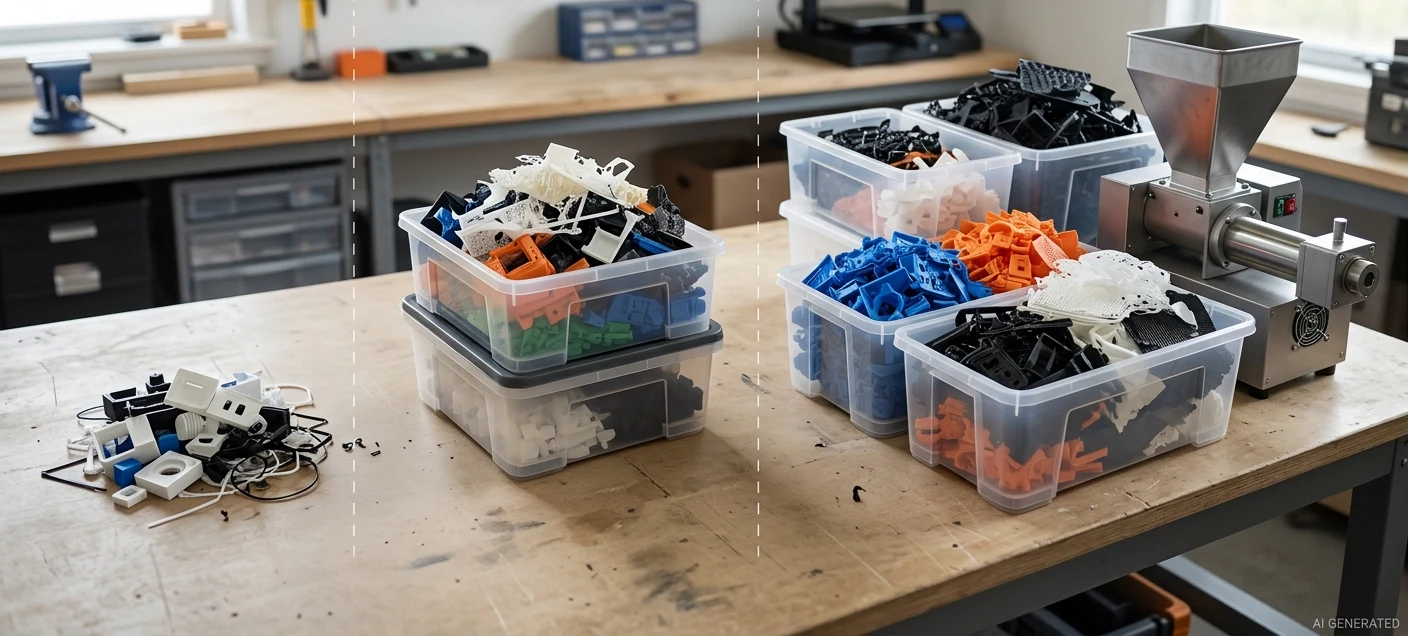
Rough thresholds:
Under 1 kg a month: don't buy. Use a mail-in service.
1 to 5 kg a month: a desktop or pro unit starts to make sense for labs and farms.
Over 5 kg a month: modular or pro hardware has a clear financial case.
For more on reducing, sorting, and reusing waste from 3D printing, see our guide to 3D printing recycling.
Filament Recycler Machine vs. Filament Extruder
People mix these up constantly. An extruder melts pellets or pre-shredded flake and pushes out filament. A recycler runs the full loop.
| Feature | Filament Extruder | Filament Recycler Machine |
|---|---|---|
| Shredding | No, you bring flake or pellets | Yes, built in or paired |
| Drying | Usually external | Often included |
| Extrusion | Yes | Yes |
| Spooling | Sometimes optional | Usually included |
| Input | Pellets, clean flake | Failed prints, supports, purge |
| Typical user | Material experimenters | People with real scrap piles |
An extruder is cheaper and more flexible. A recycler saves your weekends.
Is a Filament Recycler Worth It?
Buy one if you print enough to generate at least a kilo of sorted scrap monthly, you stick to one material per batch, you have the bench space and ventilation, and you actually enjoy tinkering. Print farms and university labs tend to land here.
Skip it if your waste is mixed, your volume is small, you need ±0.05 mm filament for demanding prints, or the thought of drying and sorting plastic makes you tired already.
Low volume doesn't mean the plastic has to go in the bin. Mail-in programs like Printerior and TerraCycle Zero Waste Boxes take scrap off your hands, and Precious Plastic community nodes handle it locally in some areas. Availability varies by country, so check what's near you.
If you want to see how discarded prints can be sorted, shredded, dried, extruded, and turned back into filament, see our guide on how to turn 3D printing waste into new filament.
Want less scrap in the first place? Order production-grade parts from JLC3DP and skip the failed-print pile.
Filament Recycler Machine FAQs
What's the best machine for beginners?
For DIY, Felfil Evo or Filastruder. For turnkey, the Creality M1 and R1 or a ProtoCycler. Start with the turnkey route if you hate troubleshooting.
What's the general price range?
Roughly $350 for a DIY kit up to $18,000 or more for industrial gear. Most home makers land between $900 and $3,000.
Does Creality make a filament recycler machine?
Yes. The Filament Maker M1 and Shredder R1. The M1 measures 595 mm tall by 245 mm by 570 mm, and the R1 is 560 mm tall by 345 mm by 280 mm. Diameter holds between 1.70 and 1.80 mm on virgin PLA pellets, and 1.65 to 1.80 mm on recycled material. Buying the M1 or the bundle comes with a starter kit of 2 kg of PLA pellets and five 50 g packs of coloring masterbatch. It's both a recycler and a virgin-pellet filament maker.
Can you recycle PLA or PETG at home?
Yes, if it's pure, clean and dry. Moisture and mixed plastics are what ruin it.
How many times can PLA be recycled?
Not forever. Each melt cycle breaks polymer chains a little, so the strength drops. Recycled PLA may require blending with virgin material to improve processing consistency and maintain mechanical properties. However, the appropriate ratio depends on the condition and processing history of the recycled material. There is no universal blending ratio that guarantees consistent filament quality.
Can SLA resin prints be recycled?
No. Photo-cured thermosets don't melt. Send them to a local hazardous or specialty waste service instead.
Popular Articles
Keep Learning
DIY Filament Recycler: How to Build One, Cost & Process Guide
A DIY filament recycler turns clean 3D printing waste into new filament. The basic idea is simple: sort the waste, shred it, melt it, extrude it, cool it, measure the diameter, and wind it onto a spool. Building a reliable system is harder than the basic concept suggests. Shredding, moisture control, temperature stability, pulling speed, and filament diameter all affect the final result. (Reddit) PET DIY filament recycler Need 3D printed parts without managing recycling equipment? JLC3DP provides indu......
Filament Recycler Machines: Types, Costs & Buying Guide
A filament recycler machine is a system for converting compatible FDM 3D printing waste into reusable filament. The process typically involves shredding, drying, extrusion, cooling, diameter control, and spooling, although some systems require separate equipment for certain steps. Key takeaway If your printers throw out less than 1 kg of clean, single-material scrap a month, skip the machine and use a mail-in service. Between 1 and 5 kg a month, a desktop unit starts to make sense. Past 5 kg, the math......
PLA Recycling: Can You Recycle PLA & How?
Key Takeaways PLA is recyclable because it is a thermoplastic that can be reprocessed into new materials. Recycling PLA is different from composting, and most household recycling programs do not accept PLA by default. Clean, dry, and properly sorted PLA waste produces better recycled material than mixed or contaminated waste. PLA can be recycled into new 3D printing filament, but extrusion control, moisture, and filament diameter affect print quality. Repeated heating and processing can change PLA's m......
3D Printer Filament Recycling: How to Recycle and Reuse Filament Waste
Key Takeaways 1. You can recycle 3D printer filament, but it's more involved than tossing it in the recycling bin. 2. Most common filament materials like PLA, PETG, and ABS can technically be recycled, though the quality of the recycled output depends heavily on how clean, dry, and uncontaminated the waste is. 3. Recycling 3D printer filament at home requires a shredder and extruder at minimum. 4. For most people without that equipment, the practical options are filament take-back programs, makerspace......
3D Printing Recycling: For Sustainability
With the rapid development of 3D printing technology, how to effectively recycle and reuse waste generated during the printing process has become an important issue that needs to be solved in the industry. Reducing printing waste can not only reduce costs, but also is a key step to achieve sustainable development. This article will explore how to reduce waste in 3D printing and introduce some practical 3d printing recycling application cases. Source: https://www.3dnatives.com/en/10-reasons-why-3d-prin......
The Impact of 3D Printing on Sustainability
Introduction In recent years, 3D printing has emerged as a revolutionary technology with the potential to transform various industries. Its impact on sustainability has been a topic of increasing interest and debate. In this article, we will explore the ways in which 3D printing influences sustainability and discuss the potential benefits and challenges associated with this rapidly advancing technology. Reduced Waste Traditional manufacturing processes often result in significant material wastage. In ......