PLA Recycling: Can You Recycle PLA & How?
18 min
- Can You Recycle PLA?
- Why Is PLA Recyclable?
- What Happens to PLA During Recycling?
- What PLA Waste Can Be Recycled?
- How Is PLA Recycled Into New Filament?
- Does Recycling Affect PLA Filament Quality?
- Can Recycled PLA Be Used for 3D Printing?
- Can You Recycle PLA at Home?
- Is PLA Recyclable or Compostable?
- PLA Recycling: What Actually Makes It Work?
- FAQ about PLA Recycling
- PLA Recycling Is Possible, but Material History Matters
Key Takeaways
- PLA is recyclable because it is a thermoplastic that can be reprocessed into new materials.
- Recycling PLA is different from composting, and most household recycling programs do not accept PLA by default.
- Clean, dry, and properly sorted PLA waste produces better recycled material than mixed or contaminated waste.
- PLA can be recycled into new 3D printing filament, but extrusion control, moisture, and filament diameter affect print quality.
- Repeated heating and processing can change PLA's molecular structure and mechanical properties over time.
- Recycled PLA performance depends on its processing history and application requirements, not just the fact that it is recycled.
PLA gets marketed as the eco-friendly 3D printing filament. Biodegradable, plant-based, renewable feedstock, the messaging is consistent and the comparison to petroleum-based plastics like ABS or PETG is implied. Some of that is true. PLA is derived from cornstarch or sugarcane rather than crude oil, and it does break down under the right conditions.
The part that gets glossed over is what "the right conditions" actually means. And for anyone trying to figure out what to do with PLA failed prints, empty spools, and support structures sitting in a bin beside their printer, that's the part that matters.
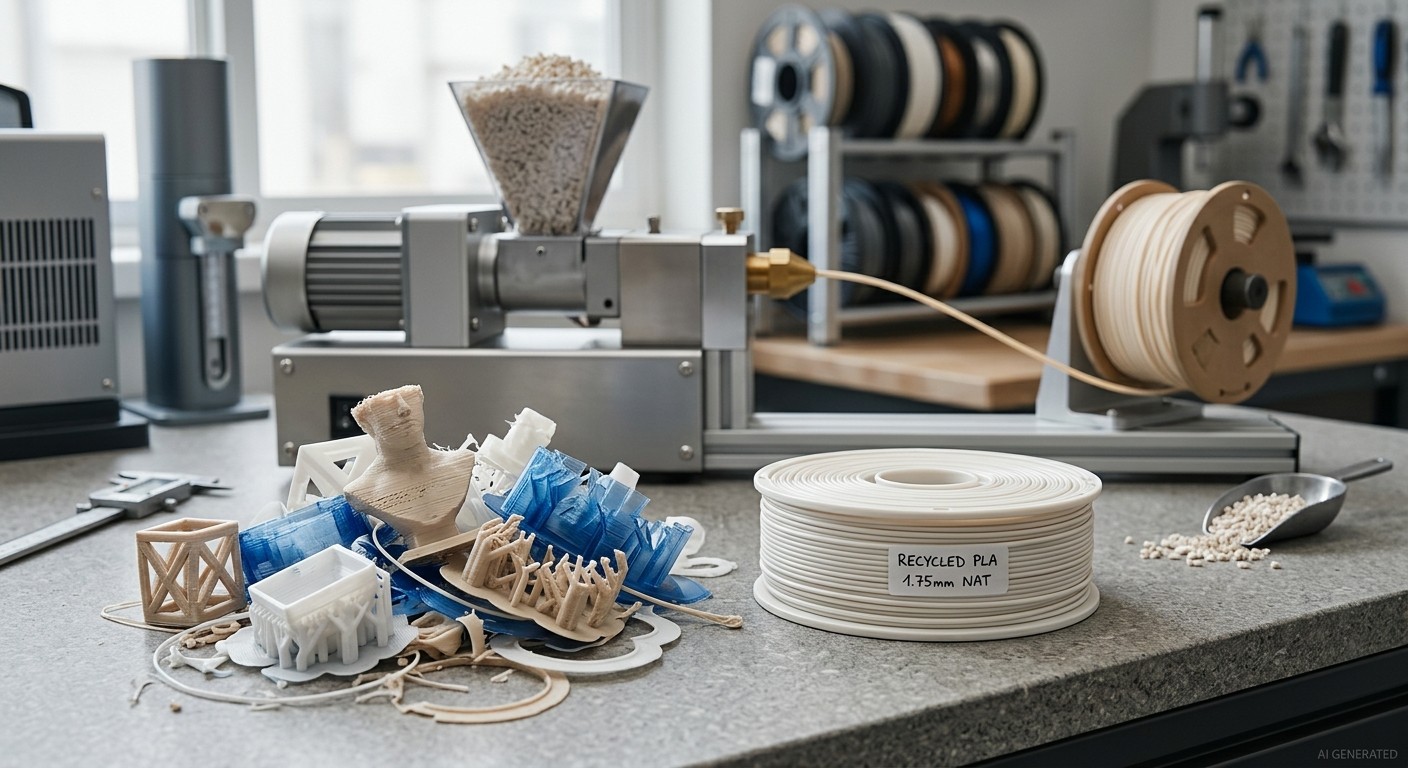
PLA 3D-printing waste beside recycled PLA filament
Can You Recycle PLA?
Yes. PLA can technically be recycled because it is a thermoplastic. It can be heated until it becomes processable, formed into a new shape, and cooled again. Failed prints, supports, brims, rafts, and clean filament scraps can therefore become feedstock for another manufacturing cycle.
The important distinction is between being technically recyclable and being accepted by a recycling program. A material can be recyclable in a polymer-processing sense while having limited collection infrastructure. Whether you can put PLA in a household recycling bin depends on the rules and capabilities of the local facility.
PLA recycling also does not produce a material that is automatically identical to virgin PLA. Every time PLA is processed, its thermal and mechanical history changes. Research on repeated extrusion has found reductions in molecular weight and changes in melt flow and other material properties as processing cycles accumulate.
So the practical answer to "is PLA recyclable?" is yes, but the quality of the recovered material depends heavily on what happened to it before and during recycling.
Why Is PLA Recyclable?
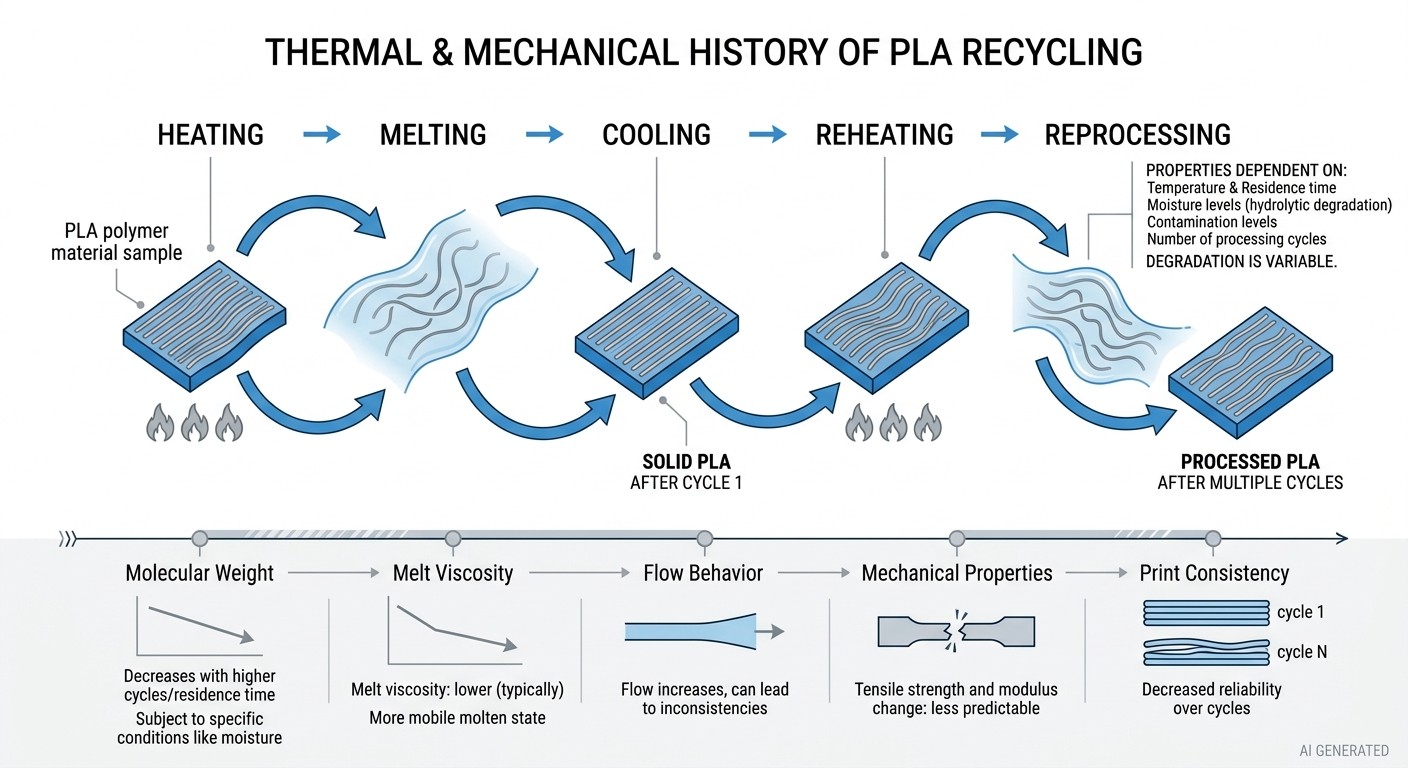
PLA undergoing repeated heating, cooling, and reprocessing
PLA is recyclable for a fairly straightforward materials reason: it is a thermoplastic.
Thermoplastics can be softened or melted by heating and then solidified again when cooled. That behavior allows manufacturers to process them through operations such as extrusion and molding multiple times.
For PLA waste, the basic material transformation looks like this:
PLA waste → Heating → Melt processing → Reshaping → Recycled PLA
Mechanical recycling does not rebuild the polymer from its original chemical building blocks. It primarily takes existing PLA and processes it into another usable form.
That sounds almost reversible, but there is a catch.
The polymer does not experience every heating cycle as if it were the first one. Heat, shear, oxygen exposure, moisture, and residence time can affect the polymer chains. PLA is particularly sensitive to hydrolysis because its polyester backbone contains ester bonds. Moisture combined with heat can promote chain scission, reducing molecular weight and changing melt behavior.
This is why PLA recycling is better understood as controlled reprocessing rather than simply melting plastic again.
The goal is not only to get the material through an extruder. The goal is to retain enough of its molecular and physical properties for the recycled material to perform the job you need it to do.
What Happens to PLA During Recycling?
This is where PLA recycling gets interesting.
A failed PLA print may look exactly like the filament it came from. At the molecular level, however, the two materials can have different processing histories.
Thermal and Mechanical History
A typical recycling cycle might look like:
Printing → Cooling → Collection → Grinding → Heating → Extrusion → Cooling → Printing
The material is exposed to heat during the original filament extrusion, again during 3D printing, and again during recycling.
Mechanical recycling adds another thermal cycle when the recovered PLA is extruded into new filament.
That repeated history can affect:
- molecular weight
- melt viscosity
- melt flow
- crystallinity
- tensile behavior
- brittleness
- thermal stability
- extrusion consistency
One recent study on PLA waste specifically intended for 3D printing found that known-source PLA waste could tolerate up to three re-extrusion cycles without significant degradation, while mixed-origin waste performed worse. That difference is important because it shows why feedstock traceability matters.[1]
Why Repeated Processing Can Change PLA
The main concern is polymer chain scission.
PLA consists of long polymer chains. Under sufficiently severe thermal, mechanical, or hydrolytic conditions, those chains can break into shorter chains.
Shorter chains can change the way the material flows.
One useful indicator is melt flow behavior. As molecular weight falls, melt viscosity can decrease and melt flow can increase. That can affect extrusion stability and the behavior of the filament inside the printer.
This does not mean one recycling cycle automatically ruins PLA.
It means there is no sensible universal statement such as "PLA can only be recycled once" or "PLA can be recycled indefinitely."
A 2025 study of repeated mechanical reprocessing found progressive reductions in PLA molecular weight [2], while a 2026 study found that adding 20 wt% virgin PLA during successive recycling cycles helped mitigate deterioration and maintain more consistent mechanical performance [3].
For a closer look at how heat affects PLA's stiffness, deformation, creep, and service temperature, see our guide to PLA temperature resistance.
Why Processing Conditions Matter
Four variables deserve particular attention:
- Temperature: Higher processing temperatures can accelerate degradation if the material spends too much time at elevated temperature.
- Residence time: PLA sitting in a hot extrusion system for longer than necessary gets more thermal exposure.
- Moisture: Water can promote hydrolytic degradation during hot processing. Drying is therefore not just about preventing bubbles in the filament. It can also protect the polymer during reprocessing.
- Shear: Grinding and extrusion introduce mechanical stresses. Excessive shear combined with heat can contribute to polymer degradation.
The number of previous cycles matters too, but it should not be treated as a standalone lifetime counter. Two PLA batches that have both been recycled three times can have very different properties if one was kept dry and traceable while the other was contaminated and repeatedly exposed to heat and humidity.
What PLA Waste Can Be Recycled?
The best recycling feedstock is boring.
You want clean, dry, known PLA with as little contamination and material mixing as possible.
This is one reason industrial or organized recycling streams can have an advantage over a random box of failed prints.
A known batch of PLA from one material source is much easier to characterize than a pile containing five colors, several brands, different PLA formulations, support materials, adhesive residue, and a few mystery pieces.
JLC3DP's existing filament-recycling guide also emphasizes sorting waste by material and removing contaminants before shredding and extrusion.
| PLA waste | Recycling suitability | Key consideration |
|---|---|---|
| Failed PLA prints | Generally suitable | Keep material clean and identifiable |
| PLA supports | Generally suitable | Avoid mixed support materials |
| PLA brims and rafts | Generally suitable | Easy to collect as single-material waste |
| PLA filament scraps | Generally suitable | Sort by material and formulation where possible |
| PLA purge waste | Depends | Mixed materials can complicate recycling |
| Painted or coated PLA | More difficult | Coatings can contaminate the feedstock |
| Unknown plastic | Not recommended | Material identity is uncertain |
| Contaminated PLA | Limited | Dirt, adhesives, or other plastics reduce feedstock quality |
How Is PLA Recycled Into New Filament?
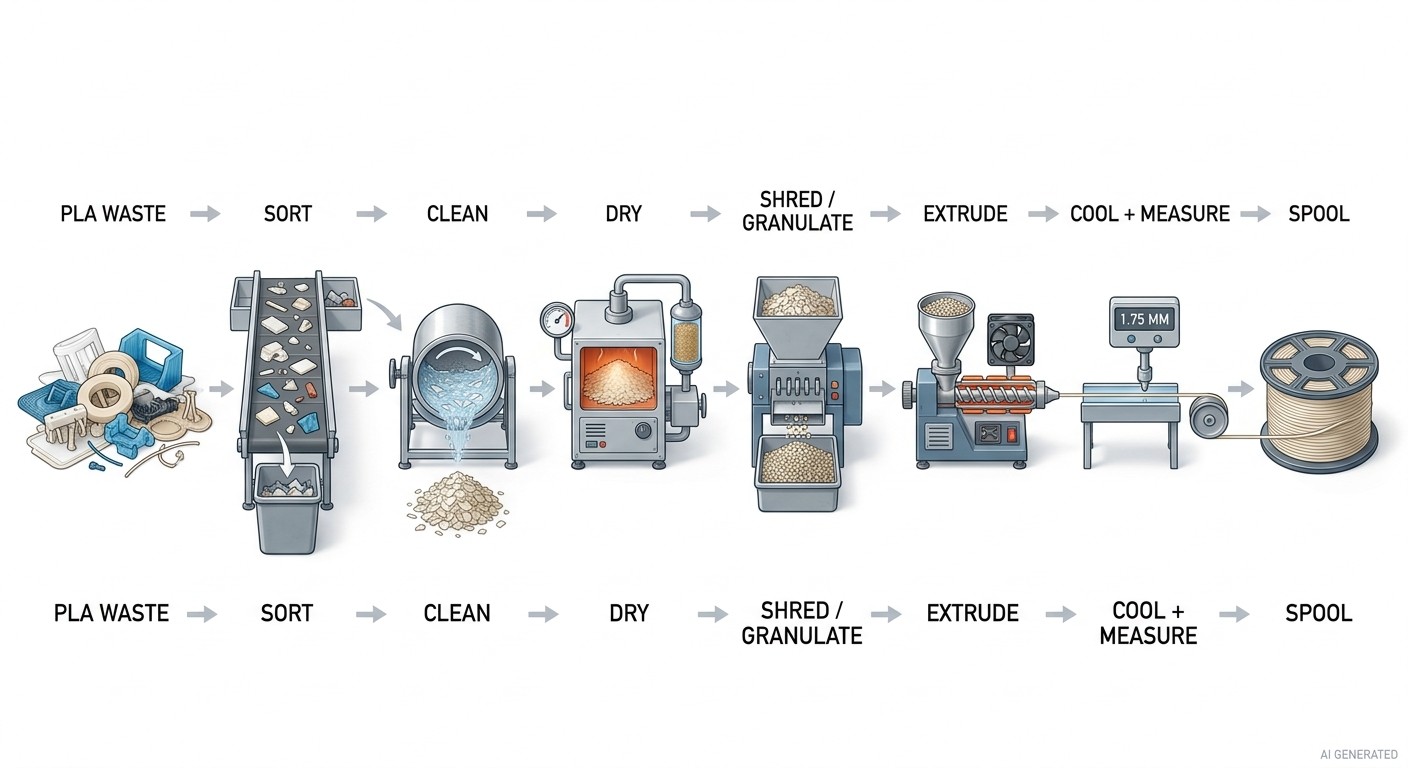
PLA recycling process diagram
The PLA-specific process is straightforward in principle:
PLA waste, sort, clean, dry, shred, extrude, cool, measure, spool.
The important part is what each step does to protect the material.
For the broader recycling workflow, including shredding, drying, extrusion, winding, and filament quality control, see our guide to 3D printer filament recycling.
-
Sort the PLA
Separate PLA from other plastics first.
Ideally, keep different known material grades separated as well. A pile of unknown FDM waste is a poor starting point for making controlled filament because you do not know exactly what polymer or additive package you are feeding into the extruder.
-
Clean the Waste
Remove dirt, adhesive residue, labels, coatings, and other foreign material.
For 3D printing waste, also watch for support materials or purge material that may have been mixed with the PLA.
The cleaner the feedstock, the easier it is to produce predictable recycled material.
-
Dry the PLA
Drying deserves more attention than it usually gets.
PLA is sensitive to moisture during melt processing. Water can contribute to hydrolytic chain scission when the polymer is heated, which can reduce molecular weight and alter melt behavior.
So drying serves two purposes:
(1) It helps produce consistent extrusion.
(2) It reduces moisture-driven degradation during hot processing.
The exact drying conditions should come from the material supplier or validated process rather than a universal temperature copied from another PLA grade.
-
Shred or Granulate the Waste
The clean PLA is reduced to flakes or pellets that can be fed consistently into an extruder.
Uniform feedstock helps the extrusion system maintain a more stable material flow.
-
Extrude the Recycled PLA
The shredded PLA is heated and pushed through an extrusion die to create a continuous filament.
Temperature matters here. Too little heat can create poor flow and inconsistent extrusion. Excessive heat or unnecessary residence time can increase degradation.
The objective is not simply to melt the PLA. It is to melt and move it through the system under controlled conditions.
-
Cool the Filament
The extruded strand needs to cool in a controlled way before winding.
Cooling conditions influence the final filament geometry and can also affect crystallization behavior.
-
Measure Filament Diameter
This is one of the biggest differences between "recycled plastic" and "usable 3D printing filament."
The filament needs a controlled diameter so the printer can feed and melt a predictable amount of material.
A filament that varies significantly in diameter can cause inconsistent extrusion, under-extrusion, over-extrusion, and dimensional variation in the printed part.
-
Spool and Store It Properly
Once the diameter is controlled, the filament can be wound onto a spool.
Storage still matters. Recycled PLA should be protected from moisture before printing, because the material can be exposed to humidity again after extrusion.
Does Recycling Affect PLA Filament Quality?
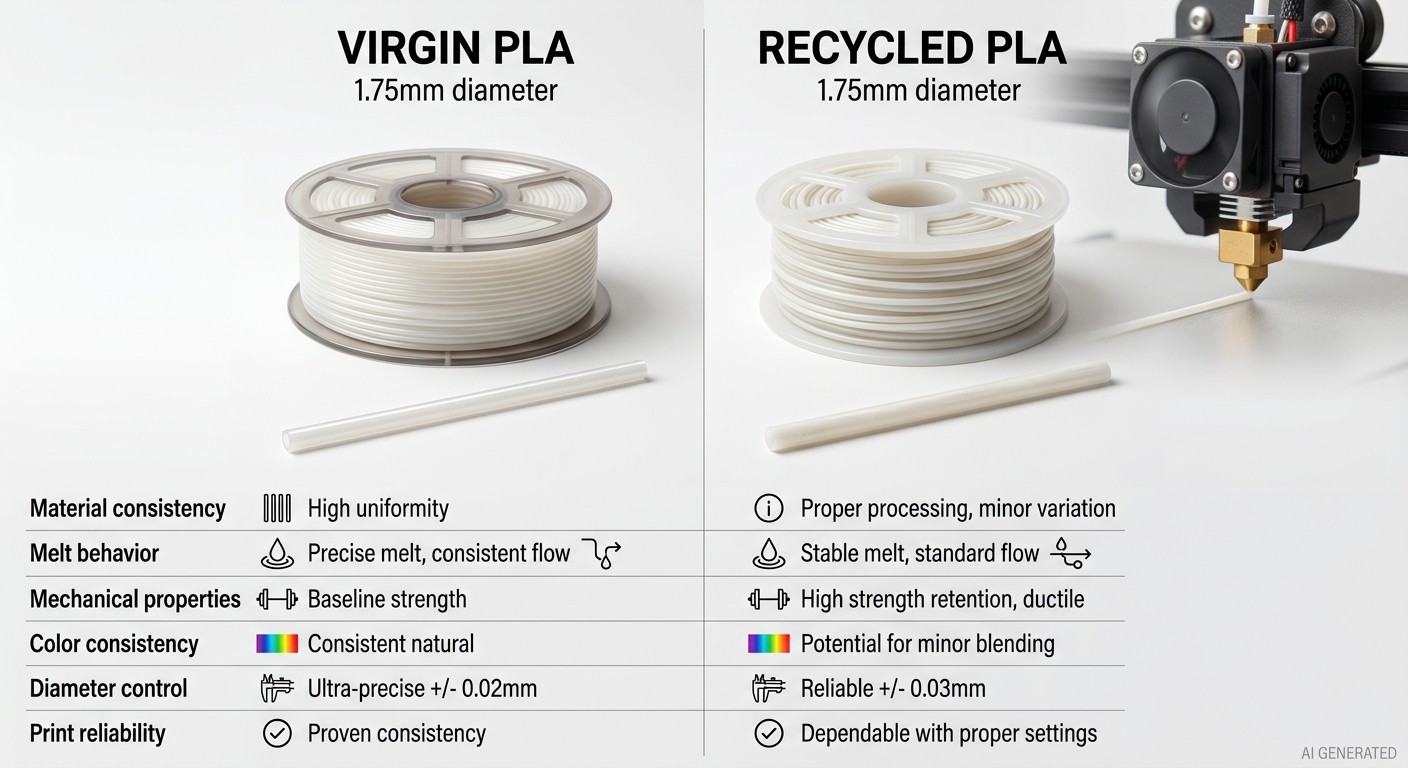
Comparison of virgin and recycled PLA filament
It can.
But "recycled PLA is lower quality" is too broad to be useful.
A better way to think about it is that recycled PLA has more variables.
Research has repeatedly shown that repeated processing can reduce PLA molecular weight and change melt behavior. However, the magnitude of the change varies with the polymer grade and processing conditions.
A 2026 study is particularly useful here because it tested a controlled mechanical recycling route and found that adding 20 wt% virgin PLA during reprocessing helped mitigate deterioration. That points toward an important industrial strategy: recycled content does not always have to be used at 100%. Blending recycled and virgin resin can be one way to bring material behavior back toward a more controlled range.
| Factor | Virgin PLA | Recycled PLA |
|---|---|---|
| Material consistency | Usually predictable | Depends on feedstock and processing |
| Melt behavior | More predictable | Can change with processing history |
| Molecular weight | Determined by resin grade | May decrease during reprocessing |
| Mechanical properties | Usually well characterized | May change between recycling batches |
| Color consistency | Usually controlled | Can vary with waste stream |
| Filament diameter | Factory controlled | Depends on extrusion control |
| Print reliability | More predictable | Requires material and process validation |
What Can Affect Recycled PLA Quality?
The main variables are:
- contamination
- moisture
- thermal history
- residence time
- extrusion temperature
- shear
- number of processing cycles
- material mixing
- additives and colorants
- filament diameter control
The practical lesson is simple: recycled PLA quality is a process-control problem.
A clean, dry, traceable feedstock processed once under controlled conditions is a very different material proposition from mixed PLA waste that has already been heated several times.
Can Recycled PLA Be Used for 3D Printing?
Yes, potentially. Recycled PLA can be used for 3D printing if the filament has controlled diameter, moisture, contamination, and melt behavior. However, recycled material should be validated before use in demanding functional or production applications.
Recycled PLA can be converted into filament and printed again, but printable does not automatically mean production-qualified.
For a recycled PLA filament to print reliably, several things need to line up:
- consistent filament diameter
- controlled moisture
- low contamination
- predictable melt behavior
- stable extrusion
- acceptable mechanical properties
- suitable printing parameters
Research has demonstrated the production of filament from real PLA waste and its use in 3D printing. Other studies have also shown that repeated recycling can eventually affect the mechanical strength and molecular structure of PLA.
That creates a useful distinction.
A recycled PLA filament may be perfectly reasonable for a decorative part, prototype, test fixture, or non-critical component.
That does not automatically qualify it for a load-bearing production component.
Application Suitability Table
| Application | Recycled PLA suitability | Consideration |
|---|---|---|
| Decorative parts | Generally suitable | Appearance and color consistency may vary |
| Concept prototypes | Generally suitable | Validate printability first |
| Test fixtures | Case-dependent | Check mechanical requirements |
| Functional prototypes | Validate first | Test under actual service conditions |
| Load-bearing parts | Case-dependent | Mechanical properties should be validated |
| Critical components | Not recommended without qualification | Requires material and process validation |
Before Printing Recycled PLA
- Check the filament diameter.
- Make sure the material is dry.
- Look for visible contamination.
- Test extrusion before committing to a large print.
- Run a small test part.
- For functional components, validate the material under the actual mechanical and environmental conditions it will see in service.
If you need consistent PLA parts without managing recycled filament yourself, JLC3DP offers FDM printing with PLA-P, its current standard PLA material. The material is specified for prototype, decorative, mechanical, and functional applications, with a listed tolerance of ±0.3 mm within 100 mm or ±0.4% above 100 mm.
Can You Recycle PLA at Home?
Yes, PLA can technically be recycled at home.
That does not mean producing good filament at home is as simple as melting failed prints.
A useful home recycling setup needs a way to sort and prepare the material, reduce it to consistent feedstock, dry it, extrude it, control the filament diameter, and wind the finished material.
The biggest challenge is consistency.
A home setup may successfully produce a strand that looks like filament but still vary enough in diameter or material behavior to cause unreliable printing.
There is also the question of whether the effort makes sense for the amount of waste being generated.
For a hobbyist with a steady stream of clean PLA waste, recycling can be an interesting material experiment. For occasional failed prints, buying a new spool may be simpler and more predictable.
The same basic equipment applies to broader filament recycling, but the PLA-specific concern is what repeated heat and processing are doing to the polymer. Our broader 3D printer filament recycling process covers the equipment and general workflow in more detail.
Is PLA Recyclable or Compostable?
PLA recycling and PLA composting are two different end-of-life routes.
Recycling recovers the polymer and processes it into another material or product.
Industrial composting uses controlled biological conditions to break down certified compostable products into smaller molecules and ultimately carbon dioxide, water, and biomass. The process depends on temperature, moisture, aeration, time, and the specific product or material formulation.
This is where the PLA's reputation causes confusion.
PLA is commonly described as a bio-based or biodegradable plastic. That does not mean a finished PLA 3D print will quickly disappear in a backyard compost bin.
Some PLA grades and products are designed and certified for industrial composting under specified conditions. Those conditions are different from an ordinary home compost pile. The U.S. EPA likewise notes that compostable plastics are generally intended for industrial or commercial composting systems rather than typical household compost bins.
So if you have a PLA print at the end of its useful life, do not assume that "plant-based" means "put it in the compost."
And do not assume that "PLA" means your local recycling facility accepts it either.
Check the actual requirements of the waste-management system available in your area.
PLA Recycling: What Actually Makes It Work?
PLA recycling works best when you control the material before you ever put it into an extruder.
The most useful hierarchy is:
Known material → clean feedstock → dry feedstock → controlled processing → controlled filament → validated printing
That is more important than chasing a specific number of recycling cycles.
There is no universal answer to "how many times can PLA be recycled?" Research has found substantial differences between materials and processing routes. One study found known-source PLA waste could tolerate three re-extrusion cycles without significant degradation, while other studies have reported substantial molecular-weight loss after repeated processing.
More recent work is also exploring ways to maintain recycled PLA performance through controlled blending with virgin resin and other processing strategies.
So the better engineering question is not:
"How many times can I recycle this PLA?"
Ask:
"What is the material's processing history, and does the recycled material still meet the requirements of the next application?"
That question gives you something you can actually measure.
FAQ about PLA Recycling
Q: Is PLA recyclable?
Yes. PLA is a thermoplastic and can be mechanically reprocessed. Whether a particular recycling facility accepts PLA is a separate question and depends on the local waste stream.
Q: Can you recycle PLA filament?
Yes. Clean PLA filament scraps can be sorted, dried, shredded, extruded, and converted into new filament. The quality of the resulting filament depends on the material's processing history and extrusion control.
Q: Can recycled PLA be used for 3D printing?
Yes, recycled PLA can potentially be used for 3D printing. The filament needs adequate diameter control, low contamination, appropriate moisture control, and predictable melt behavior. Functional or production applications should be validated rather than assuming recycled material behaves exactly like virgin PLA.
Q: Can PLA be recycled at home?
Yes, but consistent filament production requires more than melting failed prints. Sorting, drying, extrusion, cooling, diameter control, and storage all affect the result.
Q: How many times can PLA be recycled?
There is no universal cycle limit. PLA can undergo multiple processing cycles, but molecular weight and other properties can change as thermal and mechanical history accumulates. Research results vary significantly with material grade and processing conditions.
Q: Is PLA recyclable or compostable?
PLA can be mechanically recyclable, while some specific PLA products may also be certified for industrial composting. Recycling and composting are different processes, and ordinary PLA prints should not automatically be assumed to be home compostable.
Q: Can PLA prints go in the recycling bin?
Not necessarily. Do not assume that a local curbside recycling program accepts PLA just because PLA is technically recyclable. Check the accepted-material list for your local recycling service or facility.
PLA Recycling Is Possible, but Material History Matters
PLA is recyclable. The interesting part is what happens after the first recycling cycle.
The polymer can be reheated and processed again, but heat, moisture, shear, contamination, and previous processing can change its molecular structure and melt behavior. That is why recycled PLA should not be treated as automatically equivalent to virgin PLA.
For the best results, start with clean, dry, known-source PLA. Keep the waste stream separated. Control extrusion conditions. Measure the filament you produce. Then test the recycled material against the application it needs to serve.
For hobby projects and non-critical parts, that level of control may be enough to make recycled PLA genuinely useful.
For demanding functional or production applications, material consistency matters more than simply getting the word "recycled" onto the spool.
The goal of PLA recycling is not to keep melting the same plastic forever.
It is to recover useful material while keeping enough control over its properties for the next job.
References
[1] Hidalgo-Carvajal, D., et al. (2023). Recycled PLA for 3D Printing: A Comparison of Recycled PLA Filaments from Waste of Different Origins after Repeated Cycles of Extrusion. Polymers, 15(17), 3651. DOI: 10.3390/polym15173651.
[2] Muñoz-Shugulí, C., Morán, D., Velásquez, E., López-Vilariño, J. M., & López-de-Dicastillo, C. (2025). Effect of Degradation During Multiple Primary Mechanical Recycling Processes on the Physical Properties and Biodegradation of Commercial PLA-Based Water Bottles. Polymers, 17(18), 2542. DOI: 10.3390/polym17182542.
[3] Gong, K., Teodosio, B., Lu, Y., Feng, P., Liu, H., Xu, H., Li, M., Taghinezhad, S. F., Fitzpatrick, D., Beaucamp, A., Xiao, G., Collins, M. N., & Chen, Y. (2026). Toward a Circular Economy: An Investigation in Recycled PLA via Mechanical, Thermal, and Morphological Performances and Life Cycle Analysis. Results in Engineering, 32, 112280. DOI: 10.1016/j.rineng.2026.112280.
Keep Learning
DIY Filament Recycler: How to Build One, Cost & Process Guide
A DIY filament recycler turns clean 3D printing waste into new filament. The basic idea is simple: sort the waste, shred it, melt it, extrude it, cool it, measure the diameter, and wind it onto a spool. Building a reliable system is harder than the basic concept suggests. Shredding, moisture control, temperature stability, pulling speed, and filament diameter all affect the final result. (Reddit) PET DIY filament recycler Need3D printed parts without managing recycling equipment? JLC3DP provides indus......
PLA Recycling: Can You Recycle PLA & How?
Key Takeaways PLA is recyclable because it is a thermoplastic that can be reprocessed into new materials. Recycling PLA is different from composting, and most household recycling programs do not accept PLA by default. Clean, dry, and properly sorted PLA waste produces better recycled material than mixed or contaminated waste. PLA can be recycled into new 3D printing filament, but extrusion control, moisture, and filament diameter affect print quality. Repeated heating and processing can change PLA's m......
3D Printer Filament Recycling: How to Recycle and Reuse Filament Waste
Key Takeaways 1. You can recycle 3D printer filament, but it's more involved than tossing it in the recycling bin. 2. Most common filament materials like PLA, PETG, and ABS can technically be recycled, though the quality of the recycled output depends heavily on how clean, dry, and uncontaminated the waste is. 3. Recycling 3D printer filament at home requires a shredder and extruder at minimum. 4. For most people without that equipment, the practical options are filament take-back programs, makerspace......
3D Printing Recycling: For Sustainability
With the rapid development of 3D printing technology, how to effectively recycle and reuse waste generated during the printing process has become an important issue that needs to be solved in the industry. Reducing printing waste can not only reduce costs, but also is a key step to achieve sustainable development. This article will explore how to reduce waste in 3D printing and introduce some practical 3d printing recycling application cases. Source: https://www.3dnatives.com/en/10-reasons-why-3d-prin......
The Impact of 3D Printing on Sustainability
Introduction In recent years, 3D printing has emerged as a revolutionary technology with the potential to transform various industries. Its impact on sustainability has been a topic of increasing interest and debate. In this article, we will explore the ways in which 3D printing influences sustainability and discuss the potential benefits and challenges associated with this rapidly advancing technology. Reduced Waste Traditional manufacturing processes often result in significant material wastage. In ......
Enhancing Sustainability And Waste Reduction In 3D Printing
Enhancing sustainability and waste reduction in 3D printing is crucial for minimizing environmental impact, conserving resources, reducing waste, achieving cost efficiency, stimulating innovation, meeting consumer demands, and complying with regulations. By optimizing material usage, implementing recycling practices, and promoting sustainable materials, 3D printing can contribute to a more environmentally responsible and economically viable manufacturing industry while attracting environmentally-consc......