What Is LW PLA? How Lightweight PLA Works and When to Use It
11 min
- What Is LW PLA
- How Does LW PLA Work
- LW PLA vs Standard PLA
- LW PLA Print Settings
- When Should You Use LW PLA?
- Applications of LW PLA
- Common Printing Problems with Lightweight PLA
- FAQ about LW PLA Filament
The first time you print with LW PLA, you will genuinely think that you grabbed the wrong spool off the shelf. Pick the part up off the bed and it will feel hollow. But it isn't. Same infill setting, same model, just... lighter. Sometimes, depending on print temperature and expansion ratio, it can reduce part weight by approximately 20–50%.
So what's actually going on? This guide walks through what LW PLA is, why it does what it does, and the settings that'll get you there without fighting the printer the whole time.
If you're new to filament selection in general, our Choosing the Right 3D Printing Material guide explains how different materials trade off weight, strength, and printability.
What Is LW PLA
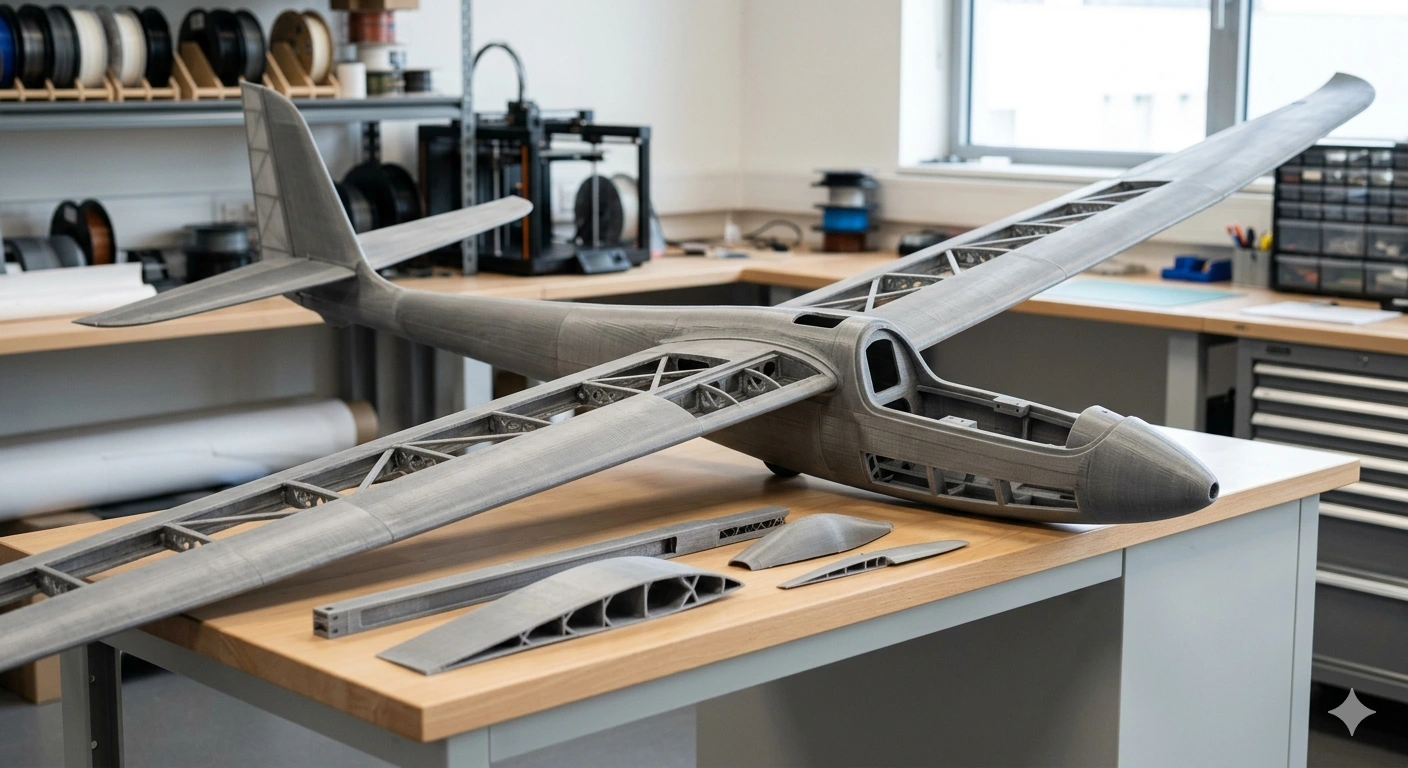
LW PLA (Lightweight PLA) is also commonly called foaming PLA filament. LW PLA (Lightweight PLA) is a PLA-based filament that contains a thermally activated chemical foaming agent, which expands during extrusion at elevated temperatures to reduce material density, so the finished part weighs less than the same shape printed in normal PLA would. The name's literal as far as filament names go.
What's actually in it is a chemical foaming agent mixed into the PLA. Heat it past a certain point inside the hot end and that agent activates, pumping gas into the molten plastic right as it's being laid down. Similar to yeast expanding bread dough, except the whole rising process happens in the seconds between the nozzle and the bed instead of over a couple hours on your counter. What comes out the other side is plastic riddled with tiny air pockets, and that's the whole weight reduction trick.
People sometimes assume this is just low infill with extra steps. It's not, and that distinction matters. Drop your infill to 15% and you've got big, visible, structurally weak gaps you have to design around. LW PLA foams down at a much smaller scale, inside the strand of plastic itself, so the foamed material can still reduce weight even at higher infill settings than solid standard PLA. The weight savings happen in the material, not in gaps you're choosing to leave empty.
How Does LW PLA Work
The foaming agent remains dormant at standard PLA printing temperatures. If printed within this normal range, the material behaves like regular PLA, offering no lightweight benefits. To activate the foaming agent and release gas into the melt, the nozzle temperature must be increased—typically to 220–260°C, depending on the brand. However, exceeding the optimal temperature range can lead to over-foaming, dimensional instability, or poor surface quality.
Running a temperature tower test is often the fastest way to identify the activation range for your specific LW PLA spool.
What people find genuinely useful about this approach: your model doesn't change at all. No manual hollowing, no lattice infill experiments, no redesign. You're adjusting one number in your slicer and the chemistry handles the rest. Push the temperature up within whatever range your specific filament tolerates and you get more expansion, less weight, right up until you push it too far and quality starts falling apart.
Where it gets annoying is consistency. Every brand foams a little differently. I've had the same spool behave differently on a humid week versus a dry one. Print speed shifts the result too. It takes more dialing in than standard PLA does before you land on settings you can trust, but once you've found them, they hold.
If you're working on something where weight is actually the constraint, RC frames, cosplay pieces, anything that gets worn or flown, and you're not sure whether LW PLA is the right call or whether your design needs tweaking first to take advantage of it, upload your CAD file and we'll take a look.
LW PLA vs Standard PLA
| Property | LW PLA | Standard PLA |
|---|---|---|
| Weight | 30-60% lighter for same volume | Baseline (solid density) |
| Print Temperature | 220-260°C (foams at higher temps) | 190-220°C |
| Print Speed | Slower, typically 20-40mm/s | Faster, 40-100mm/s |
| Surface Finish | Slightly textured, less glossy | Smooth, glossy |
| Strength | Lower tensile strength | Higher tensile strength |
| Flexibility | More forgiving, slight cushioning | Rigid, brittle under stress |
| Cost | Higher per spool | Lower, widely available |
| Best Use Case | Weight-sensitive functional parts | General purpose, strength-critical parts |
| Layer Adhesion | Can be more sensitive to settings | Generally more forgiving |
The honest takeaway here: LW PLA isn't a strict upgrade over standard PLA. It's a trade. You're giving up some strength and surface smoothness in exchange for weight reduction. For parts where weight doesn't matter, standard PLA is still the easier, cheaper, more reliable choice. For parts where weight is the whole point, lightweight PLA filament does something standard PLA simply can't.
Why pay a premium when weight reduction isn't your goal? If weight doesn't matter, keep your printing simple and budget-friendly. Go with Standard PLA now to bring back the most seamless and dependable printing experience.

LW PLA Print Settings
Getting good results with LW PLA comes down to understanding that you're essentially controlling a chemical reaction with your slicer settings, not just extruding plastic.
Nozzle temperature is the single most important setting. Most lightweight printing materials need somewhere between 220°C and 260°C to foam properly, check your specific filament's datasheet, because this varies more between brands than standard PLA does. Print too cold and the foaming agent never activates, so you just get regular-weight PLA with none of the benefit. Print too hot and you risk over-expansion, stringing, and poor dimensional accuracy.
Print speed needs to come down compared to standard PLA. Lightweight filament needs time for the foaming reaction to happen properly as it extrudes, rushing the print doesn't give the material enough time to expand evenly, leading to inconsistent density across the part. Most people find 20-40mm/s works well, though this depends on your specific setup and nozzle diameter.
Larger nozzle diameters (0.6mm or above) tend to work better with LW PLA than the standard 0.4mm nozzle. The wider opening gives the foaming material more room to expand without getting choked or causing pressure buildup that leads to under-extrusion or clogging.
Cooling settings matter more here than with standard PLA. Too much cooling fan too early can lock in the foam structure before it's fully expanded, while too little cooling can cause sagging on overhangs since the foamed material is structurally softer while still warm. A moderate cooling approach, increasing gradually after the first few layers, tends to give the most consistent results.
Retraction settings for best settings for LW PLA generally need to be slightly more conservative than standard PLA, since the foamed material can be a bit stringier. Start with your existing PLA retraction settings and adjust slightly upward if you notice stringing. If excessive oozing appears, follow our How to Reduce Stringing in 3D Printing guide.
If you want a deeper technical breakdown of dialing in flexible and specialty filaments more broadly, our flexible filaments guide covers a lot of the same troubleshooting logic that applies here, even though LW PLA isn't flexible in the same sense.
When Should You Use LW PLA?
Lightweight PLA works best when reducing weight matters more than maximizing strength or dimensional precision. Unlike standard PLA, foaming PLA reduces material density during printing without requiring major model redesign.
Suitable for:
- Components where lower weight improves performance
- Cosplay props and wearable parts that need to remain comfortable during extended use
- Large display models where lower weight improves handling and reduces material use
- Lightweight prototypes for easier transport and faster iteration
Avoid for:
- Load-bearing applications that require higher mechanical strength
- High-temperature environments where PLA-based materials may soften
- Precision parts where dimensional consistency matters more than weight reduction
If reducing weight is important but structural performance is still required, testing lightweight filament settings before full production is recommended.
If you're still deciding whether LW PLA is the right material category, see our Best 3D Printing Material Guide for Every Application.
Applications of LW PLA
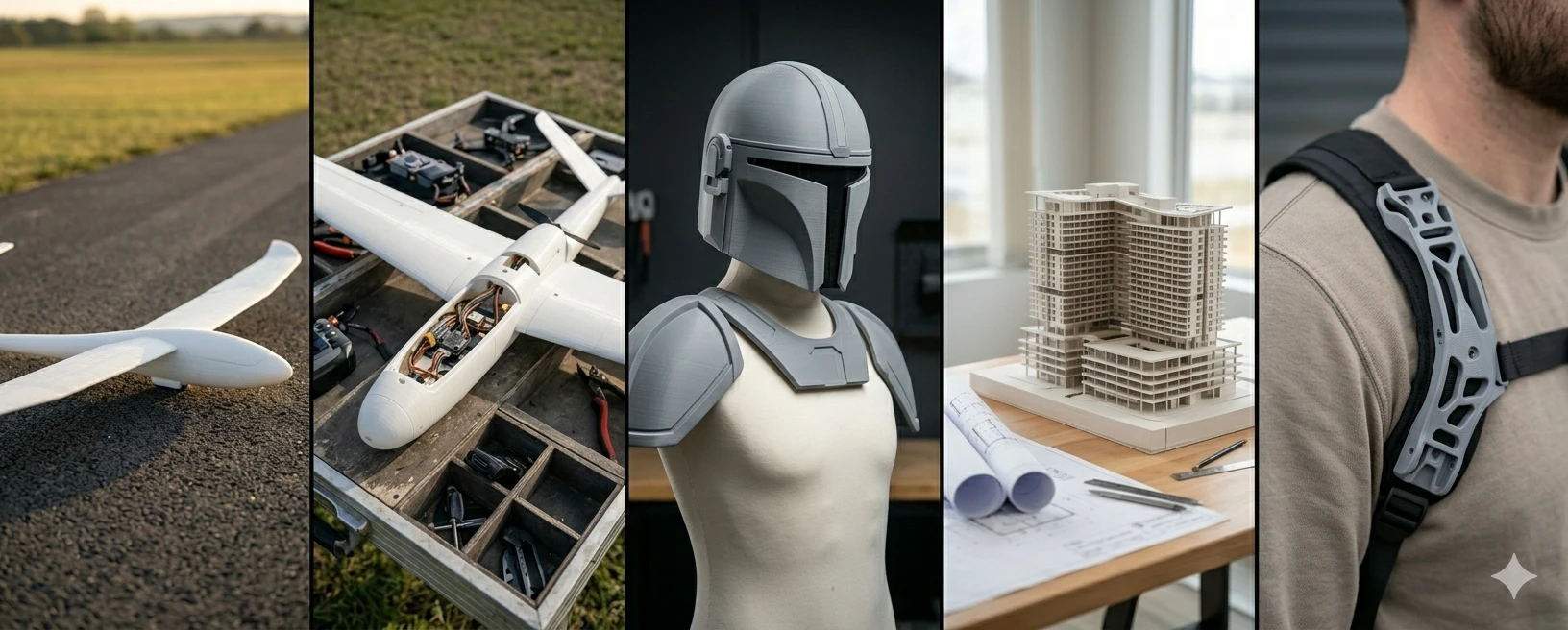
PLA lightweight material earns its place in specific situations where regular PLA's higher density actually works against you.
Cosplay and prop making benefits enormously from PLA lightweight material. Large props like helmets, armor pieces, and weapon replicas can get heavy fast when printed solid in standard PLA. Switching to lightweight PLA for these pieces makes them genuinely wearable for extended periods instead of becoming a neck and shoulder problem after twenty minutes.
Architectural and display models where you need large-scale prints without the weight (or material cost) of solid standard PLA also benefit from foaming PLA filament's reduced density.
Wearable and body-mounted parts generally, anything attached to a person for an extended period, are natural candidates for low weight PLA, since comfort over time matters more than raw material strength in many of these applications.
For projects where weight reduction needs to be paired with functional performance, load-bearing brackets, mechanical assemblies, parts that need to survive real-world stress, it's worth getting an engineering opinion before committing your whole design to PLA lightweight material, since the strength trade-off can matter more in some applications than others.
Common Printing Problems with Lightweight PLA
| Problem | Likely Cause | Fix |
|---|---|---|
| No weight reduction happening | Nozzle temp too low for foaming to activate | Increase temperature into the 220-260°C range, check filament datasheet |
| Stringing between parts | Foaming agent makes filament more prone to oozing | Increase retraction distance slightly, lower print temp slightly if over-foaming |
| Inconsistent density across part | Print speed too fast for foaming reaction to complete evenly | Slow down print speed, especially on first few layers |
| Poor layer adhesion | Cooling fan too aggressive too early | Reduce fan speed for first several layers, increase gradually |
| Clogged nozzle | Standard 0.4mm nozzle too restrictive for expanding material | Switch to 0.6mm or larger nozzle |
| Warping on large flat parts | Foamed structure cools unevenly | Use a heated enclosure or reduce drafts, ensure good bed adhesion |
| Sagging overhangs | Foamed material is softer while warm, less structural support | Increase cooling slightly on overhang sections, add supports if needed |
| Brittle or weak parts | Over-foaming from excessive temperature | Lower nozzle temp slightly, test on a small calibration piece first |
FAQ about LW PLA Filament
Q: What is LW PLA?
LW PLA is a lightweight PLA filament that contains a chemical foaming agent, designed to expand during printing when heated above standard PLA temperatures. This produces printed parts with a foamed internal structure that weighs significantly less than the same geometry printed in regular PLA.
Q: How does LW PLA work?
LW PLA works through a temperature-activated foaming reaction. Below a certain temperature threshold, the filament prints similarly to standard PLA. Above that threshold, typically 220°C or higher depending on the brand, a foaming agent in the filament activates and expands the molten plastic, creating microscopic air pockets throughout the material as it cools and solidifies.
Q: LW PLA vs PLA: what's the real difference?
The main difference is density and the trade-offs that come with it. LW PLA prints lighter, often 30-60% less weight for the same part, but sacrifices some tensile strength and surface smoothness compared to standard PLA. Standard PLA remains stronger, easier to print, and cheaper, but doesn't offer any weight reduction.
Q: What are the best settings for LW PLA?
Most lightweight PLA filament performs best at 220-260°C nozzle temperature, printed at a slower speed of 20-40mm/s, ideally through a 0.6mm or larger nozzle. Cooling should be moderate rather than aggressive in the first few layers, and retraction may need slight adjustment to manage stringing.
Q: Is LW PLA filament harder to print than regular PLA?
Somewhat, yes. LW PLA filament requires more careful temperature tuning since you're managing a foaming reaction rather than just melting and extruding plastic. Once you find the right settings for your specific brand and printer, though, it becomes fairly repeatable.
Q: Can I use LW PLA for functional, load-bearing parts?
It depends on the load requirements. Lightweight PLA trades some strength for weight reduction, so it works well for parts where weight matters more than maximum strength, props, RC frames, display pieces. For parts under significant mechanical stress, it's worth evaluating whether the strength reduction is acceptable for your specific application before committing.
Keep Learning
PLA vs PETG vs ASA: Best 3D Printing Filament for Outdoor Use
If you've ever watched a 3D printed garden hook sag in the sun or a cold snap crack your custom outdoor fixture, you already know: not all filaments are built for the elements. Choosing the best 3D printing filament for outdoor use isn't just about surviving the occasional drizzle. It's about UV exposure, temperature swings, moisture resistance, and long-term strength. And let's be real, most people don't want to reprint every few months just because they picked the wrong plastic. In this guide, we'll......
ABS Temperature Resistance: How Hot Can ABS Withstand?
Key Takeaways ABS heat resistance is defined by Tg and HDT, not melting point. Typical ABS grades have a Tg around 100–110℃ and HDT around 85–95℃. JLC3DP ABS reaches 98°C HDT under its published test conditions, but actual part performance depends on load, geometry, orientation, and exposure time. ABS offers higher heat resistance than PLA and PETG, while ASA provides similar heat performance with better outdoor durability. PC-ABS and PC are options when ABS is not enough. PC-ABS balances heat resista......
Is PETG Toxic to Print? Fumes, Risks & Safety Guide
Key Takeaways PETG is generally considered a lower-emission 3D printing material compared to ABS and ASA, but it does produce VOCs and ultrafine particles during printing. The odor during PETG printing is typically mild, some people barely notice it, others describe a faint warm-plastic smell. Low odor doesn't mean zero emissions. Ventilation is still a sensible precaution. PETG food safety is complicated, the material itself may be food-grade in some formulations, but the printing process introduces ......
Top 5 Heat-Resistant 3D Printing Filaments Compared
When Regular Filament Just Doesn’t Cut It You’ve 3D printed a functional bracket for a car engine bay. It fits perfectly, looks great, and then warps into a banana-shape after a week under the hood. That’s the danger of underestimating heat. If you're building automotive components, enclosures near motors, molds, or even kitchenware, using the wrong filament can lead to deformation, brittleness, or outright failure when exposed to heat. So, you already know the solution: Choosing the right heat-resist......
PLA Temperature Resistance: Heat Resistance, Softening & Melting Point
Key Takeaways PLA typically starts losing rigidity around 55–65℃ (Tg) and melts at approximately 150–180℃. PLA can deform and creep long before it melts, so melting point is not a practical service-temperature limit. Actual PLA deformation depends on temperature, load, geometry, print orientation, and exposure time. Standard PLA becomes increasingly risky above 50–60℃ and is generally unsuitable for sustained 70–80℃ applications. PLA+ heat resistance varies by formulation. For higher-temperature appli......
PETG Temperature Resistance: Limits & Comparison with PLA/ABS/ASA
Key Takeaways Standard PETG is best suited for continuous use below ~60℃; performance can decline as temperatures approach 70℃. PETG typically has a Tg of ~75–85℃ and an HDT of ~65–75℃, depending on the material grade and test conditions. HDT is not a maximum service temperature—load, print orientation, wall thickness, geometry, and exposure time all affect real-world performance. PETG offers better heat resistance than PLA but lower heat resistance than ABS, ASA, PA12-CF, PC, and PEEK. For sustained ......