Choosing the Right ESD Filament for Your Application
13 min
- Introduction
- What Is ESD Filament?
- Which ESD Filament Material Should You Choose?
- What Can You Print with ESD Filament?
- Best Print Settings for ESD Filament
- Common Problems When Printing ESD Filament
- Common Mistakes with ESD Filament
- FAQ About ESD Safe Filament
Introduction
Somewhere in an electronics assembly facility right now, someone is printing a fixture on a desktop 3D printer using standard PLA. It looks fine. It fits the board. And every time a PCB gets placed in it, static charge builds on that perfectly smooth, perfectly insulating plastic surface, right next to components sensitive to discharges that humans can't even feel.
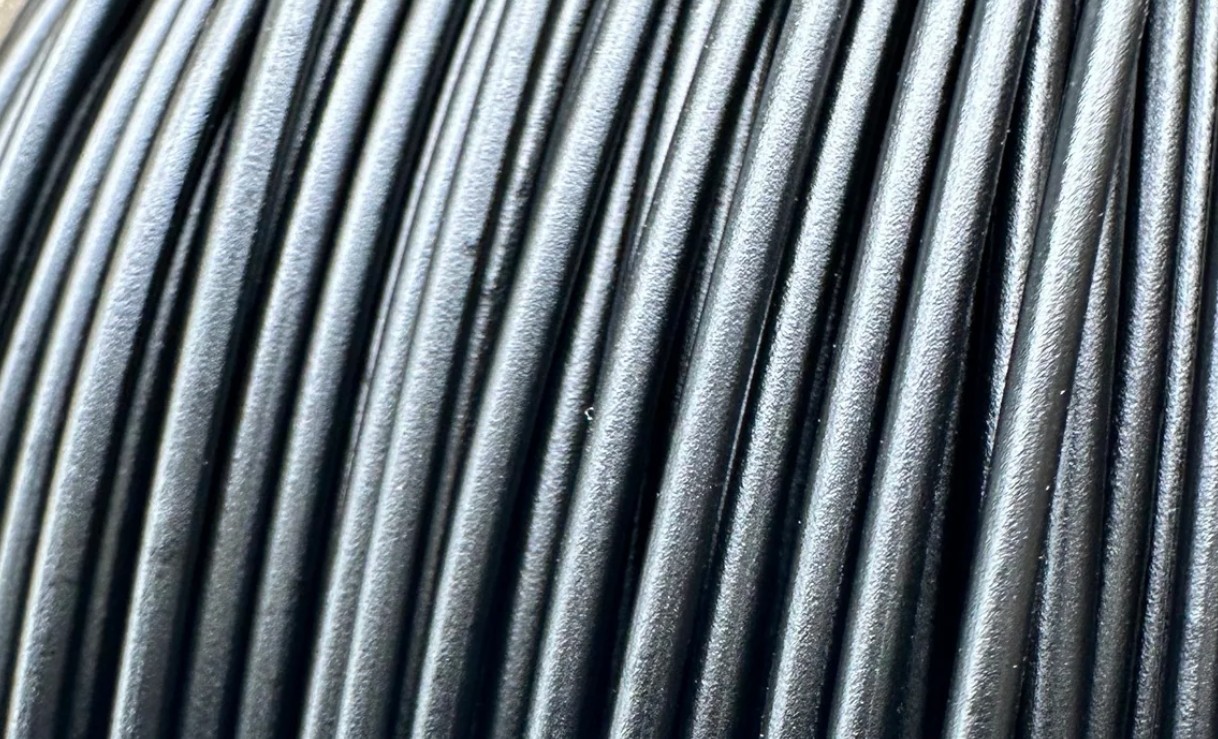
ESD filament exists specifically for this problem. It's not a premium upgrade to standard filament. It's a different material for a different job, one where the plastic needs to actively manage static electricity rather than accumulate it.
This guide covers what ESD safe filament actually is, which materials are available, how to print it without the issues that catch people off guard, and when a desktop printer isn't the right tool regardless of which filament goes in it.
What Is ESD Filament?
ESD filament is 3D printer filament that has been modified with conductive additives, typically carbon-based, to give the printed material the ability to dissipate static electrical charges in a controlled way instead of accumulating them on the surface.
Standard PLA, ABS, and PETG are excellent electrical insulators. That's generally fine for most printed parts, but it's actively problematic when those parts contact sensitive electronics. An insulating plastic surface builds up charge every time it's touched, slid against, or moved near another surface, and releases it unpredictably when conditions are right. ESD safe filament breaks this pattern by building charge dissipation into the material itself.
Want to understand how ESD safe materials work at a deeper level? Our ESD Plastic guide covers the full material science behind static control in polymers.
Which ESD Filament Material Should You Choose?
Different ESD filaments offer different balances of printability, mechanical performance, temperature resistance, and cost. The right choice comes from the application requirements, not from picking the most impressive-sounding material on the list.
| Material | Printability | Toughness | Heat Resistance | Best For |
|---|---|---|---|---|
| PLA-ESD | ★★★★★ | ★★☆☆☆ | ★★☆☆☆ | Visual prototypes, concept models |
| PETG-ESD | ★★★★☆ | ★★★☆☆ | ★★★☆☆ | Covers, guards, light-duty housings |
| ABS-ESD | ★★★★☆ | ★★★★☆ | ★★★★☆ | Functional fixtures, enclosures |
| PA12-ESD | ★★★☆☆ | ★★★★★ | ★★★★☆ | Industrial tooling, high-use jigs |
| PC-ESD | ★★★☆☆ | ★★★★☆ | ★★★★★ | Electronics housings, high-temp parts |
PLA-ESD is the most accessible ESD safe filament for anyone starting out with ESD 3D printer filament. It prints on essentially any FDM machine without an enclosure, doesn't warp, and doesn't need a hardened nozzle in most cases. The limitation is mechanical and thermal: PLA ESD filament softens above 60°C and doesn't tolerate much mechanical stress. Use it for concept models and visual prototypes where ESD protection is needed but the part won't take any real load.
PETG-ESD steps up the mechanical performance slightly and handles temperatures to around 80°C. PETG ESD filament has better chemical resistance than PLA ESD filament and is less brittle. It's a reasonable choice for covers, guards, and housings that need ESD protection but aren't in demanding environments.
ABS-ESD is where ESD 3D printer filament starts getting genuinely useful for electronics manufacturing applications. If you're unfamiliar with ABS, see our guide to the key facts about ABS filament before choosing an ESD grade. ABS ESD filament handles temperatures to around 80-90°C, has good impact resistance, and machines well for adding holes or inserts after printing. JLC3DP's ABS-ESD belongs to this category, offering the same reliable mechanical performance as our standard ABS while adding static-dissipative properties for electronics applications. At JLC3DP, ABS-ESD is offered at the same price as our standard ABS, making ESD protection more accessible for electronics fixtures and production tooling.
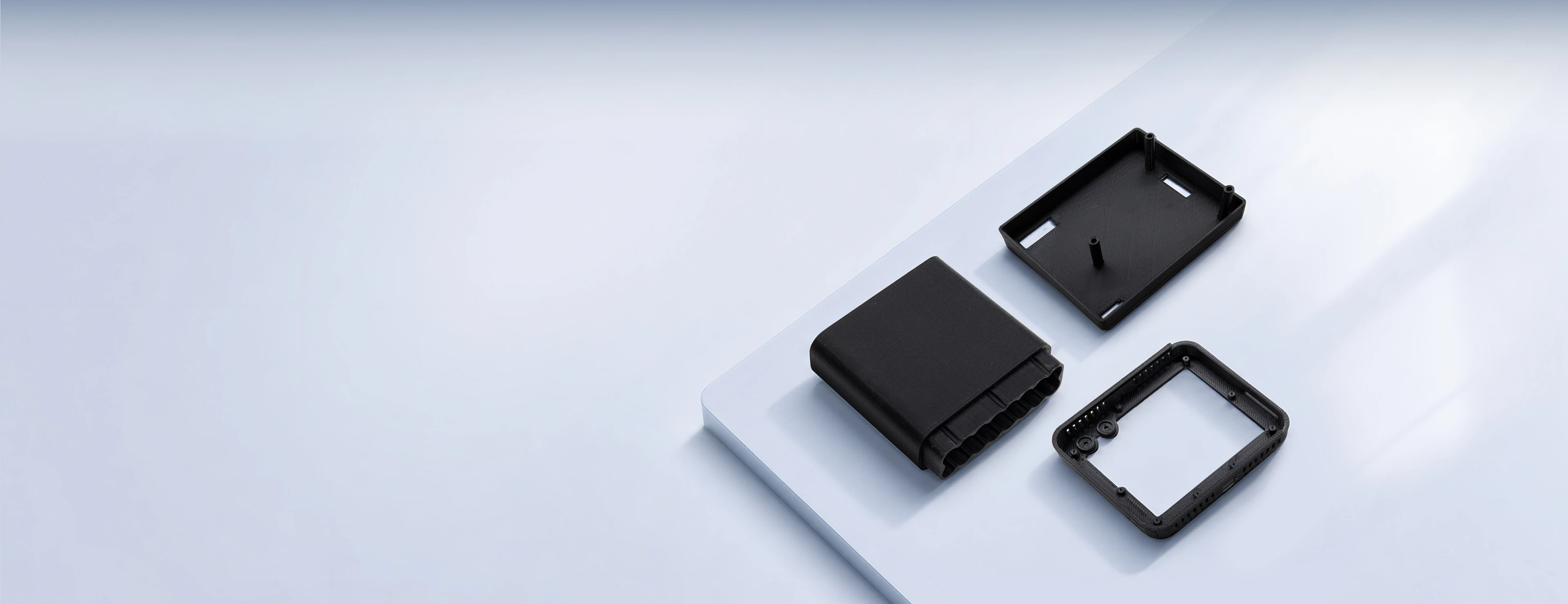
- JLC3DP Reliable antistatic ABS-ESD Plastic for electronics and industrial applications
- Starting from $3 per part & Build time from 72 hours
Quick Selection Guide
- Need easy printing for a one-off prototype → PLA-ESD
- Need a functional fixture with decent durability → ABS-ESD
- Need high-use industrial tooling → PA12-ESD
- Need high temperature or impact resistance → PC-ESD or PA12-ESD
Do You Actually Need ESD Filament?
A more useful question than "Is ESD filament better than standard PLA or ABS?" is "Do you actually need ESD filament?" The answer is: not always. ESD filament should only be used where static control is genuinely required. It costs more, is more demanding to print, and typically has slightly reduced mechanical performance compared to the equivalent standard polymer.
The right question isn't "is ESD safe filament better?", it's "does this application need ESD safe 3D printing material?" If a part contacts electronics sensitive to electrostatic discharge, ESD filament is required, not optional. If it doesn't, standard filament is cheaper and easier to print.
| Standard Filament | ESD Filament |
|---|---|
| Lower cost per kg | Higher cost per kg |
| Easy printing, forgiving settings | More demanding print parameters |
| Suitable for decorative and structural parts | Required for electronics and static-sensitive applications |
| No static protection | Controlled static dissipation |
| Wide brand and color options | Limited color options (usually black) |
| Standard brass nozzle | Hardened steel nozzle required |
What Can You Print with ESD Filament?
| Industry | Typical Printed Parts |
|---|---|
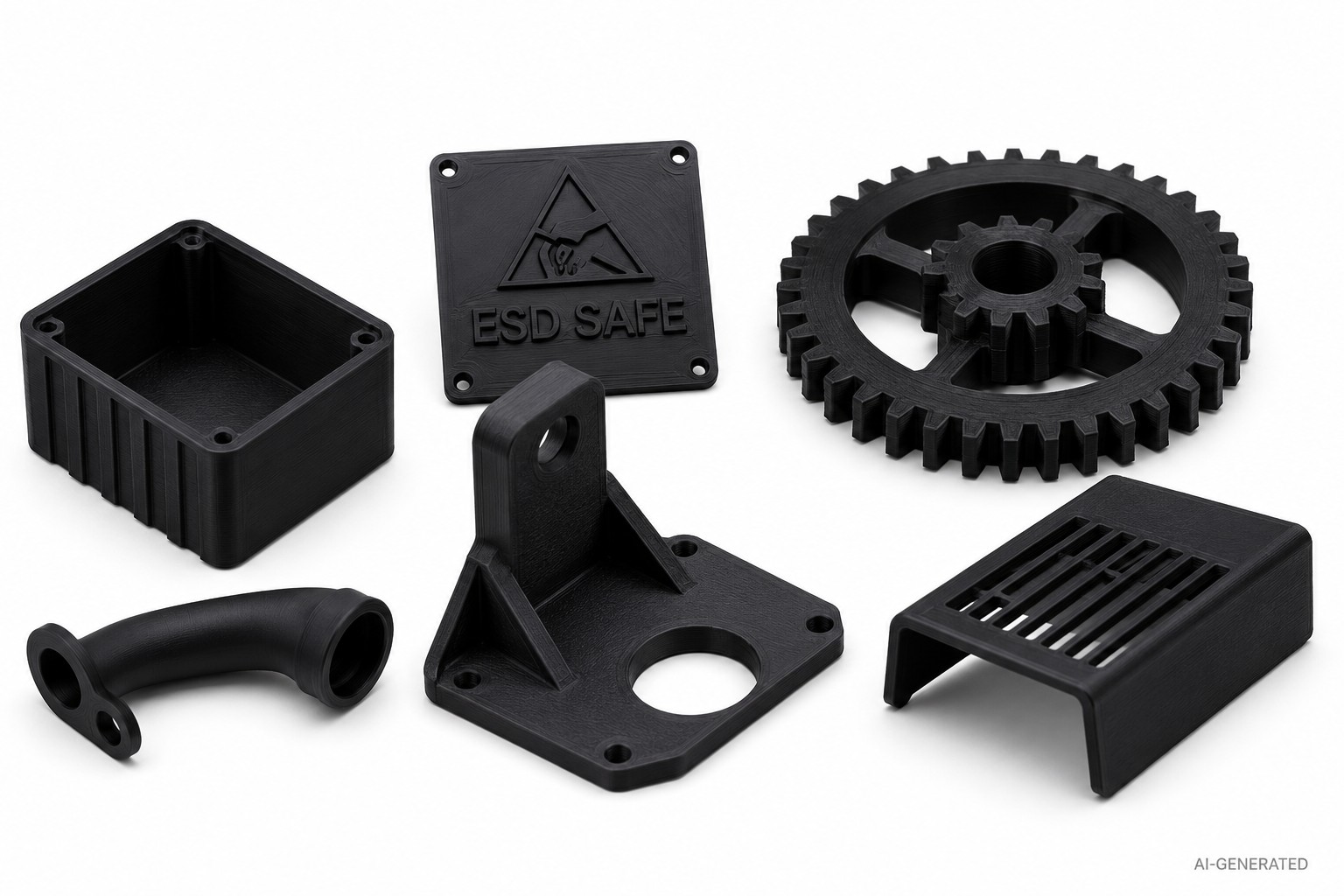
| PCB Assembly | Test fixtures, board holders, alignment jigs |
| Electronics Manufacturing | Assembly jigs, component trays, handling fixtures |
| Semiconductor | Wafer fixtures, process tooling, reticle carriers |
| Battery Manufacturing | Cell positioning fixtures, module assembly tooling |
| Medical Electronics | Device fixtures, calibration tooling |
| Automotive Electronics | Sensor holders, ECU handling trays |
PCB test fixtures are one of the most common applications for ESD 3D printer filament in engineering departments. A fixture that holds a board during testing needs to position it accurately and not introduce static charge to the components being tested. ESD safe 3D printing material lets engineers iterate on fixture geometry quickly without committing to injection molding tooling, and without the ESD risk that standard filament would introduce.
SMT assembly jigs printed in ESD safe filament are replacing machined fixtures in a growing number of facilities, particularly for low-volume production runs where the cost and lead time of machined tooling doesn't make sense. ABS ESD filament and PA12-ESD both produce jigs that hold up to the repeated handling of production use while maintaining the static control the environment requires.
Best Print Settings for ESD Filament
Most ESD filaments require proper drying, wear-resistant nozzles, and optimized print temperatures to achieve reliable quality and consistent ESD performance.
| Setting | Recommendation |
|---|---|
| Nozzle Temperature | PLA-ESD: 200-220°C / PETG-ESD: 230-250°C / ABS-ESD: 240-260°C / PA12-ESD: 250-270°C |
| Bed Temperature | PLA-ESD: 50-60°C / ABS-ESD: 80-90°C / PA12-ESD: 70-90°C |
| Enclosure | Required for ABS ESD filament and PA12-ESD, recommended for PC-ESD |
| Filament Drying | Required for all ESD safe filament types before printing |
| Print Speed | 30-50 mm/s recommended, slower than standard filament |
| Cooling | Moderate, aggressive cooling can affect layer adhesion on ESD filament |
The hardened steel nozzle requirement catches people off guard the first time. Carbon additives in ESD 3D printer filament are abrasive, brass nozzles wear significantly faster than they would with standard filament. A brass nozzle that lasts months on PLA might show measurable wear in a few hundred grams of carbon-filled ESD filament. Hardened steel or tungsten carbide nozzles are the practical choice for anyone printing ESD safe filament regularly.
Common Problems When Printing ESD Filament
| Problem | Cause | Solution |
|---|---|---|
| Rapid nozzle wear | Carbon additives are abrasive | Switch to hardened steel nozzle |
| Warping (ABS-ESD) | High shrinkage during cooling | Enclosed printer, higher bed temp, brim |
| Moisture-related defects | ESD filament is hygroscopic | Dry filament 4-8 hours, use drybox during print |
| Poor layer adhesion | Temperature too low for carbon-filled variant | Increase nozzle temp, slow print speed |
| Inconsistent resistivity | Uneven carbon dispersion from poor printing | Calibrate extrusion, maintain consistent temp |
| Stringing | Carbon additives affect flow behavior | Tune retraction for specific ESD filament brand |
Moisture Warning
The moisture issue deserves extra attention because it affects both print quality and ESD performance simultaneously. Wet ESD safe filament produces bubbles, poor surface finish, and weak layer bonding, all of which are visible quality problems. Less obviously, moisture absorption can also shift the surface resistivity of the printed part depending on polymer type and environmental conditions, meaning a fixture that was ESD safe when first printed may fall out of specification after the filament absorbed humidity. Dry your ESD 3D printer filament before printing. Every time.
While many issues such as warping, stringing, poor layer adhesion, and moisture-related defects are common with ESD filament, the troubleshooting principles are similar to those for other FDM materials. For a more detailed guide covering diagnosis and solutions, see our How to Solve Common 3D Printing Problems guide.
Common Mistakes with ESD Filament
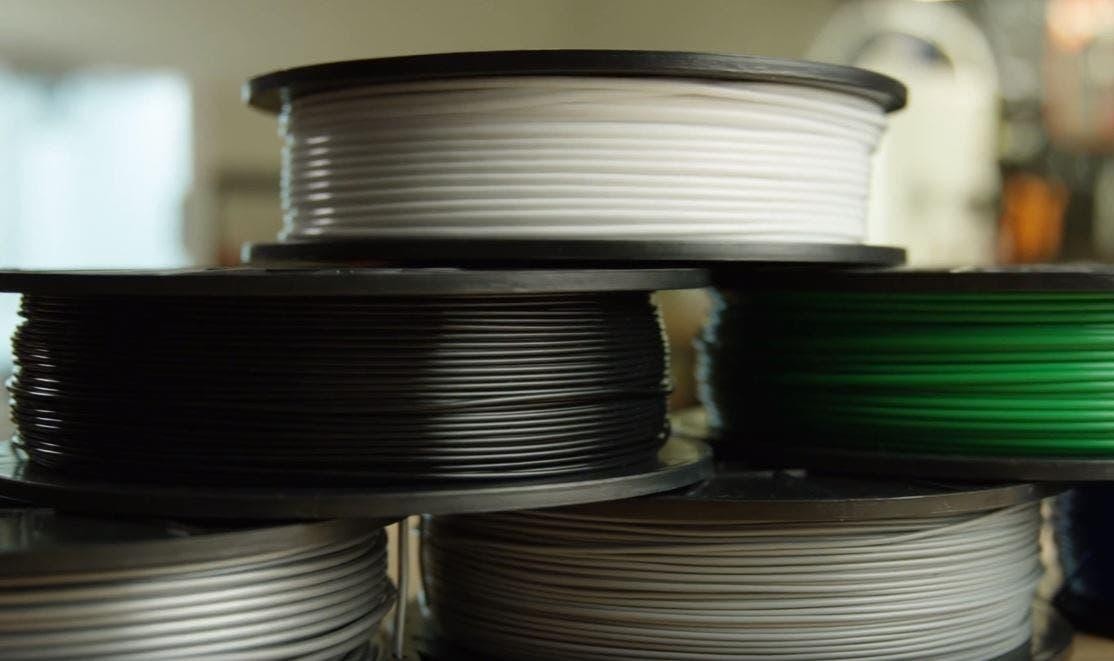
Mistakes to Avoid
- Assuming every carbon-filled filament is ESD safe: Carbon fiber reinforced filaments are widely available and contain carbon, but they're engineered for mechanical performance, not electrical performance. The carbon fiber loading and type that provides stiffness doesn't necessarily produce a resistivity in the ESD safe range. A carbon fiber filament that's great for structural parts may have resistivity well outside the 10⁵ to 10⁹ Ω/sq range that ESD applications require. Always verify measured resistivity, not just filler type.
- Choosing filament based only on price: The cheapest ESD safe filament on the market may have inconsistent carbon dispersion, meaning resistivity varies unpredictably across the printed part and between prints. ESD filament needs verified resistivity data from the supplier, not just a label that says "ESD safe."
- Choosing the wrong ESD material for the application: PLA ESD filament prints beautifully and produces clean, accurate parts. It's genuinely not suitable for most production electronics handling applications; the temperature resistance is too low, the mechanical durability under repeated use is insufficient, and the surface is more prone to wear that degrades the carbon network providing ESD performance. Know the application requirements before selecting the filament.
FAQ About ESD Safe Filament
Q: Is ESD filament conductive?
It depends on the type. Conductive filament has surface resistivity below 10⁵ Ω/sq and conducts electricity relatively freely. Anti static filament and static dissipative ESD safe filament sit in the 10⁵ to 10¹² Ω/sq range, allowing controlled charge movement without true electrical conductivity. Most electronics manufacturing applications need static dissipative ESD 3D printer filament rather than truly conductive filament.
Q: Is PLA ESD safe?
Standard PLA is not ESD safe, it's an insulator with surface resistivity above 10¹² Ω/sq. PLA ESD filament is a modified version with carbon additives that brings it into the static dissipative range. PLA ESD filament is genuinely ESD safe, but its thermal and mechanical limitations make it unsuitable for most demanding electronics manufacturing applications.
Q: Which ESD filament is best?
For most functional electronics fixtures: ABS ESD filament balances printability, mechanical performance, and ESD properties at reasonable cost. For high-performance tooling: PA12-ESD. For visual prototypes where ESD protection is needed: PLA ESD filament. There's no single best ESD safe 3D printing material, the application requirements determine the right choice. For industrial production, the best material depends on the required ESD level, mechanical performance, operating environment, and manufacturing process.
Q: Does ESD filament wear out?
The ESD properties of ESD filament are built into the bulk material, not coated on the surface, so they don't disappear suddenly. However, surface wear from repeated use, chemical contact, and UV exposure can shift resistivity over time, particularly at contact surfaces. High-use fixtures made from ESD 3D printer filament should be periodically tested for resistivity rather than assumed to maintain their initial specification indefinitely.
Q: Do I need a hardened steel nozzle?
Yes, for any carbon-filled ESD safe filament. Carbon black, carbon fiber, and carbon nanotube additives in ESD filament are abrasive and wear brass nozzles significantly faster than standard filament does. Hardened steel nozzles are the minimum recommendation; tungsten carbide nozzles offer even longer life for high-volume ESD filament printing.
Q: Can I print ESD filament on a standard FDM printer?
PLA ESD filament and PETG ESD filament print on most standard FDM printers with a hardened steel nozzle and filament drying. ABS ESD filament and PA12-ESD benefit significantly from an enclosed printer to prevent warping. PC-ESD typically requires an enclosed, higher-temperature machine. The hardware requirements increase with the performance level of the ESD safe filament.
Q: Is ABS-ESD better than PETG-ESD?
For most electronics manufacturing fixture applications, ABS ESD filament outperforms PETG ESD filament, because it handles higher temperatures, has better impact resistance, and the ESD formulations are more established and consistent. PETG ESD filament is easier to print and suitable for lighter-duty applications. The right choice depends on what the part needs to do.
Q: Can ESD filament be used for production parts?
Desktop-printed ESD safe 3D printing material can be used for low-volume production tooling and fixtures where consistent quality can be verified. For higher volumes and applications where consistent resistivity verification is required, industrial ESD safe 3D printing with process-controlled materials is the more reliable approach. Desktop ESD 3D printer filament printing is excellent for prototyping and engineering development; industrial production favors controlled manufacturing environments.
Conclusion: Making the Right ESD Filament Choice
ESD safe filament solves a real problem in electronics manufacturing, producing custom fixtures, jigs, and tooling that protect sensitive components from static discharge without the cost and lead time of injection molding or machined parts. The key is matching the right ESD filament material to the actual application: PLA ESD filament for rapid prototypes, ABS ESD filament for functional production tooling, PA12-ESD for demanding industrial applications.
Print it with hardened steel nozzles. Dry it before every use. Verify resistivity rather than assuming it. And when the application demands production-quality consistency that desktop printing can't reliably provide, industrial ESD safe 3D printing closes the gap between what a desktop machine can do and what electronics manufacturing actually requires.
Keep Learning
PLA vs PETG vs ASA: Best 3D Printing Filament for Outdoor Use
If you've ever watched a 3D printed garden hook sag in the sun or a cold snap crack your custom outdoor fixture, you already know: not all filaments are built for the elements. Choosing the best 3D printing filament for outdoor use isn't just about surviving the occasional drizzle. It's about UV exposure, temperature swings, moisture resistance, and long-term strength. And let's be real, most people don't want to reprint every few months just because they picked the wrong plastic. In this guide, we'll......
ABS Temperature Resistance: How Hot Can ABS Withstand?
Key Takeaways ABS heat resistance is defined by Tg and HDT, not melting point. Typical ABS grades have a Tg around 100–110℃ and HDT around 85–95℃. JLC3DP ABS reaches 98°C HDT under its published test conditions, but actual part performance depends on load, geometry, orientation, and exposure time. ABS offers higher heat resistance than PLA and PETG, while ASA provides similar heat performance with better outdoor durability. PC-ABS and PC are options when ABS is not enough. PC-ABS balances heat resista......
Is PETG Toxic to Print? Fumes, Risks & Safety Guide
Key Takeaways PETG is generally considered a lower-emission 3D printing material compared to ABS and ASA, but it does produce VOCs and ultrafine particles during printing. The odor during PETG printing is typically mild, some people barely notice it, others describe a faint warm-plastic smell. Low odor doesn't mean zero emissions. Ventilation is still a sensible precaution. PETG food safety is complicated, the material itself may be food-grade in some formulations, but the printing process introduces ......
Top 5 Heat-Resistant 3D Printing Filaments Compared
When Regular Filament Just Doesn’t Cut It You’ve 3D printed a functional bracket for a car engine bay. It fits perfectly, looks great, and then warps into a banana-shape after a week under the hood. That’s the danger of underestimating heat. If you're building automotive components, enclosures near motors, molds, or even kitchenware, using the wrong filament can lead to deformation, brittleness, or outright failure when exposed to heat. So, you already know the solution: Choosing the right heat-resist......
PLA Temperature Resistance: Heat Resistance, Softening & Melting Point
Key Takeaways PLA typically starts losing rigidity around 55–65℃ (Tg) and melts at approximately 150–180℃. PLA can deform and creep long before it melts, so melting point is not a practical service-temperature limit. Actual PLA deformation depends on temperature, load, geometry, print orientation, and exposure time. Standard PLA becomes increasingly risky above 50–60℃ and is generally unsuitable for sustained 70–80℃ applications. PLA+ heat resistance varies by formulation. For higher-temperature appli......
PETG Temperature Resistance: Limits & Comparison with PLA/ABS/ASA
Key Takeaways Standard PETG is best suited for continuous use below ~60℃; performance can decline as temperatures approach 70℃. PETG typically has a Tg of ~75–85℃ and an HDT of ~65–75℃, depending on the material grade and test conditions. HDT is not a maximum service temperature—load, print orientation, wall thickness, geometry, and exposure time all affect real-world performance. PETG offers better heat resistance than PLA but lower heat resistance than ABS, ASA, PA12-CF, PC, and PEEK. For sustained ......