ABS-ESD Plastic: Properties, Applications & Selection Guide
15 min
- Introduction
- When Should You Choose ABS-ESD Plastic?
- Why Choose ABS-ESD Over Standard ABS?
- How Does ABS-ESD Compare With Other ESD Materials?
- What Applications Is ABS-ESD Best Suited For?
- When Is ABS-ESD NOT the Best Choice?
- Design Guidelines for ABS-ESD Parts
- Manufacturing Methods for ABS-ESD Plastic
- How to Avoid Common ABS-ESD Selection Mistakes
- FAQ about ABS-ESD Plastic
Introduction
ABS-ESD is a specialized engineering ABS plastic developed for static-sensitive environments. Most engineers encounter ABS-ESD for the first time when a PCB fixture fails an ESD audit or a customer rejects a housing because it's not made from ESD safe ABS. The part was dimensionally correct. The material was wrong.
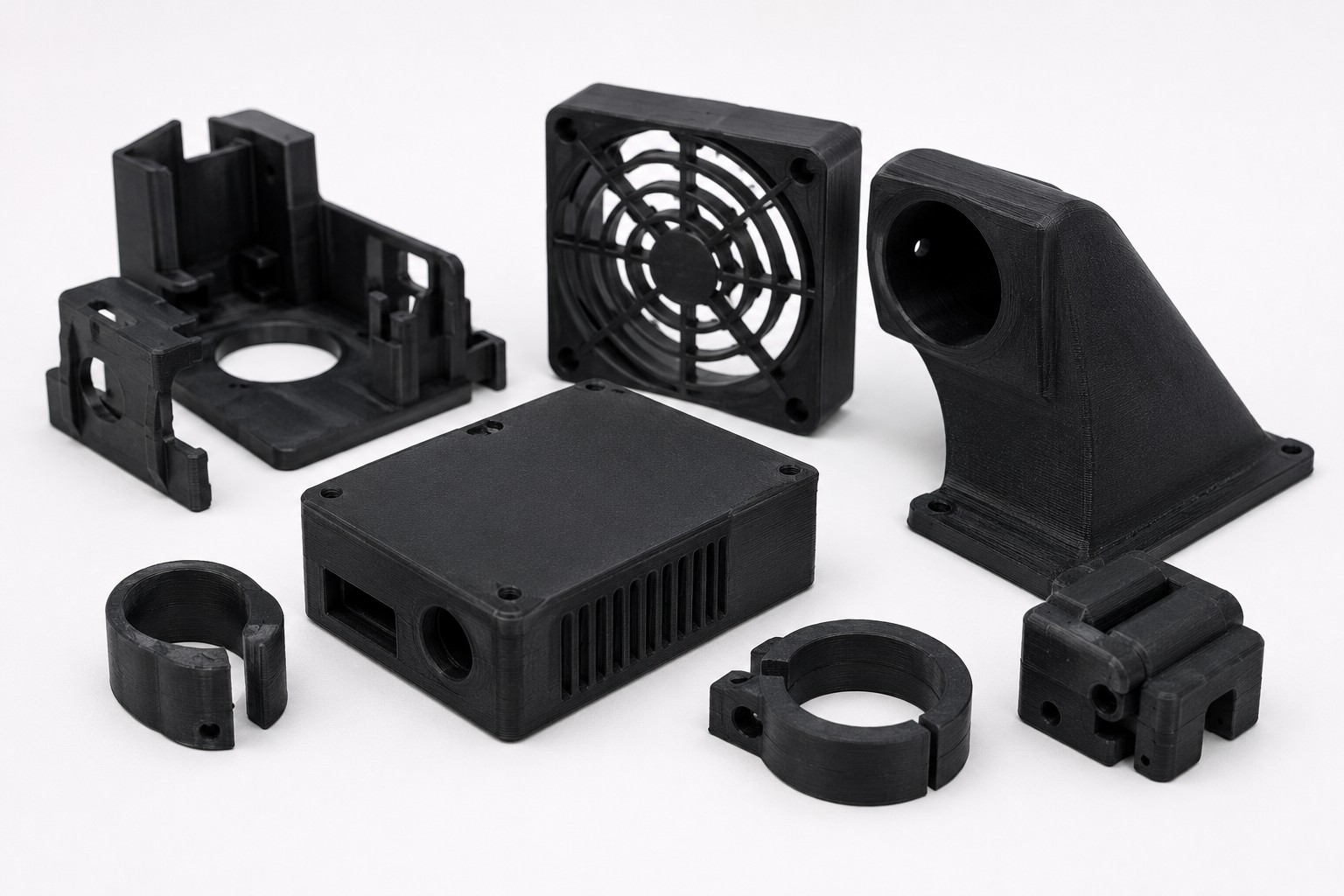
ABS-ESD plastic solves a specific problem, static charge accumulating on parts that contact or sit near electronics. It does that job well, it 3D prints reliably, and it costs less than most alternatives. But it's not the right choice for every application, and choosing it when something else fits better creates its own set of problems.
This guide covers when ABS-ESD is genuinely the right call, when it isn't, and how to design parts that get the most out of it.
Want to understand how ESD materials work before diving into ABS-ESD specifically? Start with our What Is ESD Plastic guide.
When Should You Choose ABS-ESD Plastic?
Choose ABS-ESD plastic when the part will contact, hold, or operate near electronics sensitive to static discharge, and when the application environment doesn't push beyond ABS-ESD's thermal limits. It hits the right balance of static dissipative performance, toughness, and printability for the majority of electronics manufacturing tooling and fixture applications.
| Requirement | Is ABS-ESD a Good Choice? |
|---|---|
| Static protection | Excellent, permanent dissipation built into material |
| Impact resistance | Moderate for fixture and tooling applications |
| Heat resistance | 78℃ (according to JLC3DP material data) |
| Prolonged outdoor exposure | Limited, UV degrades surface over time |
| High-temperature applications above 100℃ | Consider PC-ESD instead |
Typical Use Cases
PCB test fixtures are the most common ABS-ESD application in engineering departments. The fixture holds the board during testing, it contacts the PCB directly, sits next to sensitive components, and gets handled constantly. Standard ABS accumulates charge in exactly this scenario. ESD ABS eliminates that risk without requiring a more expensive or harder-to-print material. Read our guide on Standard ABS vs ESD ABS to help in decision-making.
SMT assembly jigs, electronics enclosures, functional prototypes for ESD environments, and production tooling for electronics manufacturing all follow the same logic, the part is in the wrong place to be made from an insulating material, and ABS-ESD plastic provides reliable static dissipation without asking for major changes to the design or manufacturing process.
Why Choose ABS-ESD Over Standard ABS?
Standard ABS is an insulator. Put it in an electronics manufacturing environment and it accumulates charge on every surface, charge that releases unpredictably when it contacts a component. ABS ESD is the same base polymer with carbon additives that give the material surface resistivity in the static dissipative range, so charge moves through the material gradually rather than building to a damaging discharge level.
The practical difference: a standard ABS fixture looks identical to an ABS-ESD fixture. The part fits the same way, feels the same, and costs about the same. The behavior on a charged surface is completely different.
| Property | Standard ABS | ABS-ESD Plastic |
|---|---|---|
| Static Dissipation | None, insulator | Permanent, built into material |
| Impact Strength | Good | Moderate |
| Dimensional Stability | Good | Good |
| Electronics Manufacturing | Not suitable | Excellent |
| Printability | Standard | Similar, requires hardened nozzle |
This comparison helps explain the material characteristics of ABS-ESD rather than serving as a full material selection guide.
The key phrase in that table is "permanent, built into material." Surface-applied anti-static coatings wear off. Carbon-filled ESD abs material doesn't, the dissipative network runs through the whole part, not just the surface layer. That permanence is why ESD safe ABS is specified for production tooling rather than just treated with a topical coating.
Looking for detailed specifications such as mechanical properties, build size, dimensional tolerance, wall thickness, and available colors? See our ABS-ESD Material Specification for the complete material data sheet.
How Does ABS-ESD Compare With Other ESD Materials?
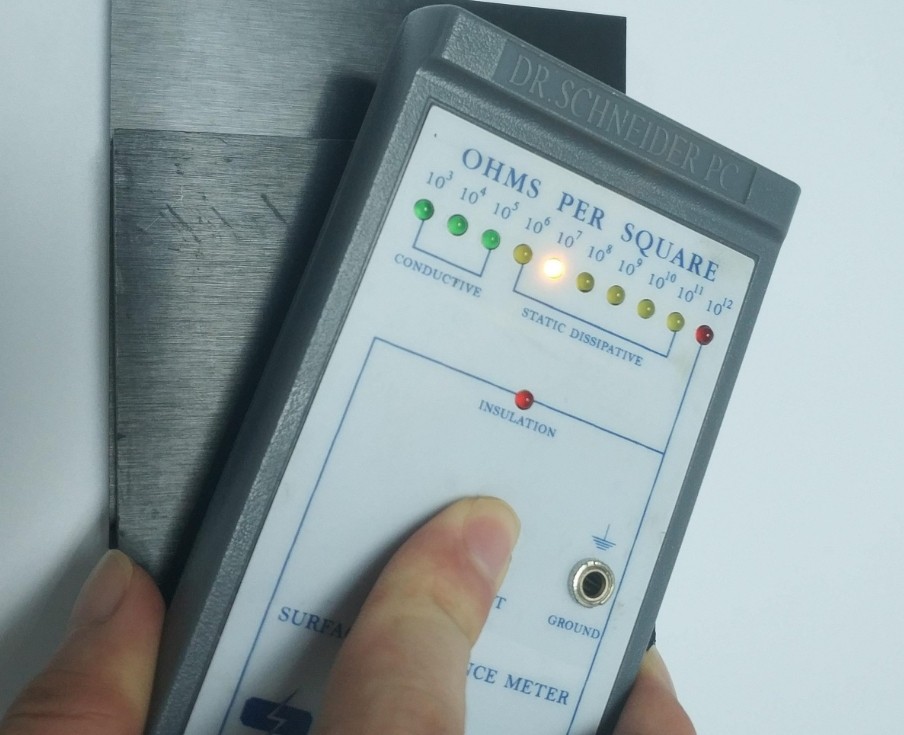
ABS-ESD plastic sits in the middle of the ESD material performance range, better than PETG-ESD on toughness, less demanding than PA12-ESD on print settings, cheaper than both PC-ESD and PEEK-ESD. For general electronics tooling and fixture applications, that middle ground is exactly where the right material should be.
| Material | Strength | Heat Resistance | Cost | Best For |
|---|---|---|---|---|
| ABS-ESD Plastic | ★★★★☆ | ★★★★☆ | $$ | General electronics tooling, fixtures, enclosures |
| PETG-ESD | ★★★☆☆ | ★★★☆☆ | $$ | Light-duty covers and guards |
| PA12-ESD | ★★★★★ | ★★★★☆ | $$$ | Industrial high-use tooling |
| PC-ESD | ★★★★☆ | ★★★★★ | $$$ | High-temperature enclosures, demanding environments |
Where ABS-ESD wins against PETG-ESD: better toughness, better heat resistance, more established ESD performance data. PETG-ESD makes sense for covers and light guards where mechanical demands are low.
Where PA12-ESD wins against ABS-ESD: higher mechanical performance overall and better chemical resistance for tooling that gets washed or exposed to process chemicals. PA12-ESD costs more and needs more careful drying and printing, which is why ABS-ESD remains the default for applications where PA12-ESD's extra capability isn't needed.
Where PC-ESD wins against ABS-ESD: sustained heat resistance above 100℃ and better impact toughness at elevated temperatures. ABS-ESD plastic isn't recommended for prolonged high-temperature environments, which is where PC-ESD takes over.
For most PCB fixtures, SMT jigs, and general electronics manufacturing tooling, ABS-ESD plastic is the appropriate choice. It's not over-specified like PEEK-ESD and not under-specified like PETG-ESD.
What Applications Is ABS-ESD Best Suited For?
The automation application is worth expanding. End-of-arm tooling (EOAT) for robots handling electronics needs to be ESD safe ABS or a comparable material, a robot gripper made from standard ABS picking up PCBs all day in a production environment is a significant static risk. ABS-ESD plastic handles the combination of wear resistance, dimensional consistency, and static dissipation that EOAT requires better than most alternatives at comparable cost.
Battery manufacturing is becoming one of the fastest-growing ABS-ESD application areas. Cell handling at every stage of battery assembly needs reliable ESD performance, lithium-ion cells are sensitive to electrostatic discharge during production, and the fixtures holding them need to be consistently within the static dissipative range throughout their service life. ESD abs material provides that consistency.
| Industry | Typical Parts | Why ABS-ESD? |
|---|---|---|
| PCB Assembly | Test fixtures, board holders | Reliable static dissipation at direct board contact |
| SMT Production | Assembly jigs, component placement guides | Dimensional stability across repeated thermal cycles |
| Consumer Electronics | Device housings, enclosures | Toughness for parts that get handled constantly |
| Automation | End-of-arm tooling, handling fixtures | Wear resistance in high-cycle applications |
| Battery Manufacturing | Cell positioning fixtures, module tooling | Consistent ESD performance in high-volume production |
When Is ABS-ESD NOT the Best Choice?
Knowing when not to use engineering ABS plastic in its ESD form is as important as knowing when to use it. Forcing ABS-ESD into applications it isn't suited for creates problems that the ESD protection doesn't compensate for.
The high-temperature limitation is the most common reason engineers move away from static dissipative ABS. If the part sits near a reflow oven, operates in an automotive engine-adjacent environment, or needs to survive sterilization cycles, ABS-ESD plastic will distort before the thermal requirement is met. Check the actual operating temperature against the material's heat deflection point before specifying it.
Chemical resistance is the other frequent limitation. ABS-ESD material handles mild cleaning agents reasonably well, but aggressive solvents, acids, and process chemicals attack ABS more than PA12 or PEEK. For parts in chemical-heavy manufacturing environments, the ESD property is the easy part, the chemical resistance is where ABS-ESD falls short.
| Requirement | Better Material |
|---|---|
| Sustained temperatures above 100℃ | PC-ESD, handles higher heat without distortion |
| Exposure to strong solvents or process chemicals | PEEK-ESD, chemically inert across most industrial chemicals |
| High-use industrial tooling needing maximum toughness | PA12-ESD, better fatigue and wear performance |
| Outdoor UV exposure over long periods | ASA-ESD if available, ABS-ESD degrades under UV |
Design Guidelines for ABS-ESD Parts
Uniform Wall Thickness
Maintain consistent wall thickness throughout the part whenever possible. Uniform walls help reduce internal stress, improve dimensional stability, and minimize the risk of warpage during manufacturing. When manufacturing ABS-ESD parts by additive manufacturing, wall thicknesses above 1.5 mm are recommended for structural sections and 1.0 mm for non-structural features to ensure sufficient strength and reliable material performance.
Learn more about Appropriate Wall Thickness for 3D Printing Parts.
Rib Design
Ribs increase stiffness without significantly increasing weight or material consumption. Keep rib thickness at 50–60% of the adjoining wall thickness to reduce the risk of sink marks and residual stress. Properly designed ribs improve the rigidity of fixtures and housings while maintaining dimensional stability.
Boss Design for Inserts
ABS-ESD performs well with threaded inserts, making it suitable for assemblies that require repeated fastening. Design boss outer diameters at approximately 2× the insert diameter, and match boss height to the insert length to provide adequate support while avoiding excessive material accumulation.
Use Fillets to Reduce Stress Concentration
Sharp internal corners create stress concentrations that can lead to cracking under repeated loading. Adding 0.5–1 mm fillets at internal corners distributes stress more evenly and improves the durability of ABS-ESD parts, especially for fixtures and tooling subjected to frequent handling.
Account for Thermal Expansion
Although ABS-ESD offers good dimensional stability, it still expands and contracts with temperature changes. When designing mating parts, snap fits, or assemblies, provide appropriate clearances and allow for thermal movement to maintain fit and function throughout the product's operating temperature range.
Tolerance Considerations
Industrial ABS-ESD 3D printing typically achieves tolerances of around ±0.2 mm on most features. For mating components or press-fit hardware, include sufficient design clearance and validate critical dimensions with prototype parts before production.
Manufacturing Methods for ABS-ESD Plastic
Industrial 3D printing is the right manufacturing method for ABS-ESD plastic when speed and flexibility matter more than the per-part economics of injection molding, which describes most engineering and electronics manufacturing tooling scenarios.
| Manufacturing Method | Best For |
|---|---|
| Industrial 3D Printing | Prototypes, custom fixtures, low-volume production |
| Injection Molding | High-volume production of identical parts |
| CNC Machining | Precision parts needing tight dimensional tolerances |
Injection molding ABS-ESD requires tooling, typically $10,000-50,000+ depending on part complexity, before a single part is made. For PCB fixtures and assembly jigs that might be needed in quantities of 5, 10, or 50, that tooling cost per part is prohibitive. If you're comparing manufacturing economics, our guide to 3D printing cost explains how tooling, material, order quantity, and production method affect the total cost of custom parts. Industrial ABS-ESD 3D printing skips the tooling entirely and delivers parts in days rather than weeks.
The other factor is design iteration. Electronics manufacturing tooling often needs to be updated when the board layout changes, the component changes, or the assembly process evolves. With 3D printed ABS-ESD parts, a design change is a file update and a new print. With injection molded parts, it's a tooling modification that costs money and takes weeks.
JLC3DP's ABS-ESD plastic combines industrial-grade static dissipative performance with good toughness and dimensional stability, making it suitable for custom PCB fixtures, electronics enclosures, and production tooling. Whether you need a single prototype or a batch of production fixtures, industrial ABS-ESD 3D printing reduces lead times without tooling investment.
How to Avoid Common ABS-ESD Selection Mistakes
Selecting based only on ESD values without checking mechanical performance. Surface resistivity in the right range is necessary but not sufficient. ABS-ESD plastic needs to physically survive the application, repeated handling, mechanical loading, temperature cycling. Engineers who optimize only for ESD performance end up with parts that are electrically correct and mechanically inadequate.
Ignoring operating temperature. JLC3DP ABS-ESD material starts to soften and distort approaching 78℃. Parts near reflow ovens, heat sources, or in automotive environments near the powertrain may regularly see temperatures in this range. Check actual operating temperature before specifying ESD ABS, it's the limitation that catches people most often.
Confusing carbon-filled ABS with certified ESD safe ABS. Carbon fiber reinforced ABS is widely available and contains carbon. It is not ABS-ESD. Carbon fiber filament is engineered for stiffness, not for resistivity in the static dissipative range. A carbon-filled ABS part may have surface resistivity outside the 10⁵ to 10ܽ Ω/sq ESD range entirely. Always use materials with measured and documented resistivity values, not materials that contain carbon for mechanical reasons.
Over-designing wall thickness to compensate for ESD concerns. Thick walls don't improve ESD performance, the static dissipative ABS material handles charge dissipation regardless of section thickness above the minimum. Adding unnecessary wall thickness to ESD ABS parts adds weight, print time, and cost without improving the electrical performance. Design to structural requirements, not to ESD requirements.
Choosing injection molding for low-volume ABS-ESD production. Tooling cost for injection molded ABS-ESD parts is significant and only justifies itself at production volumes that most electronics tooling applications never reach. For fixture quantities under a few hundred parts, industrial ABS-ESD 3D printing produces better economics and faster design iteration than tooled production.
FAQ about ABS-ESD Plastic
Is ABS naturally ESD safe?
No. Standard engineering ABS plastic is an electrical insulator with surface resistivity above 10ܽ² Ω/sq, it accumulates static charge rather than dissipating it. ABS-ESD is a modified version with carbon additives that bring resistivity into the 10⁵ to 10ܽ Ω/sq static dissipative range. Standard ABS is not a substitute for ESD safe ABS in electronics manufacturing environments.
Is ABS-ESD conductive?
ABS-ESD plastic is static dissipative, not conductive in the way a metal conductor is. Conductive materials have resistivity below 10⁵ Ω/sq. ABS-ESD plastic typically sits in the 10⁵ to 10ܽ Ω/sq range, charge moves through the material in a controlled way rather than freely. This controlled dissipation is what makes it appropriate for electronics manufacturing rather than a true conductive material.
Can ABS-ESD be machined?
Yes. ABS-ESD material machines well with standard tooling. Secondary machining of 3D printed ABS-ESD parts, drilling, tapping, milling flat reference surfaces, is common for adding precision features after printing. The carbon additives in ESD ABS are slightly more abrasive than standard ABS but don't significantly affect machining tool life at typical fixture machining volumes.
Can ABS-ESD be injection molded?
Yes, ABS-ESD plastic is available in pellet form for injection molding. The process requirements are similar to standard ABS with attention to drying and processing temperatures to maintain carbon additive distribution. For most fixture and tooling applications, industrial 3D printing is more practical than injection molding due to tooling cost and the typically low volumes involved.
How durable is ABS-ESD?
ABS-ESD material provides good durability for fixture and tooling applications with dimensional stability, and wear resistance under normal handling conditions. It is less impact-resistant than standard ABS (the carbon additives reduce toughness slightly) but handles the repeated-use demands of electronics manufacturing tooling well. For applications needing higher toughness, PA12-ESD is the better choice.
What industries use ABS-ESD?
Electronics manufacturing, PCB assembly, semiconductor fabrication, automotive electronics, battery manufacturing, and consumer electronics production are the primary industries specifying engineering ABS plastic in its ESD form. Any industry producing or handling components sensitive to electrostatic discharge uses ABS-ESD or a comparable ESD material for tooling and fixtures.
How do I choose between ABS-ESD and PA12-ESD?
If the application is general electronics fixtures, PCB tooling, and enclosures where operating temperatures stay below 78℃ and chemical exposure is minimal, ABS-ESD plastic is the appropriate choice at lower cost. If the application involves high-use industrial tooling, exposure to chemicals, or demanding mechanical loading over extended service life, PA12-ESD's better toughness and chemical resistance justify the higher cost. For most electronics manufacturing environments, ABS-ESD is the right starting point unless a specific performance gap pushes toward PA12-ESD.
Conclusion: Making the Right ABS-ESD Material Selection
ABS-ESD plastic is one of the most practical engineering plastic materials for electronics manufacturing, offering a balanced combination of static-dissipative performance, mechanical durability, and cost-effectiveness. It is well suited for PCB fixtures, SMT jigs, electronics enclosures, and other tooling where reliable ESD protection is a design requirement rather than an optional feature.
Making the right material selection means evaluating more than ESD performance alone. Mechanical strength, operating temperature, manufacturing method, production volume, and long-term service conditions should all be considered to ensure the material matches the application.
For rapid prototypes, custom fixtures, and low-volume production, industrial ABS-ESD 3D printing provides a fast and cost-effective manufacturing solution without the tooling investment required for injection molding, while still delivering reliable ESD performance for electronics manufacturing.
Keep Learning
Is PETG Toxic to Print? Fumes, Risks & Safety Guide
Key Takeaways PETG is generally considered a lower-emission 3D printing material compared to ABS and ASA, but it does produce VOCs and ultrafine particles during printing. The odor during PETG printing is typically mild, some people barely notice it, others describe a faint warm-plastic smell. Low odor doesn't mean zero emissions. Ventilation is still a sensible precaution. PETG food safety is complicated, the material itself may be food-grade in some formulations, but the printing process introduces ......
Top 5 Heat-Resistant 3D Printing Filaments Compared
When Regular Filament Just Doesn’t Cut It You’ve 3D printed a functional bracket for a car engine bay. It fits perfectly, looks great, and then warps into a banana-shape after a week under the hood. That’s the danger of underestimating heat. If you're building automotive components, enclosures near motors, molds, or even kitchenware, using the wrong filament can lead to deformation, brittleness, or outright failure when exposed to heat. So, you already know the solution: Choosing the right heat-resist......
PLA Temperature Resistance: Heat Resistance, Softening & Melting Point
Key Takeaways PLA typically starts losing rigidity around 55–65℃ (Tg) and melts at approximately 150–180℃. PLA can deform and creep long before it melts, so melting point is not a practical service-temperature limit. Actual PLA deformation depends on temperature, load, geometry, print orientation, and exposure time. Standard PLA becomes increasingly risky above 50–60℃ and is generally unsuitable for sustained 70–80℃ applications. PLA+ heat resistance varies by formulation. For higher-temperature appli......
PETG Temperature Resistance: Limits & Comparison with PLA/ABS/ASA
Key Takeaways Standard PETG is best suited for continuous use below ~60℃; performance can decline as temperatures approach 70℃. PETG typically has a Tg of ~75–85℃ and an HDT of ~65–75℃, depending on the material grade and test conditions. HDT is not a maximum service temperature—load, print orientation, wall thickness, geometry, and exposure time all affect real-world performance. PETG offers better heat resistance than PLA but lower heat resistance than ABS, ASA, PA12-CF, PC, and PEEK. For sustained ......
How to Print TPU Filament: Settings and Troubleshooting
Key Takeaways TPU is printable on ordinary FDM hardware. The material bends instead of breaking, but it punishes settings tuned for PLA — four changes (print slowly, print dry, retract gently, keep the filament path short) turn it into a routine material. Difficulty tracks Shore hardness. A 95A TPU prints readily on most FDM machines; 85A and softer grades demand a direct drive extruder and patience. TPU print settings start around a 210–230°C nozzle, 20–40mm/s speed, and minimal retraction — the full......
What Is 3D Printer Filament? Types and How to Choose
Key Takeaways 3D printer filament is the thermoplastic strand an FDM printer melts and deposits layer by layer. Two diameters dominate: 1.75mm mainstream, 2.85mm second. The main types of 3D printer filament sort into five practical groups — easy and rigid (PLA), tough and balanced (PETG), heat-resistant (ABS/ASA), flexible (TPU), engineering-grade (nylon, PC, PEEK) — plus composites and soluble support materials. Choosing comes down to four properties: strength versus stiffness, heat resistance, flex......