Why Is PEEK So Expensive? PEEK Price Explained
14 min
- What Is PEEK and Why Is It a Premium Engineering Plastic
- What Drives PEEK Price per kg in Global Markets
- Why PEEK Becomes Even More Expensive in Manufacturing and 3D Printing
- How to Reduce PEEK Manufacturing Cost
- PEEK Resin, Plastic and Engineering Grade Price Differences
- PEEK Sheet vs Rod vs 3D Printing Material Cost
- Why Is PEEK So Expensive Compared to Other Engineering Plastics?
- PEEK vs PEI (Ultem): Is PEEK Worth the Premium?
- When Is PEEK Worth the Cost in Engineering Applications?
- PEEK 3D Printing and Industrial Applications
- FAQ about PEEK Price and Cost
- Conclusion
You get the quote. The number looks wrong. You check it again. Nope, PEEK really does cost that much.
PEEK price per kg typically runs $80-150 for standard grades, and engineering or medical-grade PEEK material price can reach $300-500+ per kg depending on the form and certification. By comparison, nylon is at $3-8/kg or ABS at $2-5/kg and it's a legitimate question: what exactly are you paying for?
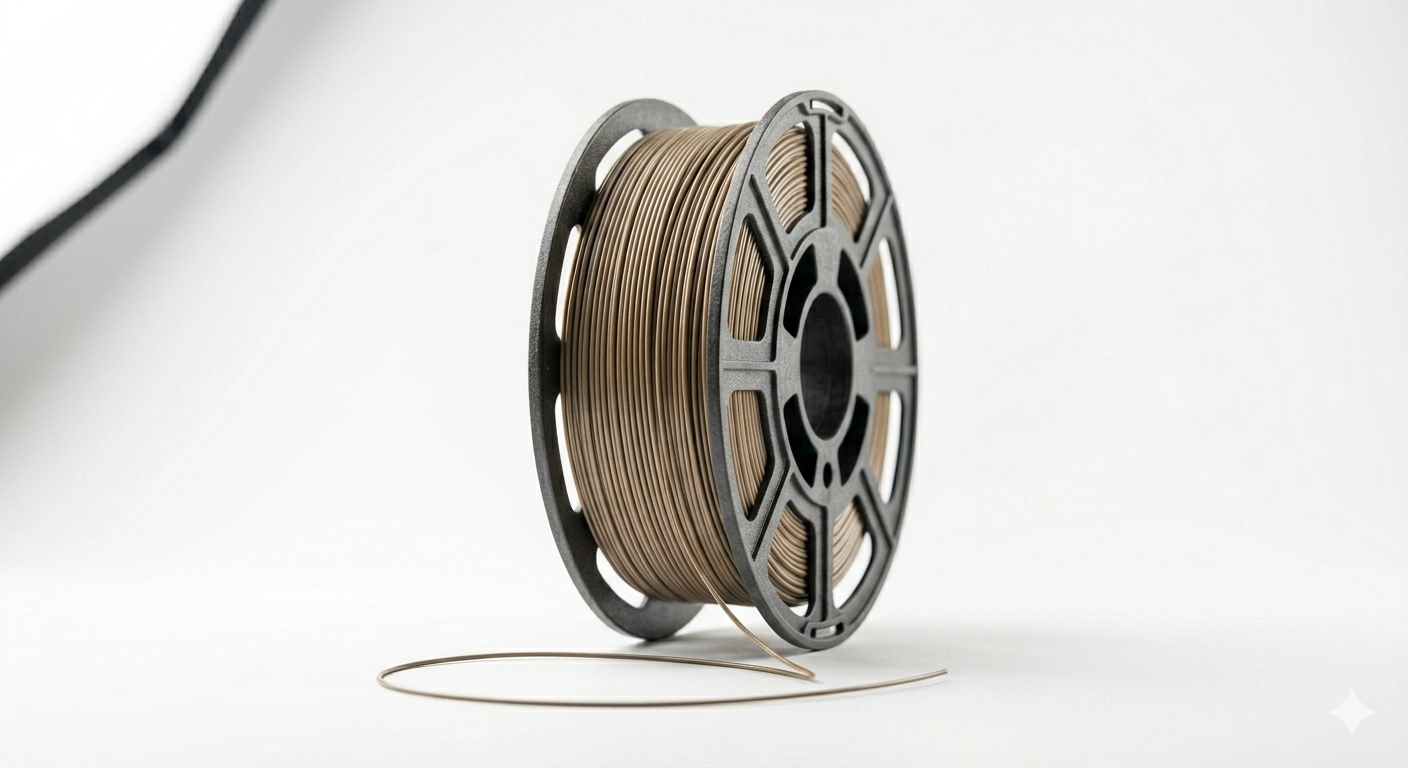
The answer isn't simple but it's logical. PEEK pricing reflects a genuinely difficult material to make, produced in limited quantities, for applications where getting it wrong is expensive.
This guide breaks down exactly where that cost comes from, and when it's actually worth it with real insights backed by JLC3DP engineers.
What Is PEEK and Why Is It a Premium Engineering Plastic
PEEK stands for Polyether Ether Ketone. The name isn't important. What's important is what it does that commodity plastics can't.
Most engineering plastics, nylon, ABS, polycarbonate, are general-purpose materials.
They're made in massive quantities, widely available, and priced accordingly. PEEK is none of those things. It's a specialty high-performance polymer used in applications where the operating environment would destroy standard plastics: continuous operation under no-load conditions, aggressive chemical exposure, repeated sterilization cycles, or mechanical loads that standard polymers handle poorly over time.
The PEEK material price reflects this positioning. It isn't competing with nylon for everyday brackets and housings. It's competing with titanium and aluminum in applications where a polymer that survives the environment saves significant weight and cost compared to metal alternatives.
The industries that specify PEEK, aerospace, medical, semiconductor, oil and gas, do so because the alternative to paying PEEK price is either using metal (heavier, harder to form into complex shapes) or using a cheaper polymer that fails in service. When the cost of field failure is a grounded aircraft, PEEK engineering plastic price becomes a line item rather than a barrier.
What Drives PEEK Price per kg in Global Markets
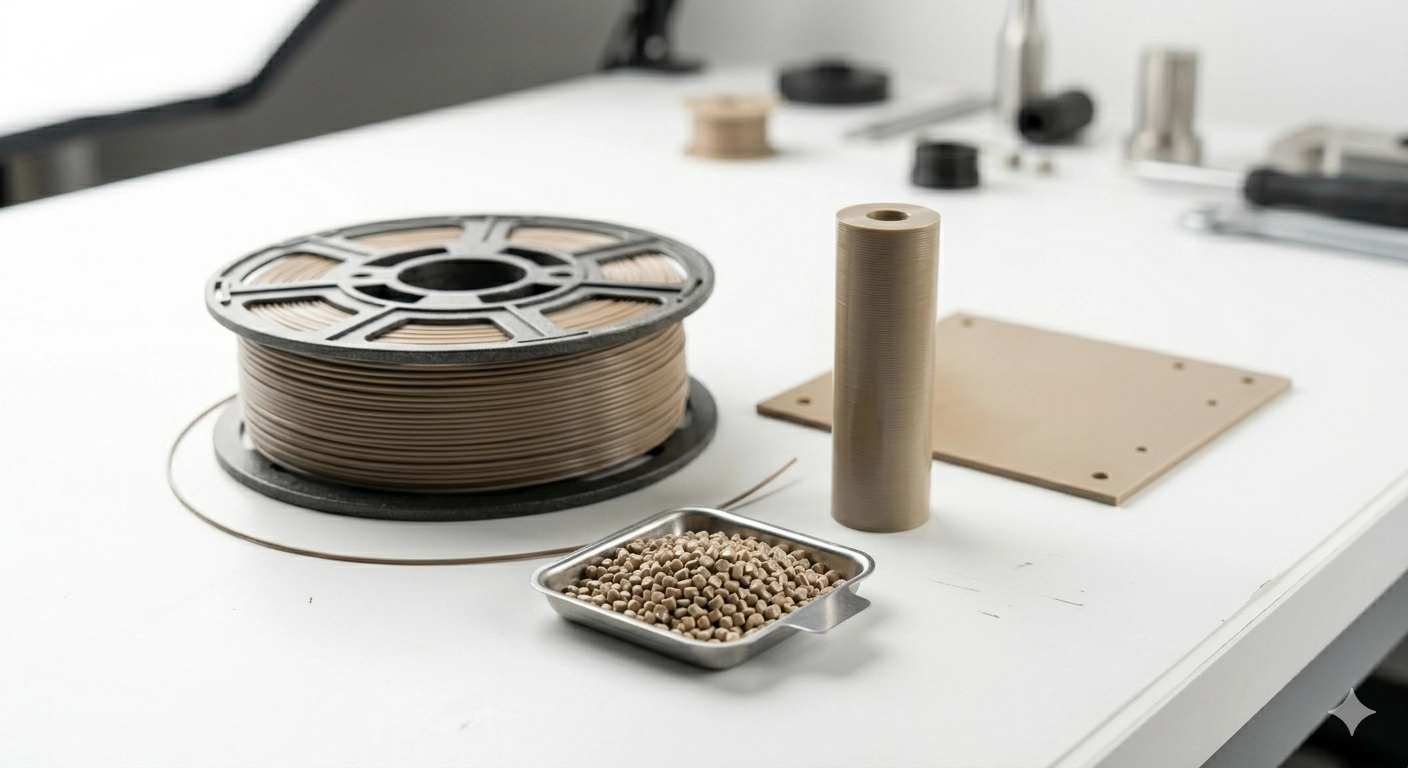
PEEK price per kg is high for four compounding reasons that don't apply to most other engineering materials.
The chemistry is genuinely difficult. PEEK is synthesized through nucleophilic aromatic substitution at temperatures above 300°C using toxic precursors that require specialized handling and reaction conditions. This process is difficult to scale economically, it requires dedicated equipment, strict process control, and significant capital investment per production facility.
Production volume is low. Global PEEK produced at significantly lower volumes than commodity plastics, orders of magnitude below commodity plastics that ship in millions of tonnes annually. Low volume means fixed costs are spread across fewer kilograms, which means higher cost per kg regardless of raw material input cost.
Certification adds real cost. Aerospace-grade and medical-grade PEEK material price includes the testing, documentation, and supply chain traceability that regulated industries require. A batch of PEEK that will be used in an aircraft interior or a surgical implant carries material certifications, lot traceability, and compliance testing that adds substantial cost beyond the polymer itself.
Supply concentration keeps prices firm. A small number of manufacturers (Victrex, Solvay, Evonik) dominate global PEEK supply. Limited competition means PEEK resin price doesn't face the same downward price pressure that commodity plastics experience. The market for PEEK is supplied by specialists to specialists.
Current PEEK price per kg ranges approximately: standard injection molding grade $80-150/kg, filament for 3D printing $150-300/kg, aerospace certified grades $300-600/kg.
Check out our 3D printing cost calculator to make everything easier.
Why PEEK Becomes Even More Expensive in Manufacturing and 3D Printing
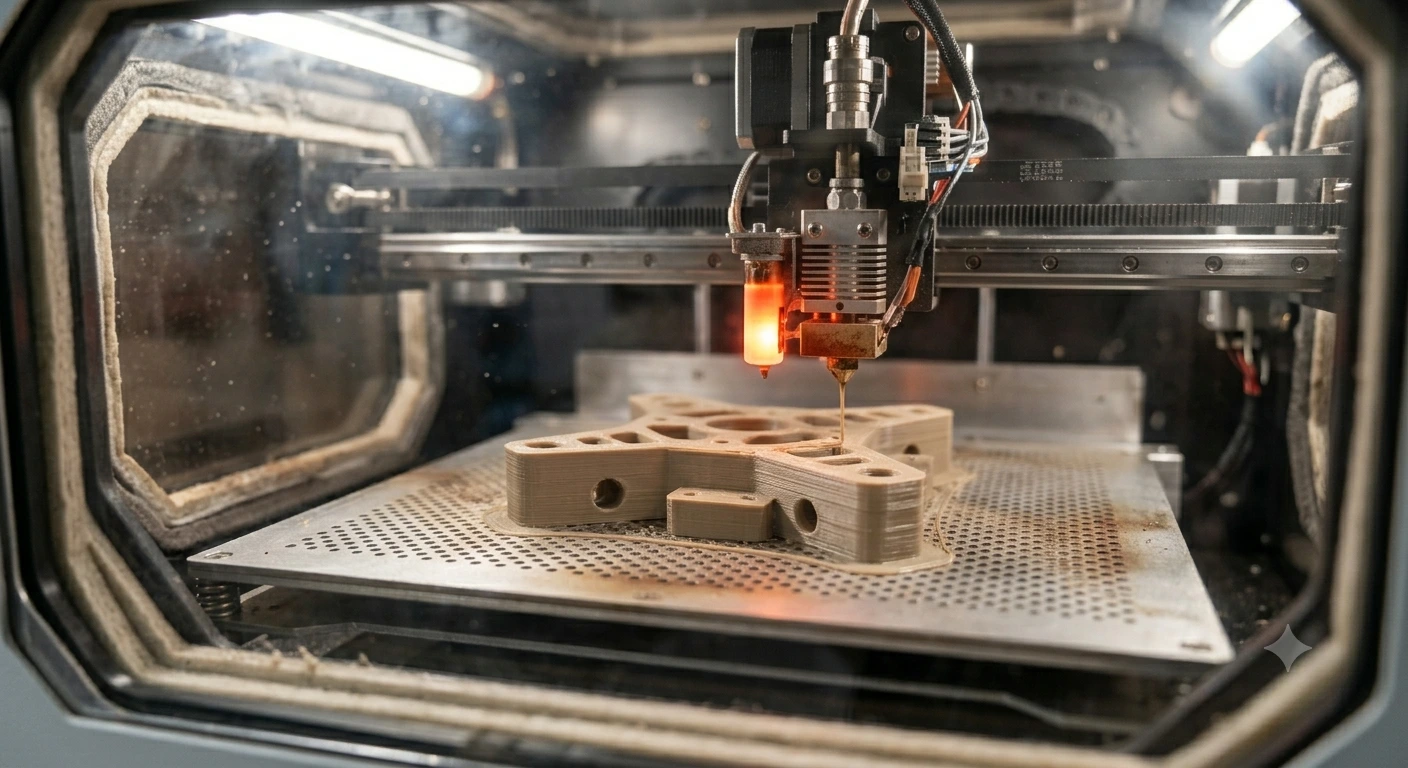
The PEEK material price is where the cost starts. Manufacturing turns that cost into something larger.
PEEK 3D printing cost is high even before the material enters the equation, because printing PEEK requires industrial equipment that most facilities don't own. Nozzle temperatures of 360-400°C, heated chambers of 120-160°C, and bed temperatures of 120-160°C put PEEK outside the capability of any standard FDM printer. The industrial machines that handle it, Stratasys Fortus, Apium P-Series, Intamsys FUNMAT HT, represent $30,000-150,000 in capital investment before the first PEEK part is printed.
That equipment cost gets factored into every hour of machine time. PEEK 3D printing service pricing typically carries significantly higher machine and operating costs than standard FDM printing. A complex PEEK part that takes 8 hours to print carries a machine cost of $1,600-4,800 before material consumption is added.
Failure rate amplifies cost further. PEEK warps during printing if process parameters aren't controlled precisely. A failed print on a material costing $200-300/kg wastes significant material cost alongside the machine time. In PEEK 3D printing, process stability requirements increase production cost, it's a real cost driver that pushes service pricing upward to cover the statistical probability of reprints.
CNC machining PEEK carries its own cost amplifiers. Machining productivity may be lower than commodity plastics and depends on tooling strategy, tooling wears faster than with many other engineering plastics, and the buy-to-fly ratio, starting material weight versus finished part weight, is often high for complex geometry. A PEEK part machined from rod or sheet stock with significant material removal carries the full material cost of the starting stock, not just the finished part.
For a PEEK printing service provider, all of these factors, equipment cost, failure rate, slow production speed, and high material cost, combine into per-part pricing that shocks engineers who are used to standard polymer pricing.
How to Reduce PEEK Manufacturing Cost
Optimize Part Geometry
Reduce unnecessary solid volume and use ribs or lattice structures where appropriate.
Minimize Machining Waste
For CNC machining, design parts closer to stock dimensions to improve material utilization.
Consider Additive Manufacturing
PEEK 3D printing can reduce waste for complex or low-volume parts.
Choose Certification Only When Needed
Aerospace certifications increase material and documentation costs.
PEEK Resin, Plastic and Engineering Grade Price Differences
PEEK price varies significantly depending on what form you're buying it in, and understanding why helps explain where the cost comes from at each stage.
PEEK resin price, raw polymer pellets or powder for injection molding, is the base cost of the material before any secondary processing. This is where the synthesis cost and supply concentration show up directly. Standard PEEK resin from Victrex or Solvay runs $80-150/kg for general grades.
PEEK filament for 3D printing costs substantially more than equivalent-weight resin, typically $150-300/kg for standard grades. The filament manufacturer buys PEEK resin, dries it, extrudes it to precise diameter tolerances, and spools it under controlled conditions. The extrusion process adds labor, equipment cost, and quality control overhead. The result is a material form that loses 15-25% of the starting pellet weight to off-spec material during production. The cost of that waste goes into the filament price.
PEEK engineering plastic price for certified grades used in aerospace or semiconductor applications includes testing, lot certification, documentation, and supply chain traceability that base grades don't carry.
Carbon fiber filled PEEK, CFPEEK, adds the cost of the carbon fiber reinforcement on top of the base PEEK plastic price, plus the compounding process that blends them uniformly. CFPEEK typically runs 20-40% higher than unfilled PEEK in equivalent form and grade.
Still feeling confused?
Get Your PEEK 3D Printing Project Started at JLC3DP by Uploading a File.

PEEK Sheet vs Rod vs 3D Printing Material Cost
| PEEK Material Form | Typical Applications | Relative Material Cost | Waste Generation | Key Advantage | Key Limitation |
|---|---|---|---|---|---|
| PEEK Sheet | Flat components, housings, plates, electrical insulation panels | Medium | Moderate to High (30–50% material removal common) | Excellent for flat or plate-like machined parts | Significant chip waste during CNC machining |
| PEEK Rod | Shafts, bushings, connectors, cylindrical components | Medium | High for heavily turned parts | Ideal for turned and rotationally symmetric components | Large diameter reductions can create substantial waste |
| PEEK Filament / Powder (3D Printing) | Complex geometries, lightweight structures, low-volume custom parts | Highest per kg | Very Low (typically ~10% extra material) | Minimal material waste and design freedom | Highest raw material price and specialized printing requirements |
Note: Material cost alone does not determine total part cost.
Practical Cost Comparison
| Manufacturing Method | Starting Material Required | Finished Part Weight | Material Utilization |
|---|---|---|---|
| CNC Machining from PEEK Rod | ~3 kg | 1 kg | ~33% |
| PEEK 3D Printing | ~1.1 kg | 1 kg | ~91% |
Why Is PEEK So Expensive Compared to Other Engineering Plastics?
| Material | Approximate Price per kg | Max Service Temperature | Chemical Resistance | Mechanical Performance |
|---|---|---|---|---|
| Nylon PA12 | $3-8 | 100-120℃ | Moderate | Good |
| PPS | $15-35 | 200-220℃ | Excellent | Good |
| PEI (Ultem) | $50-120 | 170℃ | Good | Very Good |
| PEEK | $80-150+ | 250°C sustained under no-load conditions | Excellent | Excellent |
| Certified PEEK | $300-600 | 250°C sustained under no-load conditions | Excellent | Excellent + documented |
PEEK cost per kg is higher than PEI and PPS not just because of performance but because of production economics. Both PPS and PEI are produced at larger volumes with more competitors in the supply chain. PEEK's more concentrated supply and more demanding synthesis process maintains higher pricing independent of performance comparison.
The nylon comparison is instructive. Nylon at $5/kg and PEEK at $100/kg, a 20x price difference, reflects the fact that nylon is produced in millions of tonnes annually by dozens of manufacturers for hundreds of commodity applications, while PEEK is produced in thousands of tonnes by a handful of specialists for demanding applications where performance requirements eliminate the alternatives.
PEI is worth understanding as the closest competitor to PEEK in the high-performance polymer space.
PEI handles temperatures to 170℃ and prints more easily than PEEK, for applications under 170°C without aggressive chemical exposure, PEI is often the engineering-appropriate choice at lower PEEK engineering plastic price.
PEEK's continuous no-load operation capability and superior chemical resistance are what justify the cost premium over PEI in applications that genuinely need them.
PEEK vs PEI (Ultem): Is PEEK Worth the Premium?
| Property | PEI (Ultem) | PEEK |
|---|---|---|
| Typical Price | Lower | Higher |
| Continuous Temp | ~170℃ | ~250℃ under no-load conditions |
| Chemical Resistance | Good | Excellent |
| Printability | Easier | More Difficult |
| Aerospace | Moderate | Strong |
Use PEI if:
- Below 170℃
- Cost sensitive
- Easier processing
Choose PEEK if:
- No-load operation above 200°C
- Chemical exposure
- Long-term reliability
In many projects, PEI is the economic choice. PEEK becomes valuable only when operating conditions exceed what PEI can reliably handle.
When Is PEEK Worth the Cost in Engineering Applications?
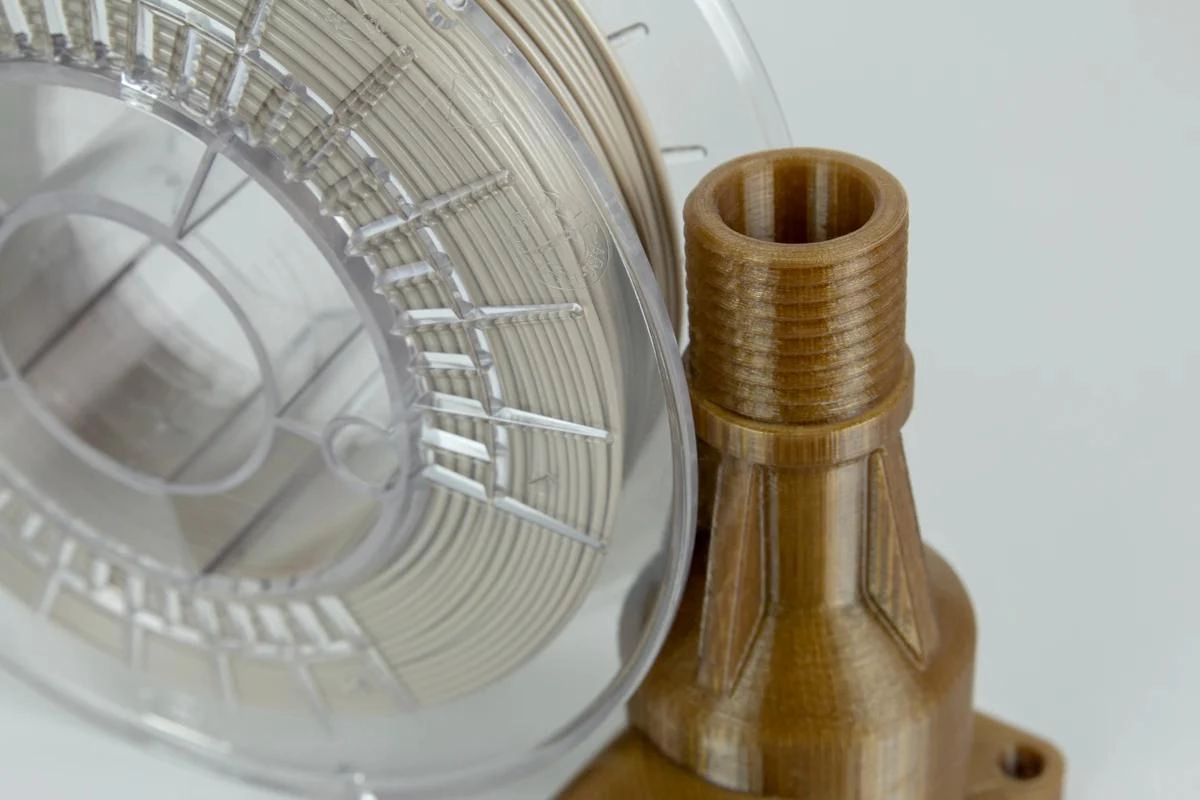
This is the question that matters for procurement decisions. PEEK cost per kg is a fact. Whether that cost is justified depends entirely on the application.
Use PEEK when:
The operating temperature exceeds 170°C sustained, this eliminates PEI and puts you in a range where few polymer options remain. PEEK’s continuous service temperature of 250℃ sustained under no-load conditions makes it the standard choice for components near heat sources in automotive, aerospace, and industrial equipment.
Chemical exposure would degrade alternatives, PEEK's resistance to fuels, hydraulic fluids, industrial solvents, and sterilization chemistry extends part life in applications where other polymers would require regular replacement. The cost comparison shifts when you factor in replacement frequency rather than just initial material cost.
Failure cost is high, an aerospace bracket that fails, a surgical instrument that can't be sterilized, an industrial component that degrades in a process fluid, the downstream cost of these failures dwarfs PEEK material price. In applications where the cost of failure is significant, PEEK is often the risk management decision as much as the engineering one.
Weight reduction versus metal is a real requirement, replacing an aluminum or steel component with a PEEK equivalent saves significant weight while maintaining structural function. The PEEK material cost versus metal cost comparison often favors metal initially, but total system cost including weight penalties (fuel consumption, payload capacity) frequently favors PEEK in aerospace and automotive applications.
Consider PEEK alternatives when:
The application operates below 150°C without significant chemical exposure, PEI, PPS, or engineering-grade nylon will perform adequately at substantially lower cost. Specifying PEEK for a bracket that never gets above 80°C is paying a premium for performance the application doesn't need.
Production volume is high and cost per unit is the primary driver, PEEK material 3D printing and machining costs are justified at low-to-medium volumes where the component's performance requirements demand it. At high production volumes of a stable design, injection molded PEEK or alternative materials become the economically rational choice.
PEEK 3D Printing and Industrial Applications
PEEK 3D printing has moved from laboratory curiosity to production process in specific application categories where the combination of complex geometry, high performance, and low volume makes additive manufacturing the right approach.
Aerospace brackets and housings printed in PEEK combine weight reduction from topology-optimized geometry with the thermal and mechanical performance that aircraft environments require. The low volumes typical of aerospace part numbers, often tens or hundreds of units rather than thousands, align well with PEEK 3D printing economics, where no tooling investment is required and part geometry can be optimized without machining constraint.
Automotive components in thermal exposure zones, sensor housings, fluid connectors, brackets adjacent to engines or exhaust systems, are increasingly produced in PEEK where operating temperatures exceed what standard engineering plastics handle reliably.
For engineers evaluating PEEK for a specific application, JLC3DP provides PEEK 3D printing service with industrial-grade equipment and process parameters validated for mechanical performance.

- Thermal stability — 144°C HDT & UL94 V0
- Strong & lightweight for structural parts
- Strong & lightweight for structural parts
FAQ about PEEK Price and Cost
Q: Why is PEEK so expensive?
PEEK is expensive because it requires a complex manufacturing process, has low global production volumes, and is supplied by only a small number of specialized manufacturers.
Q: What is PEEK price per kg?
Standard PEEK typically costs $80–150/kg, while PEEK filament ranges from $150–300/kg and certified aerospace grades can exceed $300–600/kg.
Q: Is PEEK worth the cost?
PEEK is worth the cost when applications require exceptional heat resistance, chemical resistance, and mechanical performance that cheaper plastics cannot provide.
Q: Why is PEEK more expensive than nylon?
PEEK is produced in much smaller volumes for specialized applications, whereas nylon is mass-produced globally for a wide range of commodity uses.
Q: What affects PEEK material price?
PEEK pricing is mainly influenced by manufacturing complexity, production volume, supply chain availability, material form, and certification requirements.
Conclusion
PEEK price per kg is high, and it's high for reasons that don't go away with scale or competition in the way commodity plastic pricing does. The synthesis is genuinely difficult, the market is genuinely small, and the certification requirements are genuinely demanding. PEEK material cost is what it costs to produce a material that survives where other plastics can't.
The engineering logic for PEEK is straightforward: when the application requires sustained high temperature, chemical resistance, and mechanical performance simultaneously, PEEK is often the only polymer that qualifies. When those requirements aren't present, PEEK engineering plastic price is hard to justify against alternatives that are adequate for the actual operating conditions.
For manufacturing applications, particularly PEEK 3D printing, the material cost is the starting point, not the full cost picture. Equipment requirements, processing complexity, and failure risk all amplify the material cost into per-part pricing that reflects the full difficulty of working with the material correctly.
Keep Learning
PLA vs PETG vs ASA: Best 3D Printing Filament for Outdoor Use
If you've ever watched a 3D printed garden hook sag in the sun or a cold snap crack your custom outdoor fixture, you already know: not all filaments are built for the elements. Choosing the best 3D printing filament for outdoor use isn't just about surviving the occasional drizzle. It's about UV exposure, temperature swings, moisture resistance, and long-term strength. And let's be real, most people don't want to reprint every few months just because they picked the wrong plastic. In this guide, we'll......
ABS Temperature Resistance: How Hot Can ABS Withstand?
Key Takeaways ABS heat resistance is defined by Tg and HDT, not melting point. Typical ABS grades have a Tg around 100–110℃ and HDT around 85–95℃. JLC3DP ABS reaches 98°C HDT under its published test conditions, but actual part performance depends on load, geometry, orientation, and exposure time. ABS offers higher heat resistance than PLA and PETG, while ASA provides similar heat performance with better outdoor durability. PC-ABS and PC are options when ABS is not enough. PC-ABS balances heat resista......
Is PETG Toxic to Print? Fumes, Risks & Safety Guide
Key Takeaways PETG is generally considered a lower-emission 3D printing material compared to ABS and ASA, but it does produce VOCs and ultrafine particles during printing. The odor during PETG printing is typically mild, some people barely notice it, others describe a faint warm-plastic smell. Low odor doesn't mean zero emissions. Ventilation is still a sensible precaution. PETG food safety is complicated, the material itself may be food-grade in some formulations, but the printing process introduces ......
Top 5 Heat-Resistant 3D Printing Filaments Compared
When Regular Filament Just Doesn’t Cut It You’ve 3D printed a functional bracket for a car engine bay. It fits perfectly, looks great, and then warps into a banana-shape after a week under the hood. That’s the danger of underestimating heat. If you're building automotive components, enclosures near motors, molds, or even kitchenware, using the wrong filament can lead to deformation, brittleness, or outright failure when exposed to heat. So, you already know the solution: Choosing the right heat-resist......
PLA Temperature Resistance: Heat Resistance, Softening & Melting Point
Key Takeaways PLA typically starts losing rigidity around 55–65℃ (Tg) and melts at approximately 150–180℃. PLA can deform and creep long before it melts, so melting point is not a practical service-temperature limit. Actual PLA deformation depends on temperature, load, geometry, print orientation, and exposure time. Standard PLA becomes increasingly risky above 50–60℃ and is generally unsuitable for sustained 70–80℃ applications. PLA+ heat resistance varies by formulation. For higher-temperature appli......
PETG Temperature Resistance: Limits & Comparison with PLA/ABS/ASA
Key Takeaways Standard PETG is best suited for continuous use below ~60℃; performance can decline as temperatures approach 70℃. PETG typically has a Tg of ~75–85℃ and an HDT of ~65–75℃, depending on the material grade and test conditions. HDT is not a maximum service temperature—load, print orientation, wall thickness, geometry, and exposure time all affect real-world performance. PETG offers better heat resistance than PLA but lower heat resistance than ABS, ASA, PA12-CF, PC, and PEEK. For sustained ......