How 3D Printing Is Used to Create Custom Wedding Rings
9 min
- Why Is 3D Printing Changing Custom Wedding Ring Design?
- The Process of Creating a Custom 3D Printed Wedding Ring
- What Types of Wedding Rings Can Be Created with 3D Printing?
- Which 3D Printing Technology Is Used for Wedding Rings?
- FAQ About 3D Printed Wedding Rings
For couples looking for something beyond a standard design, customization is often the priority. However, producing a one-off ring with unusual geometry or intricate details can be difficult and time-consuming using traditional methods alone.
This is where 3D printing fits into the process.
Rather than moving directly from a sketch to a finished metal ring, jewelers can develop the design digitally, print a physical model, review the result, and make adjustments before casting or final production. This gives designers more room to experiment while reducing the risk of discovering problems too late.
It is also worth clearing up a common misunderstanding: 3D printed wedding rings are not necessarily plastic rings. In many jewelry workflows, 3D printing is used to create a detailed resin or wax-like pattern. That pattern is then cast in gold, silver, platinum, or another metal.
For a broader look at this workflow, see our guide to 3D printing for complex jewelry design.
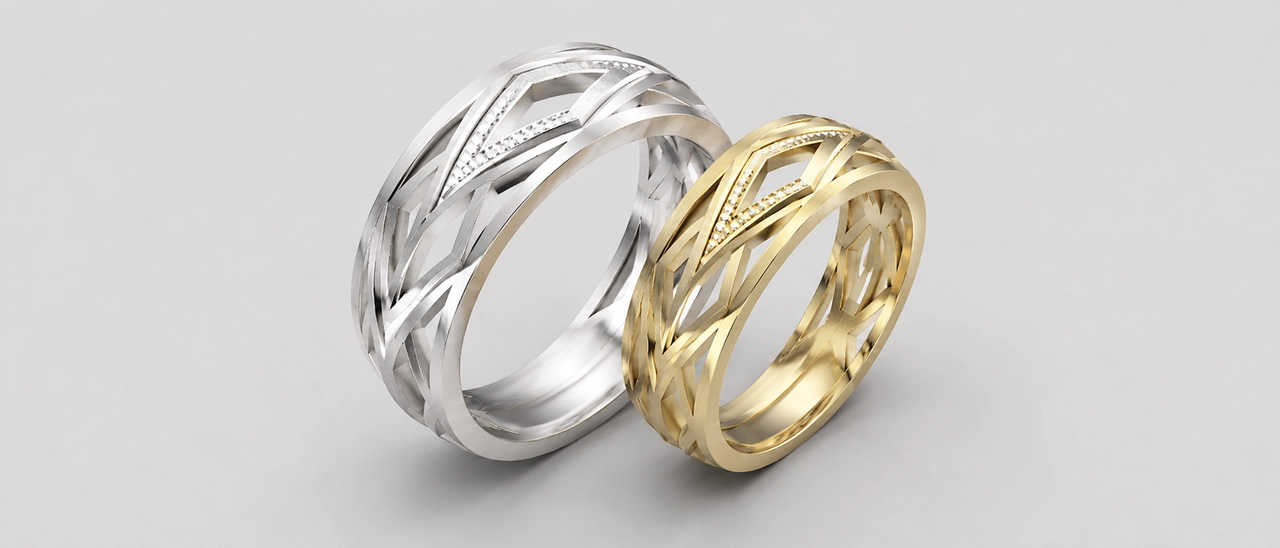
Figure 1:Custom gold- and silver-tone wedding rings featuring intricate openwork patterns enabled by 3D printing.
Why Is 3D Printing Changing Custom Wedding Ring Design?
Limitations of Traditional Jewelry Design
Traditional jewelry making remains essential for producing high-quality wedding rings, but highly customized designs can require more time and manual work. Changes to the ring size, engraving, shape, or surface pattern may mean reworking the model or creating a new mold.
Some features are also harder to produce consistently with traditional methods, including:
- Repeating geometric patterns
- Fine engraved details
- Organic or irregular surfaces
- Bands shaped around an engagement ring
- Coordinated matching ring sets
3D printing gives jewelers a faster way to test and refine these ideas before final production.
Digital Customization Possibilities
Most custom 3D printed wedding rings begin as CAD models. Designers can adjust the ring size, band thickness, engraving, texture, stone setting, and inner profile directly in the digital file.
Because the model remains editable, changes can be made without starting over. Customers can review renderings before production, while designers can confirm that the ring is practical to print, cast, polish, and wear.
This digital workflow is also useful for custom wedding rings that need to fit around an existing engagement ring or include personal details such as dates, initials, or fingerprints.
Designers preparing a model for production can also review JLC3DP’s guidance on designing printable 3D models.
Complex Designs Made Easier
3D printing makes detailed and unconventional ring designs easier to develop, including lattice structures, geometric surfaces, asymmetrical bands, and nature-inspired patterns.
A high-resolution resin prototype allows designers to inspect fine details in person and correct areas that may be too thin, sharp, or difficult to cast before moving to the final metal ring.
This is one of the main reasons 3d printed jewelry design is especially useful for one-off pieces and small collections.
The Process of Creating a Custom 3D Printed Wedding Ring
The exact production method varies depending on the ring design, final material, and jewelry manufacturer. However, most projects follow three main stages.
Step 1: CAD Design
The process starts with a sketch, reference image, existing ring, or written idea. The jewelry designer turns it into a 3D CAD model and adjusts the size, wall thickness, engraving, stone setting, comfort, and casting allowance.
Before production, the design can be reviewed from different angles and revised without making a physical model each time.
For custom 3D printed wedding rings, this stage is particularly useful because even small changes to the band profile or engraving can significantly affect the final appearance and fit.
Step 2: 3D Printing the Prototype
Once the CAD model is approved, it is prepared for 3D printing.
SLA and other resin-based technologies are commonly used because they can reproduce smooth surfaces and fine details. The printed model may serve as a fitting prototype or as a castable pattern for investment casting.
This stage helps identify issues such as incorrect proportions, unreadable engravings, or overly delicate details before the ring is made in precious metal.
For detailed prototypes, designers can explore JLC3DP’s SLA 3D printing service and compare suitable resin options before placing an order.
Step 3: Casting and Finishing
For gold, silver, or platinum wedding rings, the printed pattern is often used in investment casting.
The typical process is:
- Print the ring pattern in castable resin or wax-like material
- Create the investment mold and burn out the pattern
- Fill the cavity with molten metal
- Remove, clean, polish, and finish the ring
- Set gemstones if needed
The final piece combines digital manufacturing with traditional jewelry skills such as polishing, texturing, plating, and stone setting.
This hybrid process is one of the most established ways to produce 3D printed wedding rings in precious metals.
What Types of Wedding Rings Can Be Created with 3D Printing?
Personalized Engraved Rings
Names, initials, dates, coordinates, fingerprints, and custom symbols can be built directly into the CAD model.
Digital modeling also helps designers confirm that the lettering is large and deep enough to remain visible after casting and polishing.
Unique Geometric Designs
3D printing supports faceted bands, repeating patterns, asymmetrical shapes, interlocking forms, and layered textures.
Thin walls and narrow gaps may still need to be adjusted according to the selected material and production process.
Custom-Fit Wedding Bands
Customization is not always about decoration.
A wedding band may need to fit closely around an existing engagement ring. CAD modeling allows the band to follow the engagement ring’s profile more accurately while also improving comfort around the inner surface.
This makes the workflow particularly useful for custom 3D printed wedding rings with non-standard shapes.
Matching Wedding Ring Sets
3D printing can also help designers create coordinated ring sets.
The two rings do not need to look identical. They may share the same engraving, texture, pattern, or geometric feature while remaining individually shaped.
Creating both designs in the same CAD environment makes it easier to maintain visual consistency and adjust proportions before production.
Which 3D Printing Technology Is Used for Wedding Rings?
The best option depends on what the printed part is for: a visual prototype, a casting pattern, or the final metal ring. For most custom wedding ring projects, SLA printing and castable resin are used during development and casting, while direct metal printing is reserved for more specialized designs.
SLA 3D Printing
SLA, or stereolithography, cures liquid resin layer by layer using light. It is widely used for jewelry prototypes because it can reproduce fine details, smooth curves, small text, and accurate geometry.
Standard SLA resin is ideal for checking the shape, size, fit, and appearance of a design before production. However, regular prototype resin is not always suitable for casting.
For this reason, SLA jewelry printing materials should be selected according to the next manufacturing step rather than appearance alone.
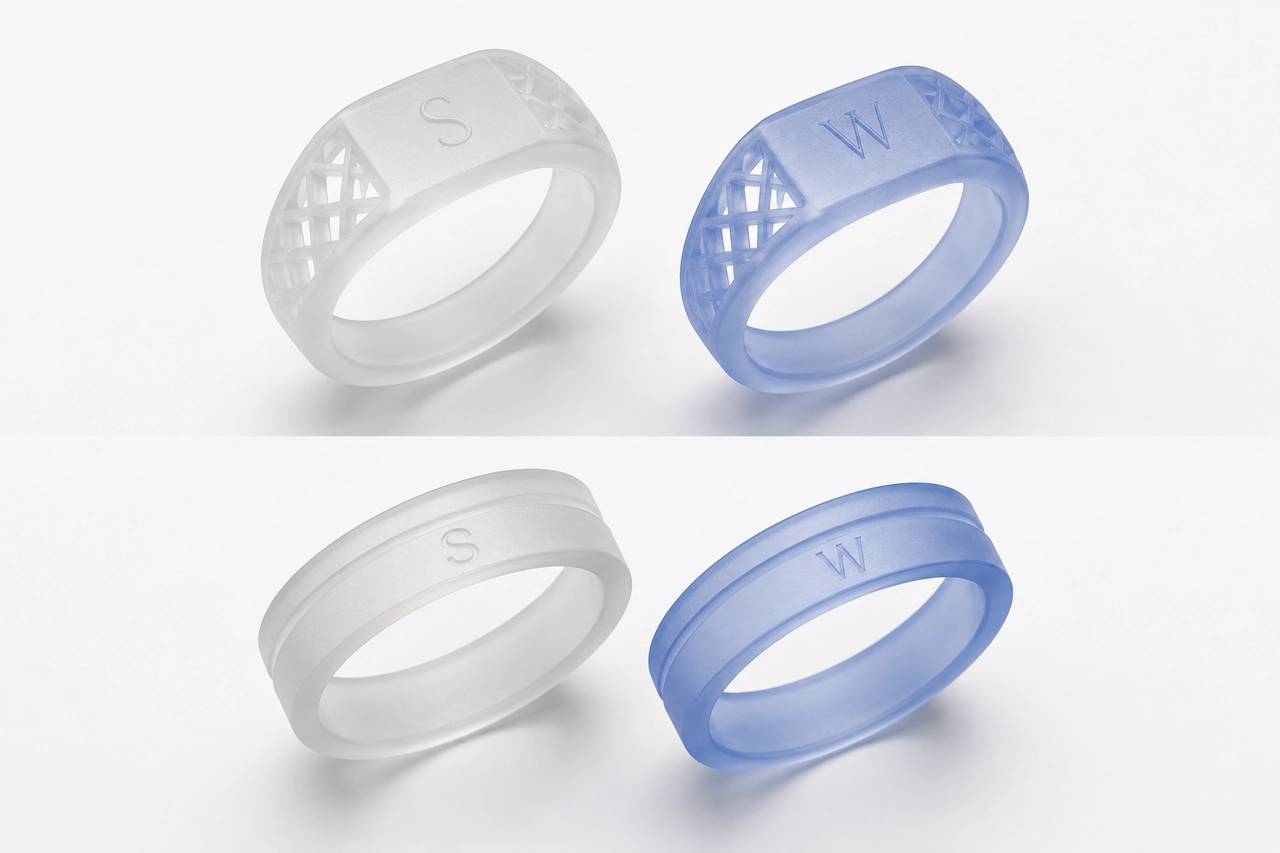
Figure 2: SLA-printed wedding ring prototypes used to evaluate surface detail, proportions, and fit before final production.
Castable Resin
Castable resin is developed specifically for investment casting. Instead of serving only as a visual model, the printed pattern is burned out of the mold and replaced with molten metal.
This material is commonly used for wedding bands, engagement ring settings, pendants, earrings, and small-batch jewelry collections.
Successful castable resin jewelry production also depends on model orientation, support placement, cleaning, curing, and the burnout schedule.
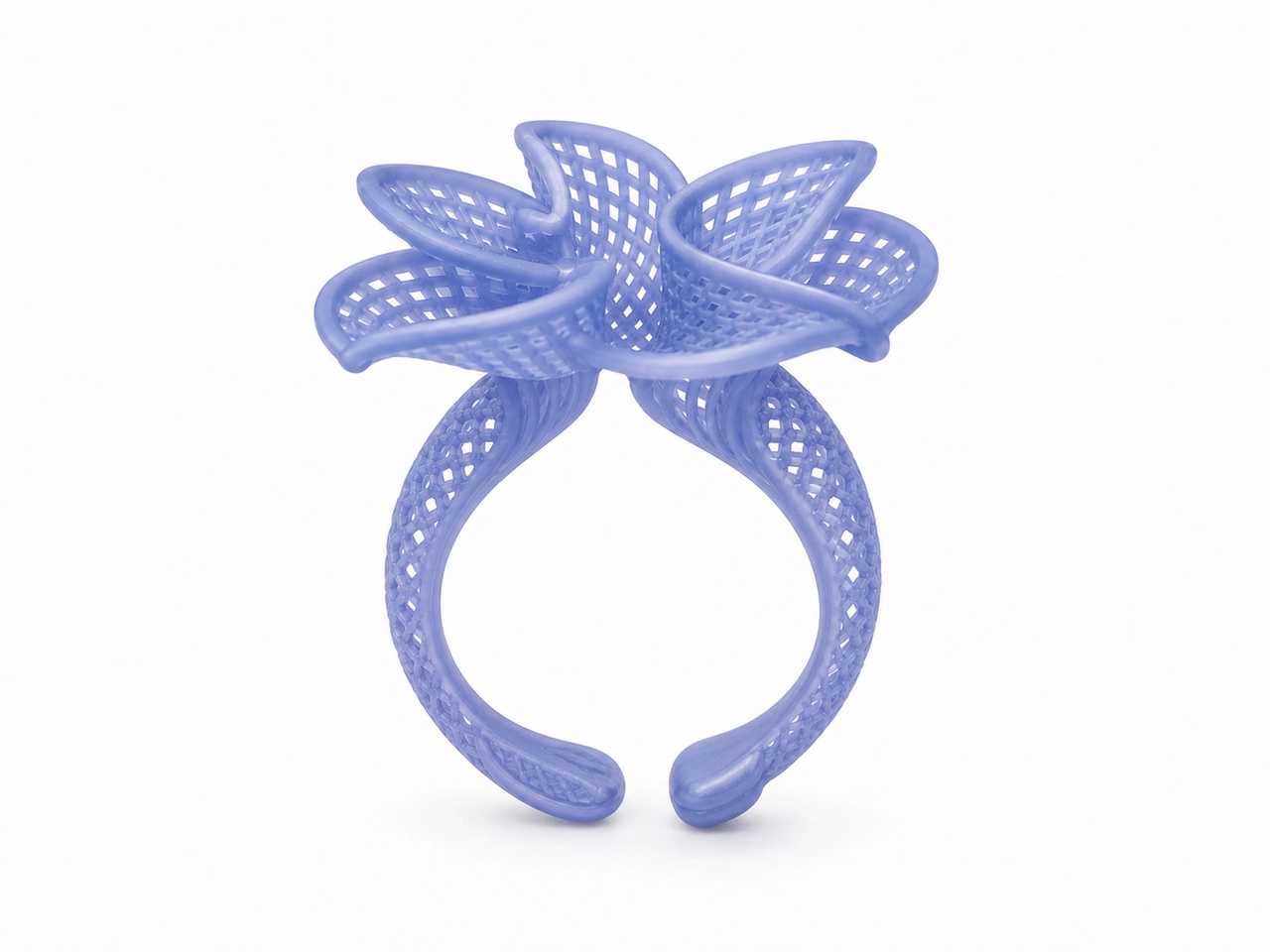
Figure 3: A castable resin ring pattern with a complex lattice design, prepared for investment casting.
Metal 3D Printing
Metal 3D printing produces the ring or jewelry component directly in metal. It can be useful for complex geometries, lightweight lattice structures, titanium rings, stainless-steel jewelry, and forms that are difficult to cast.
However, it is not always the most practical option for traditional gold, silver, or platinum rings. Material availability, cost, surface finish, tolerances, and post-processing all need to be considered.
For many precious-metal designs, printing a castable pattern and using investment casting remains the more established production route. Designers considering direct production can also review JLC3DP’s metal 3D printing introduction.
Figure 4:A directly metal 3D-printed ring featuring an intricate openwork structure that would be difficult to produce using conventional methods.
Technology Comparison
For most 3D printed wedding rings, SLA is best for design validation, castable resin is best for precious-metal casting, and metal 3D printing is best for specialized designs.
Ready to test a custom ring design before final production? Upload your model to JLC3DPto compare suitable printingto compare suitable printing technologies and materials.
FAQ About 3D Printed Wedding Rings
Q1: Can a wedding ring really be 3D printed?
Yes. 3D printing is widely used to produce wedding ring prototypes and casting patterns. Some rings can also be printed directly in metal, although many precious-metal wedding rings are still produced by printing a castable model and converting it into metal through investment casting.
Q2: Are 3D printed wedding rings made from plastic?
Not necessarily. A resin or plastic model may be printed during the design and validation stage, but the final ring can be made from gold, silver, platinum, titanium, stainless steel, or another metal. The term “3D printed wedding ring” often refers to the production workflow rather than the final material.
Q3: Are 3D printed wedding rings durable?
Durability depends on the final material, wall thickness, geometry, casting quality, and finishing process. A gold or platinum ring cast from a 3D printed pattern can be suitable for everyday wear when it is properly designed and manufactured. Very thin or delicate designs should be reviewed carefully before production.
Q4: What materials are used for 3D printed wedding rings?
Common materials used for 3D printed wedding rings include standard resin for visual prototypes, castable resin for investment casting, wax-like printing materials, stainless steel, titanium, and precious metals produced through casting or specialized metal printing processes. The right material depends on the purpose of the printed part. Prototype materials are mainly used to evaluate design details and fit, while castable materials are selected for creating molds for metal casting. For final production, metal options may be considered based on the desired appearance, durability, design complexity, and manufacturing requirements.
Keep Learning
Why You Need Custom Footwear: The Comfort Revolution of 3D Printed Shoes
Welcome to the world of 3D printed shoes, a revolutionary approach changing how footwear is made and experienced. Using advanced technology known as additive manufacturing, 3D printing shoes creates footwear layer by precise layer; a whole new way of thinking about fashion, function, and sustainability. Instead of stitching and gluing pieces together, each pair is printed in one seamless piece using advanced printing materials. And then you get shoes that are flexible, durable, breathable, and unbelie......
How 3D Printing Is Used to Create Custom Wedding Rings
Wedding rings are deeply personal. Even when two rings appear simple, details such as shape, engraving, texture, fit, and material can carry a great deal of meaning. For couples looking for something beyond a standard design, customization is often the priority. However, producing a one-off ring with unusual geometry or intricate details can be difficult and time-consuming using traditional methods alone. This is where 3D printing fits into the process. Rather than moving directly from a sketch to a f......
3D Printed Basketball Materials: Comparing TPU and PEBA Performance
Wilson dropped their airless basketball concept and the maker community went wild. Suddenly everyone wanted to print one. The problem is that most people grabbed whatever flexible filament they had, printed a lattice basketball, bounced it twice, and posted a disappointed video. The ball looked right. It didn't play right. The material choice is almost everything with a 3D printed airless basketball. Get it wrong and you get a ball that thunks instead of bounces, or cracks after a week of casual dribb......
Sustainable 3D Printed Furniture: The Future of Design
As 3D printing opens new doors across various fields, 3d design for furniture has also become increasingly popular. While mass production of furniture likely won’t stop any time soon, experimenting with innovative design, new functions, and complex geometry is something that additive manufacturing is perfect for. 3D furniture offers creative freedom for designers, with the potential of customization for clients, and the benefits of lower cost, sustainable material use and renewed aesthetics. 3d furnit......
Why 3D Printed Fabric Is the Next Big Revolution in Fashion
Additive manufacturing isn’t only reshaping the manufacturing of objects, but also revolutionizing 3D printed fabric. The fashion industry and forward-thinking 3D print fashion designer professionals can greatly benefit from 3D printing for fashion due to the complex geometries, design freedom, and customization it offers. 3D printed clothing can be both wearable and functional, while also enabling the creation of pieces with unique shapes and textures for futuristic runways and fashion shows. What se......
Custom 3D Printed Shoes – Design, Print & Wear Your Unique Pair
According to industry reports, the 3D printed footwear market represents a highly valuable segment, with projections indicating it will grow into a $5.9 billion revenue opportunity during the period from 2019 to 2029 (source: Research and Markets ). This growth is largely driven by advancements in additive manufacturing. Thanks to 3D scanning, manufacturers have recognised the potential of customisation—whether it’s a unique fashion piece or a functional running shoe. The features are fascinating, as ......