ABS vs ABS-ESD: Key Differences and How to Choose the Right Material
11 min
- Introduction
- What Are ABS 3D Printing Materials?
- What Is the Difference Between ABS and ABS-ESD?
- How Do the Mechanical Properties Compare?
- Which ABS 3D Printing Material Should You Choose?
- Should You Use Desktop Printing or Industrial 3D Printing?
- JLC3DP Engineering Insights: 3 Common Material Selection Mistakes
- FAQ about ABS 3D Printing Materials
Introduction
Standard ABS is the best choice for most general engineering parts. Choose ABS-ESD only when your application requires protection against electrostatic discharge (ESD), such as PCB fixtures, SMT assembly jigs, or semiconductor tooling.
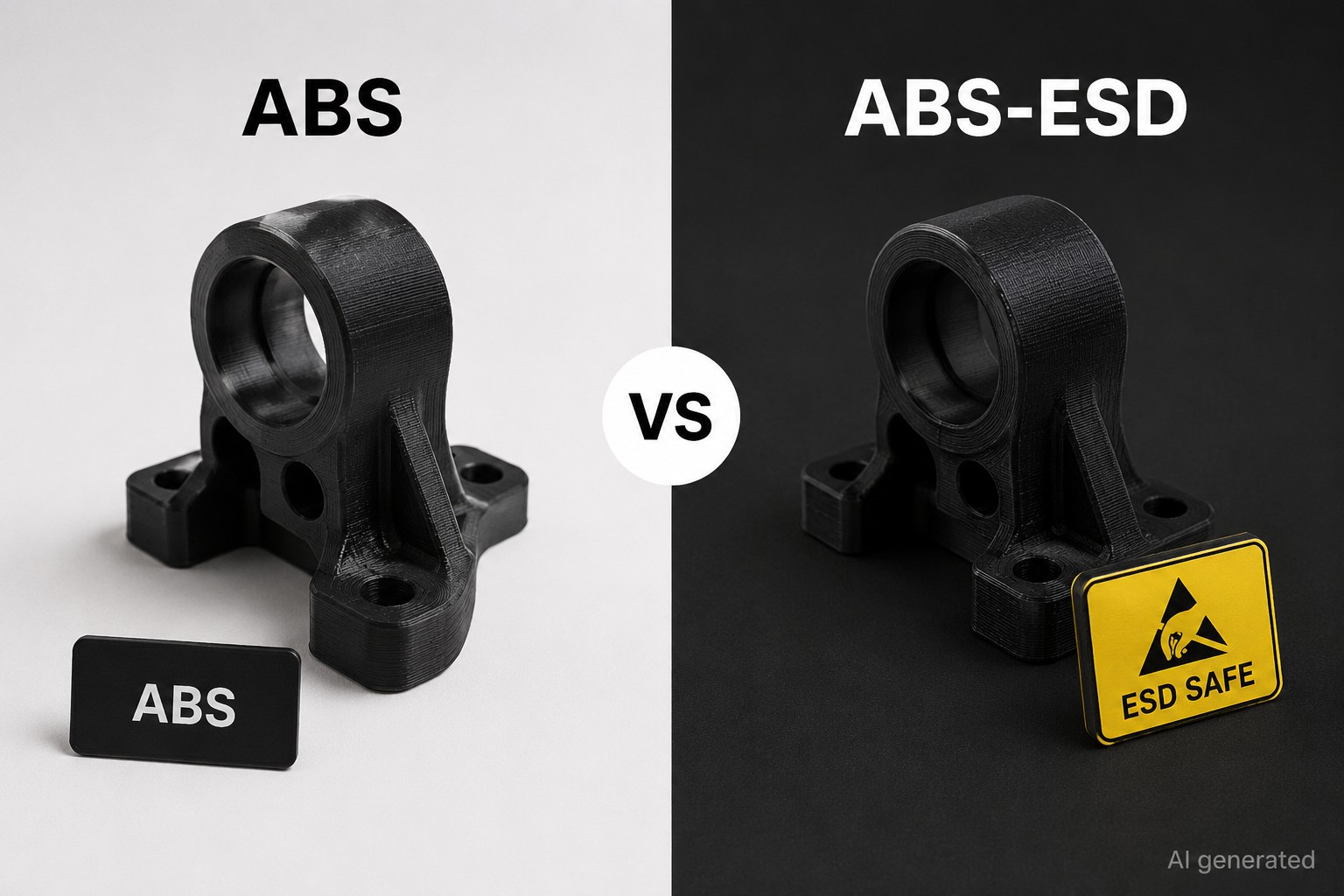
Standard ABS and ABS-ESD look similar on a spec sheet. They print the same way, cost about the same at JLC3DP, and produce parts with similar surface finish. The difference that matters is invisible, one accumulates static charge on every surface, and the other dissipates it. For electronics manufacturing, that invisible difference is the entire reason one material exists.
- Industrial ABS & ABS-ESD Printing from $3
- Production starts in as fast as 72 hours for prototypes and low-volume production.
This guide covers the ABS comparison you actually need to make the right call: what separates standard ABS from ABS-ESD plastic, when each one is the correct choice, and the mistakes engineers make when they pick the wrong one for the job.
What Are ABS 3D Printing Materials?
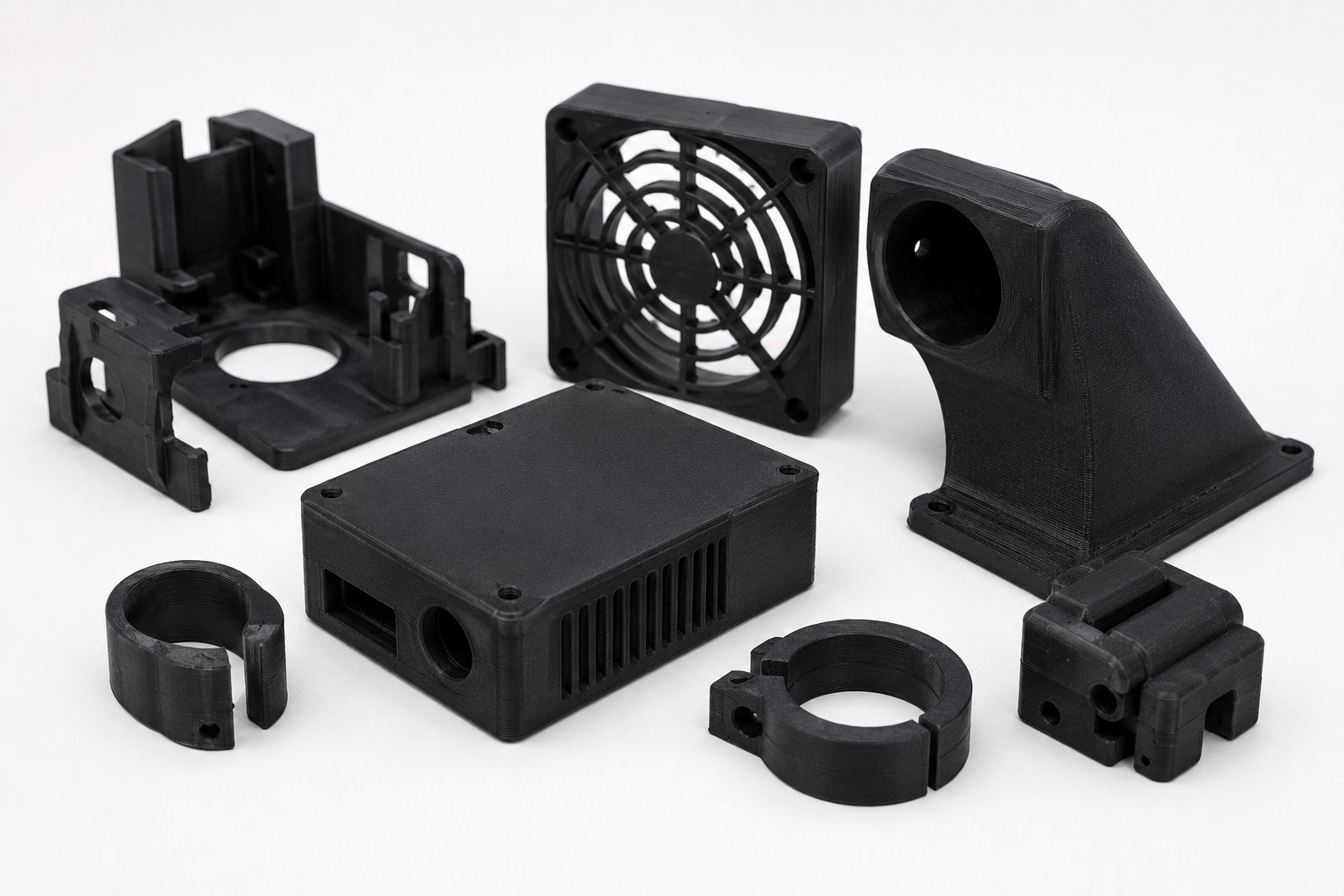
ABS 3D printing materials are engineering thermoplastics widely used for functional prototypes and production parts because of their toughness, heat resistance, and dimensional stability under mechanical load. In industrial FDM 3D printing, ABS filament is available in multiple formulations for different application requirements, standard ABS for general engineering, and ABS-ESD for electrostatic-sensitive environments where static dissipative ABS is a functional requirement rather than a preference.
The ABS material comparison starts with understanding that ABS-ESD plastic is not a premium upgrade to standard ABS, it is a specialized variant engineered for a specific need. Choosing between them is an application decision, not a quality decision.
| Material | Main Feature | Typical Applications |
|---|---|---|
| Standard ABS | Durable, tough, heat resistant | Functional prototypes, automotive parts, appliance components |
| ABS-ESD | Permanent static dissipation | PCB fixtures, electronics housings, semiconductor tooling |
What Is the Difference Between ABS and ABS-ESD?
The main difference in any ABS vs ABS-ESD comparison is static protection. Standard ABS is an electrical insulator, charge accumulates on its surface and stays there until a discharge event releases it. ABS-ESD plastic contains carbon-based conductive additives that give the material surface resistivity in the 106 to 109 Ohm/sq range, making it a static dissipative ABS that actively moves charge away from the surface rather than holding it.
The build size difference is worth noting in any practical ABS vs ABS ESD evaluation. Standard ABS at JLC3DP supports significantly larger build volumes than ABS-ESD plastic, if your part exceeds 250 x 250 x 250mm, standard ABS may be the only option regardless of other requirements. Design the part knowing this constraint before selecting materials.
| Feature | ABS | ABS-ESD |
|---|---|---|
| Static Protection | None | Permanent, built-in |
| Typical Applications | Functional engineering parts | Electronics and semiconductor manufacturing |
| Build Size (JLC3DP) | Up to 580 x 480 x 480mm | Up to 250 x 250 x 250mm |
| Surface Finish | Support Structure | Support Structure |
| Best For | General engineering components | ESD-sensitive components and fixtures |
How Do the Mechanical Properties Compare?
The mechanical property ABS comparison from JLC3DP reveals something that surprises most engineers encountering this ABS material comparison for the first time: ABS-ESD plastic outperforms standard industrial ABS plastic on tensile strength and stiffness, while standard ABS outperforms ABS-ESD on impact resistance and heat resistance.
This is not a case where one material wins across the board. ABS-ESD plastic has higher tensile strength (38 MPa vs 28.8 MPa) and significantly higher flexural modulus (2500 MPa vs 1530 MPa), it is stiffer and stronger in tension. Standard ABS handles higher sustained temperatures without distorting.
| Property | ABS | ABS-ESD | Better Choice |
|---|---|---|---|
| Tensile Strength | 28.8 MPa | 38 MPa | ABS-ESD |
| Flexural Strength | 65.5 MPa | 55 MPa | ABS |
| Flexural Modulus | 1530 MPa | 2500 MPa | ABS-ESD |
| Heat Deflection Temperature | 98℃ | 78℃ | ABS |
| ESD Protection | None | Permanent | ABS-ESD |
What does this mean for the ABS vs ABS-ESD decision? If the part needs to survive drops and knocks, standard industrial ABS plastic has the edge. If dimensional rigidity under load matters more than impact toughness, ABS-ESD plastic's higher flexural modulus is an advantage. And if the part operates in an electronics manufacturing environment, the ESD protection requirement decides it regardless of the mechanical trade-offs.
ABS-ESD is not a direct upgrade from standard ABS. It is an engineered material that delivers permanent electrostatic protection alongside mechanical performance suited to electronics manufacturing environments, which is different from outperforming standard ABS across every property.
Key Insight
JLC3DP offers both ABS 3D printing material and ABS-ESD plastic at similar starting prices. The selection decision should be based on application requirements rather than cost, the materials are positioned to let engineers choose what their parts actually need without a price penalty pushing the decision in the wrong direction. Get A Free Quote.
Which ABS 3D Printing Material Should You Choose?
Application Table
| Choose ABS When... | Choose ABS-ESD When... |
|---|---|
| Impact resistance matters | ESD protection is required |
| Large parts | PCB fixtures |
| Automotive brackets | Electronics manufacturing |
| Higher heat resistance | Static-controlled areas |
Decision Tree
Does your part require ESD protection?
Yes: Choose ABS-ESD Plastic
Does it need a large build volume (>250mm)?
Yes: Choose Standard ABS
General engineering or structural part?
Yes: Choose Standard ABS
Real Examples
For PCB fixtures and semiconductor tooling, the ABS vs ABS ESD comparison ends quickly, standard ABS is not a viable option in environments where static discharge damages components. Using industrial ABS plastic for these applications is a real risk that shows up in field failures, rework costs, and damaged components that pass initial testing but fail in service.
For automotive brackets, consumer product prototypes, and general structural components, standard ABS 3D printing material handles the application without the constraints of ABS-ESD plastic's smaller build volume and lower impact resistance.
| Your Application | Recommended Material |
|---|---|
| Functional Prototype | ABS |
| Consumer Product Prototype | ABS |
| Automotive Bracket | ABS |
| Household Appliance Component | ABS |
| PCB Fixture | ABS-ESD |
| SMT Assembly Jig | ABS-ESD |
| Electronics Enclosure | ABS-ESD |
| Semiconductor Fixture | ABS-ESD |
| Automation Tooling (ESD environment) | ABS-ESD |
The applications where both materials technically work, production parts, electronics housings, some automation tooling, are where the full ABS material comparison matters. In those cases, check whether the operating environment is classified as an ESD controlled area. If it is, ESD safe ABS is the correct specification.
The ABS comparison is genuinely simple when the application is clear. Parts that contact or operate near static-sensitive electronics need ESD safe ABS. Parts that do not, do not. What complicates the decision is when engineers treat ABS-ESD as a universal upgrade, using static dissipative ABS where standard ABS would perform better because the ESD protection sounds like a bonus feature. It is not. Each material is optimized for its specific use case.
Should You Use Desktop Printing or Industrial 3D Printing?
Desktop FDM printing works for early-stage ABS 3D printing prototypes where part quality and consistency matter less than speed and cost. For functional parts that need to perform reliably, particularly ESD safe ABS components used in electronics manufacturing, industrial FDM printing produces results that desktop printers cannot consistently match.
The consistency gap matters most for ABS-ESD plastic. Carbon additive dispersion in static dissipative ABS affects resistivity, inconsistent mixing or printing produces parts where ESD performance varies across the surface and between prints. Industrial ABS 3D printing with controlled process parameters produces ABS-ESD parts with consistent resistivity that desktop printing struggles to guarantee.
| Desktop Printing | JLC3DP Industrial Printing |
|---|---|
| Variable quality between prints | Consistent, controlled manufacturing process |
| Limited quality control | Engineering verification on every order |
| Requires your own printer and setup | Professional service, no equipment investment |
| Material quality varies by supplier | Engineering-grade ABS and ABS-ESD plastic |
| No resistivity verification for ABS-ESD | Process-controlled ESD performance |
Whether you need standard ABS for durable functional prototypes or ABS-ESD plastic for electrostatic-sensitive applications, JLC3DP provides industrial FDM manufacturing with engineering-grade materials, fast turnaround, and support for prototyping through low-volume production.

- Starting From $0.3 per part · No Minimum Order Quantity
- 24-Hour Lead Time · Up to $123 Welcome Coupons
JLC3DP Engineering Insights: 3 Common Material Selection Mistakes
The following recommendations are based on common design reviews and material selection questions handled by the JLC3DP engineering team during production preparation.
1Treating ABS-ESD as an Upgraded ABS
- ABS-ESD is designed for static control rather than general performance. If the application does not require ESD protection, standard ABS is often the more appropriate choice.
2Overlooking Build Size During Design
- Enclosure designs occasionally exceed the available build size for ABS-ESD. Checking material-specific build limits early in the design stage can avoid redesigns or splitting parts later in the manufacturing process.
3Comparing Only Tensile Strength
- Material selection is often based on tensile strength alone, while impact resistance, operating environment, and ESD requirements are equally important. Review the complete set of performance requirements for a better material choice.
FAQ about ABS 3D Printing Materials
Q: What is the difference between ABS and ABS-ESD?
Standard ABS is an insulating polymer that accumulates static charge on its surface. ABS-ESD plastic contains carbon additives that make it a static dissipative ABS with surface resistivity in the 106 to 109 Ohm/sq range. The ABS vs ABS-ESD difference is fundamentally about static control, the materials share similar processing characteristics but serve different application categories.
Q: Is ABS naturally ESD-safe?
No. Standard industrial ABS plastic is an electrical insulator with surface resistivity above 1012 Ohm/sq, the opposite of ESD safe. ABS 3D printing material without ESD modification accumulates static charge and is not suitable for electronics manufacturing environments. Only ABS-ESD plastic formulations provide ESD protection.
Q: Does ABS-ESD have better mechanical properties than ABS?
It depends on which property. ABS-ESD plastic has higher tensile strength (38 MPa vs 28.8 MPa) and higher flexural modulus (2500 MPa vs 1530 MPa). Standard ABS has higher heat deflection temperature. Neither material wins the full ABS comparison across every mechanical property.
Q: When should I choose ABS-ESD?
Choose ABS-ESD plastic whenever the part will contact or operate near electronics sensitive to electrostatic discharge, PCB fixtures, SMT assembly jigs, semiconductor tooling, electronics housings in ESD controlled environments. If the application does not involve static-sensitive electronics, standard ABS 3D printing material is usually the better choice.
Q: Is ABS-ESD more expensive than standard ABS?
At JLC3DP, ABS and ABS-ESD plastic start at similar pricing. The ABS material comparison on cost is not a meaningful differentiator, choose based on application requirements rather than material price.
Q: Can ABS-ESD replace standard ABS?
Not universally. ABS-ESD plastic has a smaller maximum build volume, lower impact resistance, and lower heat deflection temperature than standard industrial ABS plastic. It is the right choice for ESD applications and a poor substitute for standard ABS in high-impact or high-temperature environments.
Q: Which material is better for PCB fixtures?
ABS-ESD plastic, without question. Standard ABS 3D printing material is an insulator that accumulates static charge, using it for PCB fixtures introduces ESD risk to the components being handled. ESD safe ABS is the required material for any fixture in contact with static-sensitive electronics.
Q: Is ABS-ESD suitable for outdoor use?
ABS-ESD plastic shares standard ABS 3D printing material's limited UV resistance, neither is well-suited for prolonged outdoor exposure without protective coating. For outdoor applications, evaluate alternative materials. Additionally, ABS-ESD is not recommended for prolonged high-temperature environments, which may include some outdoor applications in hot climates.
Conclusion: ABS vs ABS-ESD Material Selection
There is no universally better material. The ABS vs ABS-ESD decision is straightforward once the application and mechanical needs are defined.
Choose ABS
- Better impact resistance
- General engineering performance
- Higher heat resistance
- Larger build volumes
Choose ABS-ESD
- Permanent ESD protection
- Electronics manufacturing fixtures
- Static-controlled production environments
- Higher tensile strength and stiffness
The right choice depends on your application's functional requirements, not on whether one material has a longer specification sheet.
Both are available at JLC3DP with industrial-grade process control, and the pricing is similar enough that cost should not drive the decision in either direction. Let the application requirements decide, and check the mechanical property table before assuming either material outperforms the other across the board.
Keep Learning
Is PETG Toxic to Print? Fumes, Risks & Safety Guide
Key Takeaways PETG is generally considered a lower-emission 3D printing material compared to ABS and ASA, but it does produce VOCs and ultrafine particles during printing. The odor during PETG printing is typically mild, some people barely notice it, others describe a faint warm-plastic smell. Low odor doesn't mean zero emissions. Ventilation is still a sensible precaution. PETG food safety is complicated, the material itself may be food-grade in some formulations, but the printing process introduces ......
Top 5 Heat-Resistant 3D Printing Filaments Compared
When Regular Filament Just Doesn’t Cut It You’ve 3D printed a functional bracket for a car engine bay. It fits perfectly, looks great, and then warps into a banana-shape after a week under the hood. That’s the danger of underestimating heat. If you're building automotive components, enclosures near motors, molds, or even kitchenware, using the wrong filament can lead to deformation, brittleness, or outright failure when exposed to heat. So, you already know the solution: Choosing the right heat-resist......
PLA Temperature Resistance: Heat Resistance, Softening & Melting Point
Key Takeaways PLA typically starts losing rigidity around 55–65℃ (Tg) and melts at approximately 150–180℃. PLA can deform and creep long before it melts, so melting point is not a practical service-temperature limit. Actual PLA deformation depends on temperature, load, geometry, print orientation, and exposure time. Standard PLA becomes increasingly risky above 50–60℃ and is generally unsuitable for sustained 70–80℃ applications. PLA+ heat resistance varies by formulation. For higher-temperature appli......
PETG Temperature Resistance: Limits & Comparison with PLA/ABS/ASA
Key Takeaways Standard PETG is best suited for continuous use below ~60℃; performance can decline as temperatures approach 70℃. PETG typically has a Tg of ~75–85℃ and an HDT of ~65–75℃, depending on the material grade and test conditions. HDT is not a maximum service temperature—load, print orientation, wall thickness, geometry, and exposure time all affect real-world performance. PETG offers better heat resistance than PLA but lower heat resistance than ABS, ASA, PA12-CF, PC, and PEEK. For sustained ......
How to Print TPU Filament: Settings and Troubleshooting
Key Takeaways TPU is printable on ordinary FDM hardware. The material bends instead of breaking, but it punishes settings tuned for PLA — four changes (print slowly, print dry, retract gently, keep the filament path short) turn it into a routine material. Difficulty tracks Shore hardness. A 95A TPU prints readily on most FDM machines; 85A and softer grades demand a direct drive extruder and patience. TPU print settings start around a 210–230°C nozzle, 20–40mm/s speed, and minimal retraction — the full......
What Is 3D Printer Filament? Types and How to Choose
Key Takeaways 3D printer filament is the thermoplastic strand an FDM printer melts and deposits layer by layer. Two diameters dominate: 1.75mm mainstream, 2.85mm second. The main types of 3D printer filament sort into five practical groups — easy and rigid (PLA), tough and balanced (PETG), heat-resistant (ABS/ASA), flexible (TPU), engineering-grade (nylon, PC, PEEK) — plus composites and soluble support materials. Choosing comes down to four properties: strength versus stiffness, heat resistance, flex......