What Is 9000HE Resin? The High Strength SLA Engineering Resin Explained
17 min
- What Is 9000HE Resin? The High Strength SLA Engineering Resin Explained
- What Is Engineering-grade Resin in SLA 3D Printing?
- Key Mechanical Properties of High Strength SLA Resin
- 9000HE vs Other SLA Resins
- Industrial Applications of 9000HE Resin
- Functional Prototypes
- When Should You Use 9000HE Resin?
- FAQ About 9000HE Resin
- Conclusion about 9000HE Resin
What Is 9000HE Resin? The High Strength SLA Engineering Resin Explained
Most SLA resins are designed for one thing: looking good. Smooth surface, fine detail, accurate geometry. That's where the technology excels and that's what most resin materials are optimized for.
9000HE wasn't designed for that.
It was designed for the parts that actually have to do something, carry load, survive assembly, hold up in functional testing, and behave like an engineering material rather than a display model. If you've been frustrated by SLA parts that look perfect and break under the first real load, this is the resin that changes that conversation.
Key Takeaways
9000HE is a high-performance SLA resin designed for functional parts beyond visual prototypes. It offers tensile strength of 41–61 MPa, comparable to typical engineering resins, along with strong dimensional stability.
Its key advantage is impact resistance. With a notched Izod impact strength of 36–55 J/m, it outperforms most standard SLA resins and is better suited for parts under mechanical stress.
At JLC3DP, 9000HE is available with fast turnaround and engineering support. For functional prototypes, tooling, and low-volume parts where durability matters, it is one of the most capable SLA materials available.
What Is Engineering-grade Resin in SLA 3D Printing?
Standard SLA resin is a photopolymer, also called a UV resin for engineering use, because UV light cures it layer by layer, and what you get is a hard, brittle material with excellent surface finish and dimensional accuracy. It's great at being accurate. It's not great at being tough.
Engineering resin in SLA is a different formulation entirely. The chemistry is modified to improve mechanical performance, toughness, impact resistance, heat deflection, or a combination of these, without completely sacrificing the surface quality and resolution that make SLA worth using in the first place. So, engineering resins are harder to print with, more sensitive to post-cure conditions, and more expensive per unit volume. What you get in return is a functional resin that behaves more like an engineering thermoplastic than a photopolymer.
SLA Resin Types Overview
| Resin Type | Tensile Strength | Impact Resistance | Surface Finish | Best For |
|---|---|---|---|---|
| Standard SLA resin | 38-55 MPa | Very low, brittle | Excellent | Visual models, display parts |
| Tough/ABS-like resin | 45-60 MPa | Moderate | Very good | Light functional parts, snap fits |
| Flexible/rubber-like resin | 3-8 MPa | High elongation | Good | Seals, gaskets, flexible features |
| High temp resin | 45-65 MPa | Low | Good | Heat-resistant housings, under-hood |
| 9000HE engineering resin | 41-61 MPa | High | Excellent | Structural prototypes, functional testing |
| Castable resin | Low | Low | Excellent | Jewelry, lost-wax casting patterns |
| Dental/biocompatible | Varies | Varies | Excellent | Medical, dental applications |
Functional Resin vs Standard Resin
The difference shows up the first time you try to assemble a part or apply any real load to it.
Standard SLA resin is stiff but brittle. Drop it, and it might crack. Press a fit into a bore, and it might split along a layer line. Tighten a screw into it and the boss fractures. The elongation at break, how much the material stretches before it fails, is typically 1-3% for standard resins. That's almost no plastic deformation before fracture. Parts fail without warning, without visible deflection, without the kind of progressive failure that lets you catch a problem before it becomes a failure.
Functional engineering-grade resins like 9000HE change this. Better impact resistance and improved toughness mean the part absorbs energy before it fails. You can assemble it, test it, load it, and get data from it rather than having it crack in your hand before the test starts.
Why Engineering Resin Matters
The gap between what a design looks like in CAD and how it behaves under real conditions is where most prototype failures happen. A bracket that looks robust in simulation cracks at a hole when load is applied at an angle. A housing that clears all the geometry checks cracks when a PCB connector is pressed in during assembly. An enclosure that passes visual inspection fails thermal cycling because the material has an inadequate heat deflection temperature.
Engineering resins close that gap. Not completely, SLA engineering resin is not injection-molded nylon, but enough that functional testing produces meaningful data rather than just broken parts that tell you nothing except that the material was wrong.
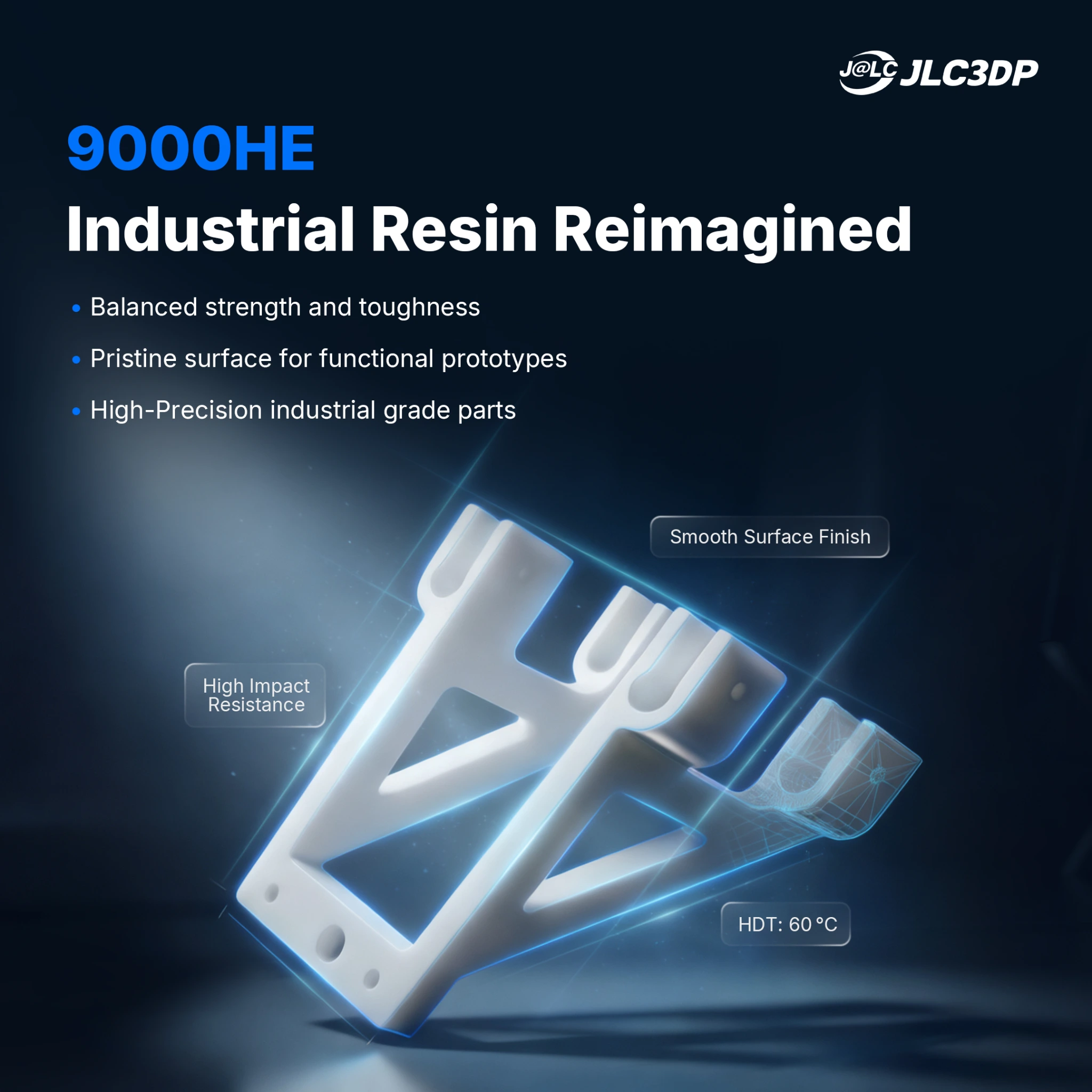
(SLA 9000HE Resin — Tough Functional Resin for Engineering Parts)
JLC3DP offers SLA 3D printing in 9000HE with fast turnaround and engineering review built in.
Get an instant SLA Quote Now >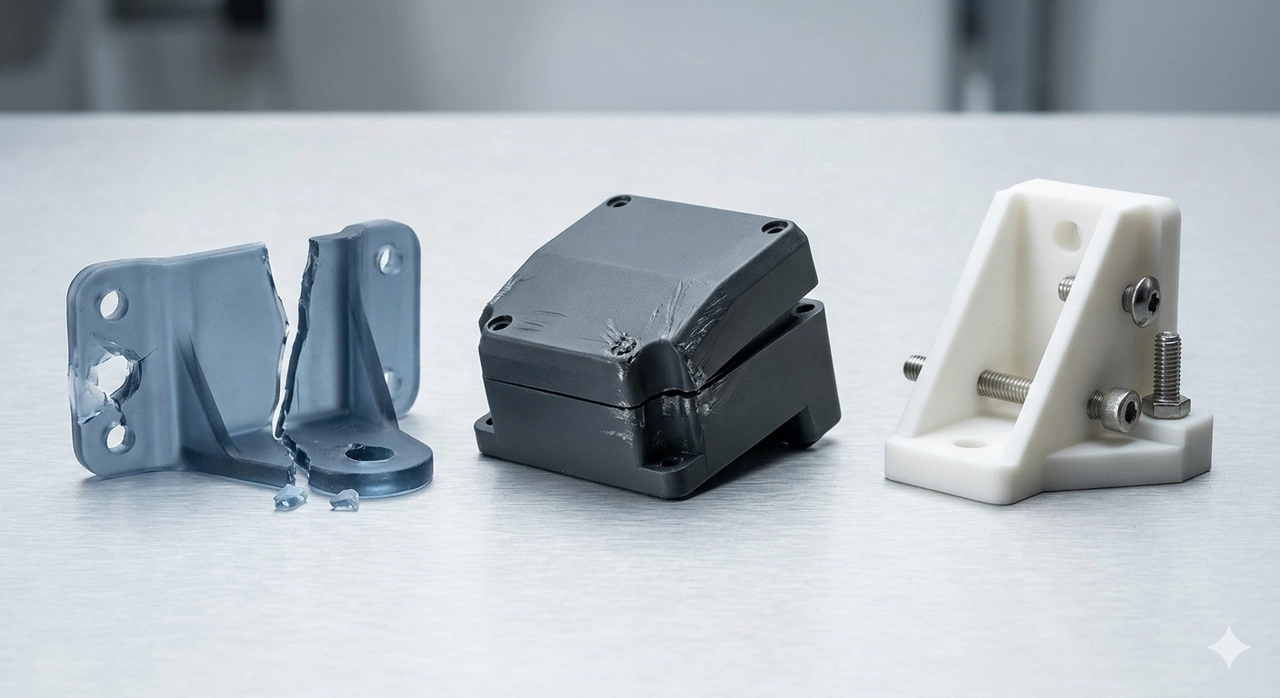
Key Mechanical Properties of High Strength SLA Resin
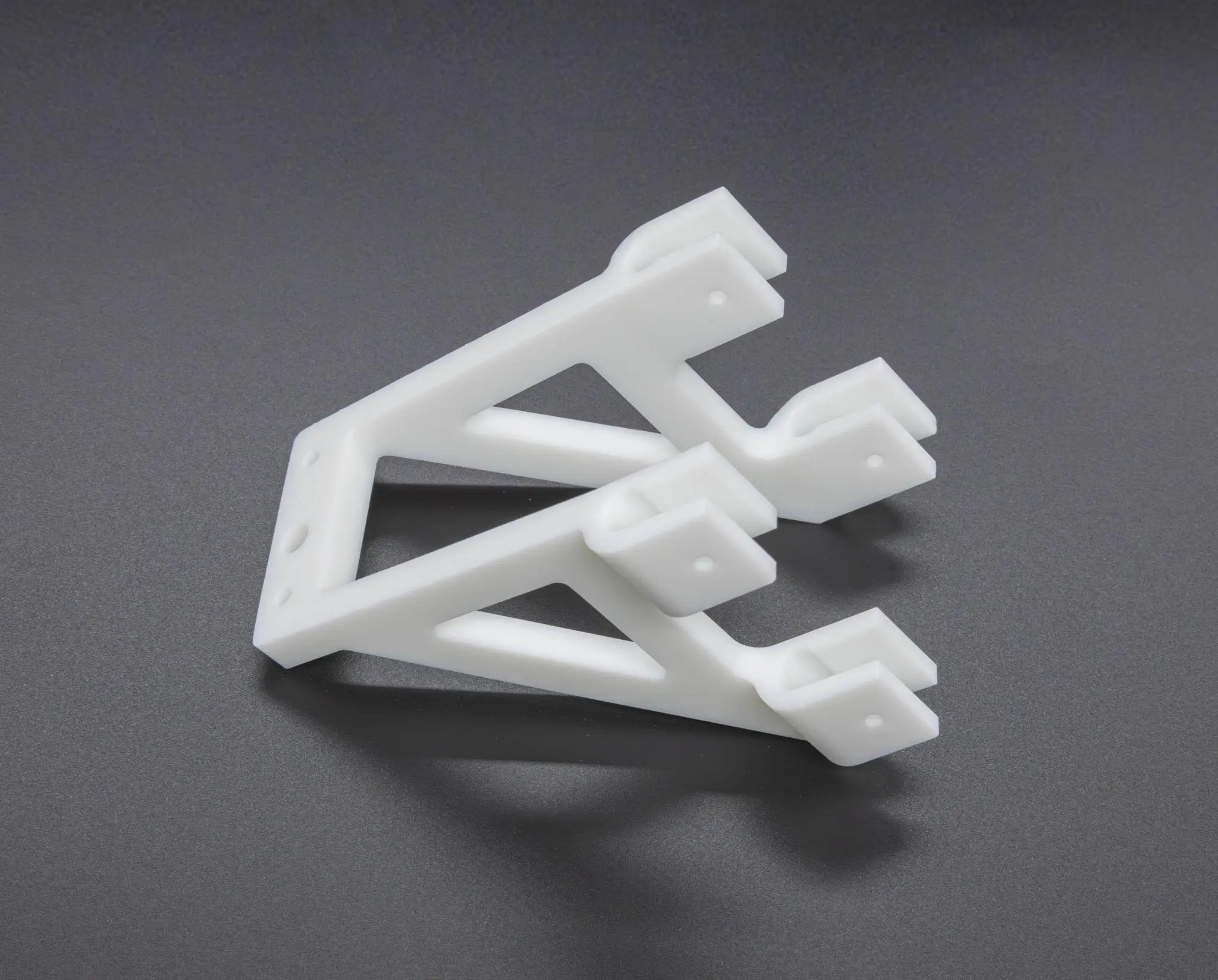
Numbers matter here. Not the marketing numbers, the ones that tell you what the material actually does under load.
Tensile Strength
9000HE delivers tensile strength in the 41-61 MPa range. For context: standard SLA resin runs 38-55 MPa. ABS injection molded is around 40-50 MPa. Glass-filled nylon runs 90-120 MPa. So 9000HE sits meaningfully above standard functional resin and actually competes with unfilled injection-molded engineering thermoplastics on peak tensile strength.
What this means practically: a bracket printed in 9000HE high-strength resin and loaded in tension can carry significantly more load before yielding than the same geometry in standard resin. For structural prototype testing where you're trying to validate whether the geometry works, that difference determines whether you get useful test data or a pile of broken parts.
Tensile strength in SLA high strength resins is also more isotropic than in FDM, the layer adhesion in SLA is fundamentally stronger than FDM inter-layer bonding because the photopolymerization happens across layers rather than just at the deposited bead surface. 9000HE takes advantage of this: cross-layer tensile strength is close to in-plane strength, which means part orientation matters less than it does in FDM for structural applications.
Impact Resistance
This is where 9000HE separates itself from the rest of the high strength SLA resin category most clearly.
Standard SLA resins have notched Izod impact resistance of 10-20 J/m. Brittle, catastrophic failure under impact. 9000HE's impact resistance is substantially higher, the material absorbs impact energy through controlled deformation rather than instant fracture. For parts that see dynamic loading, assembly stress, handling during testing, or drop events in field conditions, this difference is the difference between a useful prototype and one that breaks before it tells you anything.
The mechanism is in the polymer chemistry. 9000HE uses a modified resin formulation that includes toughening components that increase the energy required to propagate a crack through the material. It's the same principle as rubber-toughened epoxy or impact-modified nylon, you trade some stiffness for significantly better fracture toughness.
However, SLA resins still exhibit lower fracture toughness than thermoplastics like nylon.
Dimensional Stability
9000HE holds dimensions well after printing and post-cure. This matters more than most people realize for functional resin applications.
Standard SLA resins can continue to slowly react and change dimensions after initial cure, particularly if exposed to UV or heat in service. For visual models this is invisible. For a part with bore dimensions or mating features that need to stay accurate over time, post-cure dimensional drift is a real problem.
9000HE's formulation stabilizes quickly under controlled post-cure conditions. Dimensional accuracy after post-cure is typically within ±0.1-0.2% of CAD dimensions on well-supported geometries, competitive with the better FDM materials and better than many tough resins that have higher shrinkage during cure.
For functional prototypes going into assembly with other parts, this stability matters. A bore that's 0.3mm smaller than nominal three days after printing due to continued cure shrinkage doesn't tell you whether the part design works, it tells you that the material properties weren't controlled.
Heat Resistance
9000HE's heat deflection temperature runs in the range of 51-60℃@0.45MPa measured under load (ASTM D648). That's not a high-temperature resin. If you need parts that survive 150°C, there are specialized high-temp SLA materials for that. But it covers the majority of room-temperature to mildly elevated temperature functional applications: indoor mechanical assemblies, electronics housings, prototype testing environments, and short-duration thermal exposure.
9000HE vs Other SLA Resins
9000HE vs Standard SLA Resin
Standard resin wins on surface finish detail and ease of printing. 9000HE wins on every mechanical property that matters for a functional part. Tensile strength 10-30% higher. Impact resistance multiple times higher.Better post-cure stability.
For visual prototypes, design reviews, and display models, standard resin is the right choice, it's cheaper, easier to process, and produces slightly better surface detail. For anything that gets assembled, loaded, tested, or used in a real application, standard SLA resin is the wrong material regardless of how good it looks.
The comparison isn't really competitive, they serve different purposes. The problem is that many engineers specify standard resin for functional applications because it's what's available by default, then wonder why the parts break.
9000HE vs Tough Resin
Tough resins, marketed as ABS-like or engineering-grade by various suppliers, typically deliver tensile strength in the 45-60 MPa range with moderate impact resistance. They're better than standard resin for light functional applications: snap fits, clips, light-duty housings, and parts that see incidental load rather than primary structural loading.
9000HE pushes beyond that. Higher tensile strength, better impact resistance, better dimensional stability. The trade-off is usually cost and printing complexity, 9000HE is more demanding to process correctly, and the mechanical properties are only realized with proper post-cure conditions.
If the application is light functional use with occasional impact, a prototype enclosure for a device that gets handled, for example, tough resin may be sufficient. If the application is structural loading, assembly stress, or repeated dynamic load, 9000HE is the correct specification.
SLA 9000HE vs FDM Nylon/ABS
This is the comparison that matters most for engineers deciding between SLA and FDM for functional prototypes.
Based on official JLC3DP material datasheets, FDM Nylon has higher tensile strength in the print direction, 60-70 MPa for PA12-CF versus 41-61 MPa for 9000HE. FDM ABS runs lower at 20-30 MPa. Cross-layer tensile strength in FDM drops to 35-55 MPa due to inter-layer adhesion limitations, and this is where 9000HE's near-isotropic SLA cure mechanism becomes a genuine advantage. Parts with load paths that cross layer lines perform significantly better in 9000HE than in FDM nylon at equivalent geometry.
Surface finish: SLA wins substantially. FDM layer lines and surface roughness on functional parts require post-processing that SLA doesn't. For parts where surface finish affects function, sealing surfaces, bearing contact areas, fluid-contact geometry, 9000HE's as-printed surface quality is a real engineering advantage.
Feature detail: SLA wins. Thin walls, fine features, small holes, and complex internal geometry print more reliably in SLA than in FDM, where layer adhesion issues and stringing affect small features.
The honest summary: for isotropic strength in complex geometry with fine features and good surface finish, 9000HE competes seriously with FDM nylon. For raw tensile strength in large simple parts where orientation can be controlled, FDM nylon has the edge. For most functional prototype applications, 9000HE is the better all-around specification.
JLC3DP prints 9000HE alongside a full range of SLA resin types, from standard to engineering grade. Not sure which suits your application? Our engineers will tell you before you order.

Industrial Applications of 9000HE Resin
Functional Prototypes
This is the core application. The word "functional" in functional resin 3D printing means the prototype needs to behave like the intended production part, not just look like it. A bracket that carries the same load as the production part. A housing that survives the same assembly process. A connector that mates with the same force and holds under the same pull-out load.
9000HE engineering resin makes functional prototypes that actually function. The mechanical properties are close enough to engineering thermoplastics that prototype testing produces data you can use to make design decisions rather than just confirming that SLA resin isn't strong enough.
At JLC3DP, 9000HE functional prototypes are printed with build parameters optimized for mechanical performance, not just dimensional accuracy. Layer thickness, orientation, support strategy, and post-cure protocol are all controlled to ensure the printed part realizes the material's full mechanical capability rather than undershooting it due to process variation.
Structural Components
Beyond prototyping, 9000HE is used for end-use structural components in applications where volume is too low to justify injection molding tooling and the operating conditions are within the material's capability.
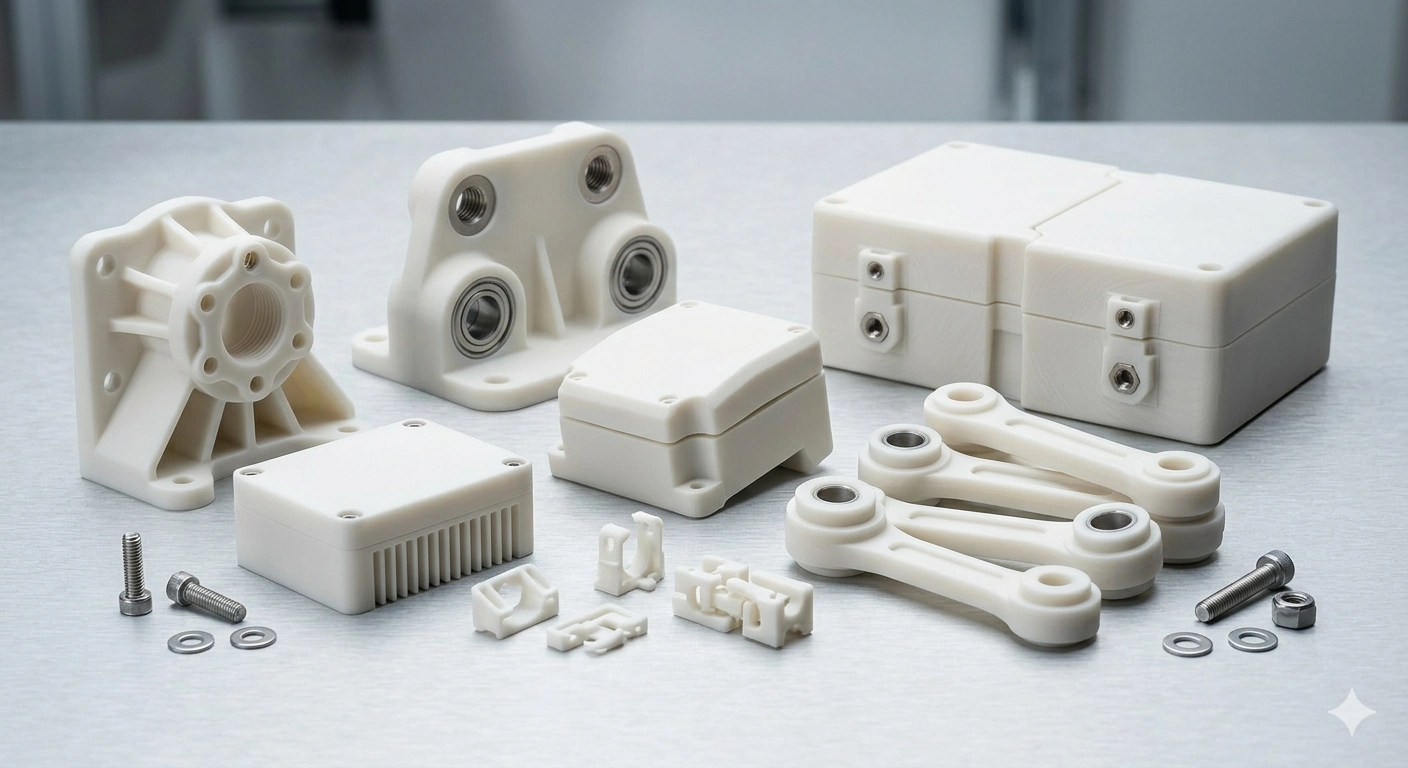
Custom brackets for industrial equipment. Structural housings for low-volume electronic assemblies. Mechanical linkages and connectors for specialized machinery. In each case, the part needs to carry real load in real service conditions, not just survive handling and assembly.
The economics work when production volumes are below roughly 50-100 parts and the geometry is complex enough that machining would be time-consuming. 9000HE printed at JLC3DP competes on both cost and lead time against machined alternatives on low-volume structural components.
Industrial Tooling
Assembly fixtures, jigs, gauges, and handling tools are applications where 9000HE's mechanical properties matter and where the low cost and fast lead time of SLA printing make compelling economic sense.
A fixture that locates a part for assembly needs dimensional stability and enough structural rigidity to resist deformation under the clamping forces applied in use. Standard resin fixtures creep and lose dimensional accuracy over time. 9000HE holds its shape.
A gauge that checks a feature needs to survive repeated use without wearing the contact surfaces to the point where measurements become unreliable. Engineering resin SLA gauges in 9000HE have meaningfully longer service life than standard resin equivalents before they need reprinting.
Low-Volume Production Parts
The fastest growing application for high strength resin for 3D printing is low-volume end-use production, quantities too small for injection molding tooling to be cost-effective and geometries too complex for machining to be practical.
For JLC3DP customers, 9000HE production parts are a real alternative to tooled components for runs below approximately 100 parts per year. The surface quality is high enough to meet appearance requirements. The mechanical properties are high enough for most structural applications. The lead time is days rather than weeks for tooling. And the per-part cost at low volume is a fraction of tooled part cost including amortized tooling expense.
For engineering resin materials and 9000HE resin specifications, JLC3DP's platform gives you instant pricing and design feedback.
When Should You Use 9000HE Resin?
When Strength Is Critical
If the part fails, what happens? If the answer is "the test fails and we learn nothing" or "the assembly doesn't work" or "the component breaks in service", 9000HE is the right specification. The material's tensile strength and impact resistance are there specifically for situations where part failure is not an acceptable outcome.
Standard resin for structural applications is a false economy. The cost difference between standard and this material per part is small. The cost of a prototype cycle that produces broken parts and no useful data is not small.
When Injection Molding Is Too Expensive
Injection mold tooling costs $5,000-50,000+ depending on complexity. At low volumes, that tooling cost per part makes injection molding economically absurd. 9000HE SLA printing at JLC3DP delivers parts with injection-molded appearance quality and functional mechanical properties at a fraction of the cost for quantities below the break-even point.
The break-even varies by part complexity and volume. For most functional parts under 100 units per year, SLA with 9000HE wins on total cost including tooling amortization. Above that, injection molding typically becomes cost-competitive. The design validation data you generate from 9000HE prototypes before committing to tooling also reduces the risk of expensive tooling modifications, prototyping in the production material equivalent first is almost always worth the cost.
When Rapid Iteration Is Needed
Design iteration that would take weeks through injection molding, tooling modification, sampling, testing, further modification, takes days with SLA printing. Upload a revised file today, have parts in hand in 3-5 days, test, learn, revise.
9000HE specifically enables meaningful iteration because the test data is meaningful. You're not testing whether standard resin survives, you're testing whether the geometry works under realistic load conditions. The feedback from 9000HE functional testing is directly applicable to the production design because the material behavior is close enough to engineering thermoplastics to draw real conclusions.
Why Strength Matters in Resin 3D Printing
The SLA resin market spent years competing on surface finish and detail resolution. Those battles are largely won, modern SLA printers from quality service providers produce excellent surface finish as table stakes. The frontier now is mechanical performance.
Engineers specifying 3D printed parts for functional applications increasingly need materials that close the gap between prototype and production, not just in geometry but in behavior. High strength resin for 3D printing like 9000HE is where that gap closes for SLA. Not completely, injection molded engineering thermoplastics still outperform SLA resins on many metrics, but closely enough that the testing, validation, and low-volume production use cases that were previously outside SLA's capability are now realistic.
At JLC3DP, 9000HE is the clearest example of this shift. It's a functional resin for engineers who need parts that work, not just parts that look like they'd work.
Use 9000HE if:
✔ Light-to-moderate load-bearing parts
✔ Functional testing
✔ Assembly required
Avoid if:
Visual-only models
Ultra-flexible parts
Ultra-flexible parts
FAQ About 9000HE Resin
Q: What is 9000HE resin?
9000HE is a high strength SLA engineering resin designed for functional 3D printed parts that require better strength, toughness, and dimensional stability than standard SLA resins.
Q: Is 9000HE resin stronger than standard SLA resin?
Yes, 9000HE engineering resin offers significantly higher tensile strength and impact resistance compared to standard SLA resin formulations.
Q: What is 9000HE resin used for?
9000HE is commonly used for functional prototypes, structural components, industrial tooling, and low-volume production parts.
Q: Is 9000HE considered an engineering resin?
Yes, 9000HE is an SLA engineering resin developed for mechanical performance rather than purely cosmetic printing applications.
Q: How strong is 9000HE SLA resin?
9000HE typically delivers tensile strength in the 65-75 MPa range, making it one of the stronger functional SLA resin options available.
Q: What is the difference between functional resin and standard SLA resin?
Functional resin is engineered for mechanical performance and durability, while standard SLA resin mainly prioritizes surface finish and visual detail.
Q: Can 9000HE resin replace injection molded parts?
For low-volume production and functional prototyping, 9000HE can replace some injection molded components where tooling costs are too high.
Q: Is 9000HE resin good for functional testing?
Yes, 9000HE is specifically designed for functional testing applications where parts must withstand assembly loads, handling stress, and real operating conditions.
Q: What industries use high strength SLA resin?
Aerospace, automotive, electronics, industrial equipment, robotics, and medical device industries commonly use high strength SLA resin for functional applications.
Q: Does 9000HE have better impact resistance than regular SLA resin?
Yes, 9000HE absorbs impact energy far better than brittle standard SLA resin, reducing the risk of sudden cracking during testing or assembly.
Conclusion about 9000HE Resin
9000HE isn't for everyone. If you need visual models, design review parts, or display prototypes, standard SLA resin is faster and cheaper. But if you're building something that has to carry load, survive assembly, withstand handling, and produce useful engineering data when tested, 9000HE is worth specifying.
The mechanical properties are real. The surface quality is real. The lead time advantage over injection molding is real. And the cost comparison at low volume is real.
JLC3DP prints 9000HE with optimized build parameters, engineering review before production, and fast turnaround. Whether it's a single functional prototype or a run of low-volume production components, the process is the same, your file in, engineered parts out.
Keep Learning
Best Resin Printer for Miniatures in 2026
Choosing the best resin printer for miniatures in 2026 comes down to one thing: detail per dollar. After a hands-on review of this year's leading SLA and 4K/8K LCD resin printers, we ranked the top picks for D&D, Warhammer, and tabletop terrain — from a $149 beginner machine to an 8K showcase rig. This guide covers resolution (4K vs 8K), build volume, resin choices, and a buyer's checklist, so you can print crisp minis without overspending or drowning in failed prints. Why Resin 3D Printers Are Best f......
Strongest Resin for 3D Printing (2026): Tough vs High Strength Resins Compared
When people ask for the strongest resin for 3D printing, what they usually mean is “the strongest for my part.” A rigid bracket, a snap-fit enclosure, and a heat-exposed fixture all fail in different ways. This guide breaks it down clearly. What Is the Strongest Resin for 3D Printing? In pure tensile and flexural testing, high strength engineering resins are typically the strongest SLA resin options available. However, in real-world applications, parts often fail from impact, repeated stress, or stres......
ABS-Like Resin vs Standard Resin: The Definitive Guide to Material Choice & Performance
Key takeaways Standard Resin: High stiffness, extreme brittleness, best for static visuals. ABS-Like Resin: High elongation, exceptional impact resistance, mandatory for snap-fits. Near-Isotropic Advantage: Unlike FDM-printed authentic ABS which suffers from weak interlaminar (Z-axis) bonds and anisotropy, SLA ABS-like resin cures via liquid cross-linking, providing near-isotropic advantage and uniform multi-directional strength. Water Washable Resin: Zero IPA needed, eco-friendly workflow, but sacrif......
Best Flexible Filament for 3D Printing: TPU vs PEBA vs TPE
You're staring at three flexible filament options and they all claim to be "flexible." That word covers a lot of ground. A phone case grip and an airless basketball both need flexibility, but they need completely different things from it. This guide breaks down what actually separates TPU, PEBA, and TPE so you pick based on what your part needs to do, not just what's available. What Is the Best Flexible Filament for 3D Printing? The softest 3D printing material depends entirely on the application. TPU......
What Is 9000HE Resin? The High Strength SLA Engineering Resin Explained
What Is 9000HE Resin? The High Strength SLA Engineering Resin Explained Most SLA resins are designed for one thing: looking good. Smooth surface, fine detail, accurate geometry. That's where the technology excels and that's what most resin materials are optimized for. 9000HE wasn't designed for that. It was designed for the parts that actually have to do something, carry load, survive assembly, hold up in functional testing, and behave like an engineering material rather than a display model. If you'v......
Which Resin Is Best for 3D Printing Fine Details vs Functional Parts?
Resin 3D printing is often marketed as a single category, but in practice, the resin you choose matters more than the printer itself. A photosensitive resin optimized for ultra-fine surface detail behaves very differently from a resin designed for load-bearing or heat-resistant parts. Treating them as interchangeable is one of the most common reasons resin prints fail to meet expectations. When comparing 3D printing resin types, the real question isn’t which resin is “best” overall, it’s what the part......