Best Flexible Filament for 3D Printing: TPU vs PEBA vs TPE
12 min
- What Is the Best Flexible Filament for 3D Printing?
- How Do TPU, PEBA, and TPE Compare?
- Flexible Filament Print Settings at a Glance
- When Should You Choose TPU Filament?
- When Should You Choose PEBA Filament?
- Is TPE Better Than TPU or PEBA?
- How to Choose the Right Flexible Filament for Your Project
- Flexible Filament Printing Tips and Common Mistakes
- FAQ about Flexible Material
You're staring at three flexible filament options and they all claim to be "flexible." That word covers a lot of ground. A phone case grip and an airless basketball both need flexibility, but they need completely different things from it. This guide breaks down what actually separates TPU, PEBA, and TPE so you pick based on what your part needs to do, not just what's available.
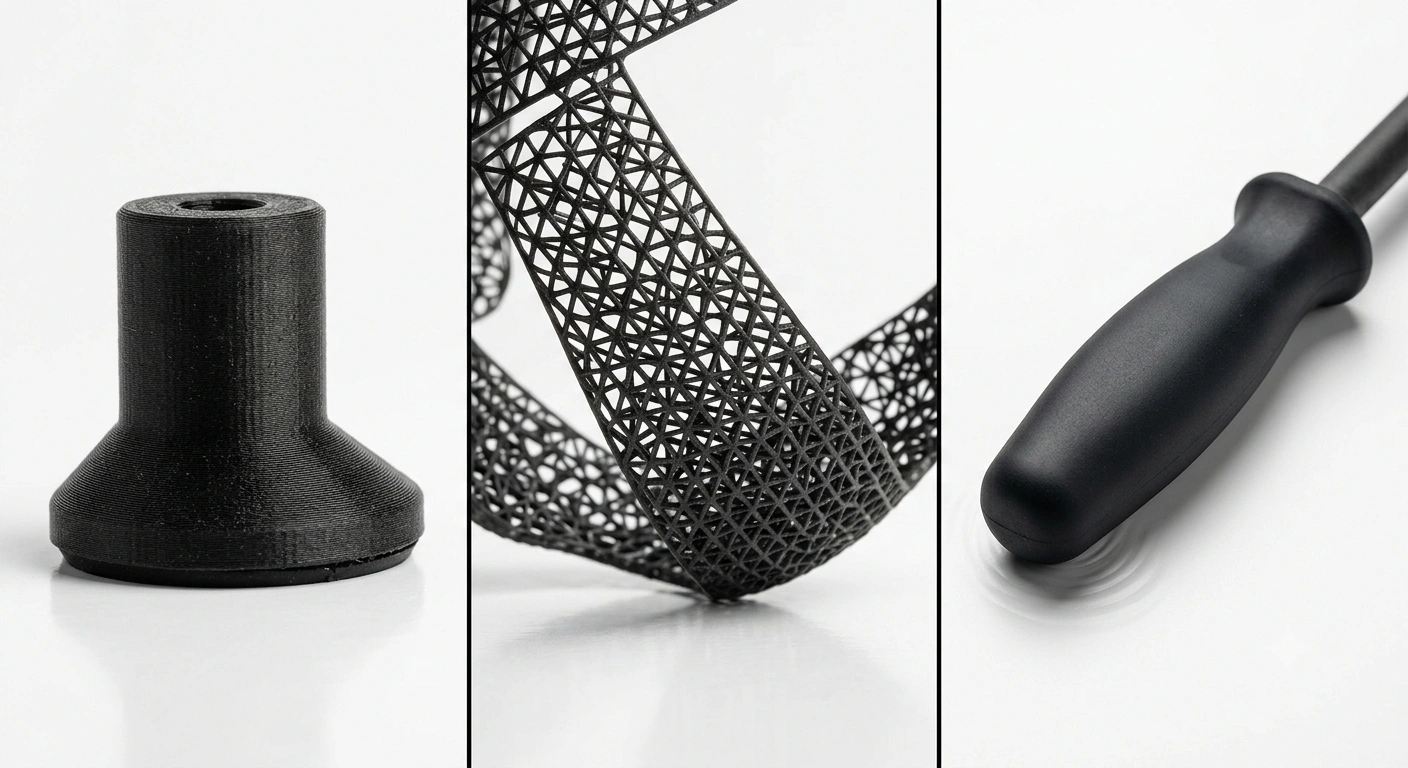
What Is the Best Flexible Filament for 3D Printing?
The softest 3D printing material depends entirely on the application. TPU (Thermoplastic Polyurethane) is the most versatile and easiest to print, making it the default choice for most functional flexible parts. PEBA offers superior rebound and lightweight performance for applications where energy return matters. TPE is a broader category of elastomers with characteristics that vary significantly between brands and formulations.
Quick Summary of Flexible Filament Types
TPU material is the workhorse, widely available, forgiving to print, and durable enough for most everyday flexible applications. PEBA material is the specialist, harder to source and print, but generally offers higher rebound than most TPU formulations when an application genuinely needs maximum energy return. TPE material is the wild card, a whole family of materials rather than one specific filament, which means performance varies more than the other two categories.
| Material | Best For | Printing Difficulty |
|---|---|---|
| TPU | General flexible parts, durability, ease of use | Easy |
| PEBA | Rebound, energy return, lightweight performance | Moderate to Difficult |
| TPE | Soft-touch products, specialized elastomer needs | Varies by formulation |
For a deeper look at flexible printing fundamentals, see JLC3DP's flexible 3D printing filament guide.
How Do TPU, PEBA, and TPE Compare?
TPU is generally the easiest flexible filament to print and the most forgiving on standard hardware. PEBA delivers the best rebound and fatigue resistance of the three. TPE covers a wide range of behaviors that depend heavily on the specific formulation you buy.
| Property | TPU | PEBA | TPE |
|---|---|---|---|
| Ease of Printing | Excellent | Moderate | Variable |
| Flexibility | High | High | High |
| Rebound | Medium | Very High | Low-Medium |
| Durability | Excellent | Good | Variable |
| Weight | Medium | Low | Medium-High |
| Cost | Lower | Higher | Lower-Medium |
| Best Applications | General functional parts | Sports, energy-return designs | Soft-touch consumer goods |
Best Flexible Printing Material Quick Recommendation
Choose:
- TPU → easiest
- PEBA → highest rebound
- TPE → special feel
The pattern here is straightforward. TPU wins on practicality. PEBA wins on performance, specifically energy return. TPE is the category you reach for when you need a specific elastomer behavior that TPU and PEBA don't quite hit, but you need to research the specific brand, because "TPE" alone doesn't tell you much.
Flexible Filament Print Settings at a Glance
Material properties affect not only flexibility and durability, but also printability. The settings below provide a practical starting point for printing flexible filaments.
| Material | Nozzle Temp (°C) | Bed Temp (°C) | Print Speed (mm/s) |
|---|---|---|---|
| TPU | 220–240 | 40–60 | 20–40 |
| PEBA | 230–260 | 50–70 | 15–30 |
| TPE | 210–240 | 40–60 | 15–25 |
When Should You Choose TPU Filament?
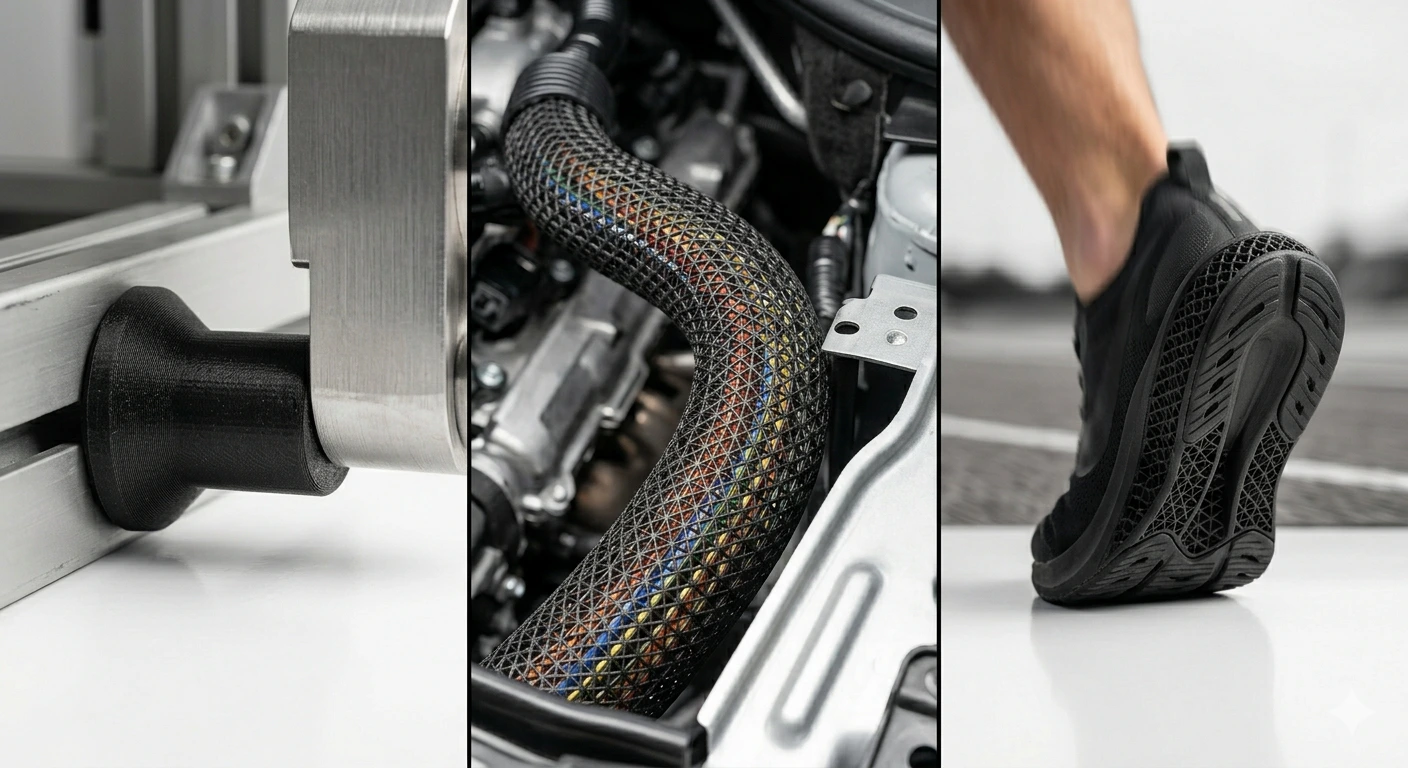
(AI generated) TPU machine impact bumper, TPU automotive component, TPU lattice sports shoe sole
Choose TPU filament when you need reliable flexibility, durability, and easy printing across a wide range of functional applications. It's the right default unless your project has a specific reason to look elsewhere.
Best TPU Applications
Grips and handles benefit from TPU's combination of flex and toughness, it holds up to repeated hand contact without degrading. Gaskets and seals work well because TPU compresses consistently and many TPU grades show good compression resistance. Vibration dampers use TPU's energy-absorbing nature, the same property that makes it less bouncy also makes it good at killing vibration. Protective covers and cases rely on TPU's abrasion resistance to survive drops and scrapes. Cable strain relief components use TPU's flex fatigue resistance for parts that bend repeatedly without cracking.
TPU Limitations
TPU has lower rebound than PEBA, which matters if your application needs the part to spring back energetically rather than just flex and return slowly. It's heavier than PEBA for equivalent volume. And it's less suitable for high-performance energy-return applications where every percentage point of bounce or rebound efficiency counts.
Need durable and easy-to-print flexible parts? Explore JLC3DP TPU material for functional prototypes and production-ready components.
When Should You Choose PEBA Filament?
Choose PEBA filament when you need maximum elasticity, lightweight performance, and exceptional energy return for dynamic applications. This is a specialist material for a specific job, not a general-purpose upgrade over TPU.
Why PEBA Can Outperform TPU
PEBA's rebound is significantly higher than TPU's because it is designed to spring back rather than absorb. Energy return follows directly from that: PEBA returns a much larger percentage of the energy put into it during compression. It's also lower density than TPU, so parts come out lighter for the same volume. Fatigue resistance is better too, PEBA holds its performance over thousands of compression cycles where TPU gradually loses its liveliness. And PEBA maintains flexibility at lower temperatures, which matters for outdoor or cold-environment applications.
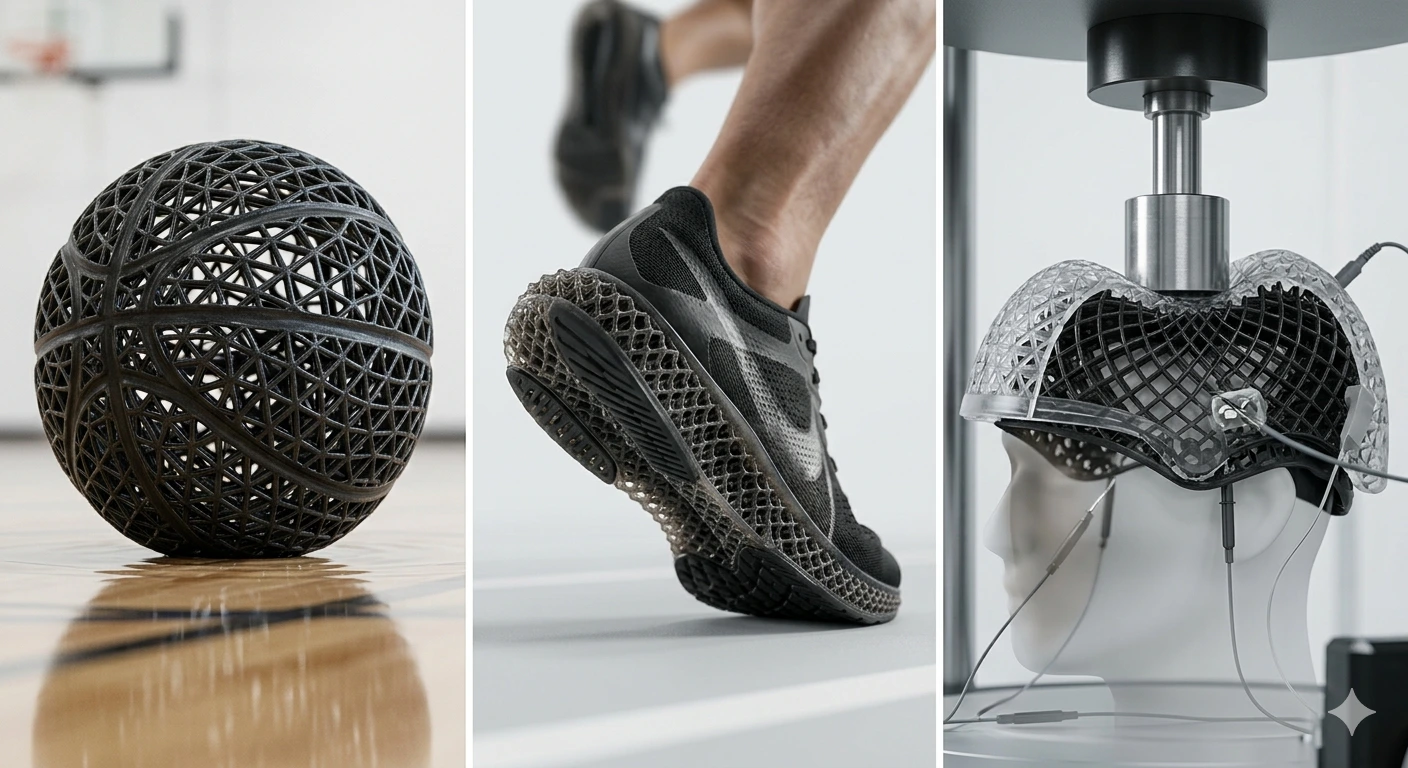
(AI generated) PEBA airless basketball lattice, PEBA racing shoe midsole, and PEBA impact protection structure
Ideal PEBA Applications
Airless basketballs are the application that's brought PEBA into the maker spotlight recently, the energy return PEBA provides is what makes a 3D printed airless basketball actually bounce like a real one, rather than feeling dead. Sports equipment prototypes more broadly benefit from the same rebound characteristics. Soft robotics uses PEBA where actuators need to flex and return precisely and repeatedly. Lattice structures designed for energy return get the most out of PEBA's material properties because the geometry and the material are both working toward the same goal. Energy-absorbing components, somewhat counterintuitively, also use PEBA in applications where consistent, predictable energy behavior matters more than pure damping.
PEBA Challenges
PEBA requires careful filament drying, it's more moisture-sensitive than TPU and performs noticeably worse when wet. It's more difficult to print overall, with tighter tolerances on temperature and retraction settings. And it costs significantly more per kilogram than TPU, which matters for larger prints or iterative testing.
Looking for high rebound and dynamic flexibility? Consider JLC3DP PEBA materials for sports equipment, airless basketballs, and advanced flexible designs.
Read TPU vs PEBA | See the Airless Basketball Material Guide
Is TPE Better Than TPU or PEBA?
TPE is not inherently better than TPU or PEBA. It's a broader material family that includes many elastomer formulations with different levels of flexibility, durability, and printability, which means the question "is TPE good" doesn't really have one answer.
Where TPE Fits
Soft-touch products use specific TPE formulations chosen for their tactile feel rather than mechanical performance. Wearables sometimes use TPE for comfort-focused contact surfaces. Consumer goods manufacturers reach for TPE when a particular softness or texture is the design goal rather than flex fatigue or rebound. Specialized elastomer applications exist where a specific TPE formulation has been engineered for a narrow use case that neither TPU nor PEBA addresses well.
TPE Challenges
some TPU materials are technically part of the TPE family. So the biggest issue with TPE as a category is inconsistency between brands, one manufacturer's TPE might print and perform completely differently from another's, even at similar advertised hardness. Feeding issues show up on some printers because TPE formulations vary in stiffness and can be harder to push through a Bowden setup than TPU. And because of that brand-to-brand variation, predicting performance before you've actually tested a specific TPE product is harder than with TPU or PEBA, where the material category is more standardized.
How to Choose the Right Flexible Filament for Your Project
Material selection should be based on performance requirements rather than flexibility alone. "I need something flexible" isn't specific enough, what does flexible need to do?
| If You Need | Recommended Material |
|---|---|
| Easy Printing | TPU |
| Low Cost | TPU |
| Functional Parts | TPU |
| Maximum Bounce | PEBA |
| High Energy Return | PEBA |
| Lightweight Performance | PEBA |
| Specialized Elastomer Behavior | TPE |
| Soft-Touch Consumer Products | TPE |
If you're not sure which category applies, ask what happens to the part under load. If it just needs to flex and hold its shape, TPU. If it needs to spring back with real energy, PEBA. If it needs a specific feel or texture more than a specific mechanical behavior, look at TPE formulations made for that purpose.
However, choosing between TPU, PEBA, and TPE is only half the challenge. Print settings, part geometry, and material behavior can dramatically affect the final result.
JLC3DP offers industrial 3D printing with flexible materials for prototypes, functional parts, wearables, gaskets, and high-performance applications. Upload your design, compare material options, and get expert feedback before production.
Get an instant quote from JLC3DP and find the right flexible material for your project.

Instant DFM & Material Validation
Upload Your CAD- 7+ Processes | 30+ Material
- Starts at $0.30 | 24h-120h Delivery
Flexible Filament Printing Tips and Common Mistakes
Most flexible filament failures are caused by moisture, excessive print speed, or poor filament handling rather than material limitations. The material usually isn't the problem, the process around it is.
Common Flexible Printing Issues
Stringing happens when retraction settings aren't tuned for the specific filament's flow characteristics. Under-extrusion shows up when print speed outruns what the flexible material can be pushed through the hotend reliably. Filament buckling occurs in Bowden setups where the soft filament compresses in the tube instead of feeding forward, this is the single most common reason flexible filament prints fail outright. Moisture absorption degrades print quality across all three material types, with PEBA being the most sensitive. Poor bed adhesion shows up when the first layer settings aren't dialed in for the specific flexible material's shrinkage behavior.
Real-World Lessons from Flexible Filament Printing
Early attempts at flexible printing on a Bowden-style printer taught a fast lesson: TPU and PEBA both buckle in long tube paths under push-force from the extruder, especially at higher print speeds. Switching to direct-drive extrusion fixed feeding reliability immediately, this isn't a minor recommendation, it's close to a requirement for anything beyond very short, simple prints.
PEBA's drying requirement turned out to be non-negotiable rather than a nice-to-have. A spool left out overnight produced visibly worse layer adhesion and a slightly tacky surface finish the next morning. Drying for several hours before printing, and keeping the spool in a dry box during longer prints, made the difference between consistent results and a frustrating guessing game.
Bounce testing, relevant specifically for basketball and sports equipment projects, showed a clear, repeatable pattern. TPU parts felt durable in testing but visibly absorbed energy on impact, bouncing noticeably lower than equivalent PEBA parts. PEBA parts sprang back closer to expectations from the first test, though they required more print speed tuning to get clean layers, since rushing the print introduced small under-extrusion gaps that affected the structure's consistency under repeated impact.
Print speed reduction was the fix for more failed prints than any other single change. Both TPU and PEBA benefit from slower speeds than rigid filaments, pushing for the same speed used on PLA or PETG produces inconsistent extrusion and weak layer bonding on flexible materials almost every time.
FAQ about Flexible Material
Q: What is the best flexible filament for 3D printing?
There isn't one universal answer. TPU is the best flexible filament for most general-purpose functional parts due to its ease of printing and durability. PEBA is the best flexible filament for applications needing maximum rebound and energy return, like airless basketballs and sports equipment. TPE is best when a specific soft-touch feel or specialized elastomer behavior is the goal.
Q: Is TPU or PEBA better for flexible 3D printing?
Neither is universally better, they're suited to different goals. TPU is better for durability, cost, and ease of printing. PEBA is better when rebound and energy return are the priority. TPU vs PEBA flexibility is similar on paper, but PEBA's rebound and fatigue resistance set it apart for dynamic, repeated-impact applications.
Q: Can PEBA be printed on a standard desktop 3D printer?
PEBA can be printed on many standard desktop printers, but results improve significantly with a direct-drive extruder and a printer that handles its temperature and drying requirements well. Bowden-style setups often struggle with PEBA filament buckling, so direct-drive is strongly recommended.
Q: What Shore hardness should I choose for flexible parts?
It depends on the application's need for rigidity versus softness. Higher Shore hardness (closer to 95A) holds geometry better and machines more predictably during printing, while lower Shore hardness (closer to 85A or below) produces a softer, more compliant part. For structural flexible parts like basketballs, higher hardness in the 90-95A range tends to perform better than very soft formulations.
Q: Are all TPE filaments similar?
No. TPE is a broad category, and formulations vary significantly between brands in flexibility, printability, and durability. Always check a specific TPE product's specifications and ideally test print samples rather than assuming consistent behavior across the category.
Q: Is PEBA worth the extra cost over TPU?
If your application depends on energy return and rebound, sports equipment, airless basketballs, energy-absorbing lattice structures, yes, the performance difference justifies the cost. For general functional parts where flex and durability matter more than rebound, TPU's lower cost and easier printing make it the more practical choice.
Keep Learning
Best Resin Printer for Miniatures in 2026
Choosing the best resin printer for miniatures in 2026 comes down to one thing: detail per dollar. After a hands-on review of this year's leading SLA and 4K/8K LCD resin printers, we ranked the top picks for D&D, Warhammer, and tabletop terrain — from a $149 beginner machine to an 8K showcase rig. This guide covers resolution (4K vs 8K), build volume, resin choices, and a buyer's checklist, so you can print crisp minis without overspending or drowning in failed prints. Why Resin 3D Printers Are Best f......
Strongest Resin for 3D Printing (2026): Tough vs High Strength Resins Compared
When people ask for the strongest resin for 3D printing, what they usually mean is “the strongest for my part.” A rigid bracket, a snap-fit enclosure, and a heat-exposed fixture all fail in different ways. This guide breaks it down clearly. What Is the Strongest Resin for 3D Printing? In pure tensile and flexural testing, high strength engineering resins are typically the strongest SLA resin options available. However, in real-world applications, parts often fail from impact, repeated stress, or stres......
ABS-Like Resin vs Standard Resin: The Definitive Guide to Material Choice & Performance
Key takeaways Standard Resin: High stiffness, extreme brittleness, best for static visuals. ABS-Like Resin: High elongation, exceptional impact resistance, mandatory for snap-fits. Near-Isotropic Advantage: Unlike FDM-printed authentic ABS which suffers from weak interlaminar (Z-axis) bonds and anisotropy, SLA ABS-like resin cures via liquid cross-linking, providing near-isotropic advantage and uniform multi-directional strength. Water Washable Resin: Zero IPA needed, eco-friendly workflow, but sacrif......
Best Flexible Filament for 3D Printing: TPU vs PEBA vs TPE
You're staring at three flexible filament options and they all claim to be "flexible." That word covers a lot of ground. A phone case grip and an airless basketball both need flexibility, but they need completely different things from it. This guide breaks down what actually separates TPU, PEBA, and TPE so you pick based on what your part needs to do, not just what's available. What Is the Best Flexible Filament for 3D Printing? The softest 3D printing material depends entirely on the application. TPU......
What Is 9000HE Resin? The High Strength SLA Engineering Resin Explained
What Is 9000HE Resin? The High Strength SLA Engineering Resin Explained Most SLA resins are designed for one thing: looking good. Smooth surface, fine detail, accurate geometry. That's where the technology excels and that's what most resin materials are optimized for. 9000HE wasn't designed for that. It was designed for the parts that actually have to do something, carry load, survive assembly, hold up in functional testing, and behave like an engineering material rather than a display model. If you'v......
Which Resin Is Best for 3D Printing Fine Details vs Functional Parts?
Resin 3D printing is often marketed as a single category, but in practice, the resin you choose matters more than the printer itself. A photosensitive resin optimized for ultra-fine surface detail behaves very differently from a resin designed for load-bearing or heat-resistant parts. Treating them as interchangeable is one of the most common reasons resin prints fail to meet expectations. When comparing 3D printing resin types, the real question isn’t which resin is “best” overall, it’s what the part......