ESD Plastic Materials: A Practical Guide for Engineers
19 min
- Indroduction
- What Is ESD Plastic?
- What Does ESD Mean?
- How Is ESD Plastic Different from Ordinary Plastic?
- How Does ESD Plastic Work?
- What Are the Different Types of ESD Plastic?
- What Properties Make ESD Plastic Different?
- What Materials Can Be Made ESD Safe?
- Where Is ESD Plastic Used?
- How Do You Choose the Right ESD Material?
- Most Common Mistakes When Choosing ESD Plastic
- FAQ about ESD Plastic
Key Takeaways
ESD plastic controls charge: It uses conductive or dissipative additives to let static charge flow away safely instead of building to a damaging discharge.
Three categories by resistivity: Conductive (<10⁵ Ω/sq), static dissipative (10⁵–10⁹ Ω/sq), and anti-static (10⁹–10¹² Ω/sq) each serve different roles.
Static dissipative is the usual target: Most electronics handling fixtures use the 10⁶–10⁸ Ω/sq range for controlled, non-damaging dissipation.
Match material to the full application: Balance resistivity with mechanical, thermal, and chemical requirements — ABS-ESD, PA12-ESD, and PEEK-ESD cover most needs.
Verify over time: Surface wear, humidity, and aging shift resistivity, so ESD parts need periodic retesting, not one-time qualification.
Indroduction
Static electricity is invisible right up until it destroys something expensive. A single electrostatic discharge event, sometimes less than 100 volts, well below what a human can feel, can permanently damage a semiconductor, corrupt a sensor, or kill a PCB component without leaving any visible evidence. The part looks fine. It fails in the field six months later.
ESD plastic is one of the most widely used static control materials in electronics manufacturing, helping engineers prevent electrostatic discharge from damaging sensitive components. The right ESD safe material doesn't just reduce static, it controls exactly how charge moves through a component, dissipating it at a rate that protects sensitive electronics without creating new problems in the process. This guide covers what ESD plastic actually is, how the different types work, which ESD safe materials suit which applications, and the selection mistakes that cause problems even when the right material category gets chosen.
If you're selecting an ESD-safe material for custom fixtures, enclosures, or production tooling, JLC3DP provides industrial 3D printing with engineering-grade ESD materials and automated manufacturability analysis.
What Is ESD Plastic?
ESD plastic is a polymer material engineered to control electrostatic discharge by allowing electrical charges to dissipate in a controlled, predictable way rather than accumulating on the surface until a damaging discharge event occurs.
Standard plastic is an excellent electrical insulator, charges generated by friction, contact, or separation build up on the surface and stay there. Touch that charged surface to a sensitive electronic component and the stored charge releases instantly, which is the discharge event that damages electronics. ESD safe plastic interrupts that accumulation by incorporating conductive or dissipative additives that give charges a path to move, slowly and safely, rather than building to a destructive discharge level.
What Does ESD Mean?
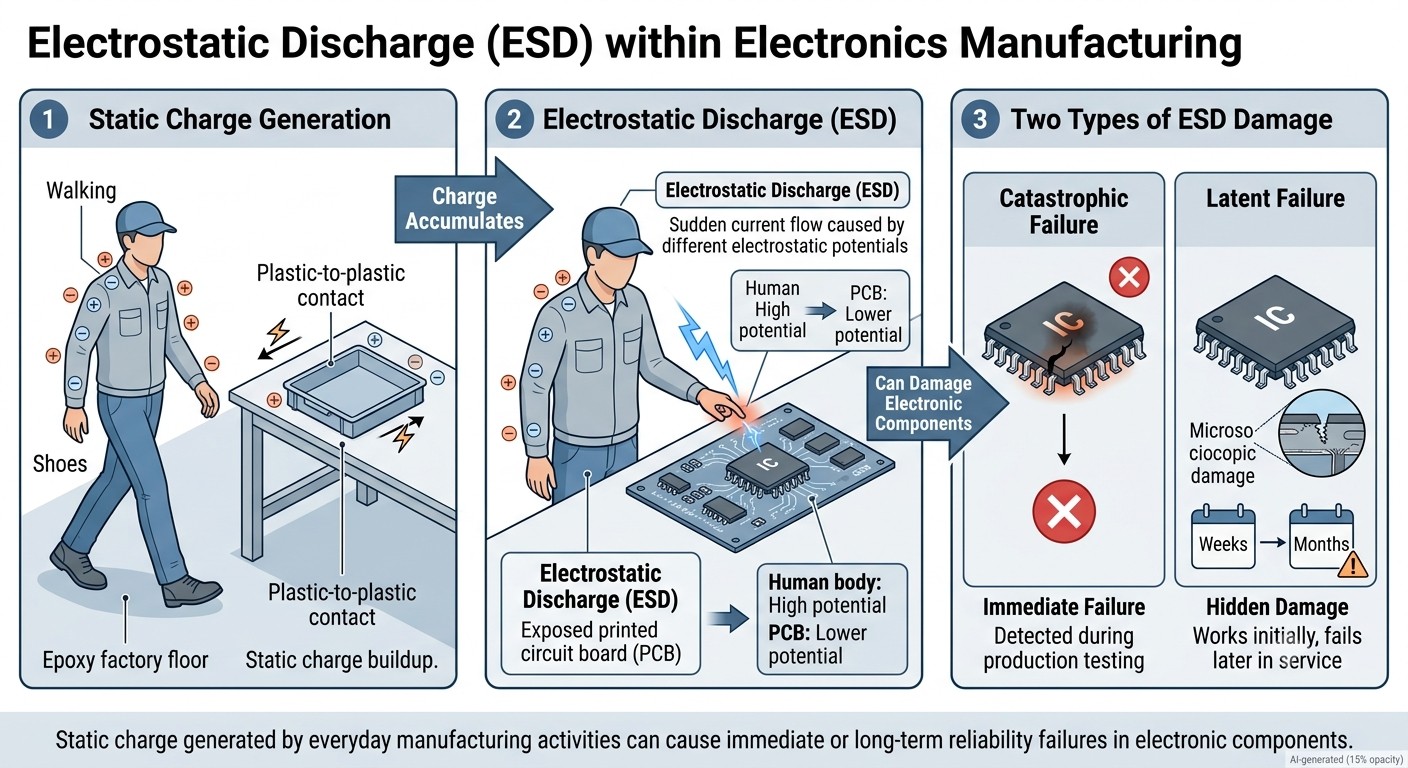
ESD stands for electrostatic discharge, the sudden flow of electrical current between two objects at different electrostatic potentials. In manufacturing environments, this happens constantly: people walking across floors, plastic components sliding against each other, parts being placed in fixtures. Every friction event generates static charge. On ordinary plastic surfaces, that charge accumulates. In electronics manufacturing, accumulated charge is a reliability problem that costs real money in field failures and rework.
The electronics industry characterizes ESD damage in two categories. Catastrophic failures are immediate and obvious, the component stops working on the line and gets caught in functional testing. Latent failures are worse: the component works initially but has been weakened by the discharge and fails early in service. Latent failures are harder to trace back to an ESD event because the failure happens weeks or months after the damage occurred.
How Is ESD Plastic Different from Ordinary Plastic?
- Friction
Static charge generated
- Charge accumulates on surface
No pathway to move the charge away
- Voltage builds up
Charge keeps climbing toward damaging levels
- Discharge event → ESD damage
Stored charge releases into sensitive components
- Friction
Static charge generated
- Charge dissipates through material
Conductive/dissipative pathways carry charge away
- Voltage stays below damaging level
Controlled dissipation rate prevents buildup
- No discharge → component protected
Charge never reaches a destructive threshold
The difference isn't in how charge is generated, friction generates charge on both materials. The difference is what happens next. Ordinary plastic has no mechanism to move that charge away. ESD plastic material has conductive or dissipative pathways built into its structure that let charge flow away at a controlled rate before it reaches damaging levels.
How Does ESD Plastic Work?
ESD plastics work by incorporating conductive or static dissipative additives into the polymer matrix, creating pathways that allow electrical charges to dissipate gradually rather than accumulating on the surface.
The base polymer, ABS, nylon, PEEK, whatever the application requires, provides the mechanical properties. The additives provide the electrical control. The type and concentration of additive determines where the finished material falls on the resistivity spectrum, which determines whether it's classified as conductive, static dissipative, or anti-static plastic.
Conductive Fillers
Carbon black is the most common additive for producing conductive plastic and electrostatic dissipative plastic. It's cost-effective, works across a range of polymer types, and produces consistent resistivity when the concentration and dispersion are controlled. The challenge with carbon black is that small variations in mixing and processing can shift resistivity significantly, batch-to-batch consistency requires tight process control.
Carbon fiber adds both conductivity and mechanical reinforcement simultaneously. Carbon fiber filled variants of ABS, nylon, and PEEK produce conductive plastic with better stiffness and strength than carbon black filled equivalents. The tradeoff is higher material cost and some anisotropy in both electrical and mechanical properties depending on fiber orientation.
Carbon nanotubes provide conductivity at much lower additive loading than carbon black or carbon fiber, which means less impact on the base polymer's mechanical properties. The polymer matrix stays closer to its unfilled mechanical performance. The tradeoff is cost, carbon nanotube modified materials are significantly more expensive than carbon black variants.
Conductive polymers, intrinsically conductive polymer chains blended into the matrix, provide another route to electrostatic discharge plastic without particulate fillers. They avoid the surface appearance changes that carbon fillers produce (most carbon-filled ESD plastic material is black) but are generally more expensive and less available in standard formulations.
Surface Resistivity Explained
Surface resistivity is the key specification for ESD safe materials. It measures resistance to current flow across a surface, lower values mean charges move more easily, higher values mean charges move more slowly or not at all.
The scale runs roughly as follows: conductors sit below 10⁵ Ω/sq, static dissipative plastic falls between 10⁵ and 10⁹ Ω/sq, anti-static plastic sits between 10⁹ and 10¹² Ω/sq, and ordinary insulating plastics exceed 10¹² Ω/sq.
For electronics manufacturing, the static dissipative range is usually what's specified, charge dissipates quickly enough to prevent damage but slowly enough that it doesn't create a fast discharge path that could itself damage sensitive components under certain conditions.
What Are the Different Types of ESD Plastic?
| Type | Surface Resistivity | Static Control | Typical Applications | Example Materials |
|---|---|---|---|---|
| Conductive Plastic | Below 10⁵ Ω/sq | Very fast dissipation | Grounding fixtures, shielding | Carbon-filled ABS, CF-PEEK |
| Static Dissipative Plastic | 10⁵ to 10⁹ Ω/sq | Controlled dissipation | PCB fixtures, handling trays | ABS-ESD, PA12-ESD |
| Anti-Static Plastic | 10⁹ to 10¹² Ω/sq | Reduces charge generation | Packaging, covers | PETG-ESD, PE-AS |
Conductive plastic dissipates charge the fastest. Too fast, in some applications, if a charged component contacts a conductive plastic fixture, charge could transfer rapidly enough to cause damage in sensitive devices. Conductive ESD plastic material is most appropriate for grounding applications where the goal is to drain charge completely, not to manage the rate of dissipation.
Electrostatic dissipative plastic in the 10⁵ to 10⁹ Ω/sq range is the specification most electronics manufacturing environments target. The dissipation rate is fast enough to prevent charge accumulation but controlled enough to avoid rapid discharge events. Most handling fixtures, trays, and tooling in ESD controlled areas use static dissipative plastic in this range.
Anti-static plastic at 10⁹ to 10¹² Ω/sq primarily reduces charge generation rather than aggressively dissipating existing charge. It's appropriate for packaging and areas where charge accumulation needs to be minimized but a full ESD safe material specification isn't required.
What Properties Make ESD Plastic Different?
Electrical Properties
Surface resistivity is the primary specification, but volume resistivity matters too, it describes charge movement through the bulk of the material rather than just across the surface. For thick components or applications where charge might enter through the body rather than the surface, volume resistivity determines whether the ESD plastic material performs as expected.
Charge decay time, how quickly a surface charge drops to 10% of its initial value, is the practical performance test. According to ANSI/ESD STM11, ESD safe material specifications typically require charge decay to below 100V within 2 seconds. Electrostatic dissipative plastic in the 10⁶ to 10⁸ Ω/sq range typically achieves this comfortably.
Mechanical Properties
Adding conductive fillers to a base polymer changes its mechanical properties, usually not in the direction you'd want. Carbon black reduces impact strength and toughness in most polymers. Carbon fiber improves stiffness but can reduce elongation to break. The engineering tradeoff in ESD plastic selection is always between the electrical performance needed and the mechanical performance the application requires.
Tensile strength of ESD plastic material typically runs 10-20% lower than the equivalent unfilled base polymer. Flexural strength is similarly affected. For applications where mechanical performance is critical alongside ESD protection, ESD PEEK and ESD PA12 are the materials that maintain the best combination, though at significantly higher cost than ESD ABS.
Thermal Properties
Conductive fillers can modestly improve thermal conductivity in ESD plastic, which is useful in applications where the component needs to dissipate heat as well as electrical charge. Heat resistance follows the base polymer, ESD ABS has similar heat resistance to standard ABS, ESD PEEK maintains PEEK's excellent high-temperature performance. The filler addition doesn't fundamentally change the polymer's thermal behavior, which means ESD safe material selection for high-temperature applications still starts with the right base polymer.
What Materials Can Be Made ESD Safe?
| Material | Strength | Temperature Resistance | Chemical Resistance | Typical Applications |
|---|---|---|---|---|
| ABS-ESD | ★★★★☆ | ★★★☆☆ | ★★★☆☆ | Fixtures, enclosures, handling trays |
| PA12-ESD | ★★★★★ | ★★★★☆ | ★★★★☆ | Functional parts, tooling, jigs |
| PETG-ESD | ★★★☆☆ | ★★★☆☆ | ★★★☆☆ | Covers, guards, light-duty packaging |
| PC-ESD | ★★★★☆ | ★★★★★ | ★★★★☆ | Electronics housings, optical components |
| PEEK-ESD | ★★★★★ | ★★★★★ | ★★★★★ | Semiconductor equipment, high-performance tooling |
ABS-ESD is the workhorse of ESD safe plastics for most electronics manufacturing environments. It's available in both injection molding pellet form and 3D printing filament, produces consistent resistivity, and machines and prints well. Its temperature resistance limits applications above 80-90°C but covers most PCB handling and assembly fixturing requirements. At JLC3DP, ABS-ESD Plastic is among the most frequently selected materials for custom ESD-safe fixtures and tooling because it provides a good balance of printability, mechanical performance, and static dissipation.
PA12-ESD, nylon 12 with ESD additives, offers better mechanical performance than ABS-ESD and handles higher operating temperatures, making it the preferred ESD plastic material for demanding functional parts. It's the standard choice for jigs and fixtures that need both ESD control and mechanical durability under repeated use.
PEEK-ESD is the highest-performing ESD safe material in the table and also the most expensive. It maintains full ESD plastic properties at temperatures that would destroy other ESD plastics, resists virtually all chemicals used in semiconductor processing, and has mechanical properties approaching some metals. For semiconductor wafer handling equipment, clean room tools, and other critical applications, ESD PEEK justifies its cost.
Where Is ESD Plastic Used?
| Industry | Typical Parts | ESD Plastic Type |
|---|---|---|
| Electronics Manufacturing | PCB fixtures, assembly trays, test sockets | ABS-ESD, PA12-ESD |
| Semiconductor | Wafer handling tools, reticle carriers, process fixtures | PEEK-ESD, PC-ESD |
| Automotive Electronics | Sensor housings, ECU handling trays | ABS-ESD, PA12-ESD |
| Aerospace | Assembly tooling, avionics handling fixtures | PA12-ESD, PEEK-ESD |
| Battery Manufacturing | Cell handling fixtures, module assembly tooling | ABS-ESD, PA12-ESD |
Electronics manufacturing is the most obvious application area for ESD plastic, essentially every handling fixture, tray, and tooling component in a PCB assembly line needs to be ESD safe material to protect the components being assembled. The volume of anti static plastic and electrostatic dissipative plastic used in a modern SMT line is significant. At JLC3DP, many customers use 3D-printed ESD fixtures during low-volume electronics production before transitioning to injection molding. Learn when to switch from 3D printing to injection molding.
Semiconductor fabrication is the most demanding ESD application. Wafer handling tools contact material worth thousands of dollars per wafer. The cleanroom environment rules out many filler types that would contaminate processes. ESD PEEK and other high-performance ESD safe plastics dominate here because the cost of a material failure far exceeds the material premium.
Battery manufacturing has become a significant growth area for ESD plastic applications as lithium-ion battery production scales up. Cells and modules are sensitive to electrostatic discharge during handling, and the conductive plastic and electrostatic dissipative plastic used in battery assembly tooling needs to maintain consistent performance across high-volume production environments.
How Do You Choose the Right ESD Material?
The selection decision starts with defining the required surface resistivity, the application determines whether conductive plastic, static dissipative plastic, or anti-static plastic is the right category. From there, operating temperature, chemical exposure, mechanical requirements, and manufacturing process narrow the material choice within that category.
See our Industrial 3D Printing Materials Guide to compare printable engineering plastics for ESD, high temperature, and functional applications.
Selection Factors
- Required resistivity range: What does the application actually need? ANSI/ESD S20.20 defines the requirements for ESD controlled environments, for most PCB handling and assembly applications, the 10⁶ to 10⁹ Ω/sq range covers the specification. More demanding applications may specify tighter ranges.
- Operating temperature: ESD ABS fails above 90°C. ESD PA12 handles to around 150°C. ESD PEEK handles continuous service to 250°C. High-temperature processing or sterilization requirements narrow the field quickly.
- Chemical exposure: Semiconductor process chemicals attack most standard ESD plastics. ESD PEEK is essentially chemically inert. ESD PA12 handles most industrial chemicals. ESD ABS is more limited. For cleanroom and chemical exposure applications, chemical compatibility needs to be checked against the specific chemicals present.
- Mechanical requirements: What load will the component carry? How often will it be used? What impact resistance is needed? The answers point to different base polymers within the ESD safe material category.
- Manufacturing process: Some ESD plastic materials are available as injection molding pellets but not 3D printing filament, or vice versa. If the component needs to be 3D printed, which is increasingly common for fixtures and tooling where low volumes and complex geometry favor additive manufacturing, material availability in printable form matters.
Decision Flow
Define the required resistivity range
Start every selection by mapping what the application actually needs before looking at materials.
Below 10⁵ Ω/sq → Conductive Plastic
Choose carbon-filled ABS or CF-PEEK for grounding and full charge drainage.
10⁵–10⁹ Ω/sq → Static Dissipative Plastic
If you need >150°C, use ESD PEEK or ESD PA12. Otherwise use ESD ABS for general use or ESD PA12 for higher performance.
10⁹–10¹² Ω/sq → Anti-Static Plastic
Choose PETG-ESD or PE-AS where reducing charge generation is the goal.
Most Common Mistakes When Choosing ESD Plastic
Mistakes to Avoid
- Choosing conductive plastic when static dissipative material is sufficient: Conductive plastic dissipates charge faster than electrostatic dissipative plastic, but faster isn't always better. Rapid charge dissipation through a conductive plastic fixture can itself cause damage to certain sensitive components. Static dissipative plastic in the 10⁶ to 10⁸ Ω/sq range provides the controlled dissipation rate most electronics handling applications actually need, and specifying conductive plastic adds cost without adding the protection margin people assume it does.
- Considering resistivity without considering mechanical performance: An ESD safe material with the right surface resistivity but inadequate impact strength cracks in use, exposing non-ESD surfaces and defeating the protection. Fixtures, trays, and tooling often involve repeated mechanical loading, so the mechanical performance needs to match the use pattern, not just the electrical specification.
- Assuming carbon-filled ESD plastic provides permanent protection: Surface wear, contamination, or long-term environmental exposure can affect measured surface resistivity even though the filler remains embedded. Surface wear removes the conductive network at contact points, chemical exposure can alter surface resistivity, and thermal cycling can shift filler distribution. ESD plastic needs periodic resistivity verification in service, not just qualification testing at commissioning.
- Ignoring humidity effects during ESD testing: Anti-static plastics that rely partly on surface moisture behave very differently at 15% versus 50% relative humidity. A material that passes ESD testing in a humid environment may fail in a dry winter cleanroom. Always test at the actual operating humidity range, not just at laboratory standard conditions.
- Selecting material before defining the application scenario: The most common mistake is picking an ESD plastic because it's familiar or worked on a previous project, without mapping actual requirements. Different positions in an assembly line have different requirements. Define what the component needs to do before selecting which electrostatic discharge plastic does it.
FAQ about ESD Plastic
Q: Is ESD plastic conductive?
It depends on the type. Conductive plastic has surface resistivity below 10⁵ Ω/sq and conducts electricity relatively freely. Static dissipative plastic sits between 10⁵ and 10⁹ Ω/sq, allowing controlled charge movement but not conducting the way a metal or conductive plastic does. Anti-static plastic at 10⁹ to 10¹² Ω/sq reduces charge generation rather than actively conducting it away. Most electronics manufacturing applications use static dissipative plastic rather than truly conductive plastic.
Q: Is ESD plastic permanent?
The ESD properties of carbon-filled ESD plastic material are built into the bulk of the material rather than applied as a coating, so they don't wear off the way topical anti-static treatments do. However, surface wear, chemical exposure, and aging can shift resistivity over time. ESD safe materials in critical applications should be retested periodically rather than assumed to maintain their initial specification indefinitely.
Q: Can ESD plastic be 3D printed?
Yes. ESD versions of ABS, PA12, PETG, and PEEK are available as FDM filament and SLS powder for 3D printing. 3D printed ESD plastic parts are increasingly common for custom fixtures, jigs, and tooling where complex geometry and low volumes favor additive manufacturing over injection molding. Resistivity consistency in 3D printed ESD plastic depends on correct printing parameters, so follow material-specific guidelines carefully.
Q: Is anti-static plastic the same as ESD plastic?
Anti-static plastic is one category of ESD plastic material, specifically the type with surface resistivity between 10⁹ and 10¹² Ω/sq that primarily reduces charge generation rather than dissipating existing charge. ESD plastic is the broader category covering conductive plastic, static dissipative plastic, and anti-static plastic. All anti-static plastic is ESD plastic material, but not all ESD safe material is anti-static plastic.
Q: Can ABS be made ESD safe?
Yes. ABS-ESD is one of the most widely used ESD safe plastics in electronics manufacturing. Carbon black or carbon fiber additives are blended into the ABS matrix to produce surface resistivity in the static dissipative or conductive range. ABS-ESD retains most of ABS's processing characteristics, injection molding and 3D printing similarly to standard ABS, while providing reliable ESD protection.
Q: What resistivity should ESD plastic have?
For most electronics assembly and PCB handling applications: 10⁶ to 10⁹ Ω/sq surface resistivity, placing the material in the static dissipative plastic category. For grounding fixtures where charge needs to be drained completely: below 10⁵ Ω/sq conductive plastic. For packaging and areas where charge generation reduction is the goal: 10⁹ to 10¹² Ω/sq anti-static plastic. The specific requirement should be defined against ANSI/ESD S20.20 or the relevant industry standard.
Q: Does ESD plastic wear out?
The bulk electrical properties of ESD plastic material are inherent to the material rather than surface-applied, so they don't disappear the way a coating does. But surface wear, UV exposure, chemical contact, and thermal cycling can all shift resistivity over time, particularly at contact surfaces experiencing repeated mechanical loading. High-use fixtures and tooling made from electrostatic dissipative plastic should be retested for resistivity at defined intervals as part of an ESD control program.
Q: What's the difference between ESD plastic and ESD shielding?
ESD plastic safely dissipates electrostatic charge, while ESD shielding materials are designed to block external electrostatic fields. Many electronics manufacturing environments use both together, for example, ESD plastic fixtures during assembly and ESD shielding bags or containers for storage and transportation.
Conclusion: Choosing the Right ESD Plastic
ESD plastic is the right material choice for any component that contacts or operates near electronics sensitive to electrostatic discharge. The key is matching the specific type of ESD safe material to the actual application requirements: conductive plastic where rapid charge drainage to ground is the goal, static dissipative plastic where controlled dissipation protects sensitive devices during handling, anti-static plastic where charge generation reduction is sufficient.
The selection mistakes covered above are all avoidable with a disciplined approach: define the required resistivity range first, verify mechanical and thermal performance against the use conditions, check material availability in the required manufacturing process, and build resistivity verification into the ongoing quality process rather than treating ESD plastic qualification as a one-time event. Done right, ESD safe material selection is straightforward engineering. Done wrong, it's an expensive field reliability problem waiting to happen.
Keep Learning
PLA vs PETG vs ASA: Best 3D Printing Filament for Outdoor Use
If you've ever watched a 3D printed garden hook sag in the sun or a cold snap crack your custom outdoor fixture, you already know: not all filaments are built for the elements. Choosing the best 3D printing filament for outdoor use isn't just about surviving the occasional drizzle. It's about UV exposure, temperature swings, moisture resistance, and long-term strength. And let's be real, most people don't want to reprint every few months just because they picked the wrong plastic. In this guide, we'll......
ABS Temperature Resistance: How Hot Can ABS Withstand?
Key Takeaways ABS heat resistance is defined by Tg and HDT, not melting point. Typical ABS grades have a Tg around 100–110℃ and HDT around 85–95℃. JLC3DP ABS reaches 98°C HDT under its published test conditions, but actual part performance depends on load, geometry, orientation, and exposure time. ABS offers higher heat resistance than PLA and PETG, while ASA provides similar heat performance with better outdoor durability. PC-ABS and PC are options when ABS is not enough. PC-ABS balances heat resista......
Is PETG Toxic to Print? Fumes, Risks & Safety Guide
Key Takeaways PETG is generally considered a lower-emission 3D printing material compared to ABS and ASA, but it does produce VOCs and ultrafine particles during printing. The odor during PETG printing is typically mild, some people barely notice it, others describe a faint warm-plastic smell. Low odor doesn't mean zero emissions. Ventilation is still a sensible precaution. PETG food safety is complicated, the material itself may be food-grade in some formulations, but the printing process introduces ......
Top 5 Heat-Resistant 3D Printing Filaments Compared
When Regular Filament Just Doesn’t Cut It You’ve 3D printed a functional bracket for a car engine bay. It fits perfectly, looks great, and then warps into a banana-shape after a week under the hood. That’s the danger of underestimating heat. If you're building automotive components, enclosures near motors, molds, or even kitchenware, using the wrong filament can lead to deformation, brittleness, or outright failure when exposed to heat. So, you already know the solution: Choosing the right heat-resist......
PLA Temperature Resistance: Heat Resistance, Softening & Melting Point
Key Takeaways PLA typically starts losing rigidity around 55–65℃ (Tg) and melts at approximately 150–180℃. PLA can deform and creep long before it melts, so melting point is not a practical service-temperature limit. Actual PLA deformation depends on temperature, load, geometry, print orientation, and exposure time. Standard PLA becomes increasingly risky above 50–60℃ and is generally unsuitable for sustained 70–80℃ applications. PLA+ heat resistance varies by formulation. For higher-temperature appli......
PETG Temperature Resistance: Limits & Comparison with PLA/ABS/ASA
Key Takeaways Standard PETG is best suited for continuous use below ~60℃; performance can decline as temperatures approach 70℃. PETG typically has a Tg of ~75–85℃ and an HDT of ~65–75℃, depending on the material grade and test conditions. HDT is not a maximum service temperature—load, print orientation, wall thickness, geometry, and exposure time all affect real-world performance. PETG offers better heat resistance than PLA but lower heat resistance than ABS, ASA, PA12-CF, PC, and PEEK. For sustained ......