Nylon vs PETG: Strength, Toughness & Heat Resistance
17 min
- Nylon vs PETG: Which Is Better?
- Nylon vs PETG at a Glance
- What Is Nylon Filament?
- What Is PETG Filament?
- Nylon vs PETG: Key Differences
- Nylon vs PETG CF: What's the Difference?
- Nylon vs PETG for Different 3D Printing Applications
- How to Choose Between Nylon and PETG
- JLC3DP Nylon 3D Printing Services
- FAQs About Nylon vs PETG
- Conclusion: Nylon vs PETG
Note: PETG is included in this article for technical comparison only. JLC3DP does not currently offer or recommend PETG as a printing material. The comparison is intended for educational purposes and should not be interpreted as a JLC3DP material recommendation.
Nylon vs PETG is not a contest with a single winner. Nylon generally leads in toughness, wear resistance, fatigue resistance, and higher-temperature applications. PETG is easier to print, easier to store, and more cost-effective for general-purpose parts. Before comparing any numbers, one point must be clear: nylon is not a single standardized material. It is a family of polyamides, and common 3D printing grades such as PA11 and PA12 can differ significantly in strength, ductility, moisture behavior, and heat resistance. A fair comparison therefore names the grade and the process, not just the material.
This guide compares nylon and PETG across the properties that drive real decisions, then shows how to match a material, and a manufacturing process, to a specific application.
Key Takeaways
- Nylon generally offers higher toughness, wear resistance, fatigue resistance, and temperature capability than PETG, but nylon is a family of polyamides, so performance varies significantly by grade and manufacturing process.
- PETG is easier to print, less sensitive to moisture, and generally less expensive, making it practical for prototypes, enclosures, brackets, fixtures, and other general-purpose parts.
- Tensile strength alone does not determine which material is better. Nylon and PETG can have similar tensile strength while behaving differently under impact, bending, repeated loading, and heat.
- For industrial functional parts, compare the specific nylon grade and printing process. FDM nylon, SLS nylon, and MJF nylon are not interchangeable.
- Carbon fiber improves stiffness and dimensional stability but does not eliminate the underlying differences between nylon and PETG.
Nylon vs PETG: Which Is Better?
Nylon is generally better for parts that require toughness, wear resistance, fatigue resistance, or higher-temperature performance, while PETG is easier to print, easier to store, and generally more cost-effective. However, there is no universal winner. The right choice depends on the specific grade, manufacturing process, mechanical load, operating temperature, and environment.
One important distinction comes first: nylon is not a single material. It is a family of polyamides that includes PA6, PA11, PA12, and many reinforced or modified grades. These materials can differ substantially in strength, ductility, moisture absorption, heat resistance, and printability.
A fair nylon vs PETG comparison therefore needs to identify both the material grade and manufacturing process, rather than treating "nylon" as one fixed specification.
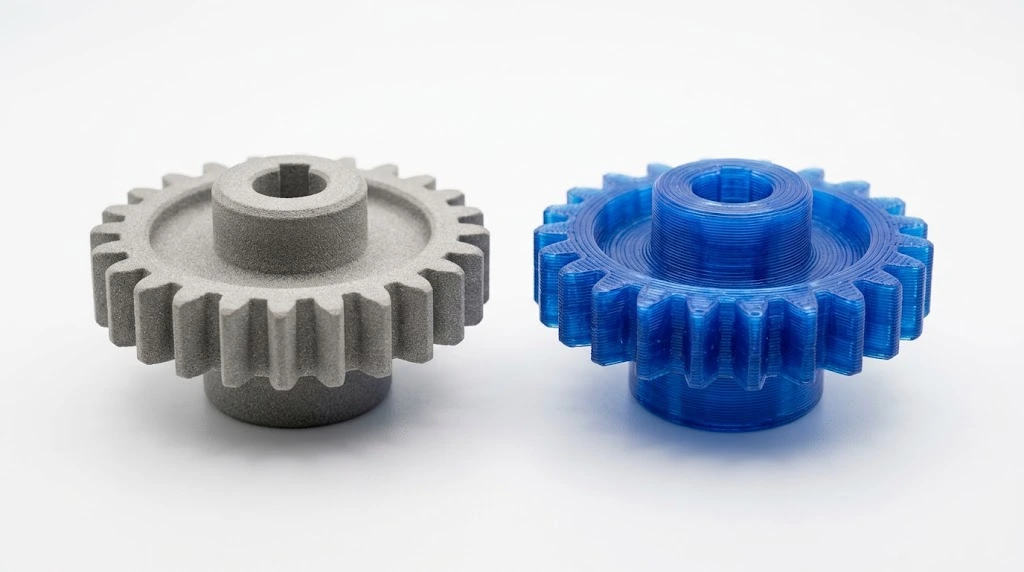
Nylon vs PETG at a Glance
| Property | Nylon | PETG |
|---|---|---|
| Material type | Polyamide family; properties vary by grade | PET-based thermoplastic |
| Strength | Grade-dependent; generally suited to functional parts | Good for general-purpose functional parts |
| Toughness | Generally high | Good |
| Heat resistance | Generally higher for suitable grades | Moderate |
| Wear resistance | Generally good | Moderate |
| Flexibility | Grade-dependent; PA11 is notably ductile | Moderate, semi-rigid |
| Moisture absorption | High | Lower |
| Printability | More demanding | Easier |
| Storage | Requires careful moisture management | Easier |
| Cost | Varies significantly by grade and process | Generally lower |
| Typical applications | Mechanical and functional parts | Prototypes, enclosures, brackets, fixtures |
This table is a practical starting point rather than a universal ranking. A material that appears less capable in one property may still be the better choice when the actual load, temperature, geometry, and manufacturing process are considered.
What Is Nylon Filament?
What Is Nylon?
Nylon is a family of polyamide (PA) thermoplastics used in functional and engineering applications. In 3D printing, nylon is valued for its toughness, ductility, wear resistance, fatigue performance, and chemical resistance.
Nylon is also relatively hygroscopic, meaning it absorbs moisture from the surrounding environment. This makes nylon filament more demanding to store and print than materials such as PETG.
These characteristics make nylon suitable for mechanically loaded parts such as gears, bushings, brackets, hinges, clips, and other functional components.
Common Nylon Grades: PA11, PA12, and Reinforced Nylon
Different nylon grades can behave very differently.
- PA11: Known for high ductility, impact resistance, and good chemical resistance. It is useful for parts that need to withstand repeated deformation or impact.
- PA12: Widely used in powder-based processes such as SLS and MJF. It provides a useful balance of strength, stiffness, ductility, and dimensional stability.
- Reinforced nylon: Glass-fiber-, carbon-fiber-, or mineral-filled grades can provide higher stiffness and improved dimensional stability, often with reduced ductility compared with the unfilled polymer.
Why Nylon Is Not a Single Material
"Strength of nylon" is not a single number. PA11 and PA12 have different molecular structures and performance characteristics. Reinforcement changes stiffness and dimensional stability. Manufacturing technology also changes the final part properties.
For example, FDM nylon, SLS nylon, and MJF nylon should not be treated as interchangeable materials, even when they use similar polymer chemistry. For engineering applications, always compare the specific grade, process, and test conditions.
JLC3DP offers several industrial nylon materials, including PA12-HP, PA11-HP, PAC-HP, and PA12S-HP. Their properties should be evaluated according to the intended application and manufacturing process rather than under the generic label "nylon."
What Is PETG Filament?
PETG is a glycol-modified form of PET and is one of the most widely used thermoplastics for FDM/FFF 3D printing.
The addition of glycol modifies the polymer structure and improves toughness and printability compared with conventional PET. PETG generally provides good layer adhesion, chemical resistance, durability, and dimensional stability while remaining relatively easy to print.
Compared with nylon, PETG has substantially lower moisture sensitivity and usually requires less demanding storage and preparation. This makes PETG practical for:
- General prototypes
- Enclosures
- Brackets
- Fixtures
- Covers
- Household parts
- Functional parts with moderate mechanical and thermal requirements
Nylon vs PETG: Key Differences
Nylon vs PETG Strength: Mechanical Performance
Strength is only one part of mechanical performance. When comparing nylon and PETG, consider:
- Tensile strength
- Tensile modulus
- Elongation
- Toughness
- Impact resistance
- Fatigue resistance
- Wear resistance
Tensile Strength
Nylon and PETG can have surprisingly similar tensile-strength values. For example, representative JLC3DP MJF materials include:
| Material | Tensile Strength (MPa) | Tensile Modulus (MPa) |
|---|---|---|
| PA12-HP | 48 | 1,700-1,800 |
| PA11-HP | 52 | 1,700-1,800 |
| PETG (typical) | 45-52 | 2,000-2,200 |
These values are specific to the listed JLC3DP materials and test conditions and should not be treated as universal values for all PA11 or PA12. FDM PETG materials can also show tensile strengths in a similar general range, depending on formulation, print orientation, and processing conditions.
This is why saying simply "nylon is stronger than PETG" can be misleading.
Toughness and Elongation
The more meaningful difference often appears when the part is bent, impacted, or repeatedly loaded.
Some nylon grades, particularly PA11, can achieve substantially higher elongation than typical PETG formulations. Higher elongation and toughness can help a part deform and absorb energy before failure. In practical terms, a nylon clip may tolerate repeated flexing better than a comparable PETG clip, even when their tensile-strength values are relatively close.
Fatigue Resistance
For components exposed to repeated loading, fatigue performance can be more important than one-time tensile strength. Nylon is commonly used for:
- Gears
- Bushings
- Hinges
- Clips
- Vibration-related components
- Repeatedly loaded mechanical parts
The exact fatigue performance still depends on the grade, geometry, load cycle, temperature, moisture condition, and manufacturing process.
Nylon vs PETG Heat Resistance
Nylon generally provides higher heat-deflection performance than PETG for suitable grades, but thermal properties must be interpreted carefully. Three concepts are particularly important:
- Glass transition temperature (Tg): the temperature range where an amorphous or amorphous region of a polymer changes from a rigid glassy state toward a softer, more rubber-like state.
- Melting temperature (Tm): the temperature at which crystalline polymer regions melt.
- Heat deflection temperature (HDT): the temperature at which a test specimen reaches a specified deformation under a defined load.
These values are not interchangeable. PETG typically has a Tg around 75–85°C, while many nylon grades have lower Tg values but retain useful mechanical performance above Tg because of their semi-crystalline structure.
For example, a specific JLC3DP PA11-HP grade has an HDT of approximately 185°C at 0.45 MPa, but only around 54°C at 1.82 MPa. This illustrates an important engineering principle: HDT depends strongly on the applied test load. Therefore, avoid comparing two materials using HDT values measured under different loads.
For a lightly loaded component exposed to elevated temperatures, a suitable nylon grade may maintain its shape much better than PETG. However, a heavily loaded nylon component can still deform or creep at elevated temperature. Always evaluate the actual service temperature, load, exposure time, and material grade.
Nylon vs PETG Toughness, Flexibility, and Impact Resistance
Nylon generally has an advantage in toughness and ductility. PA11 is particularly useful when a part needs to tolerate repeated deformation or impact. Some PA12 grades provide a more balanced combination of strength, stiffness, and ductility.
PETG is tougher than more brittle materials such as PLA and can tolerate moderate flexing, but its performance under repeated mechanical loading depends strongly on the formulation and printing conditions. Nylon is therefore often considered for:
- Snap-fit clips
- Flexible joints
- Vibration mounts
- Protective components
- Impact-loaded parts
- Repeatedly loaded mechanical parts
The key distinction is not simply that nylon is "stronger." It is that many nylon grades can provide a more favorable combination of toughness, elongation, and fatigue resistance.
Nylon vs PETG Wear Resistance
Nylon has good abrasion resistance and relatively low friction, which makes it useful for moving and contacting components. Typical applications include:
- Gears
- Bushings
- Rollers
- Hinges
- Sliding components
- Wear-resistant functional prototypes
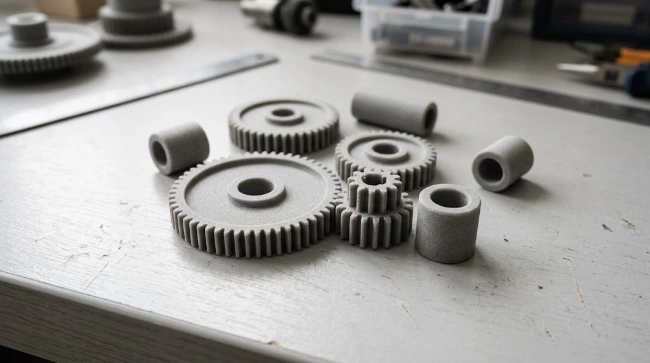
PETG can handle occasional contact and moderate mechanical use, but it is generally less suitable for continuous sliding or abrasive contact. For a part whose primary requirement is wear resistance rather than maximum tensile strength, a suitable nylon grade may be a better starting point.
The exact result still depends on the mating material, contact pressure, speed, lubrication, temperature, surface finish, and manufacturing process.
Nylon vs PETG Moisture Absorption and Storage
Moisture is one of the most important practical differences between nylon and PETG.
Nylon
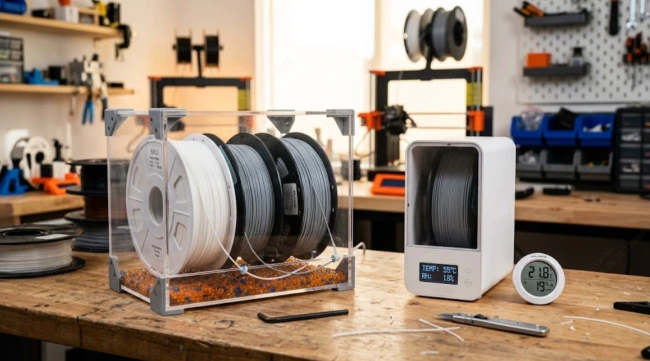
Nylon is hygroscopic and can absorb significant amounts of moisture from the air. Wet nylon filament can cause:
- Popping and bubbling during extrusion
- Poor surface quality
- Inconsistent extrusion
- Dimensional variation
- Reduced mechanical performance
Depending on the specific grade, nylon filament may need drying before printing and storage in a controlled, low-humidity environment afterward. Drying temperature and duration should always follow the material manufacturer's recommendations because different nylon grades require different conditions.
PETG
PETG is considerably less moisture-sensitive than nylon. Although PETG can also absorb moisture and benefit from proper storage, it generally requires much less moisture management for routine printing. This makes PETG more convenient for occasional or general-purpose FDM printing.
Nylon vs PETG Printability
For desktop FDM printing, PETG is generally easier to print than nylon. Typical PETG printing uses lower extrusion and bed temperatures and generally does not require the same level of chamber and moisture control as high-performance nylon. Nylon can require:
- Higher nozzle temperatures
- A heated build platform
- Controlled ambient temperature
- An enclosure or heated chamber
- Thorough filament drying
- Dry storage
- Careful warping control
The exact requirements depend on the grade and printer.
FDM Nylon Is Not the Same as SLS or MJF Nylon
This distinction is especially important for industrial applications.
With FDM, nylon is melted and deposited layer by layer. With SLS, polymer powder is selectively fused in a heated powder bed. With MJF, polymer powder is processed using a fusing process supported by selective application of detailing agents.
As a result, an engineer who finds FDM nylon difficult to print should not assume that industrial powder-based nylon printing has the same workflow or limitations.
Industrial Nylon Printing: FDM vs SLS vs MJF
| Feature | FDM Nylon | SLS Nylon | MJF Nylon |
|---|---|---|---|
| Process | Melted filament deposited layer by layer | Polymer powder fused in heated bed | Polymer powder with detailing agents |
| Support structures | Required for overhangs | Self-supporting in powder bed | Self-supporting in powder bed |
| Geometric complexity | Limited by support requirements | High complexity possible | High complexity possible |
| Surface finish | Layer lines visible | Smoother surface | Smoother surface |
| Mechanical properties | Anisotropic (layer adhesion dependent) | More isotropic | More isotropic |
| Material options | Limited to available filaments | Wide range of nylon grades | Wide range of nylon grades |
| Production volume | Low to medium | Medium to high | Medium to high |
For complex functional nylon parts, SLS and MJF can eliminate many of the geometric and support limitations associated with FDM.
Need Industrial Nylon Without Desktop FDM Limitations?
If your application requires functional nylon parts but you do not want to manage the warping, filament drying, and other process constraints of desktop FDM, industrial SLS or MJF can be an alternative.
JLC3DP offers industrial nylon 3D printing with materials including PA12-HP, PA11-HP, PAC-HP, and PA12S-HP. Select the material based on the required strength, toughness, dimensional stability, and operating environment. Upload your 3D model to compare available materials and obtain a quote for your part.
Nylon vs PETG Cost
There is no single universal cost for either material. For FDM filament, PETG is generally less expensive than engineering-grade nylon. Reinforced nylon and specialty grades can cost substantially more.
For finished 3D-printed parts, however, material price is only one factor. Total cost can also depend on:
- Part volume
- Printing time
- Build efficiency
- Supports
- Powder utilization
- Post-processing
- Production quantity
- Manufacturing technology
Therefore, comparing a price per kilogram does not necessarily predict the final cost of a finished part. For low-cost general-purpose FDM prototypes, PETG can be economical. For complex functional parts, an industrial nylon process may provide a better overall manufacturing solution even when the raw material is more expensive.
Nylon vs PETG CF: What's the Difference?
CF stands for carbon fiber. Adding chopped carbon fiber to a polymer matrix generally increases stiffness and can improve dimensional stability. It can also change thermal expansion and wear behavior. However, carbon fiber does not make nylon and PETG equivalent materials.
| Property | CF Nylon | CF PETG |
|---|---|---|
| Base polymer | Nylon (PA11 or PA12) | PETG |
| Stiffness | High | Higher than standard PETG |
| Toughness | Generally good | Depends on formulation |
| Dimensional stability | Improved by CF | Improved by CF |
| Moisture sensitivity | Still relatively high | Generally lower |
| Printability | More demanding | Generally easier |
| Typical use | Functional mechanical parts | Stiff functional prototypes |
CF nylon is often selected when stiffness, dimensional stability, toughness, and temperature capability are important. CF PETG can be useful when increased stiffness is needed while retaining the easier processing characteristics of PETG.
One important practical consideration is nozzle wear. Carbon-fiber-filled filaments are abrasive, so a wear-resistant nozzle is generally recommended.
Nylon vs PETG for Different 3D Printing Applications
The right question is not simply "Which material is better?" Instead, ask: What will the part experience during its service life?
When to Choose Nylon
Consider nylon when the part requires:
- High toughness
- Repeated flexing
- Fatigue resistance
- Wear resistance
- Impact resistance
- Higher temperature capability
- Functional mechanical performance
- Complex geometries better suited to SLS or MJF
Typical applications include:
- Gears
- Bushings
- Hinges
- Clips
- Mechanical housings
- Vibration-resistant components
- Functional prototypes
- Low-volume production parts
When to Choose PETG
PETG is often a practical choice when you need:
- Easy FDM printing
- Lower material cost
- Lower moisture sensitivity
- Good general-purpose durability
- Moderate mechanical performance
Typical applications include:
- Prototypes
- Enclosures
- Brackets
- Fixtures
- Covers
- Household components
- General-purpose functional parts
Need a Functional Prototype? From prototype to functional part, choose a material based on the strength, toughness, and heat resistance your application requires. Get a 3D Printing Quote
When Neither Nylon Nor PETG Is the Best Choice
Some applications require a different material or manufacturing process.
| Requirement | Materials to Consider |
|---|---|
| Very high heat resistance | High-temperature engineering polymers such as PEEK or PEI |
| Flexible, rubber-like parts | TPU |
| Very high stiffness | Carbon-fiber-reinforced polymers |
| High-volume plastic production | Injection molding |
| Very tight tolerances | CNC machining |
| Industrial polymer powder printing | SLS or MJF |
Material selection should always start with the actual operating requirements rather than the material's popularity.
How to Choose Between Nylon and PETG
Use the following decision framework:
Choose Nylon When:
- The part experiences repeated loading.
- Impact resistance matters.
- Wear resistance is important.
- The part needs substantial toughness or ductility.
- The application involves elevated temperatures.
- You need a functional mechanical component.
- Industrial SLS or MJF manufacturing is appropriate.
Choose PETG When:
- Easy printing is a priority.
- The part has moderate mechanical requirements.
- Moisture management should be minimal.
- Lower material cost is important.
- You are producing prototypes, brackets, enclosures, or fixtures.
Choose Based on the Process, Too
For industrial applications, do not stop at the material name. Compare:
Material grade → Printing process → Part geometry → Load → Temperature → Environment → Production volume → Cost
This approach produces a much more reliable material decision than simply asking whether nylon or PETG is "stronger."
JLC3DP Nylon 3D Printing Services
For functional nylon parts, JLC3DP provides industrial 3D printing options using different nylon grades and manufacturing processes. Available nylon materials include:
- PA12-HP
- PA11-HP
- PAC-HP
- PA12S-HP
These materials provide different combinations of strength, ductility, dimensional stability, and application suitability. Industrial powder-based printing can also make complex nylon geometries without the support structures typically required by FDM.
Why Use JLC3DP for Nylon Parts?
JLC3DP combines:
- Industrial-grade 3D printing
- Multiple nylon material options
- SLS and MJF capabilities
- Online model upload and quotation
- Engineering-oriented material selection
- Rapid production for functional parts
- Global shipping
Instead of choosing nylon based only on a generic material name, compare the available grade and manufacturing process against your part's actual requirements.
FAQs About Nylon vs PETG
Is nylon stronger than PETG?
It depends on the property being measured. Nylon and PETG can have similar tensile-strength values, while nylon generally offers higher toughness, elongation, wear resistance, and fatigue resistance. The specific nylon grade and manufacturing process also matter.
Is nylon more heat resistant than PETG?
For many suitable nylon grades, yes. Nylon can provide higher heat-deflection performance than PETG, but the actual result depends on the grade, reinforcement, test load, and application conditions.
Is PETG easier to print than nylon?
Yes. PETG generally requires less demanding temperature, chamber, and moisture control. Nylon often requires filament drying, a heated build platform, and better environmental control.
Does nylon absorb more moisture than PETG?
Yes. Nylon is significantly more hygroscopic than PETG. Nylon filament should generally be dried according to the material manufacturer's recommendations and stored in a controlled environment.
Is nylon more expensive than PETG?
Usually, nylon filament costs more than standard PETG, while reinforced and specialty nylon grades can cost significantly more. For finished parts, however, total cost depends on the material, geometry, manufacturing process, production volume, and post-processing.
Conclusion: Nylon vs PETG
Nylon and PETG serve different priorities. Nylon generally has an advantage when toughness, wear resistance, fatigue resistance, or temperature capability are critical. PETG is often more practical when easy printing, low moisture sensitivity, and cost are more important.
The most important point is that "nylon" is a family of materials, not a single specification. PA11, PA12, reinforced nylon, FDM nylon, SLS nylon, and MJF nylon can produce significantly different results. For the most reliable material decision, compare the specific grade, manufacturing process, load, temperature, environment, and production requirements of your part.
If you need an industrial functional nylon prototype or production part, JLC3DP provides multiple nylon materials and industrial 3D printing processes to help match the material and process to your application.
For a deeper look at PETG, see JLC3DP's PETG filament guide and PETG temperature resistance guide.
Popular Articles
Keep Learning
Nylon vs PETG: Strength, Toughness & Heat Resistance
Note: PETG is included in this article for technical comparison only. JLC3DP does not currently offer or recommend PETG as a printing material. The comparison is intended for educational purposes and should not be interpreted as a JLC3DP material recommendation. Nylon vs PETG is not a contest with a single winner. Nylon generally leads in toughness, wear resistance, fatigue resistance, and higher-temperature applications. PETG is easier to print, easier to store, and more cost-effective for general-pu......
PEEK vs PEKK: Key Differences and How to Choose for 3D Printing
PEEK vs PEKK is a common comparison when selecting high-performance thermoplastics for 3D printing. Both belong to the polyaryletherketone (PAEK) family and offer high strength, thermal stability, and chemical resistance. However, differences in their molecular structures, crystallization behavior, and processing requirements can significantly affect part performance and manufacturing. PEEK has a long history in demanding industrial applications, while PEKK offers a range of grades with different melt......
Resin vs Filament 3D Printing: Which One Should You Choose?
Getting into 3D printing can feel a little like opening a toolbox without knowing what half the tools do. If you’ve ever stood between a resin printer and a filament printer, scratching your head, wondering which one’s for you, you’re not alone. Resin vs filament 3D printing is one of the most common beginner dilemmas. Each has its pros, cons, quirks, and learning curves. And choosing the right one can make all the difference in how enjoyable and successful your 3D printing journey becomes. In this gu......
Resin vs Filament: Which is Better for 3D Printing?
Resin printing and filament printing (FDM) are the two most widely used methods in 3D printing. To help you make an informed choice, this article will compare the two printing methods in detail from the perspectives of materials, resolution and quality, speed, ease of use, price, etc. If you don't have a 3D printer yet and just want to compare the two printing methods first, JLC3DP can meet your needs. Just upload your 3D model to our platform, choose the printing method and corresponding materials yo......
ABS vs PLA: Which Filament Should You Print?
Key Takeaways The ABS vs PLA choice is a trade between certainty and headroom: PLA prints easily, precisely, and cheaply; ABS survives heat, absorbs impact, and can be smoothed with acetone, but it makes you earn every print. Warping is the deciding pain: ABS parts curl as layers shrink unless you print in a heated, enclosed chamber; PLA barely warps on the same machine. "Stronger" splits into three answers: ABS is stiffer and tougher, but well-printed PLA holds layer-to-layer more consistently — pick......
ABS vs PC vs PC-ABS: Which Is Best for 3D Printing?
Key Takeaways The ABS vs PC vs PC-ABS decision comes down to one trade: PC gives you roughly 35–40°C more heat resistance and higher stiffness; ABS prints more easily and costs less; PC-ABS trades a little of each extreme for the most balanced printing experience. PC leads on heat resistance (~125–130°C vs ~85–95°C for ABS) and stiffness, with impact resistance as its signature trait — "strongest" depends on which property and grade you compare — but it demands the hottest, most enclosed, least forgiv......