ABS vs PLA: Which Filament Should You Print?
12 min
- What Is ABS?
- What Is PLA?
- ABS vs PLA: Head-to-Head Comparison
- PLA vs ABS Printability: Warping, Fumes, & Setup
- ABS vs PLA Strength: Stiffness, Toughness, & Layers
- ABS vs PLA Heat Resistance: Temperature Limits & The Car Dashboard Test
- ABS vs PLA Cost and Post-Processing (Acetone Smoothing)
- ABS vs PLA: Health and Environmental Impact
- ABS vs PLA: Which One Should You Choose?
- FAQ about ABS vs PLA
- Matching the Material to the Job
Key Takeaways
- The ABS vs PLA choice is a trade between certainty and headroom: PLA prints easily, precisely, and cheaply; ABS survives heat, absorbs impact, and can be smoothed with acetone, but it makes you earn every print.
- Warping is the deciding pain: ABS parts curl as layers shrink unless you print in a heated, enclosed chamber; PLA barely warps on the same machine.
- "Stronger" splits into three answers: ABS is stiffer and tougher, but well-printed PLA holds layer-to-layer more consistently — pick by your part's failure mode, not a single number.
- The car dashboard test settles heat: PLA parts soften around 50–55°C and sag on a summer dashboard; ABS shrugs off the same environment.
- ABS prints release noticeable fumes and want ventilation; PLA is nearly odor-free. On a desk in a shared room, that alone can make the choice.
Choose PLA for easy, precise, dimension-stable printing at the lowest cost; choose ABS when parts must survive heat above 60°C, take repeated impact, or deserve acetone smoothing. That is the core of the ABS vs PLA decision, and this guide carries the evidence — including a three-way table that puts PETG in the same comparison, because most people choosing between these two eventually ask about the third.
What Is ABS?
ABS (acrylonitrile butadiene styrene) is the tough, heat-tolerant thermoplastic behind LEGO bricks, appliance housings, and car interior trim, a mass-production plastic that found its way into 3D printing as the first widely used engineering filament. Printed parts come out stiff, impact-resistant, and capable around heat: unfilled grades hold shape to roughly 85–95°C heat deflection temperature, and the surface can be smoothed to a glossy, injection-molded look with acetone vapor.
The price of that performance is a demanding print. ABS wants a 230–250°C nozzle, a 90–110°C bed, and really wants an enclosed chamber; shrinking layers pull parts into the classic curled-corner warp. The material also releases a noticeable odor while printing, which matters more than most spec sheets admit.
The fundamentals — chemistry, brands, safety detail — live in our ABS filament key facts guide; here ABS enters as the performance side of the comparison.
What Is PLA?
PLA (polylactic acid) is the plant-derived bioplastic that most of the 3D printing world learned on. It prints at 200–220°C on a bare machine, warps minimally, carries no meaningful odor, and delivers the stiffest, most dimensionally accurate parts of any common filament at the lowest price in the market.
Its limits are thermal and mechanical: PLA softens around 50–55°C (the summer-dashboard failure everyone meets eventually), snaps under sharp impact instead of bending, and weathers outdoors within a season or two. Nothing about it is fragile in normal use, and a PLA bracket on a shelf lasts years, but push it toward heat or shock and the boundary arrives quickly.
ABS vs PLA: Head-to-Head Comparison
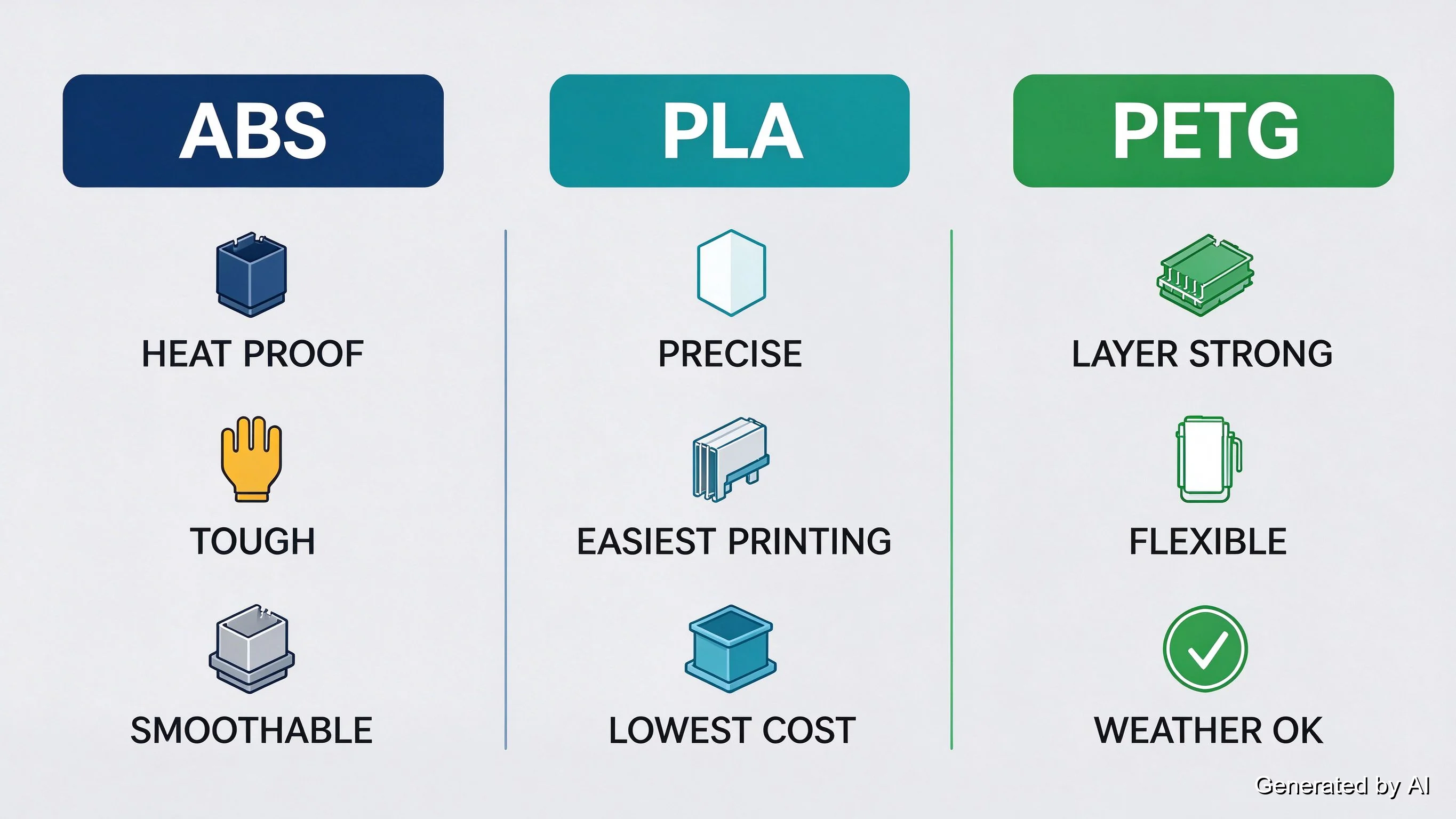
Here is the direct comparison — with PETG (polyethylene terephthalate glycol) included as a third column, because it is the natural next question and the numbers make the pattern visible:
| Property | ABS | PLA | PETG |
|---|---|---|---|
| Heat deflection (typical, 1.82MPa) | ~85–95°C | ~50–55°C | ~65–70°C |
| Stiffness / rigidity | High | Highest of the three | Moderate |
| Impact toughness | Good — bends | Brittle — snaps | Best — bends far |
| Layer adhesion | Good with enclosure | Good and consistent | Excellent |
| Print temperature (nozzle / bed) | 230–250°C / 90–110°C | 200–220°C / 50–60°C | 230–250°C / 70–85°C |
| Enclosure | Recommended | Not needed | Not needed |
| Warp tendency | High without a chamber | Minimal | Low |
| Odor while printing | Noticeable — ventilate | Faint, sweet | Faint but noticeable |
| Moisture sensitivity | Moderate | Low | High |
| Cost tier | Commodity | Lowest | Slightly higher |
| Post-processing | Acetone-vapor smoothing | Sanding, painting | Limited |
Reading the table by rows tells the story. On heat, the three materials step down cleanly: ABS holds shape where PETG softens, and PETG holds where PLA has already failed. That ordering, not any single number, is what you are choosing. On mechanics, ABS and PLA sit at opposite ends of the ductility scale, with PETG past both; on printability, the order flips, and PLA becomes the one that never fights you.
Values vary with grade and manufacturer — the table is directional, the datasheet is specific. For the full material spread including ASA (acrylonitrile styrene acrylate), PC, and PEEK, our polycarbonate guide carries the complete heat-resistance table.
PLA vs ABS Printability: Warping, Fumes, & Setup
This is where the ABS vs PLA debate is usually settled, because the two filaments ask very different things of the person holding the spool:
| Printability factor | ABS | PLA |
|---|---|---|
| First-print success rate | Low without setup | Highest of any filament |
| Minimum practical setup | Heated bed, enclosure, ventilation | A bare machine |
| Warp tendency | The classic failure mode | Minimal |
| Odor / fumes | Noticeable, ventilated space advised | Nearly none |
| Moisture care | Dry when needed | Casual storage works |
| Tuning effort | Meaningful (temps, enclosure, drafts) | Minimal |
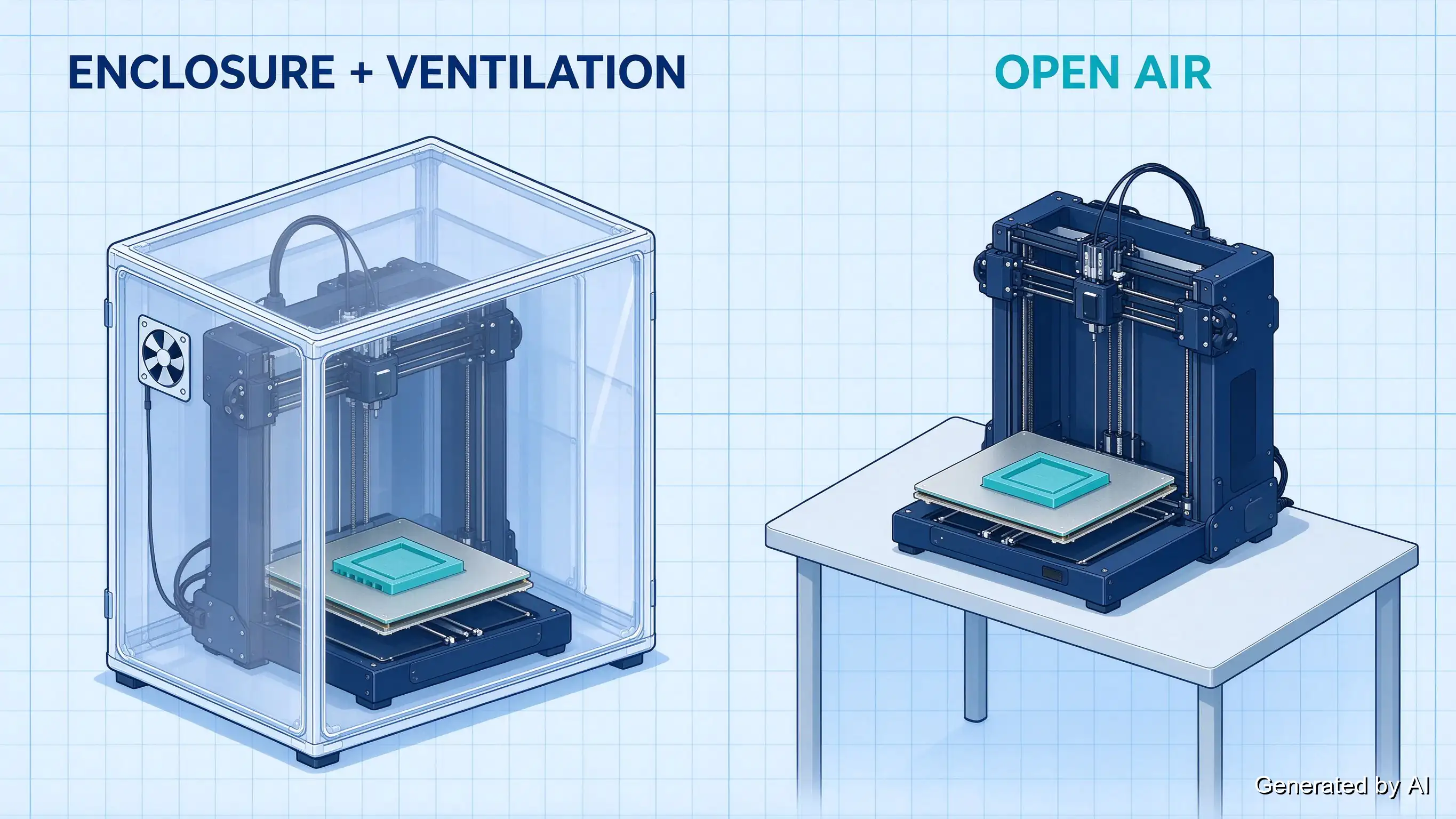
ABS warps because its layers shrink as they cool, and the shrinking layers pull the part's corners upward off the bed. The countermeasures are known and they work (a heated bed, a brim, an enclosure that slows the cooling), but they are a checklist, and skipping an entry shows up as a curled first layer. PLA has no such checklist: the same machine that prints ABS badly prints PLA beautifully on day one.
The fume difference is not a footnote. ABS releases a noticeable styrene odor while printing, unpleasant in a shared room and worth ventilating as a habit, especially around people who did not choose to be near the printer. PLA smells faintly sweet and most people print it on a desk without a second thought. Where your printer lives, and who shares that air, is a legitimate input to this decision.
Whether to buy the enclosure is the practical follow-up. For occasional ABS printing, a cardboard-and-tape enclosure works well enough to prove the concept; a proper acrylic or fabric chamber earns its keep once ABS prints become routine. PLA owners need none of it, which is why the accessories aisle of the hobby is largely an ABS tax.
ABS vs PLA Strength: Stiffness, Toughness, & Layers
"Asking which is stronger" hides three different questions, and ABS vs PLA answers them differently:
- Stiffness: ABS wins. It resists bending and flexing; PLA parts flex more under the same load.
- Impact toughness: ABS wins. A hammer test that dents an ABS part snaps a PLA one, because PLA's rigidity has no way to absorb a sudden shock.
- Layer consistency: well-printed PLA can hold layer-to-layer more reliably, because its low printing temperature builds less residual stress between layers; ABS's hotter process leaves more internal stress near the weld lines.
The practical version: an ABS bracket bends before it breaks, and a PLA bracket holds its shape until it breaks cleanly. Neither failure is "wrong" — match the material to how your part is allowed to fail. For parts whose stress crosses layer lines and that must not peel, PETG (third column above) is the strongest answer of the three; our PETG filament guide covers that material in depth.
ABS vs PLA Heat Resistance: Temperature Limits & The Car Dashboard Test
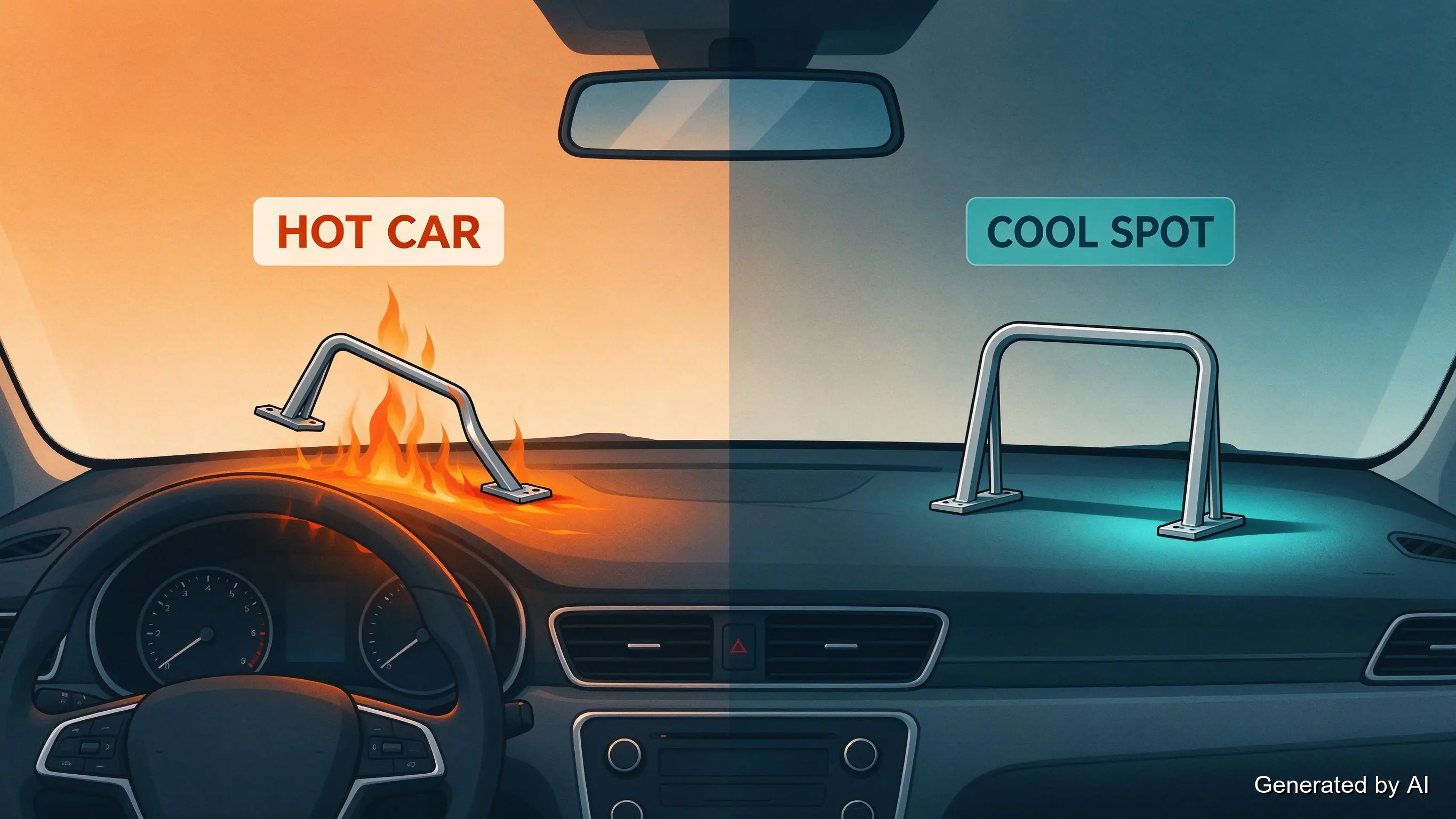
The fastest way to feel the heat-resistance gap is to leave a PLA part on a car dashboard in summer. Cabin temperatures reach well past PLA's 50–55°C softening point, and the part that went in as a bracket comes out as a sculpture. The same day, the same ABS part on the same dashboard does not move; its 85–95°C deflection range is built for exactly that abuse.
The test scales to every warm-location decision: enclosures around electronics, mounts near windows, parts under a windshield, anything that lives in a car or beside a heat source. PLA is a room-temperature material in practice; ABS buys you the 30–40°C of headroom that keeps functional parts functional through summer. For temperatures beyond ABS's range, the ladder continues through ASA and polycarbonate to PEEK; our ABS vs PC comparison covers the next rung up.
ABS vs PLA Cost and Post-Processing (Acetone Smoothing)
On the spool, PLA is the cheapest filament on the market and ABS sits in the commodity tier just above, close enough that price alone rarely decides. The honest cost adjustment is failure rate: ABS prints fail more often on marginal setups, and each failed print is filament, electricity, and an evening. PLA's failures are rarer and cheaper.
Post-processing is ABS's quiet ace. Acetone-vapor smoothing melts ABS layer lines into a glossy, cast-plastic finish few filaments can match (PLA is unaffected by acetone); PLA's finishing path is sanding and paint. If the part's surface matters, whether for cosplay props, display pieces, or consumer-looking enclosures, ABS's finishing options are a real reason to accept its printing demands.
ABS vs PLA: Health and Environmental Impact
Both plastics raise fair questions about health and environment, and the answers split the same way the rest of this comparison does. PLA is derived from plant sugars (corn, sugarcane) rather than petroleum, prints with almost no odor, and is generally regarded as the more pleasant material to live with in an enclosed room; it is also the only one of the two with a real (if limited) end-of-life story, since PLA can be industrially composted, though not in a backyard pile and not in most municipal streams. ABS is petroleum-based and releases small amounts of styrene while printing, which is exactly why ventilation was a checklist item earlier in this article; finished parts are stable, and household items made of ABS have been safe fixtures for decades. Neither filament is food-safe as printed, regardless of what a product page implies, because layer lines trap residue regardless of the polymer.
ABS vs PLA: Which One Should You Choose?
| Your priority | Pick | Why |
|---|---|---|
| First spool, learning the printer | PLA | Highest success rate, no setup checklist |
| Dimensional precision, miniatures, fits | PLA | Stiffest, most stable, finest detail |
| Parts near heat (car, engine bay, windows) | ABS | 85–95°C deflection vs PLA's 50–55°C ceiling |
| Impact-prone functional parts | ABS | Bends and dents instead of snapping |
| Smooth, glossy finished surfaces | ABS | Acetone-vapor smoothing is unique to it |
| Desk in a shared or closed room | PLA | No meaningful fumes |
| Outdoor UV, years of weather | Neither — ASA | Both degrade outdoors; ASA is the outdoor answer |
The decision, compressed: PLA buys you certainty, ABS buys you headroom. Pick certainty for everything that lives indoors at room temperature and needs to be right; pick headroom for parts that face heat, impact, or a finish worth smoothing. And when a part needs engineering-grade performance beyond either, meaning tight tolerances, production consistency, or materials like PC and PEEK, uploading it for an instant quote puts 30+ engineering materials and automated manufacturability checks on your side.
FAQ about ABS vs PLA
Q: Is ABS stronger than PLA?
Split "stronger" into its kinds and the answer is clear: ABS is stiffer and far more impact-tolerant (it dents where PLA snaps), while well-printed PLA can hold layer-to-layer more consistently thanks to its lower printing stress. Choose by your part's likely failure mode — bending loads favor ABS, clean rigidity favors PLA.
Q: Is PLA easier to print than ABS?
Yes, substantially. PLA needs no enclosure, warps minimally, carries no odor, and has the highest first-print success rate of any filament. ABS wants a heated bed, an enclosed chamber, ventilation, and draft control — skip any of those and the print usually tells you.
Q: Does ABS warp more than PLA?
It does, and it is the classic ABS failure: shrinking layers curl the part's corners off the bed. Heated bed, brim, and an enclosure to slow cooling are the working countermeasures; PLA needs none of them on the same machine.
Q: Is ABS or PLA better for outdoor use?
Neither is ideal — both degrade under UV and weather within a season or two. ABS holds up somewhat longer than PLA, but the correct outdoor material is ASA; our outdoor filament comparison covers it.
Q: Can PLA survive in a hot car?
No. Cabin temperatures in summer pass PLA's 50–55°C softening point, and parts left on dashboards or seats come out warped. ABS handles the same environment without moving, which is exactly the 30–40°C of headroom you are paying for with its harder printing.
Q: Which is cheaper, ABS or PLA?
PLA — it is the cheapest filament category, with ABS just above. Price alone rarely decides, though: ABS's higher failure rate on marginal setups adds real cost per finished part, which is worth weighing before the spool prices are.
Q: Is PLA safer than ABS to print?
Yes, generally. PLA emits no meaningful fumes and is plant-derived, while ABS releases small amounts of styrene that call for ventilation. In a shared room, the difference alone justifies choosing PLA for most hobby printing.
Matching the Material to the Job
ABS vs PLA is not a ranking; it is a matching exercise. PLA matches everything that lives indoors at room temperature and needs to be right the first time. ABS matches parts that face heat, impact, or deserve a smoothed finish — for people willing to run the checklist. Decide which your part needs, and the comparison resolves itself; when the job outgrows both, the upload is one step away.
Popular Articles
Keep Learning
Nylon vs PETG: Strength, Toughness & Heat Resistance
Note: PETG is included in this article for technical comparison only. JLC3DP does not currently offer or recommend PETG as a printing material. The comparison is intended for educational purposes and should not be interpreted as a JLC3DP material recommendation. Nylon vs PETG is not a contest with a single winner. Nylon generally leads in toughness, wear resistance, fatigue resistance, and higher-temperature applications. PETG is easier to print, easier to store, and more cost-effective for general-pu......
PEEK vs PEKK: Key Differences and How to Choose for 3D Printing
PEEK vs PEKK is a common comparison when selecting high-performance thermoplastics for 3D printing. Both belong to the polyaryletherketone (PAEK) family and offer high strength, thermal stability, and chemical resistance. However, differences in their molecular structures, crystallization behavior, and processing requirements can significantly affect part performance and manufacturing. PEEK has a long history in demanding industrial applications, while PEKK offers a range of grades with different melt......
Resin vs Filament 3D Printing: Which One Should You Choose?
Getting into 3D printing can feel a little like opening a toolbox without knowing what half the tools do. If you’ve ever stood between a resin printer and a filament printer, scratching your head, wondering which one’s for you, you’re not alone. Resin vs filament 3D printing is one of the most common beginner dilemmas. Each has its pros, cons, quirks, and learning curves. And choosing the right one can make all the difference in how enjoyable and successful your 3D printing journey becomes. In this gu......
Resin vs Filament: Which is Better for 3D Printing?
Resin printing and filament printing (FDM) are the two most widely used methods in 3D printing. To help you make an informed choice, this article will compare the two printing methods in detail from the perspectives of materials, resolution and quality, speed, ease of use, price, etc. If you don't have a 3D printer yet and just want to compare the two printing methods first, JLC3DP can meet your needs. Just upload your 3D model to our platform, choose the printing method and corresponding materials yo......
ABS vs PLA: Which Filament Should You Print?
Key Takeaways The ABS vs PLA choice is a trade between certainty and headroom: PLA prints easily, precisely, and cheaply; ABS survives heat, absorbs impact, and can be smoothed with acetone, but it makes you earn every print. Warping is the deciding pain: ABS parts curl as layers shrink unless you print in a heated, enclosed chamber; PLA barely warps on the same machine. "Stronger" splits into three answers: ABS is stiffer and tougher, but well-printed PLA holds layer-to-layer more consistently — pick......
ABS vs PC vs PC-ABS: Which Is Best for 3D Printing?
Key Takeaways The ABS vs PC vs PC-ABS decision comes down to one trade: PC gives you roughly 35–40°C more heat resistance and higher stiffness; ABS prints more easily and costs less; PC-ABS trades a little of each extreme for the most balanced printing experience. PC leads on heat resistance (~125–130°C vs ~85–95°C for ABS) and stiffness, with impact resistance as its signature trait — "strongest" depends on which property and grade you compare — but it demands the hottest, most enclosed, least forgiv......