PEEK vs PEKK: Key Differences and How to Choose for 3D Printing
21 min
- PEEK vs PEKK: Key Differences at a Glance
- What Are PEEK and PEKK?
- PEEK vs PEKK: Chemical Structure and Molecular Differences
- PEEK vs PEKK: Mechanical Properties
- PEEK vs PEKK: Heat Resistance and Thermal Properties
- PEEK vs PEKK: Chemical Resistance
- PEEK vs PEKK: Crystallization Behavior and Dimensional Stability
- PEEK vs PEKK for 3D Printing: Printability and Processing Requirements
- PEEK vs PEKK: Material Cost and Total 3D Printing Cost
- PEEK vs PEKK vs PEI: Which High-Performance Plastic Should You Choose?
- How to Choose Between PEEK and PEKK for 3D Printing
- Common Applications of PEEK and PEKK
- How to Get PEEK and PEKK 3D-Printed Parts
- FAQ about PEEK vs PEKK
PEEK vs PEKK is a common comparison when selecting high-performance thermoplastics for 3D printing. Both belong to the polyaryletherketone (PAEK) family and offer high strength, thermal stability, and chemical resistance. However, differences in their molecular structures, crystallization behavior, and processing requirements can significantly affect part performance and manufacturing.
PEEK has a long history in demanding industrial applications, while PEKK offers a range of grades with different melting and crystallization characteristics. These differences influence how each material performs under mechanical loads, responds to heat, and behaves during FDM 3D printing.
Understanding these properties is essential when selecting a material for functional prototypes or end-use components. This guide compares PEEK vs PEKK in terms of mechanical properties, heat resistance, chemical resistance, printability, and cost, helping engineers identify the material characteristics that matter for their applications.
Key Takeaways
- PEEK and PEKK are semi-crystalline PAEK thermoplastics with high mechanical strength, thermal stability, and chemical resistance, but their properties vary by grade.
- PEEK generally has faster crystallization and a higher melting point, while PEKK can offer a higher glass transition temperature and a wider range of processing characteristics.
- Both materials require specialized high-temperature FDM equipment, controlled cooling, and proper filament drying to achieve consistent print quality.
- Choosing between PEEK and PEKK requires evaluating operating conditions, mechanical requirements, material grades, printability, and total manufacturing cost.
PEEK vs PEKK: Key Differences at a Glance
PEEK and PEKK are high-performance polymers in the PAEK family, offering excellent mechanical properties and thermal resistance. However, their performance differs depending on the material grade and manufacturing process. For FDM 3D printing, JLC3DP's material data shows that PEEK offers a higher heat deflection temperature, while PEKK provides higher tensile and flexural strength.
| Property | PEEK | PEKK |
|---|---|---|
| Polymer family | PAEK | PAEK |
| Polymer structure | Two ether groups and one ketone group | One ether group and two ketone groups |
| Material density (g/cm³) | 1.3 | 1.27 |
| Heat deflection temperature (HDT) | 144°C (at 1.8 MPa) | 139°C (at 0.45 MPa) |
| Tensile modulus (MPa, X–Y / Z) | 3,042 / 2,763 | 3,580 ± 200 / 2,280 ± 200 |
| Tensile strength (MPa, X–Y / Z) | 73 / 25.6 | 92 ± 5 / 80 ± 5 |
| Elongation at break | 3.7% (X–Y), 1.3% (Z) | 5 ± 1% |
| Glass transition temperature (Tg) | 143°C | 158°C |
Note: The values above are based on JLC3DP's material data.
What Are PEEK and PEKK?
PEEK (polyether ether ketone) and PEKK (polyether ketone ketone) are high-performance thermoplastics belonging to the PAEK family. Their molecular structures combine aromatic rings with ether and ketone linkages, giving them a combination of thermal stability, mechanical strength, and chemical resistance.
Unlike amorphous thermoplastics, both materials can form crystalline regions as they cool. This semi-crystalline structure contributes to their mechanical properties, chemical resistance, and dimensional behavior.
PEEK is widely used in aerospace, automotive, medical, and industrial applications where conventional engineering plastics may not provide sufficient performance. PEKK offers similar high-performance characteristics, with additional flexibility in tailoring its properties through changes in molecular composition.
Both materials are suitable for demanding manufacturing applications, but their high processing temperatures and sensitivity to thermal history make them challenging to manufacture using conventional FDM equipment.
PEEK vs PEKK: Chemical Structure and Molecular Differences
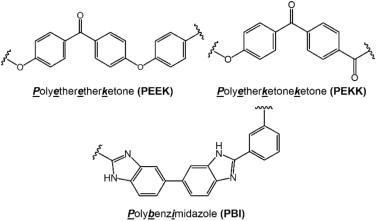
Image source: ScienceDirect
The main molecular difference between PEEK and PEKK is the proportion and arrangement of ether and ketone linkages in their polymer backbones.
PEEK contains two ether groups and one ketone group in its repeating unit, giving it a ketone-to-ether ratio of approximately 1:2. The different ether-to-ketone balance affects chain rigidity and molecular packing, which contributes to differences in melting behavior and crystallization kinetics.
PEKK contains one ether group and two ketone groups, resulting in a ketone-to-ether ratio of approximately 2:1. Its higher ketone content contributes to a more rigid molecular backbone and stronger intermolecular interactions.
These structural differences influence several material properties:
- Thermal behavior: PEKK grades can have higher glass transition temperatures, while their melting temperatures depend strongly on molecular composition.
- Crystallization: PEEK generally crystallizes relatively quickly. Certain PEKK grades crystallize more slowly, allowing different approaches to thermal management.
- Processing: Different crystallization rates affect cooling behavior, dimensional stability, and the processing window available during 3D printing.
PEKK is also available in different terephthaloyl-to-isophthaloyl (T/I) ratios. For example, commercial grades may include 60/40, 70/30, and 80/20 compositions. Changing this ratio affects melting temperature, crystallization, and processing behavior.
Consequently, PEKK should not be treated as a single material with fixed thermal properties. Engineers should compare specific grades rather than relying exclusively on the general PEEK vs PEKK distinction.
PEEK vs PEKK: Mechanical Properties
Mechanical properties are among the most important considerations when choosing between PEEK and PEKK for functional 3D-printed parts. Tensile strength, elastic modulus, and elongation at break help determine how a component responds to different mechanical loads.
The following table compares typical JLC3DP FDM-printed PEEK and PEKK properties.
| Property | PEEK | PEKK |
|---|---|---|
| Tensile strength, XY | 73 MPa | 92 ± 5 MPa |
| Tensile strength, Z | 25.6 MPa | 80 ± 5 MPa |
| Tensile modulus, XY | 3,042 MPa | 3,580 ± 200 MPa |
| Tensile modulus, Z | 2,763 MPa | 2,280 ± 200 MPa |
| Elongation at break, XY | 3.70% | 5 ± 1% |
Source: JLC3DP PEEK and JLC3DP PEKK FDM-printed material data. These values apply to the specified printed materials and test conditions, not all PEEK and PEKK grades.
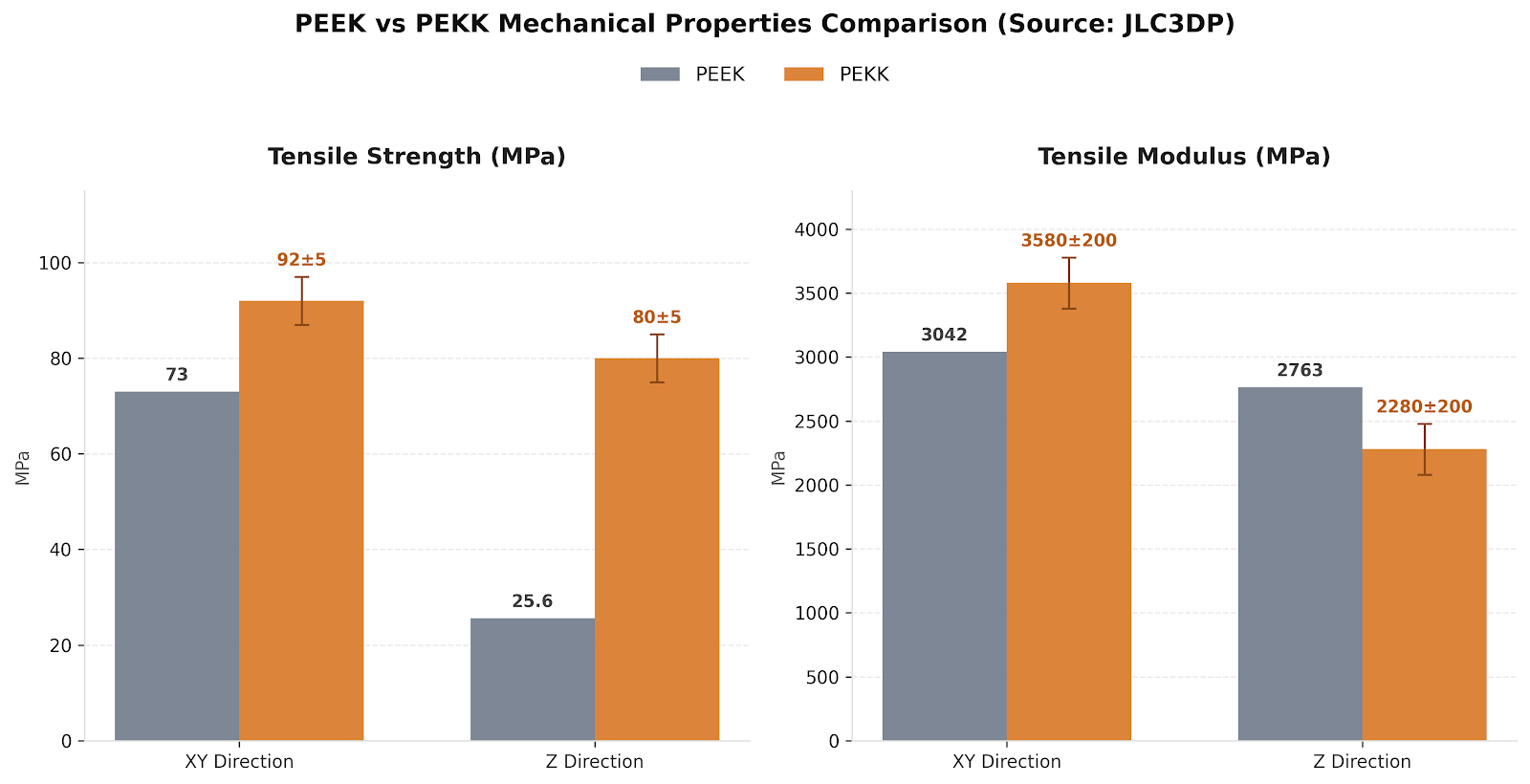
In these particular printed samples, PEKK has higher XY tensile strength and elongation at break than PEEK. However, PEEK has a higher Z-direction tensile modulus in the reported data. This illustrates why mechanical performance should be evaluated across multiple properties and print orientations rather than by a single strength value.
Tensile strength and stiffness
Tensile strength measures the maximum tensile stress a material can withstand before failure, while tensile modulus indicates its resistance to elastic deformation.
The reported JLC3DP data show higher XY tensile strength and modulus for the tested PEKK material. However, the Z-direction results differ, demonstrating the importance of print orientation and interlayer bonding.
For components subjected to loads in multiple directions, engineers should examine both XY and Z performance instead of relying on the highest reported tensile strength.
Elongation and deformation
Elongation at break indicates how much a material stretches before fracturing. Higher elongation can be useful in components that experience deformation, vibration, or impact.
The reported PEKK sample has higher XY elongation at break than the tested PEEK sample. However, this does not establish a universal toughness advantage. Impact strength, fatigue resistance, and fracture behavior require separate testing.
The influence of 3D printing
Mechanical properties of FDM-printed parts are influenced by several factors:
- Print orientation and layer adhesion
- Nozzle and chamber temperatures
- Cooling rate and crystallinity
- Part geometry and wall thickness
- Reinforcement, such as carbon fiber
For load-bearing components, printed test specimens produced under the intended manufacturing conditions provide more relevant evidence than generic polymer datasheets alone.
PEEK vs PEKK: Heat Resistance and Thermal Properties
Both PEEK and PEKK are designed for demanding thermal environments. However, glass transition temperature, melting temperature, heat deflection temperature, and continuous operating temperature describe different aspects of thermal performance.
| Thermal property | PEEK | PEKK |
|---|---|---|
| Glass transition temperature (Tg) | Approximately 143°C | Approximately 158–165°C for common grades |
| Melting temperature (Tm) | Approximately 343°C | Approximately 305–358°C for representative grades |
| Heat deflection temperature (HDT) | 144°C (ISO 75-f, 1.8 MPa) | 139°C (ISO 75, 0.45 MPa) |
| Continuous operating temperature | Depends on grade, load, and environment | Depends on grade, load, and environment |
PEEK values are representative of common unfilled grades. PEKK ranges are illustrative of selected commercial grades, not universal limits.
Glass transition temperature
The glass transition temperature is the point at which amorphous regions within a polymer become significantly more mobile. Above this temperature, the material's stiffness and dimensional behavior can change.
PEEK typically has a glass transition temperature of approximately 143°C. Many commercial PEKK grades have higher values, often around 158–165°C.
A higher Tg can be beneficial when a component needs to maintain stiffness as temperatures rise. However, Tg alone does not establish a material's maximum operating temperature.
Melting temperature
Melting temperature is particularly relevant to semi-crystalline polymers because it determines when crystalline regions melt.
PEEK typically melts at approximately 343°C. PEKK has a broader range of melting temperatures because its T/I ratio and grade influence its crystalline structure. Representative commercial grades can have melting temperatures ranging from approximately 305°C to 358°C.
This variation allows manufacturers to tailor PEKK for different processing requirements. It also means that engineers must verify the melting temperature of the specific grade being considered.
Heat deflection temperature and continuous operating temperature
Heat deflection temperature measures how much a specimen deforms under a specified load and standardized test conditions. Results obtained using different loads or test methods are not directly comparable.
Continuous operating temperature describes the conditions under which a material can maintain acceptable performance over an extended period. It depends on the material grade, applied stress, surrounding environment, and required service life.
Therefore, a higher Tg or melting temperature does not automatically mean that a material is suitable for a higher continuous operating temperature. Engineers should evaluate thermal performance using the conditions that reflect the actual application.
PEEK vs PEKK: Chemical Resistance
PEEK and PEKK both offer excellent resistance to many industrial chemicals, making them suitable candidates for components exposed to fuels, oils, lubricants, and various solvents.
Their semi-crystalline structures contribute to their chemical resistance by limiting the penetration of many chemicals into the polymer. However, chemical compatibility varies with the material grade and exposure conditions.
Important factors include:
- Chemical composition: Strong acids, certain solvents, and aggressive chemical mixtures can affect PAEK materials.
- Temperature: Higher temperatures can accelerate chemical degradation and affect mechanical performance.
- Concentration: The same chemical can produce different effects at different concentrations.
- Exposure duration: Short-term compatibility does not necessarily indicate long-term durability.
- Material grade: Fillers and additives can change the chemical behavior of the finished material.
PEEK vs PEKK: Crystallization Behavior and Dimensional Stability
Crystallization is a defining characteristic of PEEK and PEKK and plays an important role in their processing behavior. As the polymer cools, molecular chains can organize into crystalline regions. The resulting crystallinity affects stiffness, chemical resistance, dimensional stability, and thermal performance.
PEEK generally crystallizes faster than many PEKK grades. Rapid crystallization can be useful in some manufacturing processes, but it can also lead to uneven shrinkage and residual stress during FDM printing if the temperature is not properly controlled.
PEKK offers a wider range of crystallization behavior. Some grades crystallize slowly, allowing polymer chains more time to relax during cooling. Under suitable printing conditions, this can help reduce residual stress and warping.
However, slower crystallization does not guarantee better dimensional stability. Insufficient thermal control can result in inadequate crystallinity, which may compromise mechanical and thermal properties.
For both materials, dimensional stability depends on the interaction between crystallization, cooling rate, part geometry, and thermal management. The appropriate processing strategy must be determined for the specific material grade and equipment.
PEEK vs PEKK for 3D Printing: Printability and Processing Requirements
PEEK and PEKK are among the more demanding thermoplastics to process using FDM 3D printing. Their high melting temperatures and sensitivity to thermal conditions require specialized equipment and carefully controlled manufacturing parameters.
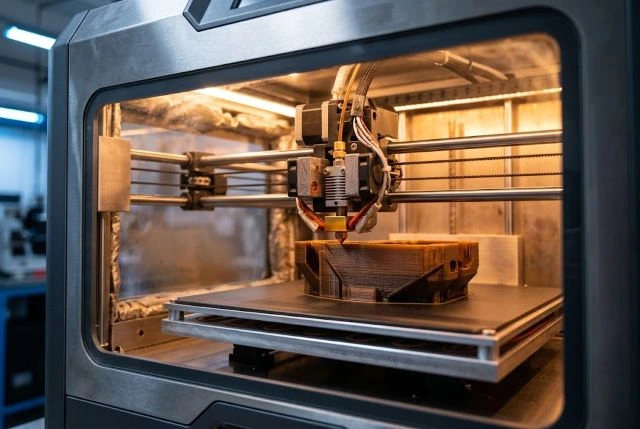
Why are PEEK and PEKK difficult to print?
Several factors contribute to their printing challenges:
- High extrusion temperatures that exceed the capabilities of standard desktop hotends
- Heated build platforms to maintain adhesion and control thermal gradients
- Heated chambers to limit premature cooling
- Shrinkage and residual stress during cooling
- Crystallization behavior that influences dimensional stability
- Interlayer bonding that depends on thermal history
- Moisture control to reduce printing defects
Standard desktop FDM printers generally cannot maintain the temperatures and thermal stability required for reliable PEEK or PEKK printing. Industrial high-temperature systems are typically needed for these materials.
PEEK vs PEKK printability
PEEK generally crystallizes faster, which can make it more sensitive to cooling conditions and increase the risk of warping if thermal management is inadequate.
Certain PEKK grades crystallize more slowly and can offer greater flexibility in managing residual stress and dimensional changes. This can make them suitable for geometries or processes in which controlling shrinkage is particularly challenging.
However, PEKK is not inherently easier to print in every situation. Printability depends on the specific grade, chamber design, nozzle temperature, build-plate temperature, printing speed, and part geometry.
A well-calibrated PEEK printing system can produce consistent components, while an unsuitable PEKK process can still result in warping, poor layer adhesion, or incomplete crystallization.
Typical FDM printing requirements
The following table provides indicative processing ranges. Actual settings must be based on the manufacturer's recommendations for the specific filament grade.
| Parameter | PEEK | PEKK |
|---|---|---|
| Nozzle temperature | Approximately 360–450°C | Approximately 350–430°C |
| Build-plate temperature | Approximately 120–160°C | Approximately 120–160°C |
| Chamber temperature | Approximately 150–200°C or higher | Approximately 150–200°C or higher |
| Chamber | Actively heated | Actively heated |
| Filament drying | Required; follow grade-specific recommendations | Required; follow grade-specific recommendations |
These ranges are intended for initial evaluation rather than direct printer configuration. Temperature limits, drying conditions, and cooling strategies vary by filament and machine. Excessive temperatures or inappropriate drying conditions can also damage the material.
Interlayer bonding and thermal management
In FDM printing, interlayer bonding depends on the ability of adjacent extruded layers to form sufficiently strong molecular connections before cooling and solidification prevent further chain movement.
Maintaining an appropriate part temperature can improve interlayer diffusion. However, excessively high chamber temperatures or unsuitable cooling conditions can increase distortion or affect crystallinity.
The objective is to balance interlayer adhesion, crystallinity, and dimensional accuracy. Neither PEEK nor PEKK has a universal advantage across all printing conditions.
PEEK vs PEKK: Material Cost and Total 3D Printing Cost
PEEK and PEKK are both high-cost engineering thermoplastics. PEEK has a more established supply chain and broader commercial availability, while PEKK is available in a more grade-dependent range of formulations and may carry a higher material price.
However, filament price alone is insufficient for evaluating the cost of a 3D-printed component. The total manufacturing cost also depends on processing time, equipment, energy consumption, material waste, and post-processing.
Material cost
PEEK has a well-established industrial supply base, with a wide range of unfilled and reinforced grades. PEKK is also commercially available, but its price and availability can vary considerably by formulation and supplier.
Carbon-fiber-reinforced grades and specialized formulations can increase material costs for either polymer. Therefore, a meaningful cost comparison should use equivalent material grades and reinforcement levels.
Printing and equipment costs
Both materials require specialized high-temperature FDM systems. The equipment investment, energy consumption, and relatively long printing times can contribute substantially to the cost of a finished part.
Other cost factors include:
- Heated chamber operation and energy consumption
- Material drying and storage
- Support structures and material waste
- Failed prints and rework
- Annealing, machining, and dimensional inspection
Total cost of ownership
The material with the lower filament price is not necessarily the more economical option. A grade that prints more reliably under the available manufacturing conditions may reduce scrap, rework, and production time.
For functional parts, engineers should evaluate the total cost of manufacturing a component that meets the required specifications rather than comparing the price per kilogram alone.
PEEK vs PEKK vs PEI: Which High-Performance Plastic Should You Choose?
PEEK, PEKK, and PEI are frequently considered for high-temperature engineering applications. However, they differ in molecular structure, thermal properties, processing requirements, and cost.
PEI (polyetherimide), commonly associated with the ULTEM trade name, is an amorphous high-performance thermoplastic. Unlike PEEK and PEKK, it does not have a crystalline melting point. Its relatively high glass transition temperature and generally more accessible processing requirements make it suitable for a different range of applications.
| Property | PEEK | PEKK | PEI (ULTEM) |
|---|---|---|---|
| Polymer family | PAEK | PAEK | PEI |
| Structure | Semi-crystalline | Semi-crystalline or slowly crystallizing, depending on grade | Amorphous |
| Glass transition temperature | Approximately 143°C | Approximately 158–165°C for common grades | Approximately 217°C for common grades |
| Melting temperature | Approximately 343°C | Grade-dependent | No crystalline melting point |
| Mechanical properties | High strength and stiffness | High strength and stiffness | High strength and stiffness |
| Chemical resistance | Excellent against many chemicals | Excellent against many chemicals | Good, but sensitive to certain solvents |
| FDM printability | Requires specialized equipment | Requires specialized equipment | Grade-dependent; generally less demanding than PEEK and PEKK |
| Relative material cost | High | High; often higher | Generally lower |
The three materials serve different engineering requirements. PEEK and PEKK are semi-crystalline materials with high thermal and chemical resistance. PEI offers a different balance of thermal performance, processing requirements, and cost.
For applications with lower operating temperatures and less demanding chemical exposure, PEI may meet the requirements without the additional material and processing costs associated with PEEK or PEKK. When higher temperature resistance, specific chemical compatibility, or a particular grade's mechanical properties are required, PEEK or PEKK may be considered.
Material selection should be based on the actual service conditions rather than the assumption that one polymer is universally superior.
How to Choose Between PEEK and PEKK for 3D Printing
Selecting between PEEK and PEKK starts with the component's operating requirements. The most relevant factors include operating temperature, mechanical loads, chemical exposure, dimensional tolerances, and the capabilities of the available manufacturing process.
When to consider PEEK
PEEK may be a suitable option when:
- The application requires a well-established material with extensive industrial performance data.
- The selected grade meets demanding mechanical and thermal requirements.
- Long-term chemical compatibility has been demonstrated for the intended environment.
- The application requires a specific PEEK grade, qualification, or established supply chain.
- The manufacturing process is already optimized for PEEK.
PEEK's established industrial history can be particularly relevant when material documentation, repeatability, and long-term performance records are important.
When to consider PEKK
PEKK may be worth evaluating when:
- A particular grade's crystallization behavior is compatible with the intended printing process.
- Controlling shrinkage and residual stress is a major manufacturing consideration.
- The required thermal and mechanical properties are available in a suitable PEKK grade.
- The printer and thermal management system are compatible with that grade's processing requirements.
- A specific PEKK formulation meets the application's performance and cost requirements.
Because PEKK is available in different T/I ratios, the selected grade can have a substantial effect on processing behavior and final properties.
When to consider PEI or other materials
PEEK and PEKK may be unnecessary when a less demanding material can meet the application's requirements.
PEI can be considered for applications that need high stiffness and thermal performance but do not require the full chemical resistance or thermal characteristics of PEEK and PEKK. PPS and other engineering thermoplastics may also be appropriate for certain industrial applications.
A practical selection process should consider the following questions:
| Selection factor | What to evaluate |
|---|---|
| Operating temperature | Continuous temperature, peak temperature, and exposure duration |
| Mechanical loads | Tensile strength, stiffness, fatigue, and impact requirements |
| Chemical exposure | Specific chemicals, concentration, temperature, and exposure time |
| Dimensional accuracy | Tolerances, shrinkage, warping, and thermal expansion |
| Manufacturing | Printer capabilities, grade-specific settings, and process repeatability |
| Cost | Material price, printing time, equipment, waste, and post-processing |
| Compliance | Required certifications, traceability, and material documentation |
For parts with demanding mechanical or thermal requirements, printing and testing samples under representative conditions can help verify whether the selected material meets the design requirements.
Common Applications of PEEK and PEKK
PEEK and PEKK are used in industries where a combination of mechanical strength, thermal stability, and chemical resistance is required. Their suitability for a particular component depends on the material grade, manufacturing process, and application-specific qualification requirements.
Aerospace
Aerospace components may require high strength, thermal stability, chemical resistance, and weight reduction. PEEK and PEKK can be considered for brackets, bushings, ducts, and other functional components where their properties meet the design requirements.
PEEK has an established history in aerospace applications. PEKK is also used in advanced aerospace materials, including applications involving additive manufacturing and specialized formulations. Certification and traceability requirements should be assessed for each component.
Automotive
Automotive applications may expose components to elevated temperatures, fuels, oils, vibration, and repeated mechanical loading. PEEK and PEKK can be considered for functional prototypes and selected end-use components where conventional plastics cannot meet the required operating conditions.
Semiconductor and electronics
Semiconductor manufacturing can involve elevated temperatures, aggressive chemicals, and demanding dimensional requirements. PEEK and PEKK may be considered for fixtures, handling components, and other equipment parts, provided the material meets the relevant chemical, thermal, and cleanliness requirements.
Chemical processing and industrial equipment
In industrial environments, PEEK and PEKK can be considered for selected pump components, seals, valve parts, and wear-resistant components. Their suitability depends on the specific chemical media, temperature, mechanical loads, and expected service life.
How to Get PEEK and PEKK 3D-Printed Parts
Selecting a suitable material is only one part of producing a reliable PEEK or PEKK component. Part geometry, build orientation, wall thickness, support structures, thermal management, and dimensional tolerances can all affect the final result.
Before manufacturing, engineers should confirm the operating requirements, identify suitable material grades, and review the design for potential printing challenges. For demanding applications, prototype testing can help validate mechanical properties and dimensional accuracy under representative conditions.
JLC3DP PEEK and PEKK 3D Printing Services
JLC3DP provides high-performance thermoplastic 3D printing services for engineering applications. Depending on material availability and project requirements, PEEK and PEKK can be considered for parts requiring high thermal stability, mechanical strength, and chemical resistance.
Submit your 3D model to obtain a quote and confirm the available materials, manufacturing specifications, and achievable tolerances for your design.
FAQ about PEEK vs PEKK
Q: Is PEKK easier to 3D print than PEEK?
Certain PEKK grades can be easier to manage during FDM printing because of their slower crystallization and potential for reduced warping. However, printability depends on the material grade, printer capabilities, chamber temperature, cooling strategy, and part geometry. PEKK is not automatically easier to print in every application.
Q: Can PEEK and PEKK be printed on a standard desktop 3D printer?
Generally, no. Both materials require high extrusion temperatures, heated build platforms, and carefully controlled thermal environments. Most standard desktop FDM printers cannot maintain the necessary processing conditions. Industrial high-temperature systems are generally required.
Q: Does PEKK have a higher heat resistance than PEEK?
The answer depends on which thermal property is being compared. PEKK often has a higher glass transition temperature, but PEEK has a higher melting temperature than many PEKK grades. Continuous operating temperature also depends on the material grade, mechanical load, and operating environment.
Q: Is PEKK more expensive than PEEK?
PEKK is often more expensive than comparable PEEK grades, although actual prices vary by supplier, formulation, and reinforcement. The total cost of a 3D-printed component also includes equipment, printing time, energy, material waste, and post-processing.
Q: Can 3D-printed PEEK and PEKK parts be sterilized?
Some PEEK and PEKK grades can withstand specific sterilization processes, but compatibility depends on the grade, manufacturing process, sterilization method, and number of cycles. Medical applications also require appropriate material documentation and validation. General-purpose 3D printing filament should not automatically be considered suitable for medical use.
Conclusion: PEEK vs PEKK
PEEK and PEKK are high-performance PAEK thermoplastics with excellent mechanical, thermal, and chemical properties. Their main differences lie in molecular structure, crystallization behavior, and grade-dependent thermal characteristics.
PEEK offers a well-established material platform with a broad industrial history, while PEKK provides a range of formulations with different melting and crystallization characteristics. Both require specialized FDM equipment and careful process control to achieve reliable printed parts.
For engineers comparing PEEK vs PEKK, the key is to evaluate the specific material grade against operating temperature, mechanical loads, chemical exposure, dimensional requirements, and manufacturing capabilities. Comparing grade-specific data and validating printed samples under representative conditions can help establish whether either material meets the application's requirements.
If you need PEEK or PEKK 3D-printed components, upload your 3D model to JLC3DP to explore available options and request a quote.
Popular Articles
Keep Learning
Nylon vs PETG: Strength, Toughness & Heat Resistance
Note: PETG is included in this article for technical comparison only. JLC3DP does not currently offer or recommend PETG as a printing material. The comparison is intended for educational purposes and should not be interpreted as a JLC3DP material recommendation. Nylon vs PETG is not a contest with a single winner. Nylon generally leads in toughness, wear resistance, fatigue resistance, and higher-temperature applications. PETG is easier to print, easier to store, and more cost-effective for general-pu......
PEEK vs PEKK: Key Differences and How to Choose for 3D Printing
PEEK vs PEKK is a common comparison when selecting high-performance thermoplastics for 3D printing. Both belong to the polyaryletherketone (PAEK) family and offer high strength, thermal stability, and chemical resistance. However, differences in their molecular structures, crystallization behavior, and processing requirements can significantly affect part performance and manufacturing. PEEK has a long history in demanding industrial applications, while PEKK offers a range of grades with different melt......
Resin vs Filament 3D Printing: Which One Should You Choose?
Getting into 3D printing can feel a little like opening a toolbox without knowing what half the tools do. If you’ve ever stood between a resin printer and a filament printer, scratching your head, wondering which one’s for you, you’re not alone. Resin vs filament 3D printing is one of the most common beginner dilemmas. Each has its pros, cons, quirks, and learning curves. And choosing the right one can make all the difference in how enjoyable and successful your 3D printing journey becomes. In this gu......
Resin vs Filament: Which is Better for 3D Printing?
Resin printing and filament printing (FDM) are the two most widely used methods in 3D printing. To help you make an informed choice, this article will compare the two printing methods in detail from the perspectives of materials, resolution and quality, speed, ease of use, price, etc. If you don't have a 3D printer yet and just want to compare the two printing methods first, JLC3DP can meet your needs. Just upload your 3D model to our platform, choose the printing method and corresponding materials yo......
ABS vs PLA: Which Filament Should You Print?
Key Takeaways The ABS vs PLA choice is a trade between certainty and headroom: PLA prints easily, precisely, and cheaply; ABS survives heat, absorbs impact, and can be smoothed with acetone, but it makes you earn every print. Warping is the deciding pain: ABS parts curl as layers shrink unless you print in a heated, enclosed chamber; PLA barely warps on the same machine. "Stronger" splits into three answers: ABS is stiffer and tougher, but well-printed PLA holds layer-to-layer more consistently — pick......
ABS vs PC vs PC-ABS: Which Is Best for 3D Printing?
Key Takeaways The ABS vs PC vs PC-ABS decision comes down to one trade: PC gives you roughly 35–40°C more heat resistance and higher stiffness; ABS prints more easily and costs less; PC-ABS trades a little of each extreme for the most balanced printing experience. PC leads on heat resistance (~125–130°C vs ~85–95°C for ABS) and stiffness, with impact resistance as its signature trait — "strongest" depends on which property and grade you compare — but it demands the hottest, most enclosed, least forgiv......