PA11 vs PA12: Key Differences and How to Choose for 3D Printing
13 min
- PA11 vs PA12 at a Glance
- What Are PA11 and PA12?
- PA11 vs PA12: Key Material Properties
- PA11 vs PA12 for 3D Printing
- PA11 vs PA12 vs PA6 and PA66
- How to Choose Between PA11 and PA12
- Common Applications of PA11 and PA12
- FAQ about PA11 vs PA12
- Conclusion: PA11 vs PA12
Quick Answer
Pick PA11 when the part must flex, absorb impact, or when bio-based sourcing matters.
Pick PA12 when you want the established, balanced default that is widely available.
The difference between pa11 vs pa12 comes down to chemistry and economics more than to a winner and a loser. PA11 has eleven carbons in its repeating unit and is traditionally made from castor oil, which gives it a bio-based story and a slightly higher melting point. PA12 has twelve carbons and is conventionally petroleum-derived, though bio-based PA12 grades exist too. From there, the practical differences fan out into ductility, moisture, cost, and how easily you can get each one in a given printing process.
PA11 vs PA12 at a Glance
This table is a qualitative overview, not a datasheet. Numbers only mean something when they come from comparable test methods, conditioning, and processes, so treat every row as a direction and verify against the exact grade before committing.
| Property | PA11 | PA12 |
|---|---|---|
| Typical feedstock | Bio-based (castor oil) | Petroleum (bio versions exist) |
| Melting temperature | About 185–190°C | About 175°C |
| Ductility and impact behavior | Higher; elongation at break ~50% | Lower; elongation at break ~20% |
| Moisture absorption | About 1.8% | About 1.5% |
| Chemical resistance | Good with oils, fuels, greases | Good with oils, fuels, greases |
| Manufacturing availability | Selected MJF/SLS grades | Widely established |
| Relative material cost | Often higher | Often lower |
What Are PA11 and PA12?
PA11 and PA12 are long-chain aliphatic polyamides, the branch of the nylon family known for low moisture absorption and good chemical resistance. Compared with the short-chain PA6 and PA66, they take up far less water, which is exactly why they dominate powder-bed 3D printing: a material that does not swell much stays dimensionally stable through the build and in service.
Material Source and Molecular Structure
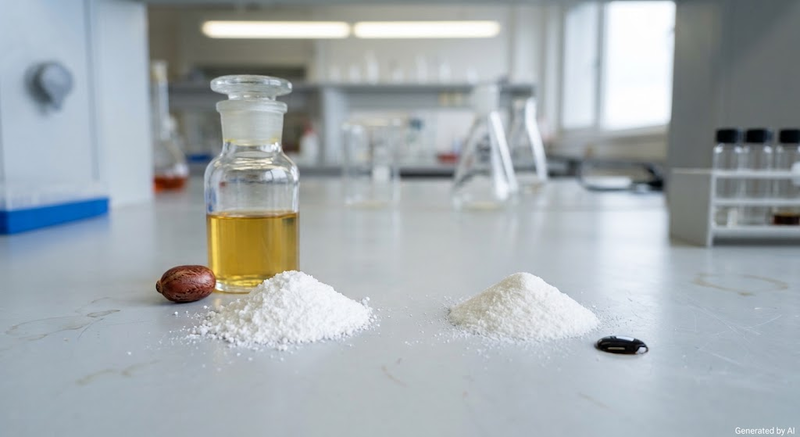
The carbon count in the name is the real difference. PA11 has eleven carbons per repeating unit and is classically produced from castor-oil-derived feedstock, which is why bio-based grades are common. PA12 has twelve carbons and is conventionally petroleum-derived, though bio-based PA12 is available. The extra methylene spacing in PA12's chain slightly lowers its melting point and shifts its crystallization, which shows up as a small difference in melting temperature and moisture uptake.
A word of caution on the sourcing story: bio-based content is a feedstock attribute, not a guarantee of biodegradability or better environmental performance. A bio-sourced PA11 is still a durable engineering plastic that will not break down in a landfill.
What PA11 and PA12 Have in Common
Both share the traits that make long-chain nylons useful: relatively low moisture absorption compared with PA6 and PA66, good resistance to many oils, fuels, and greases, and useful toughness and abrasion resistance. Both appear in functional components, housings, ducts, and other engineering parts. If you are choosing between the two, you are usually deciding on a margin of ductility, cost, or availability rather than a completely different material philosophy.
PA11 vs PA12: Key Material Properties
Thermal Properties: Melting Point, Tg, and HDT
Keep the thermal terms apart. Melting point (Tm) is where a semicrystalline solid melts, about 185–190°C for PA11 and about 175°C for PA12. Glass transition (Tg) is where the material softens, and both sit low, in the 40–50°C range. Heat deflection temperature (HDT) is a standardized sag test under load. On JLC3DP's published MJF grades, PA11 has an HDT around 185°C and PA12 around 175°C at the low-load 0.45MPa condition. That does not make PA11 universally more heat-resistant; the higher melting point and slightly higher HDT are a real but narrow advantage, and continuous-use temperature is a separate figure still.
Mechanical Properties: Strength, Stiffness, and Impact Resistance
This is where the two genuinely part ways. PA11 is the more ductile option, with higher elongation at break and impact energy absorption, which is why it is chosen for parts that flex or take a hit. On JLC3DP's MJF grades, PA11 reaches roughly 52MPa tensile strength and 50% elongation at break, while PA12 reaches about 48MPa and 20%. PA12 is stiffer in flex and is the balanced choice for general functional parts. Remember that datasheet values describe raw material under standard test conditions; finished printed-part properties shift with grade, build orientation, process parameters, and conditioning.
Moisture Absorption and Dimensional Stability
Both absorb little compared with PA6 and PA66, which is the whole point of the long chain. PA11 takes up about 1.8% and PA12 about 1.5%, so the difference is small, and PA12 is marginally more dimensionally stable when wet. Neither needs the extreme drying discipline of PA6, but both still benefit from dry storage, and powder-bed parts should still be conditioned and checked for the final service environment.
Chemical Resistance
The two are close here. Both resist fuels, oils, greases, and hydraulic fluids, and both are vulnerable to strong acids and some solvents. Compatibility always depends on the chemical, its concentration, temperature, and exposure time, so for a critical application, check the manufacturer's compatibility data for the exact grade rather than relying on a family-level claim.
Material Cost and Total Part Cost
PA12 is usually the more cost-competitive option because its supply chain is mature and it is available in more grades and processes. PA11 tends to run slightly higher. But material price is rarely the whole cost: part geometry, build efficiency, production volume, machine time, powder refresh rate in SLS/MJF, and post-processing all contribute, so the per-part number is the one that matters. Avoid treating "PA12 is cheaper" as a fixed rule without current supplier pricing.
PA11 vs PA12 for 3D Printing
Material choice is only half the story; the process shapes the printed part as much as the polymer does. The nylon pa11 vs pa12 answer looks different in MJF, SLS, and FDM, so each gets its own look.
PA11 vs PA12 in MJF 3D Printing
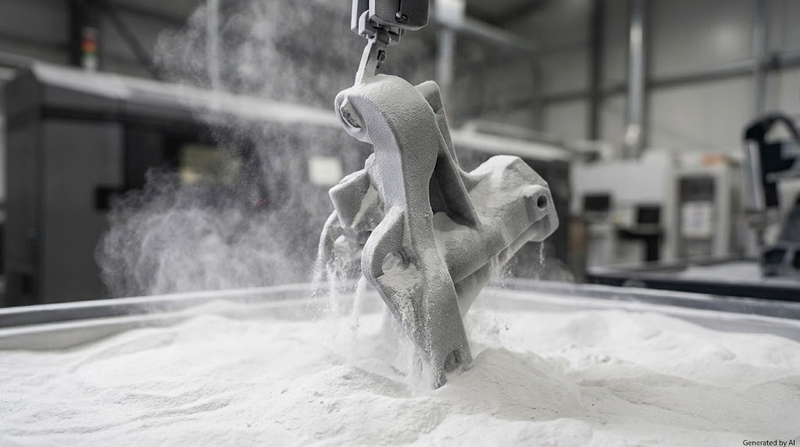
Multi Jet Fusion fuses nylon powder with an inkjet and infrared pass, and it is where both materials are most commonly offered. In MJF, PA11 shows its higher ductility and impact tolerance, making it a good fit for living-hinge-like flexing, snap fits, and parts that take repeated loading. PA12 is the balanced workhorse with good strength, stiffness, surface finish, and dimensional consistency, and it is the default for most functional MJF parts. JLC3DP lists both PA11-HP and PA12-HP in MJF, so the choice comes down to the ductility-versus-balance trade-off; compare the datasheets for the exact grades offered.
PA11 vs PA12 in SLS 3D Printing
Selective laser sintering fuses powder with a laser, and while both nylons are processable in SLS, availability is grade-specific and not every PA11 or PA12 formulation is offered on every machine. Like MJF parts, SLS parts need no support structures and show much smaller differences in strength between directions than FDM parts, though, as with any 3D-printed part, the properties are never fully uniform. Surface finish, powder refresh rate, and dimensional accuracy vary by powder and machine. Do not assume a material is available in SLS just because it is available in MJF; check what your service actually lists.
PA12-CF and Other Reinforced Nylon Grades
Reinforcement changes the game. Glass-fiber, carbon-fiber, and mineral-filled grades raise stiffness and dimensional stability dramatically and cut warping, at the cost of brittleness and abrasive wear on FDM nozzles. PA12-CF is a common reinforced option, and it should not be treated as mechanically equivalent to unfilled PA12. Reinforced PA11 exists as well, and the same rule applies: a filled grade is a different material, not an upgrade with no trade-offs.
FDM/FFF Printing: Filament and Process Considerations
Filament printing introduces considerations that powder-bed processes simply do not have. Filament must be dried before printing, bed and nozzle temperatures are grade-specific, and warping, shrinkage, and layer adhesion become the dominant concerns. FDM nylon warps more than ABS or ASA and needs an enclosure. Carbon-fiber-filled nylon needs a hardened nozzle. None of the MJF or SLS settings transfer directly to filament, so treat FDM as its own discipline.
How Printing Conditions Affect Final Part Performance
The same polymer can produce very different parts depending on how it was printed. Build orientation creates anisotropy, especially in FDM, where layer bonding is the weak axis. Powder-bed parts show lower anisotropy, but their properties still shift with fusion and cooling behavior. Part geometry, wall thickness, conditioning, and post-processing all move the numbers, so avoid the claim that one nylon consistently prints stronger or more accurately across every machine and process.
PA11 vs PA12 vs PA6 and PA66
PA6 and PA66 are the short-chain nylons, and they are not inferior, just different. They are stiffer and often stronger, but they absorb far more water and move more with humidity, which is why they are less common in powder-bed printing and more common in injection molding.
| Property | PA11 | PA12 | PA6 | PA66 |
|---|---|---|---|---|
| Chain length | Long | Long | Short | Short |
| Typical sourcing | Bio-based | Petroleum | Petroleum | Petroleum |
| Moisture absorption | ~1.8% | ~1.5% | ~9% | ~8% |
| Melting temperature | ~185–190°C | ~175°C | ~220°C | ~260°C |
| Ductility | High | Moderate | Moderate | Moderate |
| Stiffness | Moderate | Moderate | Higher | Highest |
| AM availability | MJF/SLS selected | MJF/SLS/FDM | FDM | Limited |
If stiffness and thermal performance matter more than moisture stability, PA6 or PA66 may be the better tool, provided the process and cost work out. They are a different answer to a different problem, not a downgrade.
How to Choose Between PA11 and PA12
Start with the process, then the part's job. The pa11 vs pa12 decision is best made by running down a short list rather than memorizing a winner.
When to Consider PA11
Choose PA11 when the part must flex or absorb impact, when the selected grade's higher elongation and impact energy matter, when repeated bending is part of the service life, or when bio-based sourcing is a requirement the chosen grade actually meets. Verify that the grade and process satisfy the design specification before committing.
When to Consider PA12
Choose PA12 when you want an established, balanced material for functional parts, when stiffness, strength, toughness, and dimensional stability need to coexist, when supplier availability and cost competitiveness matter, and when the grade is already qualified for your process and operating environment. Do not assume PA12 is automatically cheaper, easier, or more stable; verify against the exact grade.
When PA6, PA66, or Reinforced Nylon May Be More Suitable
Step outside the PA11/PA12 pair when the application demands more stiffness or thermal performance, in which case PA6, PA66, or a reinforced grade may fit better. If operating temperature, chemical exposure, regulatory requirements, or mechanical loading exceed what the available nylon grades can do, a different engineering thermoplastic is the right call.
Quick Material Selection Checklist
- What manufacturing process will be used: SLS, MJF, or FDM/FFF?
- Does the part need flexibility, impact resistance, stiffness, or dimensional precision?
- What temperature, moisture, and chemical exposure will it see in service?
- Are there certification or sourcing requirements?
- What is the target production volume, budget, and lead time?
The final answer should rest on the exact material grade and validated part performance, not on a generic "PA11 is better for X" rule.
Common Applications of PA11 and PA12
Automotive and Fluid-Handling Components
Ducts, clips, protective covers, and fluid-handling parts are common for both materials, where the grade must meet the required temperature, pressure, and chemical compatibility. PA11's extra ductility helps with clips and snap features; PA12's dimensional stability suits tightly fitting ducts and housings.
Consumer Products and Sports Equipment
Housings, protective gear, and footwear-related components lean on the materials' toughness. PA11's impact tolerance suits parts that flex or take a hit, such as soles and guards, while PA12's balance suits rigid shells and structural pieces.
Industrial and Functional 3D-Printed Parts
Housings, brackets, ducts, and fixtures are the core of powder-bed nylon production. Here the decision usually comes down to geometry, load, process consistency, and volume, and PA12's mature supply chain often makes it the economical default for large runs.
Medical and Food-Contact Applications
Suitability for medical or food-contact use depends entirely on the exact grade, its regulatory status, the sterilization method, and the application conditions. Do not assume generic PA11 or PA12 is biocompatible or food-contact approved without verification.
FAQ about PA11 vs PA12
Q: What is the difference between PA11 and PA12?
PA11 has eleven carbons in its repeating unit and is usually castor-oil based; PA12 has twelve and is usually petroleum-based. Practically, PA11 is more ductile and impact-tolerant with a slightly higher melting point, while PA12 is stiffer, more widely available, and often cheaper.
Q: Is PA11 stronger than PA12?
Not in a clean way. PA11 is more ductile and absorbs more impact energy, while PA12 is stiffer and slightly stronger in flex. On comparable MJF grades, the tensile numbers are close, around 52MPa for PA11 and 48MPa for PA12.
Q: Is PA11 or PA12 better for MJF printing?
Both are available in MJF, and the choice is ductility versus balance. Pick PA11 for flexing and impact-loaded parts, and PA12 for the balanced, dimensionally stable default for most functional parts.
Q: Does PA11 absorb more water than PA12?
Yes, slightly. PA11 absorbs around 1.8% and PA12 around 1.5%, both far below PA6 and PA66. The difference is small, and both are considered low-moisture nylons.
Q: Is PA11 bio-based and biodegradable?
PA11 is commonly made from castor oil, so bio-based grades are widely available, but bio-based is not the same as biodegradable. It is still a durable engineering plastic that will not break down in a landfill.
Q: Which is cheaper, PA11 or PA12?
PA12 is usually more cost-competitive because of its mature supply chain and broader availability, but the total part cost depends on geometry, process, volume, and post-processing, so compare per-part pricing rather than raw material price.
Conclusion: PA11 vs PA12
PA11 and PA12 are long-chain polyamides with overlapping strengths and a handful of real differences. PA11 is the ductile, impact-tolerant, bio-based option; PA12 is the established, balanced workhorse with the broader supply chain. Thermal, mechanical, chemical, and dimensional performance all depend on the specific grade and process, and SLS, MJF, and FDM each impose their own requirements.
Choose by the part's job, not by a slogan: ductility and impact point to PA11, balance and availability point to PA12, and reinforced or short-chain nylons step in when the requirements call for more stiffness or heat. Validate against the exact grade and your actual operating conditions, then run the part. Need custom PA11 or PA12 parts? Upload your 3D model to explore the available options and get a quote.
Keep Learning
PA11 vs PA12: Key Differences and How to Choose for 3D Printing
Quick Answer Pick PA11 when the part must flex, absorb impact, or when bio-based sourcing matters. Pick PA12 when you want the established, balanced default that is widely available. The difference between pa11 vs pa12 comes down to chemistry and economics more than to a winner and a loser. PA11 has eleven carbons in its repeating unit and is traditionally made from castor oil, which gives it a bio-based story and a slightly higher melting point. PA12 has twelve carbons and is conventionally petroleum......
ABS 3D Printing: Settings, Warping & Acetone Smoothing
Key Takeaways ABS 3D printing succeeds or fails on three controls: bed heat, drafts, and cooling airflow. A typical working setup is a 230–250°C nozzle, a 90–110°C bed, and the cooling fan off. Warping comes from uneven cooling, so the countermeasures rank in priority order: an enclosure that holds warmth does more than any glue trick, and a brim of five or more outlines rescues stubborn corners. The cooling fan is the counterintuitive setting. PLA habits say open it up; ABS says leave it closed, beca......
What Is PEEK Filament? High-Performance 3D Printing Explained
PEEK (Polyether Ether Ketone) is not your average 3D printing filament. It’s the powerhouse of engineering-grade thermoplastics, offering strength, chemical resistance, thermal stability, and durability that rivals even some metals. But can you really 3D print with PEEK? Absolutely, if you know what you're doing. In this guide, we’ll explore what PEEK filament is, the challenges of 3D printing PEEK, where it excels, and how to prepare for using it in advanced applications. What Is PEEK Filament? PEEK ......
Why Use PEEK 3D Printing? Benefits, Applications & Challenges
Most engineering materials get chosen because they're available, familiar, or cheap. PEEK gets chosen because nothing else works. When an engineer specifies PEEK 3D printing, it's almost always because the part needs to survive conditions that would disqualify every other plastic on the shortlist, sustained heat above 200℃, aggressive chemicals, sterilization cycles, or mechanical loads that other polymers handle poorly over time. PEEK 3D printed parts aren't “prototype outputs”. They're functional en......
Choosing the Right ESD Filament for Your Application
Introduction Somewhere in an electronics assembly facility right now, someone is printing a fixture on a desktop 3D printer using standard PLA. It looks fine. It fits the board. And every time a PCB gets placed in it, static charge builds on that perfectly smooth, perfectly insulating plastic surface, right next to components sensitive to discharges that humans can't even feel. ESD filament exists specifically for this problem. It's not a premium upgrade to standard filament. It's a different material......
ESD Plastic Materials: A Practical Guide for Engineers
Key Takeaways ESD plastic controls charge: It uses conductive or dissipative additives to let static charge flow away safely instead of building to a damaging discharge. Three categories by resistivity: Conductive (<10⁵ Ω/sq), static dissipative (10⁵–10⁹ Ω/sq), and anti-static (10⁹–10¹² Ω/sq) each serve different roles. Static dissipative is the usual target: Most electronics handling fixtures use the 10⁶–10⁸ Ω/sq range for controlled, non-damaging dissipation. Match material to the full application: ......