ABS Temperature Resistance: How Hot Can ABS Withstand?
16 min
- ABS Temperature Resistance: How Hot Can ABS Actually Withstand?
- ABS Temperature Resistance: Tg, HDT, Vicat, and Melting Point
- When ABS Starts to Soften or Deform
- What Affects ABS Heat Resistance
- Print Temperature Is Not Service Temperature
- ABS Heat Resistance Compared with PLA, PETG, and ASA
- When to Upgrade from ABS to PC-ABS or PC
- How to Improve ABS Heat Resistance
- Is ABS Suitable for High-Temperature Applications?
- FAQ about ABS Temperature Resistance
- Managing ABS Temperature Limits in Engineering Design
Key Takeaways
- ABS heat resistance is defined by Tg and HDT, not melting point. Typical ABS grades have a Tg around 100–110℃ and HDT around 85–95℃.
- JLC3DP ABS reaches 98°C HDT under its published test conditions, but actual part performance depends on load, geometry, orientation, and exposure time.
- ABS offers higher heat resistance than PLA and PETG, while ASA provides similar heat performance with better outdoor durability.
- PC-ABS and PC are options when ABS is not enough. PC-ABS balances heat resistance and toughness, while PC provides higher thermal performance.
- Printed ABS parts can fail below material limits because layer adhesion, stress, and design factors affect real-world heat resistance.
Standard ABS holds shape under meaningful load to roughly 85–95℃, with the measured spread across brands running 70–100℃. Push past that and you are into deformation territory. The material does not go from solid to liquid; it softens progressively, and whether that softening matters depends entirely on what the part is doing.
Materials decide machines, and ABS escalates every temperature number a printer must deliver. If you are still deciding between the materials themselves, our ABS vs PLA and ABS vs PC comparisons sort that first; this page assumes the filament is chosen and turns the demands into hardware and design decisions.
ABS Temperature Resistance: How Hot Can ABS Actually Withstand?
Here is the key temperature data for JLC3DP ABS 3D printing, against the typical ranges for unfilled ABS:
| Property | JLC3DP ABS | Typical ABS range |
|---|---|---|
| Glass transition temperature (Tg) | ~101℃ | 95–115℃ |
| Heat deflection temperature (HDT) | 98℃ (ISO 75, 1.82MPa) | 85–95℃ typical; 70–100℃ across brands |
| Vicat softening point | ~102℃ | 95–110℃ |
| Melt processing range | ~220–240℃ | 200–250℃ |
| Recommended max service temp | Application-dependent | ~85℃ conservative |
Note
A note on that HDT figure: JLC3DP's published ABS data lists 98℃ under ISO 75 at 1.82MPa. HDT is a standardized test result, not a guaranteed continuous-use temperature for every printed part. Actual performance depends on the material grade, print orientation, geometry, applied load, and operating conditions.
The ABS melting point is not the number to design around for service temperature. ABS is an amorphous thermoplastic with no sharp melting point; it progressively softens as temperature rises. By the time it approaches anything resembling a melt, it has been useless for structural purposes for a long time. The relevant numbers are Tg and HDT.
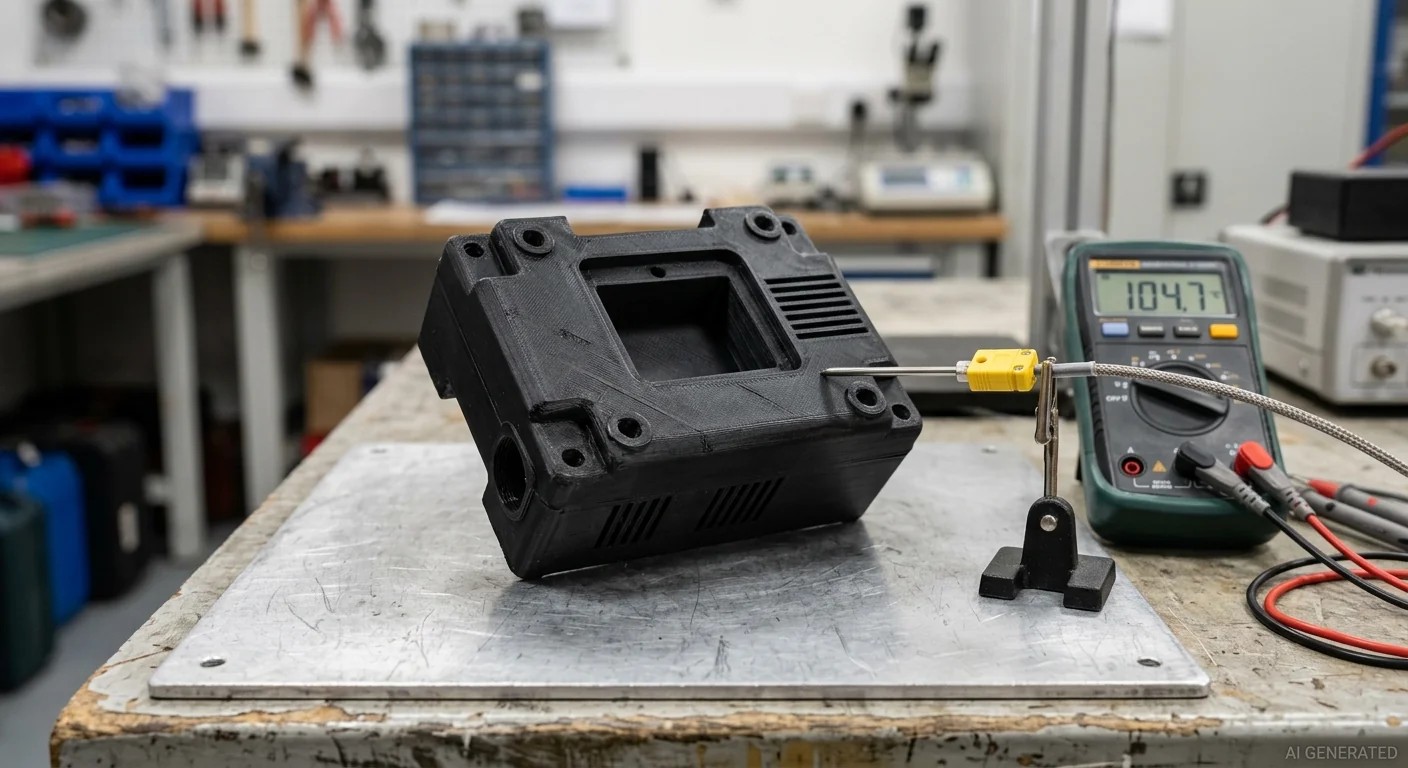
abs temperature resistance fdm abs component
There is also a meaningful difference between these values in FDM-printed ABS and injection-molded ABS. Printed parts have layer interfaces that create local weakness, and parts loaded across those layers (Z direction) can deform at lower temperatures than bulk material data suggests.
ABS Temperature Resistance: Tg, HDT, Vicat, and Melting Point
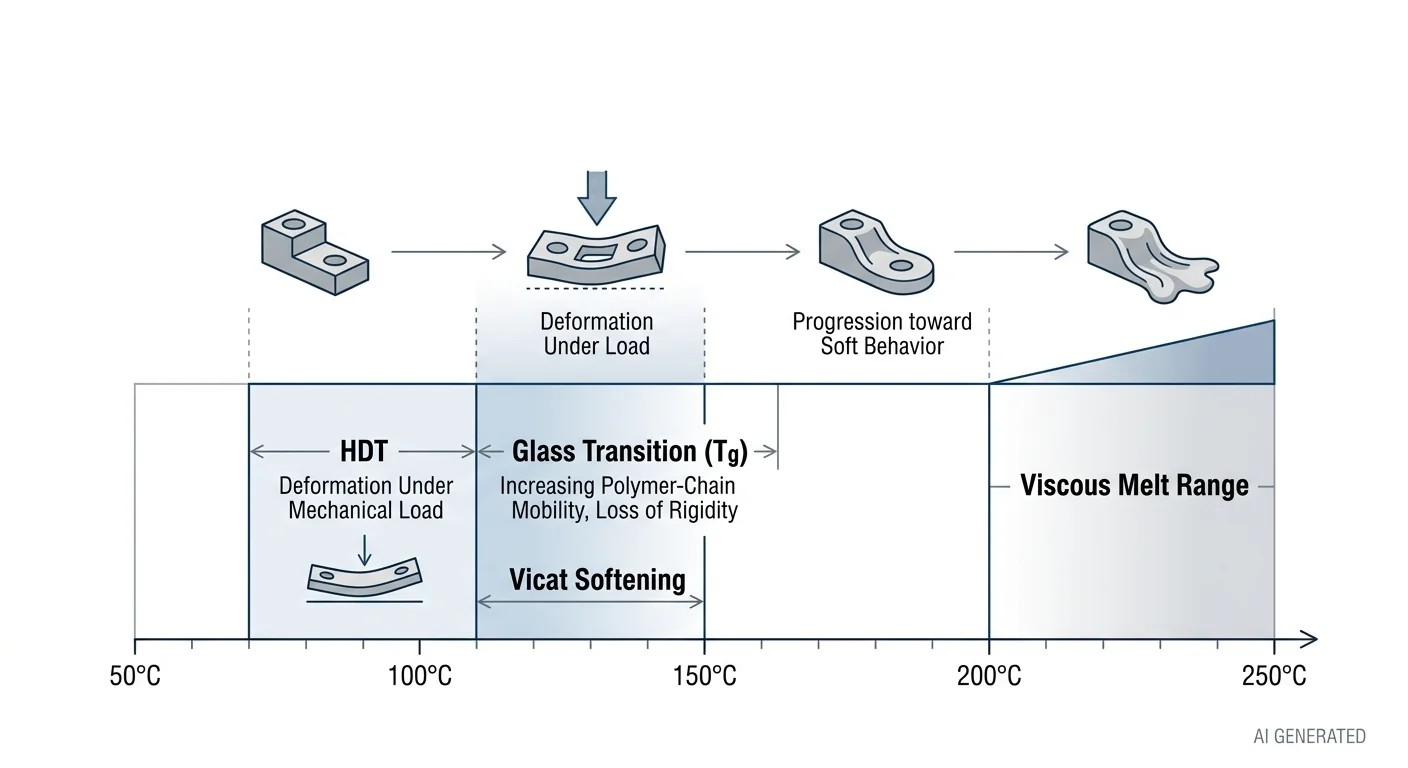
abs tg hdt vicat temperature scale
These three numbers describe different things happening at different temperatures. Mixing them up leads to parts that fail in service when the datasheet seems to say they would be fine.
Glass Transition Temperature (Tg)
The ABS glass transition temperature is where the polymer chains in the amorphous regions start gaining mobility: the material transitions from a hard, glassy state to a softer, more rubbery one. For ABS this happens around 95–115℃ depending on formulation, with most grades clustering at 100–110℃; JLC3DP's ABS measures ~101℃.
Below Tg, ABS is rigid and dimensionally stable. Above it, stiffness degrades progressively through a range, not at a sharp line. Depending on the load the part carries, deformation may become noticeable well before the top of that range. The glass transition is the ceiling for serious load-bearing applications; design for sustained use below it.
Heat Deflection Temperature (HDT)
HDT is measured under load: a standard specimen under a specific bending stress is heated until it deflects by 0.25mm. For ABS at 1.82MPa, typical grades cluster at 85–95℃, with the spread across brands running 70–100℃. At 0.45MPa (lower stress), HDT lands higher, closer to 95–107℃.
HDT is more practically useful than Tg because it factors in load. A part under no stress can tolerate temperatures closer to Tg; a part under meaningful mechanical load starts having problems closer to HDT. For most ABS applications where the part does something structural, HDT is the number to design around.
ABS Softening Temperature
The ABS softening temperature sits in the same general band as Tg, 95–110℃ by Vicat measurement. The Vicat test uses a small indentor under a specific load and measures when it penetrates 1mm into the material. It is another way of characterizing the same rigid-to-soft transition.
ABS Melting Point
ABS is amorphous and has no well-defined melting point; it turns into a viscous melt somewhere in the 200–250℃ range, which is why it prints at nozzle temperatures of 220–250℃. For service temperature purposes, the melting point is essentially irrelevant.
When ABS Starts to Soften or Deform
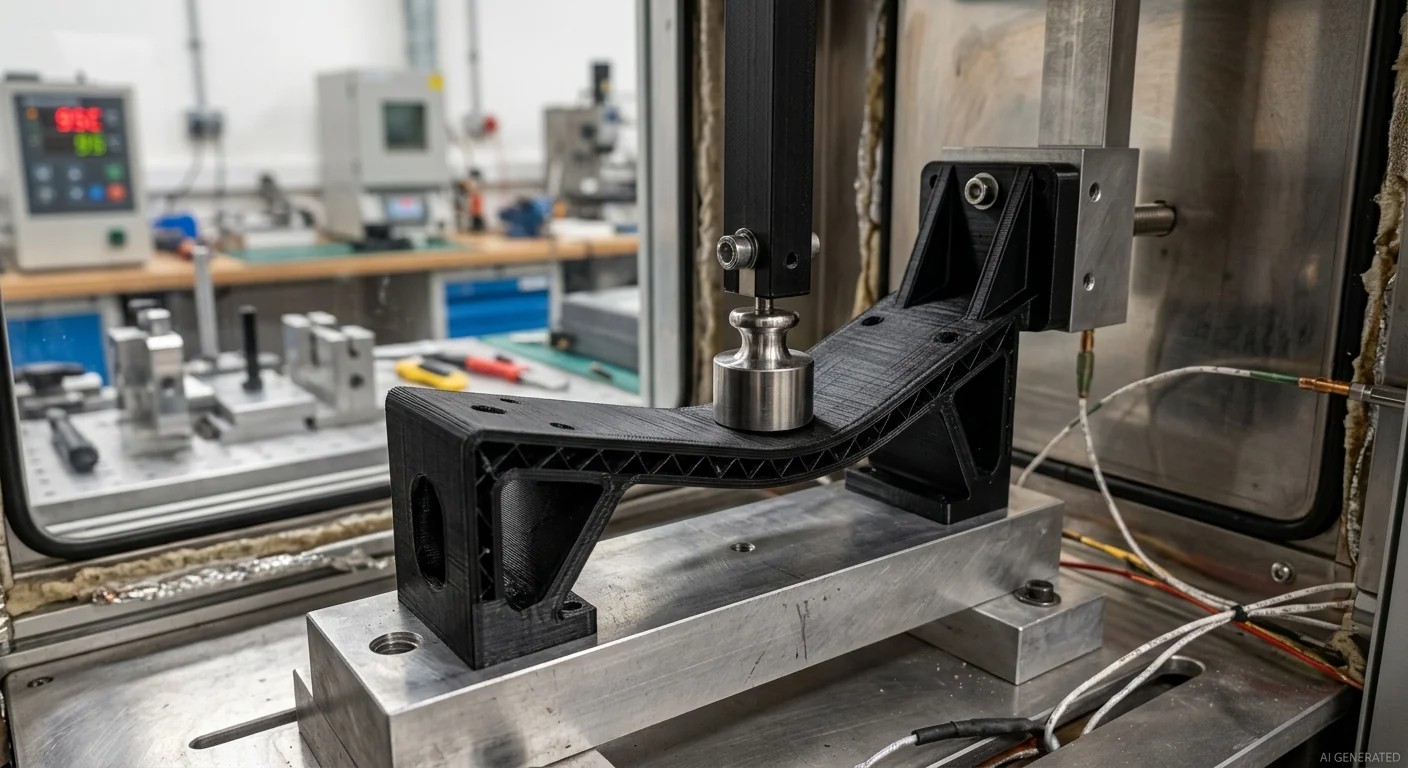
fdm abs bracket thermal deformation
This is the practical question, and the honest answer has more variables than a single temperature. ABS starts deforming in service when the combination of temperature, load, geometry, and exposure time pushes the material past what it can handle at that specific operating point. A thick, lightly loaded part sitting passively in a 90℃ environment behaves very differently from a thin-walled clip under spring tension at 85℃.
Some real-world scenarios where the deformation question shows up:
- A car interior on a hot summer day. Dashboard surfaces can reach 80–90℃ in direct sun, which presses against the HDT band. Parts on or near the dashboard that carry any mechanical load are at risk.
- Proximity to heat-generating electronics. Power supplies, motors, and actuators push the local ambient temperature up around an otherwise comfortable part.
- Enclosed spaces like equipment housings, where heat accumulates faster than it dissipates and internal temperatures run well above ambient.
Within those scenarios, the actual failure point depends on the factors below.
What Affects ABS Heat Resistance
Load
The bigger the load, the earlier ABS fails thermally. This is what the HDT test formalizes: higher stress means deflection happens at a lower temperature. A part under its own weight behaves differently from a part under spring preload or assembly force. If the part's function involves sustained compressive or bending load, design around the lower HDT values; if it is essentially a passive enclosure, you have more margin.
Wall Thickness
Thicker walls improve thermal resistance in practice: more material to distribute load across, and more rigidity through a given temperature range. Thin walls concentrate stress and deflect earlier. For FDM-printed ABS specifically, thicker sections also mean more overlap between layer paths and reduced sensitivity to layer-interface weakness at elevated temperature. A 1.2mm wall and a 4mm wall of the same ABS behave quite differently when heated.
Print Orientation
This matters specifically for 3D printed ABS and does not apply to injection-molded parts. FDM parts are anisotropic, stronger in XY than in Z. The layer interfaces are the weak points, and heat lowers their strength faster than it lowers bulk properties. A part loaded parallel to the layer lines handles heat better than the same part loaded perpendicular to them. When designing printed ABS parts for warm environments, orient the critical load paths in XY.
Exposure Time
Brief thermal spikes are less damaging than sustained elevated temperature. ABS can handle short excursions above HDT without permanent deformation, the key word being short. Sustained exposure at or above Tg produces creep even at modest loads. A part that looks fine after a one-minute exposure might not look fine after a day at the same temperature under load. If peak temperature is reached only briefly, real-world performance is better than a static HDT number suggests; if it is sustained for hours regularly, design for the sustained condition.
Print Temperature Is Not Service Temperature
Search interest around abs filament temperature usually points at the nozzle setting, and that is a different property. ABS prints at 230–250℃ because that is what it takes to melt and extrude the filament, a manufacturing condition. Once the part cools, its heat limits reset to the material's own values: the deflection and glass transition ranges discussed above. A hot end running at 250℃ says nothing about the finished part surviving 250℃.
What printing does affect is how close to the datasheet the part actually performs. Well-printed ABS (proper temperature, an enclosed chamber, good layer bonding) approaches the rated values. Poorly printed ABS, with weak layer adhesion and residual stress from uneven cooling, underperforms them: layers can separate at temperatures a sound print would shrug off. Printing well is part of heat resistance, which is also why the annealing route below works at all.
ABS Heat Resistance Compared with PLA, PETG, and ASA
ABS is the entry level of heat-capable filaments, and the ladder around it is well marked (all HDT values at 1.82MPa, typical unfilled grades):
| Filament | HDT @1.82MPa | Max recommended service temp | Print difficulty | Notes |
|---|---|---|---|---|
| PLA | 50–55℃ | ~50℃ | Easy | Deforms on a hot windowsill |
| PETG | 65–70℃ | ~70℃ | Medium | The middle path for warm environments |
| ABS | 85–95℃ | ~85℃ | Higher (enclosure needed) | The entry level of heat-capable filaments |
| ASA | 90–95℃ | ~85℃ | Higher | ABS's UV-stable sibling; similar heat |
PLA has the lowest heat-deflection range of the three common FDM materials, and its 50–55℃ band means you are operating close to the edge at temperatures a car interior exceeds routinely in summer. The full breakdown on PLA's thermal limits is in our PLA temperature resistance guide.
PETG sits in the middle: meaningfully better than PLA, noticeably worse than ABS. Its 65–70℃ deflection band buys margin for warm environments without ABS's warping problems. For applications that need more heat resistance than PLA but where ABS's print difficulty is not worth dealing with, PETG is often the right call; the full PETG thermal picture is in our PETG temperature resistance guide.
ASA deserves one clarification, because it is frequently assumed to be a heat upgrade: the ASA glass transition temperature lands in roughly the same band as ABS, around 100–105℃, so the real reason to pick ASA is UV and weather resistance, not heat.
That closes the easy part of the ladder. Above ABS sit PC and the PC-ABS blend, and they change the conversation from print difficulty to real hardware, which the next section covers in full.
When to Upgrade from ABS to PC-ABS or PC
ABS offers better heat resistance than many standard PLA and PETG grades, but it may not be enough for parts exposed to higher temperatures under load. In these cases, polycarbonate (PC) and PC-ABS are worth considering. PC generally offers the highest heat resistance of the three, while PC-ABS balances heat resistance, toughness, and printability.
Typical FDM data puts PC's HDT at around 125–130℃, roughly 35–40℃ above standard ABS. PC-ABS lands in between; the JLC3DP material datasheet lists the blend at 106℃ at 1.82MPa.
| Property | ABS | PC-ABS | PC |
|---|---|---|---|
| HDT at 1.82MPa | 85–95℃ | ~106℃ | 125–130℃ |
| Glass transition temp | 95–115℃ | Two phases, ABS and PC | 145–150℃ |
| Impact strength | Good | Very high | High |
| Print difficulty | Higher (enclosure needed) | Medium-high | Highest (high-temp hardware) |
| Relative cost | Lowest | Middle | Highest |
PC keeps its stiffness at temperatures where ABS is already softening. That gap is why engine-bay brackets and lighting housings tend to get specified in PC, but PC asks a lot from the printer: its high glass transition means high-temperature equipment is required, and it costs meaningfully more than ABS.
PC-ABS is the compromise. It borrows heat resistance and toughness from the PC side and printability and surface finish from the ABS side, and because the blend dilutes the PC, it is cheaper than PC alone. JLC3DP offers PC-ABS as a production FDM material with published figures on the PC-ABS material page.
So which one? If your part sits below roughly 80℃ under load, standard ABS is fine and cheaper. Between 80 and 100℃, PC-ABS is the safer pick. Above that, or when the part is both hot and carrying real load, PC is the material that stays put, and the polycarbonate guide maps the full ladder above ABS.
How to Improve ABS Heat Resistance
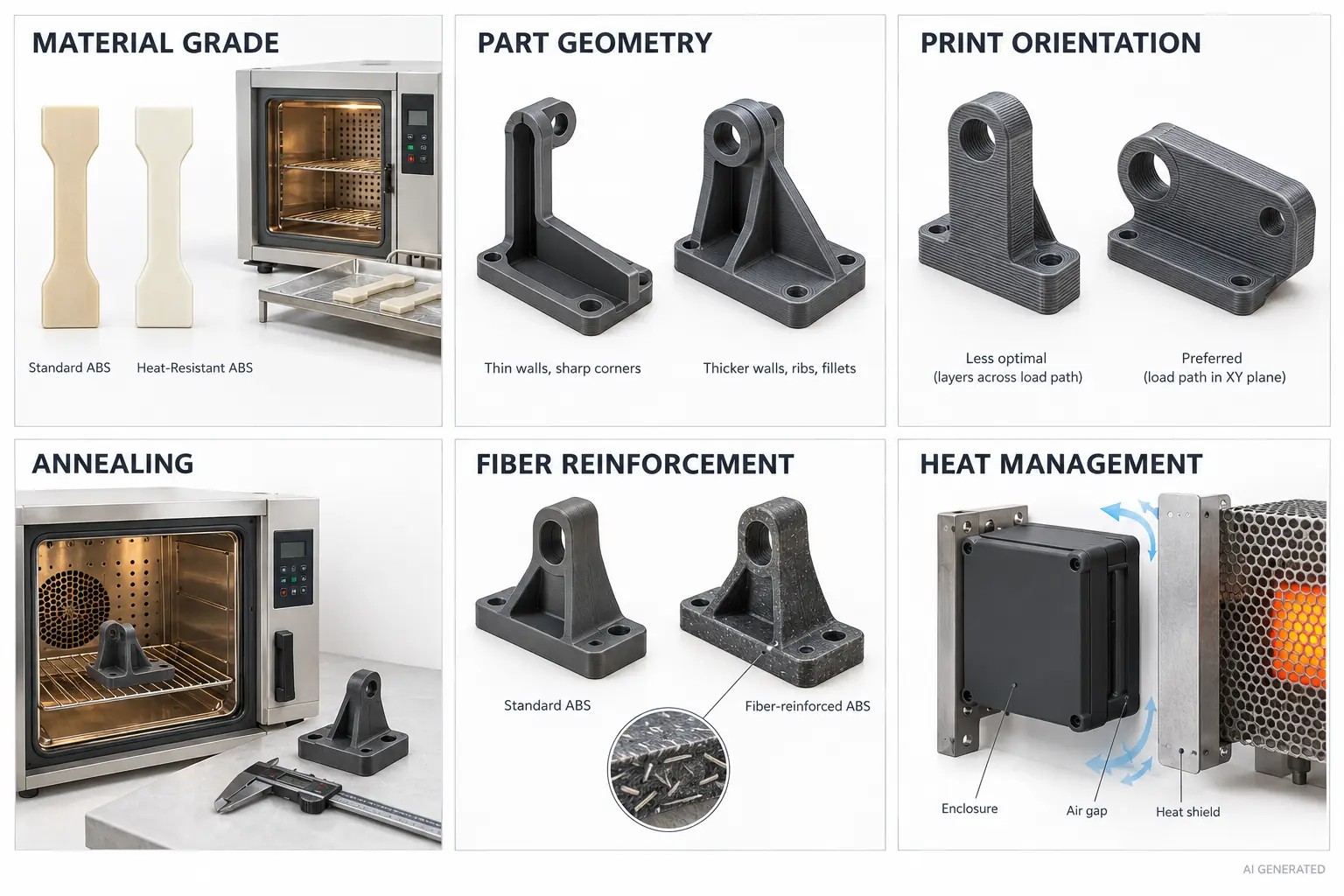
abs heat resistance improvements
You cannot change the chemistry of standard ABS. What you can change is how much of its limit you use up. Most of the gains come from design and process, not the material itself.
1Start with the right grade
Not every ABS is the same. Heat-resistant ABS grades are formulated with a higher Tg and HDT than general-purpose filament. If the datasheet does not list HDT at 1.82MPa, treat the material as a standard grade.
2Make the part stiffer where it counts
Thicker walls, ribs, and generous fillets all spread load, which keeps stress low when the material softens. Sharp internal corners concentrate stress and are where heated ABS starts creeping first. Well-printed ABS approaches the datasheet numbers; poorly printed ABS with weak layer adhesion underperforms them, so printing quality is itself part of heat resistance.
3Orient for heat
Heat attacks layer interfaces before it attacks bulk material. Keep the main load path along the XY plane, not across layers, and print with more perimeters than infill so the outer shell does the work. Dense infill helps; a hollow part does not.
4Anneal, carefully
Annealing can relieve internal stress and improve layer bonding in printed ABS. It is not a magic fix. ABS is amorphous, so annealing will not raise Tg the way it does for semi-crystalline materials like PLA, and the part can warp or shrink if you rush it. Anneal a test coupon first, not the final part, and design parts destined for annealing oversize. Vapor smoothing does nothing for heat resistance either; it improves finish, not thermal limits.
5Add fibers
Glass or carbon fiber-filled ABS holds stiffness better as temperatures climb, because the fibers resist the softening of the polymer matrix. It costs more and wears nozzles faster, which is why it is usually a production-service material.
6Fix the environment
Often the cheapest improvement is no change to the part at all. Add an air gap between the part and the heat source, a heat shield, or ventilation in an enclosure. Dropping the service temperature 15℃ is cheaper than upgrading the material. If you are still near the limit after all of this, move to ASA, PC-ABS, or PC.
Is ABS Suitable for High-Temperature Applications?
Depends on what "high" means. For moderate heat, yes. For truly high temperatures, no.
ABS is a good fit for electronics enclosures running warm, appliance housings, tool handles, and automotive interior parts that stay out of direct sun and away from heat sources: jobs where temperatures stay under about 80–85℃ and loads stay light. It is a poor fit for parts near engines, exhaust, or heating elements, anything sterilized by autoclave, hot-water contact near 100℃, and sustained loaded use above its HDT.
| Application | Is ABS suitable? | Better option if not |
|---|---|---|
| Electronics enclosure (warm, ventilated) | Yes | N/A |
| Car interior, away from dashboard | Usually | ASA for UV exposure |
| Dashboard in direct sun, loaded | Borderline | PC-ABS or PC |
| Near motors or heating elements | Depends on distance | PC-ABS, PC |
| Engine bay or exhaust | No | PC, nylon, PEEK |
| Autoclave sterilization | No | PEEK or other high-temp polymers |
One more thing. The test is not "does the datasheet number clear my peak temperature." It is "does the part still do its job after weeks at its normal operating temperature, under its normal load." Creep is quiet. By the time you notice it, the part has already moved.
FAQ about ABS Temperature Resistance
Q: How hot can ABS withstand?
Standard ABS handles about 85–95℃ under meaningful load before dimensional problems start, with the brand-to-brand spread running 70–100℃. A common design ceiling is around 85℃, and lower if the part is thin or heavily loaded.
Q: What is the ABS plastic melting point?
ABS has no sharp melting point because it is amorphous. It turns into a viscous melt somewhere in the 200–250℃ range, which is why it prints at nozzle temperatures of 220–250℃. For service use, the melting point does not matter.
Q: What's the difference between ABS glass transition temperature and HDT?
Tg is where the polymer chains gain mobility, around 95–115℃. HDT is the temperature where a loaded sample deflects a set amount, typically 85–95℃ at 1.82MPa for common grades. HDT is lower because it includes load, so it is the number to design around.
Q: What is the ABS softening temperature?
Vicat softening for ABS usually falls around 95–110℃. It describes the same rigid-to-soft transition as Tg, measured with a small indentor under load.
Q: What's the ASA glass transition temperature compared to ABS?
Close. ASA sits around 100–105℃, which is within ABS's range. ASA is chosen for outdoor UV stability, not for a big jump in heat resistance.
Q: Will ABS deform in a hot car?
It can. Dashboard surfaces reach 80–90℃ in direct sun, which is close to ABS's HDT. Light, unloaded trim usually survives. Loaded or thin parts on the dash may warp over repeated cycles.
Q: Is PC-ABS better than ABS for heat?
Yes. Typical ABS lands around 85–95℃ HDT, while the JLC3DP PC-ABS datasheet lists about 106℃. PC is higher again at roughly 125–130℃, with more cost and more printing difficulty.
Q: Does the printing temperature affect the finished part's heat resistance?
No. ABS prints at 230–250℃ because that is what extrusion requires; the finished part's heat limits come from the material's glass transition and deflection behavior. Print quality does matter, though: weak layer adhesion and residual stress make a part underperform its datasheet at temperature.
Managing ABS Temperature Limits in Engineering Design
ABS temperature resistance is best used the way engineers use any limit: know the three numbers, respect the failure stages below them, and improve the part or the environment when the number is genuinely too low. When the application outgrows ABS entirely, the ladder to PC-ABS and PC is well marked, and the climb starts with one upload.
Keep Learning
PLA vs PETG vs ASA: Best 3D Printing Filament for Outdoor Use
If you've ever watched a 3D printed garden hook sag in the sun or a cold snap crack your custom outdoor fixture, you already know: not all filaments are built for the elements. Choosing the best 3D printing filament for outdoor use isn't just about surviving the occasional drizzle. It's about UV exposure, temperature swings, moisture resistance, and long-term strength. And let's be real, most people don't want to reprint every few months just because they picked the wrong plastic. In this guide, we'll......
ABS Temperature Resistance: How Hot Can ABS Withstand?
Key Takeaways ABS heat resistance is defined by Tg and HDT, not melting point. Typical ABS grades have a Tg around 100–110℃ and HDT around 85–95℃. JLC3DP ABS reaches 98°C HDT under its published test conditions, but actual part performance depends on load, geometry, orientation, and exposure time. ABS offers higher heat resistance than PLA and PETG, while ASA provides similar heat performance with better outdoor durability. PC-ABS and PC are options when ABS is not enough. PC-ABS balances heat resista......
Is PETG Toxic to Print? Fumes, Risks & Safety Guide
Key Takeaways PETG is generally considered a lower-emission 3D printing material compared to ABS and ASA, but it does produce VOCs and ultrafine particles during printing. The odor during PETG printing is typically mild, some people barely notice it, others describe a faint warm-plastic smell. Low odor doesn't mean zero emissions. Ventilation is still a sensible precaution. PETG food safety is complicated, the material itself may be food-grade in some formulations, but the printing process introduces ......
Top 5 Heat-Resistant 3D Printing Filaments Compared
When Regular Filament Just Doesn’t Cut It You’ve 3D printed a functional bracket for a car engine bay. It fits perfectly, looks great, and then warps into a banana-shape after a week under the hood. That’s the danger of underestimating heat. If you're building automotive components, enclosures near motors, molds, or even kitchenware, using the wrong filament can lead to deformation, brittleness, or outright failure when exposed to heat. So, you already know the solution: Choosing the right heat-resist......
PLA Temperature Resistance: Heat Resistance, Softening & Melting Point
Key Takeaways PLA typically starts losing rigidity around 55–65℃ (Tg) and melts at approximately 150–180℃. PLA can deform and creep long before it melts, so melting point is not a practical service-temperature limit. Actual PLA deformation depends on temperature, load, geometry, print orientation, and exposure time. Standard PLA becomes increasingly risky above 50–60℃ and is generally unsuitable for sustained 70–80℃ applications. PLA+ heat resistance varies by formulation. For higher-temperature appli......
PETG Temperature Resistance: Limits & Comparison with PLA/ABS/ASA
Key Takeaways Standard PETG is best suited for continuous use below ~60℃; performance can decline as temperatures approach 70℃. PETG typically has a Tg of ~75–85℃ and an HDT of ~65–75℃, depending on the material grade and test conditions. HDT is not a maximum service temperature—load, print orientation, wall thickness, geometry, and exposure time all affect real-world performance. PETG offers better heat resistance than PLA but lower heat resistance than ABS, ASA, PA12-CF, PC, and PEEK. For sustained ......