PLA Temperature Resistance: Heat Resistance, Softening & Melting Point
19 min
- How Hot Can PLA Withstand?
- Understanding PLA Tg, Softening, HDT, and Melting Temperature
- What Temperature Does PLA Deform?
- PLA Temperature Resistance vs. Printing Temperature
- PLA Temperature Resistance at 50℃, 60℃, 70℃, and 80℃
- Does PLA Deform in a Hot Car or Direct Sunlight?
- Is PLA Suitable for High-Temperature Applications?
- PLA vs. PETG: Which Has Better Heat Resistance?
- How to Choose a 3D Printing Material for Heat Resistance
- FAQs About PLA Temperature Resistance
- Final Thoughts: PLA Is Easy to Print, but Not a High-Temperature Material
Key Takeaways
- PLA typically starts losing rigidity around 55–65℃ (Tg) and melts at approximately 150–180℃.
- PLA can deform and creep long before it melts, so melting point is not a practical service-temperature limit.
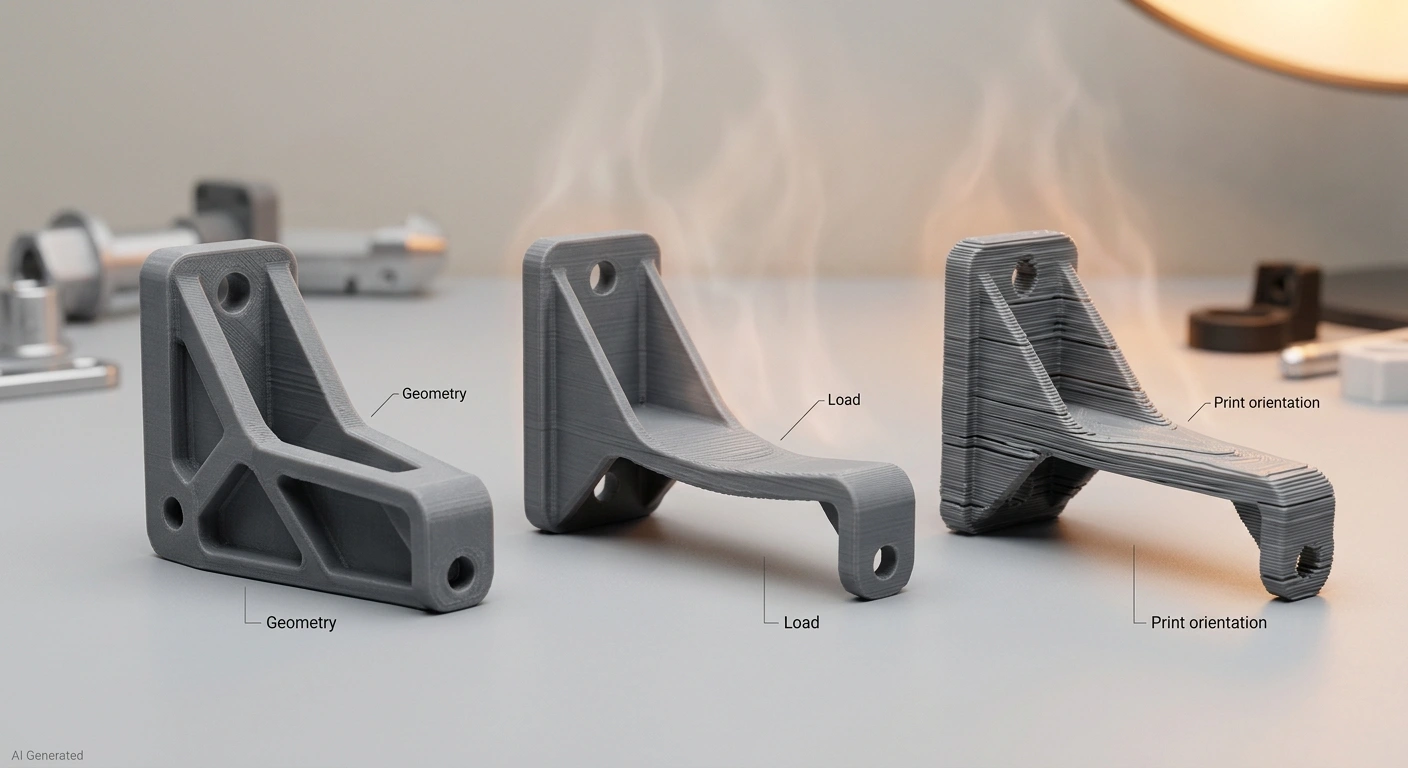
- Actual PLA deformation depends on temperature, load, geometry, print orientation, and exposure time.
- Standard PLA becomes increasingly risky above 50–60℃ and is generally unsuitable for sustained 70–80℃ applications.
- PLA+ heat resistance varies by formulation. For higher-temperature applications, consider PETG, ABS, ASA, PA12-CF, or PEEK based on the required operating conditions.
Introduction
PLA is the easiest material to print using the FDM process. It's also the one that fails most predictably when heat gets involved. Leave a PLA part on a car dashboard in summer. Not at the melting point, nowhere near it. Just at the temperature where PLA stops holding its shape under its own weight.
PLA's problem isn't its melting point. It's how early it starts losing stiffness long before it gets anywhere near melting. For 3D-printed PLA parts, the practical temperature limit is usually determined by softening, creep, and deformation—not by the melting point.
This guide covers where that softening actually starts, what the numbers mean, when PLA is and isn't suitable for heat-exposed applications, and what to use instead when you need something that survives warmer environments.
How Hot Can PLA Withstand?
Less than most people expect. PLA temperature resistance is one of the lower ones among common 3D printing materials, and the number that matters most isn't the melting point, it's the point where it starts going soft.
Here's how the key temperature values line up for JLC3DP's PLA Plastic material data compared to what you'd see across typical PLA:
| Property | JLC3DP PLA-P | Typical PLA Range |
|---|---|---|
| Glass Transition Temperature (Tg) | ~60℃ | ~55–65℃ |
| Heat Deflection Temperature (HDT) | ~53℃ | ~50–65℃ |
| Melting Temperature | ~155–165℃ | ~150–180℃ |
| Recommended Service Temperature | <50℃ (low load) | Application-dependent |
| Thermal Conductivity | ~0.13 W/m·K | ~0.10–0.16 W/m·K |
JLC3DP PLA-P values are based on the material's technical data. Test conditions and methods can affect reported thermal properties.
The HDT (Heat Deflection Temperature), the temperature at which a standardized loaded specimen deflects or bends by a specified amount, sits around 53℃. That's not very far from room temperature in warm environments. HDT is a test-specific performance value, not a universal temperature at which every PLA part begins to deform.
One important note! These numbers come from standardized test specimens under controlled conditions. Actual PLA temperature resistance in a real printed part depends on the load applied, the part geometry, wall thickness, print orientation, layer adhesion quality, material formulation, crystallinity from the printing process, and how long the part is exposed to heat. A thick, lightly loaded PLA bracket and a thin-walled PLA clip behave very differently at the same temperature.
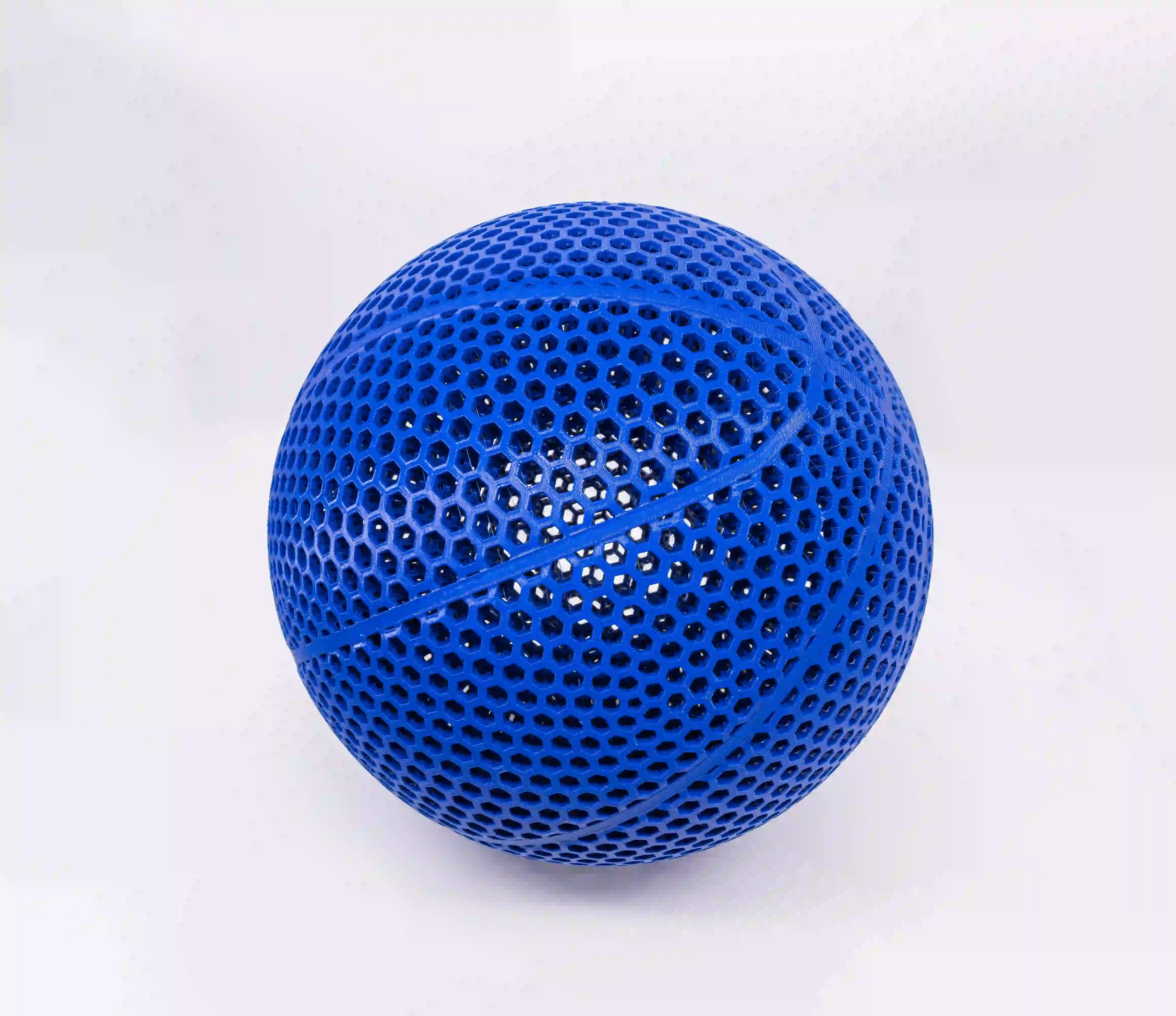
- JLC3DP's Standard PLA (PLA-P) is a popular FDM material starting at $1.00, ideal for precise, highly rigid prototypes.
- Built with ±0.3mm tolerance and a 53℃ HDT, it delivers clean, textured results for non-load-bearing designs.
Understanding PLA Tg, Softening, HDT, and Melting Temperature
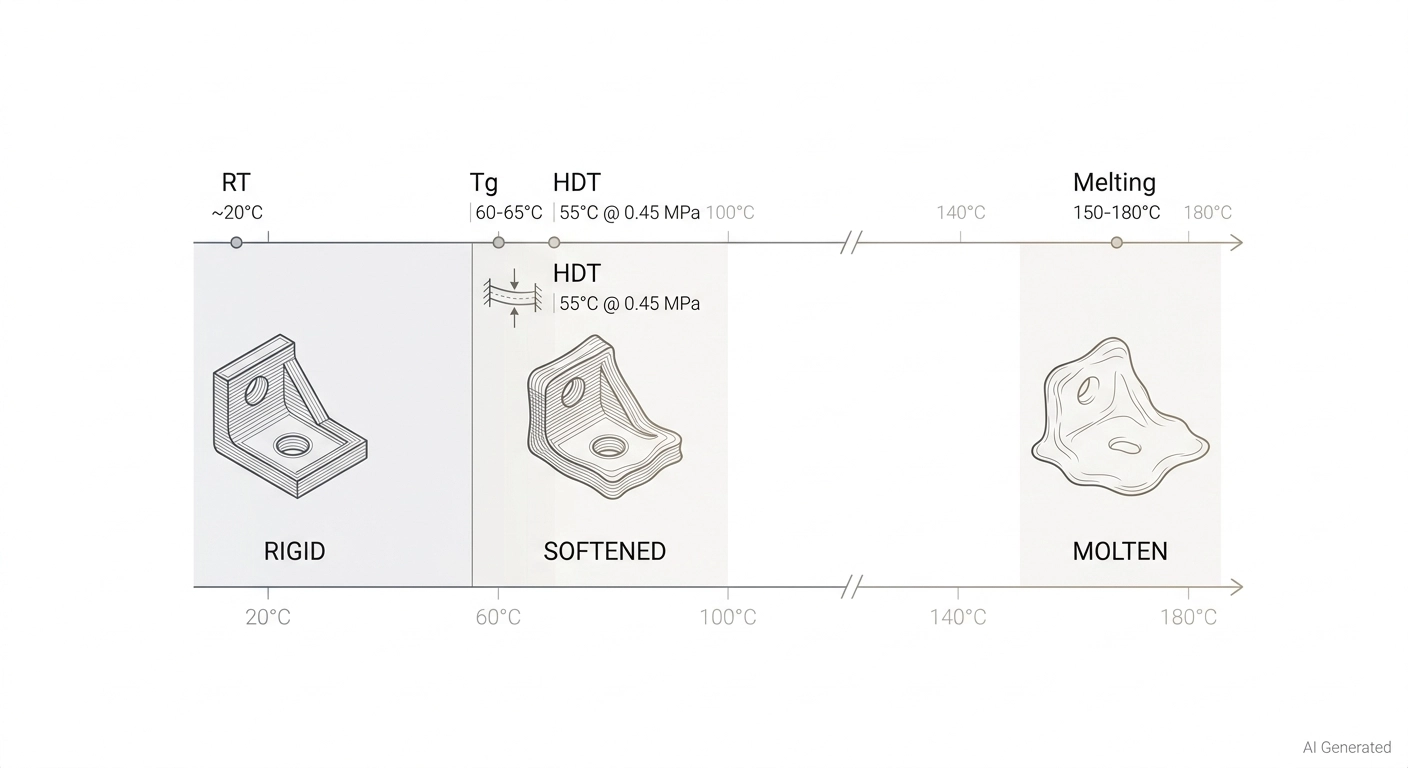
These four terms get used interchangeably all the time, and they shouldn't. They describe different things happening at different temperatures.
Recommended Summary Table
| Property | What It Means | Typical PLA Range |
|---|---|---|
| Tg | Temperature region where PLA begins transitioning from rigid/glassy to softer behavior | ~55–65℃ |
| Softening | Progressive loss of stiffness around and above Tg | Around Tg |
| HDT | Deflection temperature measured under a specified load | ~50–55℃ |
| Melting Temperature | Temperature range associated with PLA melting | ~150–180℃ |
| Thermal Conductivity | How readily PLA conducts heat | ~0.10–0.16 W/m·K |
-
Glass Transition Temperature (Tg)
The glass transition is where PLA shifts from a hard, glassy state to a softer, more rubbery state. For standard PLA, this happens roughly between 55℃ and 65℃. The material doesn't suddenly become liquid, it becomes progressively less rigid. Think of it as the point where PLA starts losing the stiffness you printed it for. Below Tg it holds its shape reasonably well. Above Tg, things start getting uncertain, especially if there's any load applied.
-
Softening
PLA softening temperature is effectively the range starting at Tg where the material becomes noticeably less rigid. This isn't a single temperature, it's a range where stiffness degrades progressively. A part that was dimensionally stable at 50℃ might be visibly deformed after an hour at 65℃ under moderate load. The PLA deformation temperature, when parts actually fail their functional requirements, typically occurs somewhere in this range, not at the melting point.
-
Heat Deflection Temperature (HDT)
HDT is a standardized measurement, a specimen is placed under a specific bending load and the temperature is raised until it deflects 0.25mm. For standard PLA this typically comes in around 50–55℃ depending on the formulation and test parameters. HDT is practically useful because it's a loaded measurement. It tells you something closer to what the material does under real conditions, not just unloaded.
-
What Is the Melting Point of PLA?
Actually, PLA does not have one universal melting point. PLA melts somewhere between 150℃ and 180℃ depending on the specific formulation and crystalline structure.
The important thing to understand: the PLA melting point is essentially irrelevant to the question of how hot your finished part can get in service. By the time PLA reaches anything like 150℃, it's been soft, deformed, and functionally useless for a long time. The gap between where PLA deforms under load (~52–65℃) and where it actually melts (~155–165℃) is nearly 100℃. Everything interesting, and everything that causes real-world failures, happens in that gap.
The relationship looks like this:
Deformation under load (HDT, ~50–55℃) → Softening (Tg, ~55–65℃) → Continued loss of structure → Melting (~150–180℃)
For service-temperature decisions, Tg and HDT are generally more useful than the melting temperature because a printed PLA part can lose functional stiffness long before it melts.
-
Thermal Conductivity of PLA
PLA has relatively low thermal conductivity, typically around 0.10–0.16 W/m·K depending on formulation and test method. PLA has relatively low thermal conductivity compared with metals, so heat transfers through PLA more slowly than through highly conductive materials such as aluminum or copper. However, low thermal conductivity does not mean high heat resistance.
What Temperature Does PLA Deform?
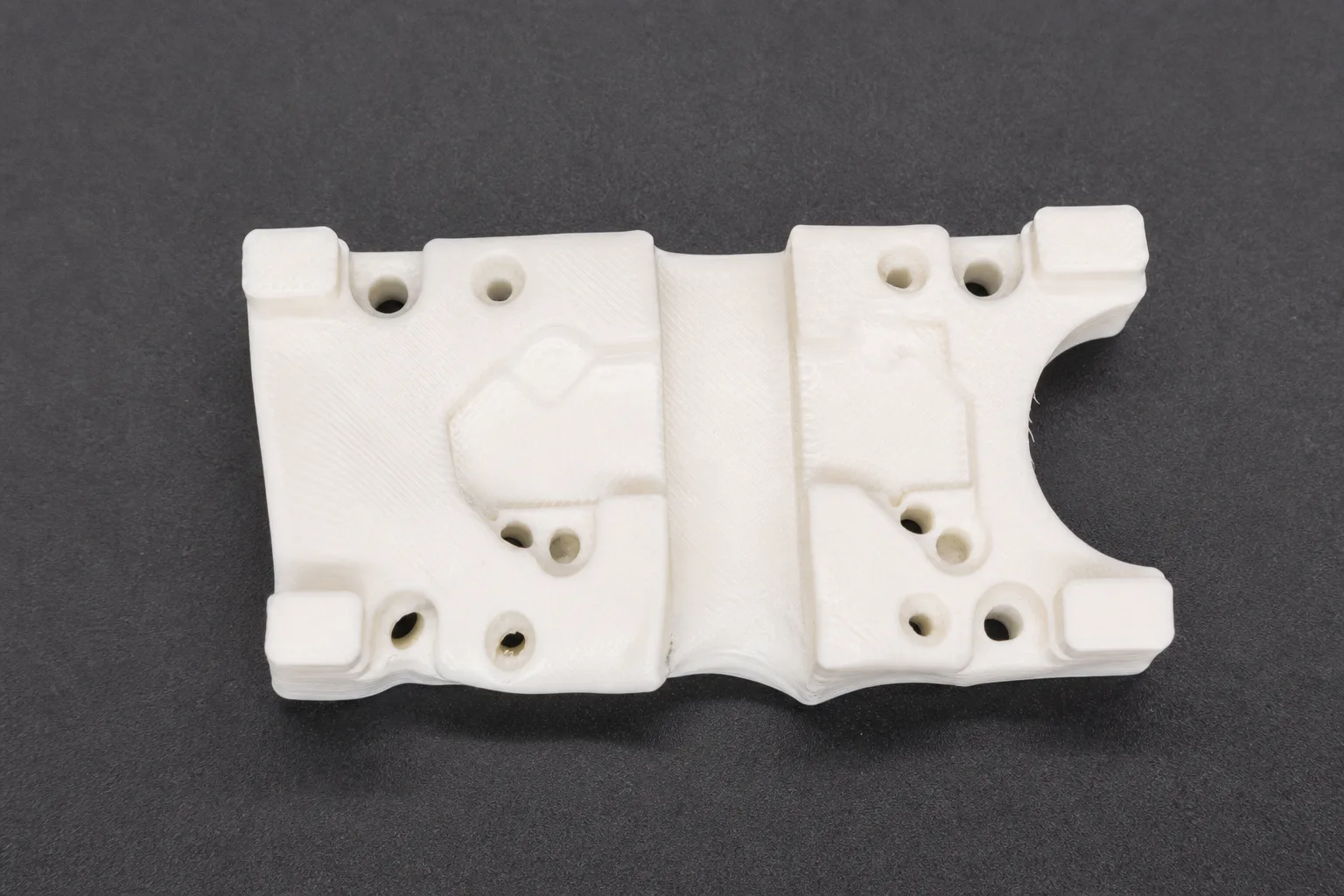
PLA does not have one universal deformation temperature. In many standard PLA formulations, deformation risk begins to increase significantly around 50–65℃, but the actual temperature at which a printed part loses its functional shape depends on load, geometry, wall thickness, print orientation, and exposure time.
This is why a single statement such as “PLA deforms at 60℃” can be misleading. The same PLA material may remain dimensionally stable in one application but deform in another at the same temperature.
1Load and Mechanical Stress
Mechanical load can significantly affect PLA heat resistance. A loaded PLA part may deform at a lower temperature than an unloaded part because heat reduces stiffness while the applied stress remains.
Bending, tensile, and sustained loads are particularly important. Long-term loading can cause creep, which is gradual, permanent deformation under sustained stress. Creep becomes more significant as temperature increases.
2Part Geometry and Wall Thickness
Part geometry affects the structural response of PLA without changing the polymer's intrinsic thermal properties.
Thin walls, long unsupported sections, and large flat surfaces are generally more vulnerable to heat-induced deformation. Thicker walls, shorter spans, and structural features such as ribs can improve stiffness and resistance to deformation.
However, thicker parts do not have a higher Tg or melting point. Geometry changes structural stiffness, not the intrinsic PLA temperature range of the material.
3Print Orientation and Layer Adhesion
FDM parts are anisotropic, so their mechanical behavior varies with print direction. A part loaded across its layer interfaces may behave differently from one loaded primarily along the printed layers.
When heat and mechanical stress occur together, weak layer adhesion can increase the risk of deformation or failure. Print orientation should therefore be considered when designing functional PLA parts for elevated temperatures.
4Infill and Structural Design
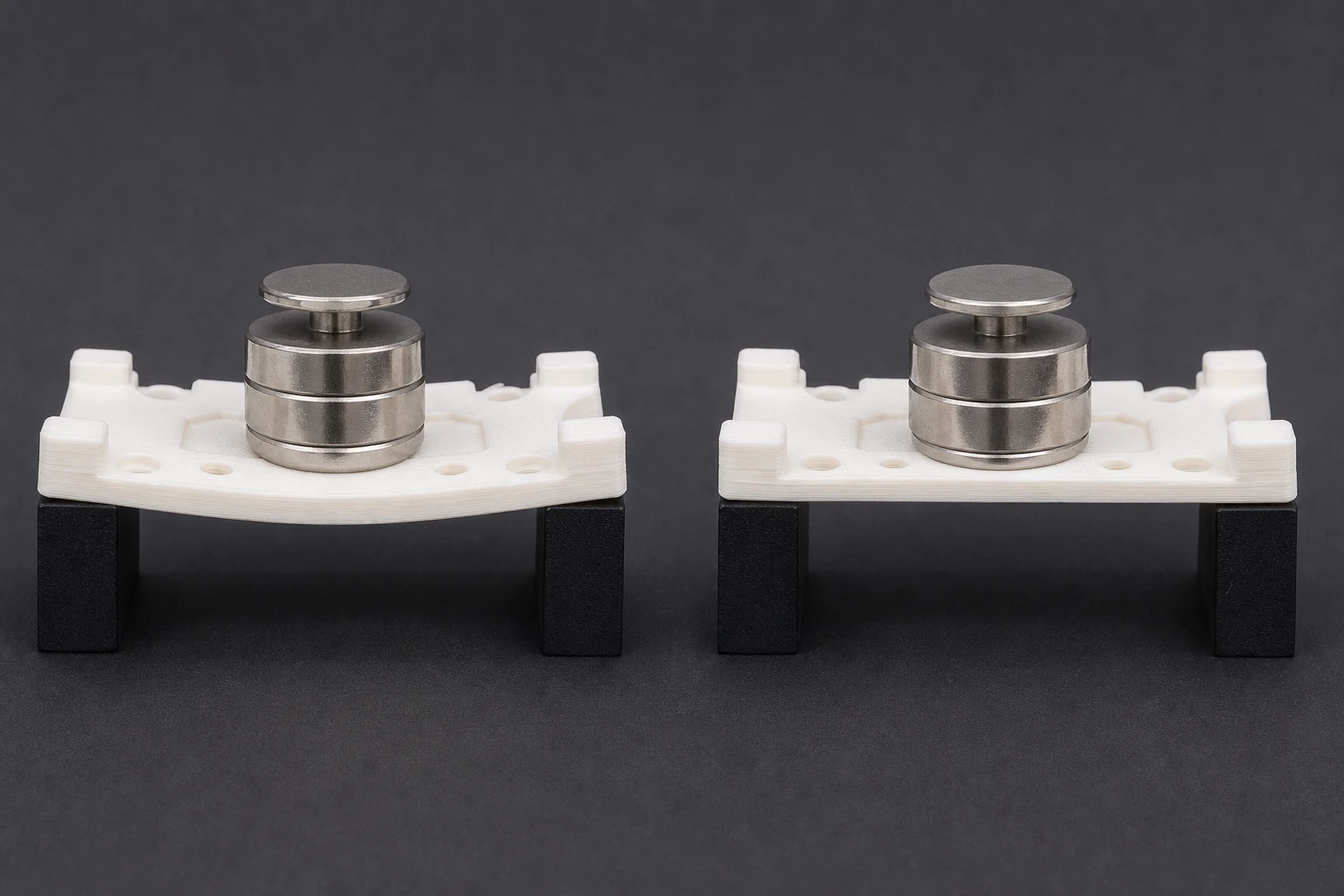
Higher infill and additional walls can increase the structural stiffness of a printed part and may improve its resistance to heat-induced deformation.
However, these parameters do not increase PLA's intrinsic Tg, HDT, or melting point. They change the structural response of the printed part.
In JLC3DP testing: a 60% infill PLA part showed better resistance to heat-induced deformation than a 25% infill part under the same test conditions. It changes the structure of the printed part rather than the thermal properties. This demonstrates how structural design can influence the practical heat resistance of a printed part.
5Exposure Time and Creep
Exposure time also affects PLA temperature resistance. A brief exposure to 60℃ is not equivalent to several hours at the same temperature.
Under sustained heat and load, PLA can gradually creep and lose dimensional accuracy. Therefore, both temperature and exposure duration should be considered when determining whether PLA is suitable for a functional application.
6Why There Is No Single “PLA Deformation Temperature”
The PLA deformation temperature depends on the combination of temperature, mechanical load, geometry, print orientation, and exposure time.
A useful engineering rule is:
Temperature + Load + Time + Geometry → Actual Deformation Risk
For this reason, Tg and HDT should be treated as material reference values rather than guaranteed failure temperatures for every 3D-printed PLA part.
7Why PLA Heat Resistance Varies
PLA heat resistance can vary between formulations and printed parts. Two PLA products may have different Tg, HDT, and deformation behavior, even if both are simply labeled “PLA.”
1. Formulation
Formulation is the biggest variable. Standard PLA, PLA+, high-speed PLA, and specialty blends all have different additive packages that shift Tg, HDT, and deformation behavior.
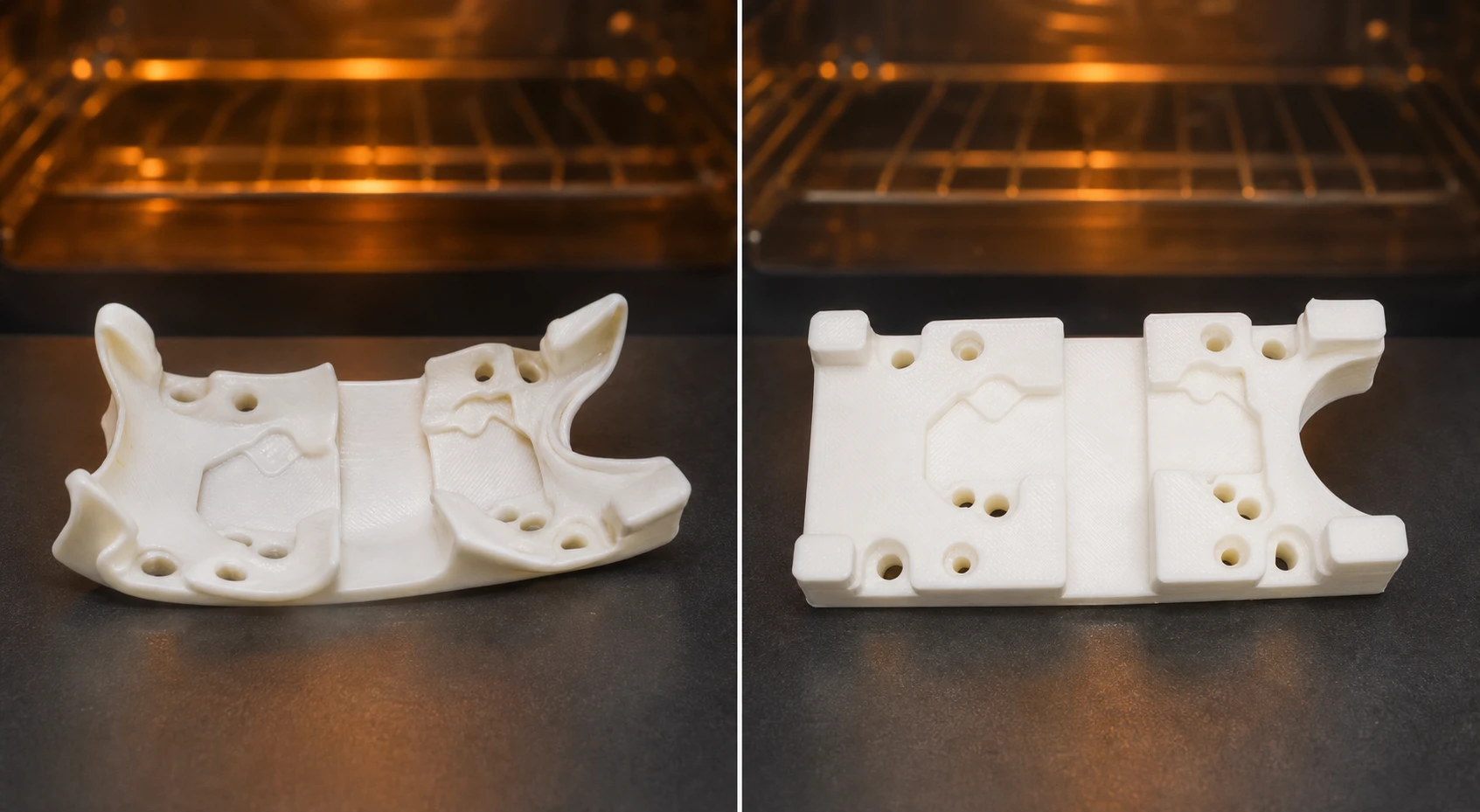
PLA and PLA+ heat resistance comparison
PLA+ heat resistance varies by formulation. PLA+ is not a standardized material grade, so its Tg, HDT, and deformation behavior can differ significantly between manufacturers. Some PLA+ formulations may offer slightly better thermal performance than standard PLA, but the product's technical data should be used rather than assuming that every PLA+ filament has higher heat resistance.
2. Crystallinity and Annealing
Crystallinity can also affect the heat resistance of PLA. Annealing can increase crystallinity in suitable PLA formulations, potentially improving HDT and resistance to heat-induced deformation. However, annealing can also cause dimensional changes or warping, especially when temperature control is uneven or the part has an asymmetric geometry. This means there is no single PLA warping temperature that applies to every part. But, not all PLA grades respond the same way, and dimensional shrinkage can be significant.
| Benefit | Trade-off |
|---|---|
| Higher crystallinity | Dimensional shrinkage |
| Higher thermal stability | Possible warping |
| Potentially higher HDT | Requires formulation-specific validation |
Therefore, PLA temperature resistance should be evaluated based on the specific material formulation and the final printed part—not a single temperature value.
PLA Temperature Resistance vs. Printing Temperature
This distinction is worth being clear about because it confuses a lot of people. When you read "PLA prints at 190–220℃," that's the nozzle temperature, the temperature used to melt and extrude the material during printing. That has nothing to do with how hot the finished part can get in service.
| Temperature Type | What It Actually Means |
|---|---|
| Nozzle temperature | Temperature used to melt PLA during printing (190–220℃) |
| Glass transition (Tg) | Where the finished part starts losing rigidity (~55–65℃) |
| HDT | Temperature at which a loaded specimen deflects measurably (~50–65℃) |
| Service temperature | Maximum temperature the finished part should experience |
| Melting point | Where PLA actually becomes liquid (~150–180℃) |
The nozzle needs to be hot enough to melt the material during printing. The part needs to stay well below that in service. The two numbers describe different things happening at completely different stages of the part's life.
PLA Temperature Resistance at 50℃, 60℃, 70℃, and 80℃
For practical applications, PLA heat resistance is easier to understand by looking at common operating temperatures. The following PLA temperature ranges are general guidance rather than guaranteed failure temperatures. Actual performance depends on load, geometry, wall thickness, print orientation, and exposure time.
| Temperature | General Risk for Standard PLA |
|---|---|
| 40–50℃ | Generally low risk for low-load applications |
| 50–60℃ | Increasing loss of stiffness; evaluate load and exposure time |
| 60–70℃ | High deformation/creep risk, especially under load |
| 70–80℃ | Very high risk of permanent deformation |
| 80℃+ | Generally unsuitable for standard PLA functional parts |
Note: These are engineering guidance ranges, not guaranteed failure temperatures.
1Can PLA Withstand 50℃?
PLA can generally withstand 50℃ in many low-load applications, but this should not be treated as a guaranteed safe limit. Continuous exposure, mechanical stress, part geometry, and dimensional requirements can all affect performance.
For simple covers, decorative parts, and lightly loaded components, 50℃ is generally a manageable temperature range. Parts requiring tight dimensional stability should still be validated under their actual operating conditions.
2Can PLA Withstand 60℃?
PLA may withstand 60℃ in lightly loaded applications, but deformation risk increases significantly because 60℃ is close to or above the Tg of many standard PLA formulations.
At this temperature, a thick, rigid, unloaded part may remain functional, while a thin-walled clip, bracket, or continuously loaded component may begin to deform. Short-term exposure is also less demanding than continuous exposure for several hours.
For applications operating continuously around 60℃, PETG or a higher-temperature material may provide greater thermal margin.
3Can PLA Withstand 70℃?
Standard PLA is generally not recommended for sustained exposure around 70℃, particularly when the part carries a mechanical load.
At this temperature, PLA can experience significant loss of stiffness, increased creep, and permanent deformation. Thin sections, long unsupported spans, and parts under bending or tensile stress are especially vulnerable.
An unloaded or heavily reinforced part may survive a brief exposure, but 70℃ should generally be considered a high-risk range for standard PLA functional parts.
4Can PLA Withstand 80℃?
Standard PLA is generally unsuitable for sustained 80℃ exposure in functional applications. At 80℃, the material is well above its typical glass transition range, and the risk of significant softening, creep, and permanent deformation is high.
Importantly, PLA does not melt at 80℃. The problem is that the material can become too soft to maintain its intended shape or mechanical function long before reaching its PLA melting point, typically around 150–180℃ depending on formulation.
For applications that must continuously withstand 80℃, consider materials with higher thermal performance, such as ABS, ASA, PA12-CF, or PEEK.
The key takeaway is that these temperatures should be treated as risk ranges rather than fixed PLA deformation temperatures. A thick, reinforced, lightly loaded part may remain functional at a temperature where a thin-walled clip under continuous stress fails. When selecting PLA for a heat-exposed application, evaluate temperature together with load, geometry, and exposure time.
Does PLA Deform in a Hot Car or Direct Sunlight?
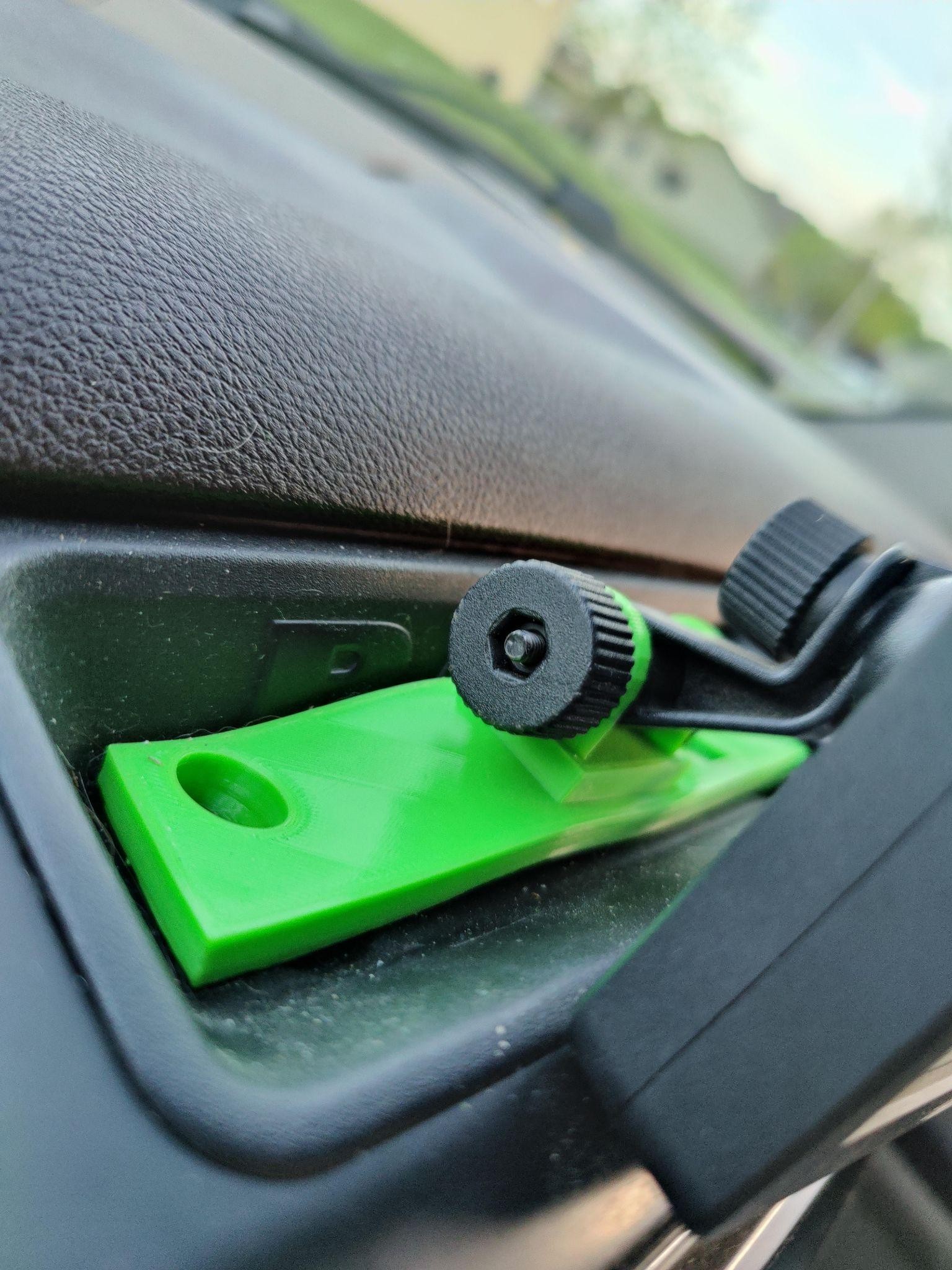
(Reddit) Deformed PLA 3D printed component
Yes. This is one of the most common real-world PLA failures and it's worth understanding why it happens even when the ambient temperature seems fine.
The problem is that ambient temperature and actual part temperature aren't the same thing. A car interior on a summer day doesn't need to be parked in a desert to create problems. In moderate climates, a car parked in direct sunlight can have dashboard temperatures reaching 80–90℃ even when the outside air temperature is only 25–30℃. Dark-colored parts absorb more solar radiation and get hotter than light-colored ones. Parts in enclosed spaces, inside a car, in a dark enclosure, accumulate heat that air-cooled environments would dissipate.
Factors that push actual PLA part temperature above ambient:
Direct sunlight, especially on dark-colored parts, absorbs radiant heat independently of air temperature
Car interiors, particularly dashboard areas and behind glass, trap solar heat dramatically
Enclosed spaces near heat-generating components (motors, electronics, light sources) create sustained elevated temperatures
Black or dark material colors absorb significantly more radiation than white or light parts
So when the question is "will my PLA part survive in a car," the answer depends on where in the car, what color the part is, what time of year, and what load it's carrying. In many cases, standard PLA will deform. If the application is in or near a vehicle, ASA or ABS is worth considering seriously.
Is PLA Suitable for High-Temperature Applications?
Honestly, PLA is excellent for a lot of things. Heat exposure isn't really one of them. It's worth being direct about where it works and where it doesn't.
PLA works well for:
- Visual prototypes and presentation models
- Concept models not intended for functional testing
- Decorative parts and display components
- Room-temperature fixtures and jigs
- Low-load functional parts in controlled indoor environments
- Parts that will never be near a heat source
PLA generally isn't the right choice for:
- Automotive environments, interior, exterior, or near the engine
- Outdoor applications in warm climates or direct sun
- Parts near heat sources (lights, electronics, motors)
- Any application requiring long-term dimensional stability above ~50℃
- Load-bearing parts that will experience even moderate warmth
If your project needs better heat resistance than PLA provides, JLC3DP offers professional 3D printing in ABS, ASA, PA12-CF, and PEEK, materials designed for environments where PLA would fail.
PLA vs. PETG: Which Has Better Heat Resistance?
PETG generally provides greater thermal margin than standard PLA. PETG's glass transition temperature sits roughly 15–20℃ higher than standard PLA's, which in practical terms means PETG parts have more margin before they start going soft in warm environments.
| Property | PLA | PETG |
|---|---|---|
| Glass transition (Tg) | ~55–65℃ | ~75–85℃ |
| Heat resistance | Lower | Higher |
| Softening tendency | Earlier | Later |
| High-temperature suitability | Limited | Better |
| Chemical resistance | Moderate | Better |
| Print difficulty | Easy | Moderate |
PETG isn't a high-temperature engineering material, it has its own limits and it's not suitable for genuinely hot applications either. But the extra headroom compared to PLA makes a real difference for applications that sit in the 60–75℃ range where PLA starts struggling.
For a full comparison of PETG's heat behavior, see our PETG Temperature Resistance Guide.
How to Choose a 3D Printing Material for Heat Resistance
PLA's temperature limitations point toward a broader question: when do you step up to something else, and what do you step up to?
These ranges are starting points for material selection, not guaranteed service-temperature limits. Check the specific material's datasheet and validate the printed part under its actual load and exposure conditions.
| Operating Condition | Starting Point |
|---|---|
| <50℃, low load | PLA |
| <70℃, moderate thermal exposure | PETG |
| ~70–100℃, functional parts | ABS / ASA |
| Higher load + elevated temperature | PA12-CF / PC |
| High-temperature engineering applications | PEEK |
The rough selection logic:
Under 60℃, low load
Standard PLA or PETG handle most applications. PLA for appearance and room-temperature function, PETG if you need a bit more thermal margin or chemical resistance.
60–100℃ range
ABS or ASA for general applications. ASA specifically for outdoor or UV-exposed parts. Nylon or PC for higher load requirements in this range.
Above 100℃ or high-load
PA12-CF, PEEK, or other engineering-grade materials. These require industrial equipment and carry higher per-part cost, but they handle environments where everything else fails.
The specific temperature you need to survive matters less than the combination of temperature, load, geometry, and exposure time. A material that technically has a higher HDT than you need might still fail under the specific load your application applies. Always check the material datasheet for your specific conditions, not just the headline numbers.
For a full comparison of heat-resistant filaments across these ranges, see our Best Heat Resistant 3D Printing Materials Guide.
FAQs About PLA Temperature Resistance
Q: What temperature does PLA soften at?
PLA begins softening around its glass transition temperature, typically 55–65℃ for standard formulations. This is where the material starts losing rigidity, not melting, just going progressively softer. The actual PLA softening temperature in a real part depends on the load applied, the geometry, and how long it's exposed.
Q: What temperature does PLA deform at?
PLA deformation often in the 50–55℃ range under load, which aligns with its heat deflection temperature. This varies significantly with load magnitude, part geometry, wall thickness, and exposure duration. It's not a fixed number, it's a risk range that gets worse the more of those factors stack up.
Q: What is the melting point of PLA?
Standard PLA melts between roughly 150℃ and 180℃ depending on the formulation. This is the nozzle temperature range used during printing, not a useful service temperature limit, PLA parts fail functionally at much lower temperatures due to softening long before anything melts.
Q: Is PLA more heat resistant than PETG?
No. PETG has a higher glass transition temperature (~75–85℃ vs ~55–65℃ for PLA) and better heat resistance overall. For applications where PLA's temperature limits are a concern, PETG is the natural next step up.
Final Thoughts: PLA Is Easy to Print, but Not a High-Temperature Material
If your application requires sustained exposure above ~50–60℃, especially under mechanical load, PLA may not provide enough thermal stability. Consider PETG for moderate temperatures, or ABS, ASA, PA12-CF, PEEK, and other engineering materials for more demanding environments.

- Starting From $0.3 per part · No Minimum Order Quantity
- 24-Hour Lead Time · Up to $123 Welcome Coupons
Keep Learning
ABS Temperature Resistance: How Hot Can ABS Withstand?
Key Takeaways ABS heat resistance is defined by Tg and HDT, not melting point. Typical ABS grades have a Tg around 100–110℃ and HDT around 85–95℃. JLC3DP ABS reaches 98°C HDT under its published test conditions, but actual part performance depends on load, geometry, orientation, and exposure time. ABS offers higher heat resistance than PLA and PETG, while ASA provides similar heat performance with better outdoor durability. PC-ABS and PC are options when ABS is not enough. PC-ABS balances heat resista......
Is PETG Toxic to Print? Fumes, Risks & Safety Guide
Key Takeaways PETG is generally considered a lower-emission 3D printing material compared to ABS and ASA, but it does produce VOCs and ultrafine particles during printing. The odor during PETG printing is typically mild, some people barely notice it, others describe a faint warm-plastic smell. Low odor doesn't mean zero emissions. Ventilation is still a sensible precaution. PETG food safety is complicated, the material itself may be food-grade in some formulations, but the printing process introduces ......
Top 5 Heat-Resistant 3D Printing Filaments Compared
When Regular Filament Just Doesn’t Cut It You’ve 3D printed a functional bracket for a car engine bay. It fits perfectly, looks great, and then warps into a banana-shape after a week under the hood. That’s the danger of underestimating heat. If you're building automotive components, enclosures near motors, molds, or even kitchenware, using the wrong filament can lead to deformation, brittleness, or outright failure when exposed to heat. So, you already know the solution: Choosing the right heat-resist......
PLA Temperature Resistance: Heat Resistance, Softening & Melting Point
Key Takeaways PLA typically starts losing rigidity around 55–65℃ (Tg) and melts at approximately 150–180℃. PLA can deform and creep long before it melts, so melting point is not a practical service-temperature limit. Actual PLA deformation depends on temperature, load, geometry, print orientation, and exposure time. Standard PLA becomes increasingly risky above 50–60℃ and is generally unsuitable for sustained 70–80℃ applications. PLA+ heat resistance varies by formulation. For higher-temperature appli......
PETG Temperature Resistance: Limits & Comparison with PLA/ABS/ASA
Key Takeaways Standard PETG is best suited for continuous use below ~60℃; performance can decline as temperatures approach 70℃. PETG typically has a Tg of ~75–85℃ and an HDT of ~65–75℃, depending on the material grade and test conditions. HDT is not a maximum service temperature—load, print orientation, wall thickness, geometry, and exposure time all affect real-world performance. PETG offers better heat resistance than PLA but lower heat resistance than ABS, ASA, PA12-CF, PC, and PEEK. For sustained ......
How to Print TPU Filament: Settings and Troubleshooting
Key Takeaways TPU is printable on ordinary FDM hardware. The material bends instead of breaking, but it punishes settings tuned for PLA — four changes (print slowly, print dry, retract gently, keep the filament path short) turn it into a routine material. Difficulty tracks Shore hardness. A 95A TPU prints readily on most FDM machines; 85A and softer grades demand a direct drive extruder and patience. TPU print settings start around a 210–230°C nozzle, 20–40mm/s speed, and minimal retraction — the full......