Why Use PEEK 3D Printing? Benefits, Applications & Challenges
15 min
- What Is PEEK 3D Printing?
- Why PEEK Is Used in Industrial 3D Printing
- Key Benefits of PEEK Additive Manufacturing
- Challenges of 3D Printing PEEK Materials
- Engineering Applications of PEEK 3D Printed Parts
- When to Choose PEEK Over Other Plastics
- FAQ about PEEK Additive Manufacturing
- Conclusion about PEEK Additive Manufacturing
Most engineering materials get chosen because they're available, familiar, or cheap.
PEEK gets chosen because nothing else works. When an engineer specifies PEEK 3D printing, it's almost always because the part needs to survive conditions that would disqualify every other plastic on the shortlist, sustained heat above 200℃, aggressive chemicals, sterilization cycles, or mechanical loads that other polymers handle poorly over time.
PEEK 3D printed parts aren't “prototype outputs”. They're functional end-use components in aerospace brackets, surgical instruments, automotive thermal systems, and industrial equipment where the material's performance isn't a premium, it's a requirement.
JLC3DP provides a professional PEEK 3D printing service for engineering prototypes and end-use parts. Few 3D printing providers currently offer reliable PEEK printing, making JLC3DP a trusted choice for high-performance applications.

What Is PEEK 3D Printing?
PEEK 3D printing is the additive manufacturing of functional parts using Polyether Ether Ketone, a semi-crystalline, high-performance thermoplastic, on industrial FDM systems capable of maintaining the processing temperatures PEEK requires throughout the full build.
According to Victrex, PEEK retains mechanical properties at temperatures where many engineering plastics lose dimensional stability, making it one of the most widely specified high-performance polymers for aerospace, medical, and industrial applications. PEEK 3D printing leverages these properties to produce parts requiring heat resistance, chemical resistance, and mechanical strength.
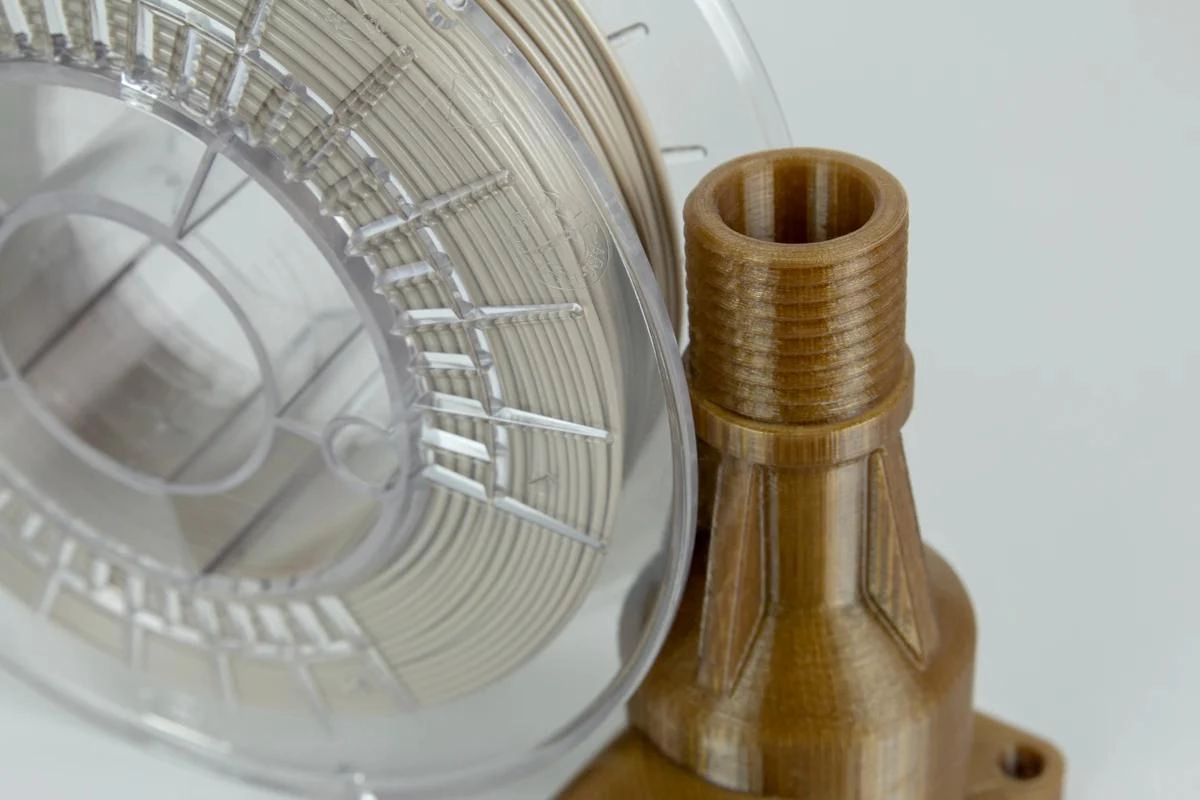
Can you 3D print PEEK? Yes, but not on desktop equipment.
PEEK requires nozzle temperatures of 360-400°C, a heated chamber at 100-160°C, and a heated bed at 120-160°C.
Standard consumer FDM printers don't reach these temperatures. Industrial high-temperature FDM systems, Stratasys Fortus, Apium P-Series, AON3D, Intamsys FUNMAT HT, are the equipment class that makes PEEK 3D printing viable.
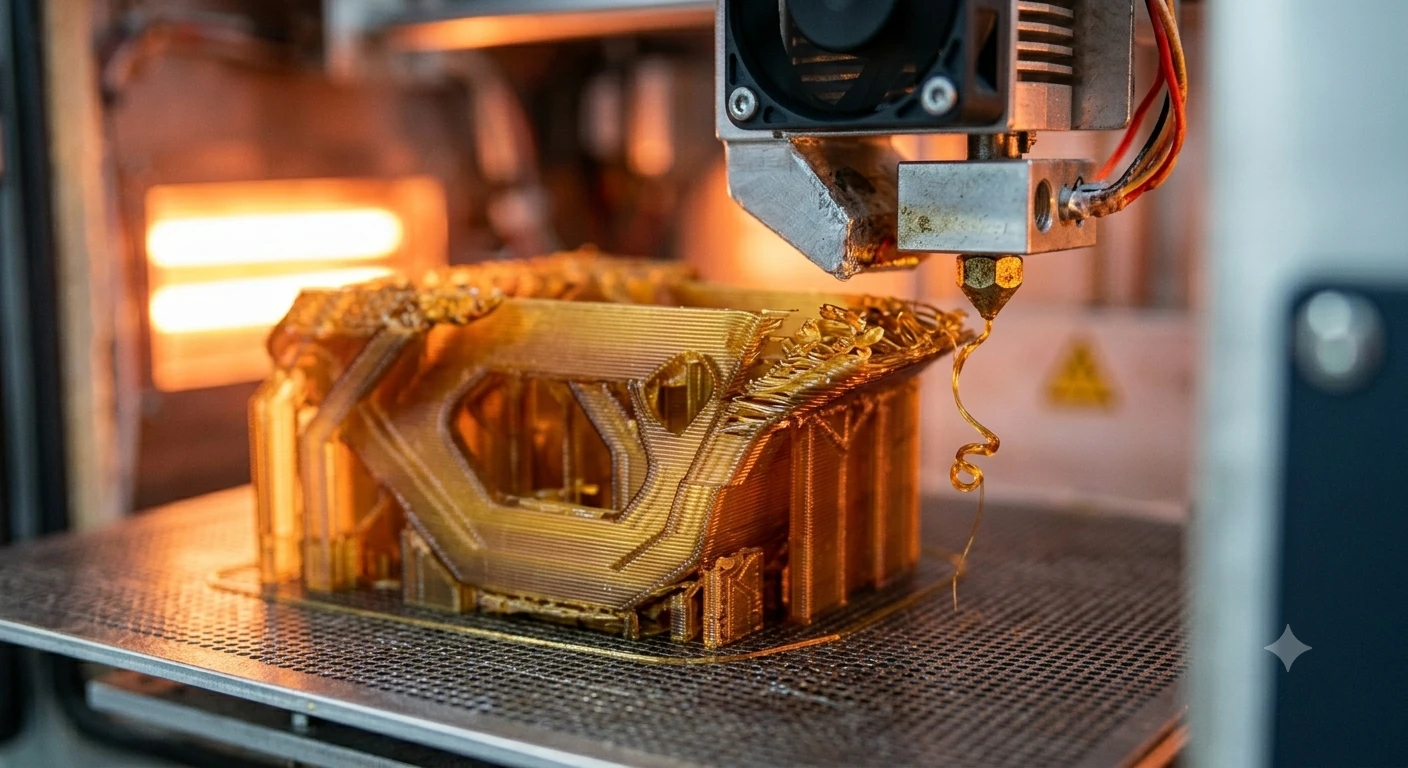
What separates PEEK additive manufacturing from simply selecting a strong material is that printing enables geometries that machining PEEK can't efficiently produce, internal cooling channels, topology-optimized cross-sections, consolidated assemblies, and complex shapes that would require multiple machined components to replicate. The process and the material work together to produce functional parts that neither could achieve as effectively alone.
PEEK Properties Table
| Property | Why It Matters |
|---|---|
| 73 MPa Tensile Strength | Supports functional load-bearing parts |
| 343°C Melting Point | Enables high-temperature applications |
| UL94 V0 Rating | Suitable for demanding industrial environments |
| Low Water Absorption | Improves dimensional stability |
The values above are based on JLC3DP's PEEK printing material. Actual performance may vary depending on part geometry, print orientation, and post-processing conditions.
These PEEK Plastics properties explain why PEEK is widely used in aerospace, medical, and industrial applications.
Why PEEK Is Used in Industrial 3D Printing
The question isn't what PEEK's properties are, it's when those properties matter enough to justify the cost and processing complexity. Engineers reach for PEEK 3D printing in three engineering scenarios.
Lightweight Functional Parts Where Metal Is Over-Specified
PEEK's specific strength, strength relative to density, makes it a genuine metal replacement in components that carry mechanical load but don't need metal's thermal conductivity, electromagnetic properties, or extreme structural capacity. An aerospace bracket that holds electronic equipment, a medical instrument handle that needs rigidity and sterilizability, an automotive sensor housing operating near engine heat, these are applications where aluminum or steel is overengineered and standard plastics are underperforming. PEEK 3D printed parts fill the gap.
Sustained High-Temperature Operating Conditions
Solvay reports that PEEK maintains mechanical properties up to 250°C continuous service temperature. For parts in engine bays, near industrial heating systems, in sterilization autoclaves, or in aerospace thermal environments, this sustained stability is what makes PEEK the engineering decision rather than a preference. Materials that perform adequately at room temperature but creep, soften, or lose dimensional stability at elevated temperature create system failures that appear weeks or months after installation. PEEK doesn't.
Prolonged Chemical Exposure in Industrial Environments
Fuels, hydraulic fluids, industrial solvents, cleaning agents, and process chemicals attack most engineering polymers over time, surface degradation, swelling, loss of mechanical properties. PEEK resists this class of chemical exposure reliably over long service lives. For parts that see chemical contact in automotive systems, chemical processing equipment, or medical environments with aggressive sterilization chemistry, PEEK 3D printing produces components that don't require periodic replacement due to chemical degradation.
Get PEEK 3D printed parts engineered for your application. JLC3DP offers professional PEEK printing with process parameters optimized for mechanical performance. Explore JLC3DP PEEK Plastic 3D Printing.

- Excellent thermal and chemical resistance for harsh environments
- Strong, lightweight parts for industrial and functional use
Key Benefits of PEEK Additive Manufacturing
The decision to use additive manufacturing for PEEK parts, rather than CNC machining, which is also viable, comes from what printing enables that machining doesn't.
Design Freedom for Performance-Optimized Geometry
Machining PEEK produces accurate, high-quality parts, but it produces them from the outside in, removing material until the shape emerges. This constrains geometry to what a cutting tool can reach. PEEK 3D printing builds from the inside out, which enables internal cooling or fluid channels that can't be drilled, topology-optimized cross-sections that remove material from low-stress regions while reinforcing high-stress ones, and lattice structures that achieve stiffness targets at reduced mass. For functional engineering components where geometry serves performance rather than just form, additive manufacturing produces designs that machining physically cannot.
Part Consolidation and Assembly Reduction
A surgical instrument assembly that previously required five machined PEEK components, three titanium fasteners, and 40 minutes of assembly time can often be redesigned as a single PEEK 3D printed part. Consolidation matters in engineering applications for reasons beyond cost, every interface between components is a potential failure point, a source of dimensional variation, and a maintenance requirement. Reducing component count through PEEK additive manufacturing improves system reliability alongside reducing assembly cost and time.
Production-Ready Parts at Low-to-Medium Volume
PEEK machining is cost-effective at low quantities because no tooling is required. PEEK 3D printing is cost-effective at the same volumes and extends to geometries where machining cost would be prohibitive. For functional prototypes that need to behave exactly like production parts, bridge production before full manufacturing investment is committed, and specialized components with genuine low annual demand, PEEK additive manufacturing produces end-use quality without tooling capital.
Advanced Reinforced Grades (CF-PEEK)
For applications requiring additional stiffness, dimensional stability, or reduced warping, carbon fiber reinforced PEEK (CF-PEEK) 3d printing provides an enhanced solution. Compared to standard PEEK, CF-PEEK delivers:
- Higher stiffness – increased rigidity under mechanical load
- Better dimensional stability – less deformation during printing and in service
- Reduced warping – improved consistency for large-format prints
- Improved strength-to-weight ratio – superior performance without significant added mass
Limitations: CF-PEEK is more brittle than unfilled PEEK, incurs higher material costs, and can reduce interlayer adhesion if printing parameters aren’t optimized.
Typical Applications include aerospace brackets, UAV structures, industrial fixtures, and robotic arms, where precision, stiffness, and thermal stability are critical.
Challenges of 3D Printing PEEK Materials
PEEK 3D printing isn't difficult because of the material, it's difficult because the processing requirements expose every weakness in the equipment, environment, and process planning. These are the constraints that determine whether PEEK additive manufacturing produces reliable parts or expensive failures.
Warping During Large-Format Printing
PEEK's high processing temperature combined with its semi-crystalline structure creates significant thermal gradients as large parts cool. The outer surfaces cool faster than the core, which creates differential shrinkage, parts warp, lift from the bed, and lose dimensional accuracy in ways that don't show up until the build is complete.
For large PEEK 3D printed parts, housings, structural components, thick cross-sections, this warping risk reduces production yield and increases post-processing cost. Controlled-environment printing chambers that maintain elevated ambient temperature throughout the build are essential for large PEEK parts, not optional.
High Processing Temperature Requirements
PEEK 3D printing temperature requirements, 360-400°C at the nozzle, 120-160°C chamber, 120-160°C bed, put it outside the capability of all standard and prosumer FDM equipment. Industrial high-temperature systems cost $20,000-150,000 depending on build volume and capability.
This equipment investment either requires in-house commitment at volumes that justify it or access to specialist PEEK printing services. The temperature requirements also mean that PEEK printing is harder to iterate on quickly, process adjustments, test prints, and parameter tuning all require industrial machine time rather than desktop printer experimentation.
Layer Adhesion Sensitivity in Thick and Structural Parts
PEEK 3D printing produces inter-layer bond strength that approaches bulk material properties when process parameters are optimized. When they're not, when chamber temperature drifts, when print speed is too high, when cooling is inconsistent, layer adhesion degrades and parts fail at inter-layer boundaries under mechanical or thermal stress.
For structural PEEK 3D printed parts used in load-bearing applications, this sensitivity means process control isn't a quality preference, it's what separates a functional part from a part that looks correct and fails in service. Fatigue loading is particularly sensitive to interlayer adhesion quality, which is why PEEK 3D printing for cyclic load applications requires validated process parameters rather than first-principles estimation.
Engineering Applications of PEEK 3D Printed Parts
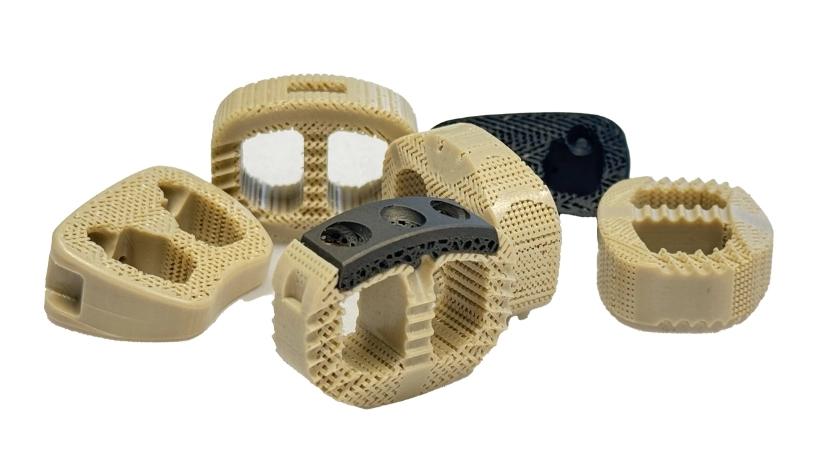
(source: odtmag)
Aerospace Lightweight Brackets and Interior Components
Aerospace applications select PEEK 3D printing when weight reduction, thermal stability, and flame, smoke, and toxicity (FST) performance need to coexist in a single part. Brackets for avionics mounting, interior structural panels, cable management components, and fluid system housings are produced in PEEK where aluminum would be overweight and standard engineering plastics wouldn't survive the thermal environment.
The ability to topology-optimize a PEEK aerospace bracket through additive manufacturing, removing material from low-stress regions while maintaining structural performance, compounds the weight savings beyond what the material density difference alone provides.
Medical Sterilizable Surgical Tooling and Implants
PEEK's biocompatibility, autoclave sterilization resistance (134°C steam), and radiolucency make it the dominant engineering polymer in medical device applications. PEEK 3D printed surgical guides, instrument handles, and patient-specific cutting guides survive repeated sterilization cycles that would degrade less stable materials.
Research and emerging medical applications include 3D printed PEEK spinal cages and patient-specific implants, spinal interbody fusion devices printed in PEEK provide bone-like modulus that reduces stress shielding compared to titanium alternatives, while additive manufacturing enables porosity structures that support bone ingrowth in ways machined solid PEEK cannot. Industry studies have shown that the combination of material biocompatibility and geometric capability from printing is what drives PEEK additive manufacturing in medical device development.
Automotive High-Heat Functional Parts
Engine-adjacent components, sensor housings, fluid connectors, thermal management components, under-hood brackets, require materials that maintain dimensional and mechanical stability at temperatures that reach 150-200°C in sustained operation. PEEK 3D printing produces these components without the tooling investment of injection molding, which matters for model-year-specific components, performance applications with low volumes, and development programs where the design is still being validated. The chemical resistance of PEEK against fuels, oils, and coolants in automotive environments extends service life for components that would require periodic replacement in less resistant materials.
Industrial and Semiconductor Equipment
Semiconductor fabrication equipment operates with aggressive process chemicals and requires materials with minimal outgassing that won't contaminate ultra-clean processes. PEEK's chemical resistance and low outgassing characteristics make it the material of choice for wafer handling components, equipment fixtures, and fluid handling parts in semiconductor manufacturing.
Custom PEEK 3D printed parts for this application avoid the lead times and minimum order quantities of machined PEEK components, enabling faster equipment development and maintenance part production.
When to Choose PEEK Over Other Plastics
PEEK is the right engineering choice in a specific operating window. Outside that window, specifying PEEK is over-engineering, paying a material and processing premium that the application doesn't require.
PEEK vs High-Temperature Alternatives
PEI (Ultem) handles temperatures to 170°C and is easier to print than PEEK. For applications under 170°C where chemical resistance to fuels and hydraulic fluids isn't a requirement, PEI is the more practical choice, better printability, lower cost, still genuinely high-performance. PEI loses to PEEK when sustained temperatures exceed 170°C or when chemical exposure includes the solvents that attack PEI.
PPS handles aggressive chemical environments and high temperatures reasonably well, but its mechanical performance, tensile strength, impact resistance, fatigue life, falls below PEEK in demanding structural applications. For applications that are primarily chemical resistance problems with modest mechanical requirements, PPS may be adequate. For applications where both matter simultaneously, PEEK's combination is difficult to match.
Nylon (PA12, PA6) is the right choice for a vast range of functional 3D printed parts, it's tough, machinable, printable, and available in dozens of variants including glass-filled and carbon-filled grades. Nylon reaches its limit at sustained temperatures above 100-120°C and in environments with strong acids, strong bases, or specific organic solvents. Below those conditions, specifying PEEK over nylon is rarely justifiable on engineering grounds.
The Decision Framework
PEEK 3D printing is the correct specification when the operating temperature exceeds 150°C sustained, when chemical exposure includes substances that attack PEI or nylon, when mechanical performance under load and thermal stress must both be maintained long-term, and when geometry complexity or low volume makes machining impractical or expensive.
When any of these conditions isn't present, evaluate PEI, PPS, or filled nylon before defaulting to PEEK. The cost and processing complexity of PEEK 3D printing is justified by genuine material necessity, not by material ambition.
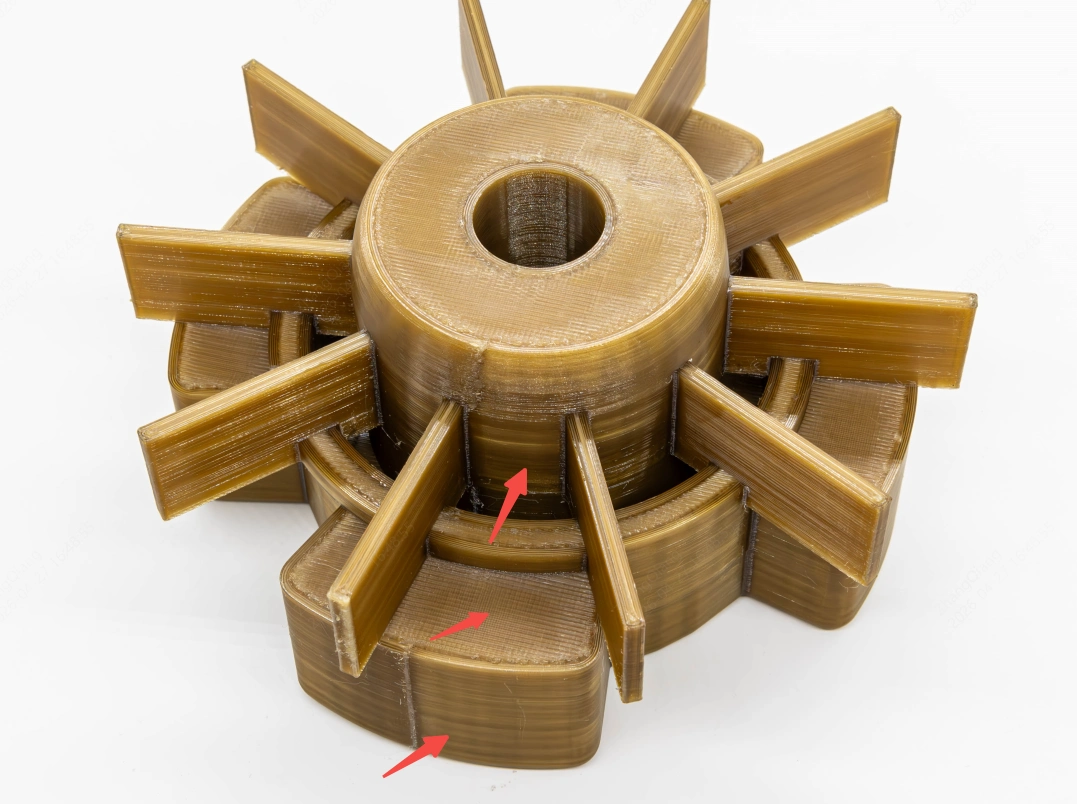
A peek functional parts from JLC3DP
FAQ about PEEK Additive Manufacturing
Q: What is PEEK 3D printing?
PEEK 3D printing is the additive manufacturing of functional parts from Polyether Ether Ketone, a high-performance semi-crystalline thermoplastic, using industrial FDM systems that maintain the sustained high temperatures PEEK requires for processing.
Q: Can you 3D print PEEK with a normal 3D printer?
No. Standard desktop FDM printers cannot reach the nozzle temperatures of 360-400°C or the heated chamber temperatures of 120-160°C that PEEK 3D printing requires.
Q: What 3D printer can print PEEK?
Industrial FDM systems designed for high-temperature materials handle PEEK 3D printing, Stratasys Fortus 450mc, Apium P-Series, AON3D AON M2+, Intamsys FUNMAT HT, and Roboze One+400 are the established options. The critical requirements are nozzle capability above 400℃, heated build chamber to at least 150℃, and heated bed above 120℃.
Q: What is the PEEK 3D printing temperature?
PEEK 3D printing temperature runs 360-400°C at the nozzle depending on the specific PEEK formulation and printer. Bed temperature runs 120-160°C. Chamber temperature, critical for preventing warping and maintaining layer adhesion, runs 100-160°C.
Q: Is PEEK filament suitable for desktop printers?
No. PEEK filament is available from multiple suppliers in 1.75mm and 2.85mm formats, but the filament format doesn't make it compatible with desktop hardware. The limitation is temperature capability of the printer, not the filament form factor.
Q: What is carbon fiber PEEK 3D printing used for?
Carbon PEEK 3D printing, PEEK with short carbon fiber reinforcement, increases stiffness and tensile strength while reducing weight further compared to unfilled PEEK. It's used in aerospace structural components where maximum specific stiffness matters, in high-performance industrial applications where deflection under load must be minimized, and in components where the additional strength of carbon reinforcement justifies the higher material cost and reduced toughness compared to unfilled PEEK. The carbon fiber content also improves dimensional stability during printing, which benefits large-format PEEK 3D printing applications.
Q: Where can I get a PEEK 3D printing service?
JLC3DP provides professional PEEK 3D printing service with process parameters validated for mechanical performance rather than just geometric accuracy. Industrial equipment, engineering review before production, and material capability documentation are included. PEEK plastic 3D printing is available for functional prototypes, bridge production, and end-use engineering components across medical, aerospace, industrial, and automotive applications.
Conclusion about PEEK Additive Manufacturing
PEEK 3D printing occupies a specific and well-defined position in the engineering materials hierarchy. It isn't the default choice for functional 3D printed parts, and it doesn't need to be, PEI, PPS, and high-performance nylon grades cover a substantial range of demanding applications at lower cost and with easier processing. But when the application genuinely sits at the intersection of sustained high temperature, mechanical performance under load, and chemical resistance in harsh environments, PEEK is not over-engineering. It's the correct answer.
What additive manufacturing adds to PEEK is geometric freedom that machining can't match at equivalent cost, consolidated assemblies, internal features, topology-optimized structures, and custom geometries produced without tooling investment. The combination makes PEEK 3D printed parts a practical production solution, not just an engineering curiosity, for the applications that genuinely need what the material provides.
For engineers evaluating PEEK for a specific application, the decision framework is straightforward: if the operating conditions are within the performance envelope of a less demanding material, use that material. If they're not, PEEK additive manufacturing produces the part the application requires.
Get Your PEEK 3D Printing Project Started at JLC3DP by Uploading a File.

Keep Learning
PLA vs PETG vs ASA: Best 3D Printing Filament for Outdoor Use
If you've ever watched a 3D printed garden hook sag in the sun or a cold snap crack your custom outdoor fixture, you already know: not all filaments are built for the elements. Choosing the best 3D printing filament for outdoor use isn't just about surviving the occasional drizzle. It's about UV exposure, temperature swings, moisture resistance, and long-term strength. And let's be real, most people don't want to reprint every few months just because they picked the wrong plastic. In this guide, we'll......
ABS Temperature Resistance: How Hot Can ABS Withstand?
Key Takeaways ABS heat resistance is defined by Tg and HDT, not melting point. Typical ABS grades have a Tg around 100–110℃ and HDT around 85–95℃. JLC3DP ABS reaches 98°C HDT under its published test conditions, but actual part performance depends on load, geometry, orientation, and exposure time. ABS offers higher heat resistance than PLA and PETG, while ASA provides similar heat performance with better outdoor durability. PC-ABS and PC are options when ABS is not enough. PC-ABS balances heat resista......
Is PETG Toxic to Print? Fumes, Risks & Safety Guide
Key Takeaways PETG is generally considered a lower-emission 3D printing material compared to ABS and ASA, but it does produce VOCs and ultrafine particles during printing. The odor during PETG printing is typically mild, some people barely notice it, others describe a faint warm-plastic smell. Low odor doesn't mean zero emissions. Ventilation is still a sensible precaution. PETG food safety is complicated, the material itself may be food-grade in some formulations, but the printing process introduces ......
Top 5 Heat-Resistant 3D Printing Filaments Compared
When Regular Filament Just Doesn’t Cut It You’ve 3D printed a functional bracket for a car engine bay. It fits perfectly, looks great, and then warps into a banana-shape after a week under the hood. That’s the danger of underestimating heat. If you're building automotive components, enclosures near motors, molds, or even kitchenware, using the wrong filament can lead to deformation, brittleness, or outright failure when exposed to heat. So, you already know the solution: Choosing the right heat-resist......
PLA Temperature Resistance: Heat Resistance, Softening & Melting Point
Key Takeaways PLA typically starts losing rigidity around 55–65℃ (Tg) and melts at approximately 150–180℃. PLA can deform and creep long before it melts, so melting point is not a practical service-temperature limit. Actual PLA deformation depends on temperature, load, geometry, print orientation, and exposure time. Standard PLA becomes increasingly risky above 50–60℃ and is generally unsuitable for sustained 70–80℃ applications. PLA+ heat resistance varies by formulation. For higher-temperature appli......
PETG Temperature Resistance: Limits & Comparison with PLA/ABS/ASA
Key Takeaways Standard PETG is best suited for continuous use below ~60℃; performance can decline as temperatures approach 70℃. PETG typically has a Tg of ~75–85℃ and an HDT of ~65–75℃, depending on the material grade and test conditions. HDT is not a maximum service temperature—load, print orientation, wall thickness, geometry, and exposure time all affect real-world performance. PETG offers better heat resistance than PLA but lower heat resistance than ABS, ASA, PA12-CF, PC, and PEEK. For sustained ......