Rapid Prototyping Cost: How Much Does a Prototype Cost?
19 min
- What Affects Rapid Prototyping Cost?
- Which Manufacturing Process Is Most Cost-Effective?
- How Do Materials Affect Prototype Cost?
- How Does Quantity Affect Prototype Pricing?
- How Can You Reduce Rapid Prototyping Cost?
- Typical Prototype Cost Comparison
- When Is 3D Printing More Cost-Effective Than CNC Machining?
- Common Cost Estimation Mistakes
- Making Smarter Rapid Prototyping Cost Decisions
- FAQ about Rapid Prototyping Cost
While rapid prototyping can be produced through multiple manufacturing methods, 3D printing is one of the most widely used approaches for fast design validation and functional prototype development. Learn more about rapid prototyping with 3D printing, including technologies, materials, and applications in our rapid prototyping with 3D printing guide.
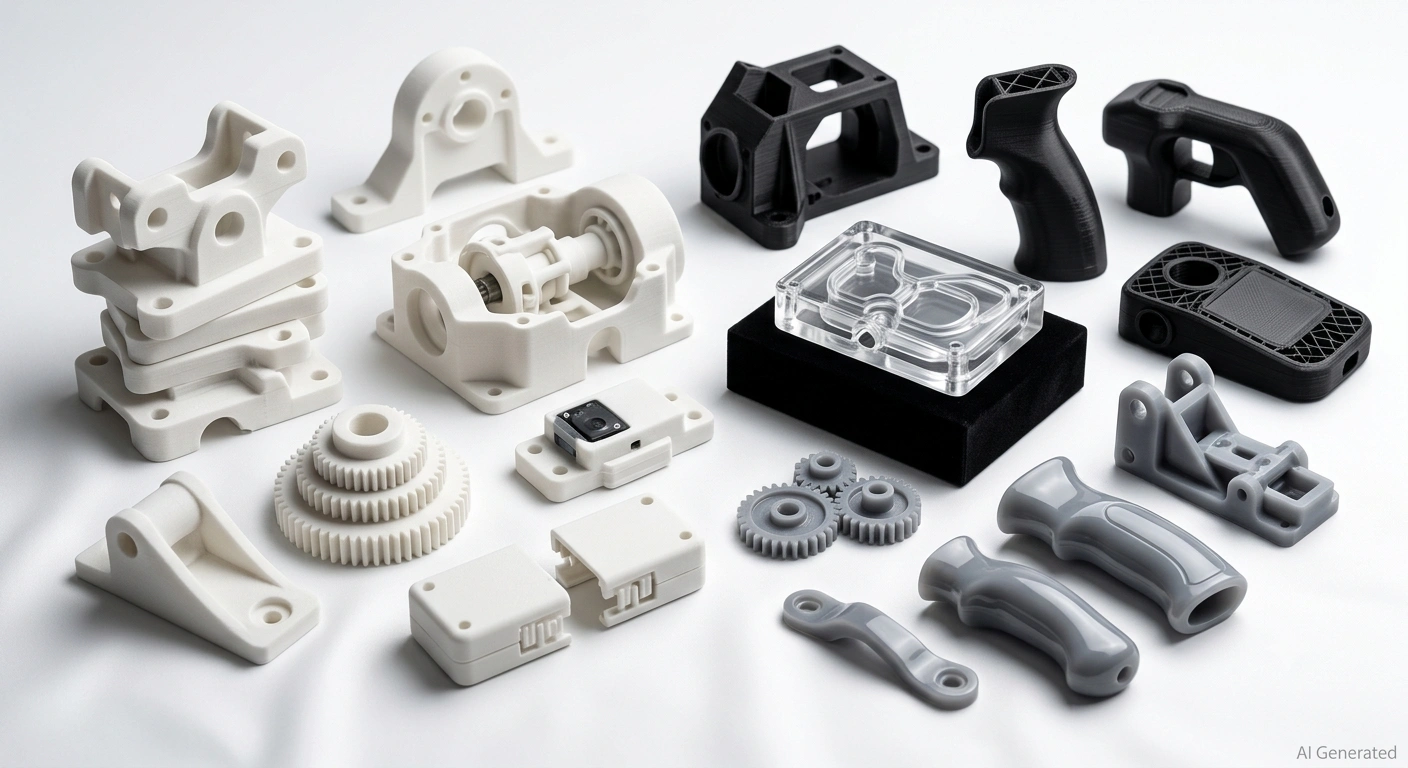
In this guide, you'll learn:
- What factors drive rapid prototyping cost across different processes, materials, and part requirements
- How to compare prototype manufacturing cost across FDM, SLA, SLS, MJF, CNC, and vacuum casting
- How quantity affects prototype pricing
- Practical strategies for reducing rapid prototyping cost without sacrificing function
- Common cost estimation mistakes that increase prototype manufacturing cost unnecessarily
What Affects Rapid Prototyping Cost?
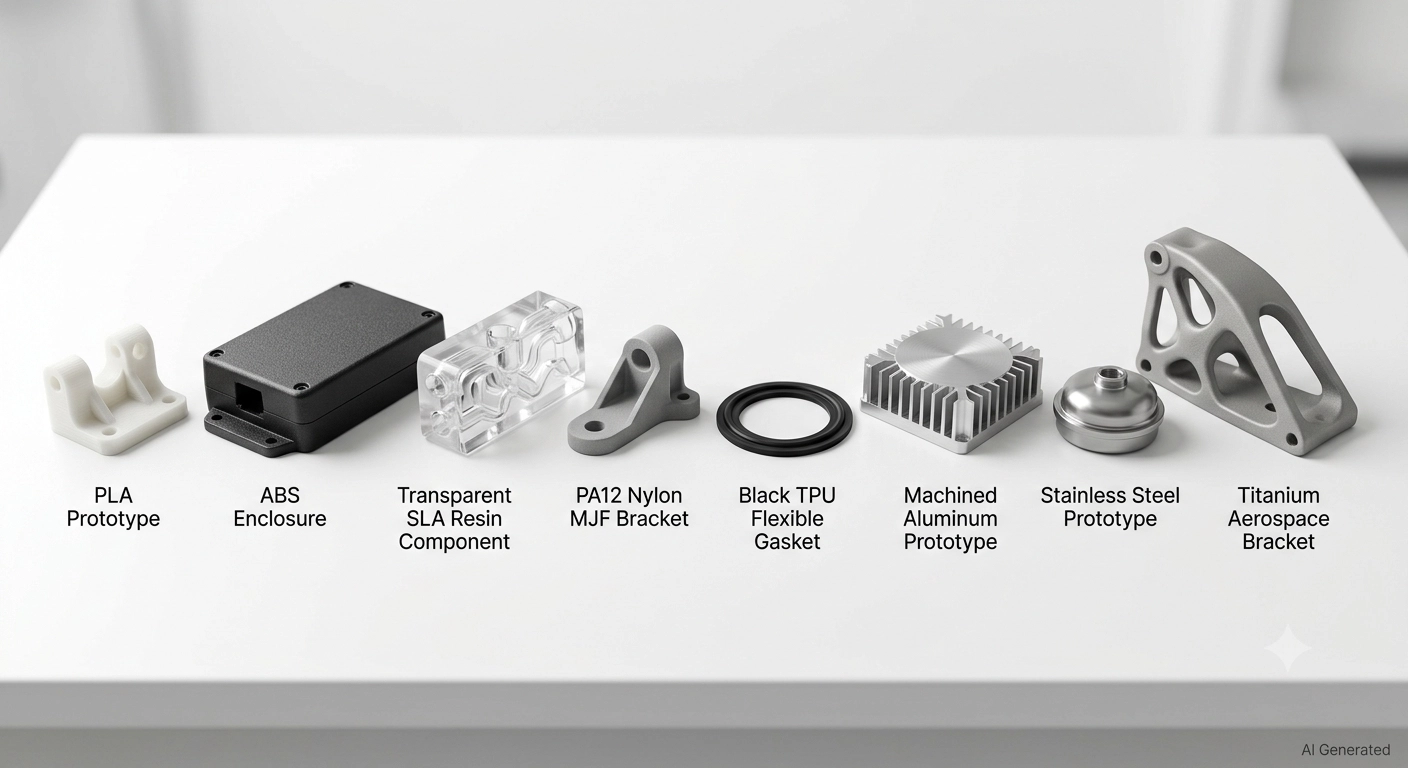
The cost to make a prototype isn't a fixed number, it's the output of six interacting variables. Change any one of them and the prototype cost changes with it. Understanding each factor gives you the ability to estimate prototype pricing before a quote comes back, and to make design decisions that keep rapid prototyping pricing within budget.
Material Selection
↓
Manufacturing Process
↓
Part Size and Geometry
↓
Production Quantity
↓
Post-Processing and Finishing
↓
Shipping and Lead Time
↓
Final Rapid Prototyping Cost
Material
Material is often the dominant cost driver for metal prototypes and a significant factor for engineering plastic prototypes. Metal powders for SLM printing cost $50-200+ per kilogram. Engineering resins for SLA run $100-300 per kilogram. Standard nylon powder for SLS runs $50-120 per kilogram. FDM filament for basic materials like PLA and ABS starts below $20 per kilogram.
The material choice also affects machine time, some materials require slower printing speeds, higher temperatures, or more careful process control, all of which add to prototype manufacturing cost beyond the raw material price.
Manufacturing Process
Each rapid prototyping process has a fundamentally different cost structure. FDM has low material cost but limited surface quality. SLA has moderate material cost but produces the best surface finish. SLS and MJF have higher material cost but no support structures, which reduces post-processing labor. CNC machining prototype cost depends on machine time and setup, which scales with geometric complexity. Vacuum casting has relatively low per-piece cost but a mold cost that's fixed regardless of quantity.
The cost of rapid prototyping doesn't reduce to "which process is cheapest", it reduces to "which process delivers the required prototype capability at the lowest total cost for this specific project."
Part Size
Larger parts consume more material and take longer to build. In 3D printing, build time scales with part height, a tall narrow part can take as long as a short wide part of larger volume if the height requires more layer cycles. In CNC machining, part size affects raw material consumption and machine travel distance. Rapid prototype cost scales with size, but the relationship isn't perfectly linear across all processes.
Geometry Complexity
Complex geometry increases prototype manufacturing cost in different ways for different processes. In FDM and SLA, complex overhangs require more support structures, adding material, print time, and post-processing labor. In CNC machining, complex geometry requires more tool changes, more setups, and longer programming time, all of which appear in the prototype pricing.
For SLS and MJF, geometric complexity is largely cost-neutral, surrounding powder supports any geometry, so undercuts and internal channels that are expensive in other processes add minimal cost. This is one reason SLS and MJF rapid prototyping pricing competes effectively against simpler processes for geometrically complex functional parts.
Quantity
Single-piece prototype cost is highest per unit. Setup time, programming, and fixturing are the same whether you make one part or ten, spreading those costs across more parts drops the per-unit rapid prototype cost significantly. In 3D printing, batch builds that fill the build volume efficiently reduce per-part cost further by sharing the fixed cost of a single build cycle across multiple parts.
Surface Finishing
As-printed or as-machined surfaces are the lowest cost output. Each post-processing step, sanding, painting, bead blasting, anodizing, electropolishing, adds labor, material, and processing time that directly increases prototype cost. For functional prototypes where appearance isn't critical, accepting the as-built surface finish is one of the fastest ways to achieve cheap rapid prototyping without affecting the prototype's mechanical performance.
Shipping and Lead Time
Standard shipping adds a fixed cost to every order. Express shipping for urgent delivery can add 50-200% to the shipping line. Rush production fees, prioritizing your job over the standard queue, typically add 20-50% to the base prototype manufacturing cost. Planning prototype timelines to avoid rush requirements is a reliable way to reduce the total cost to make a prototype.
Which Manufacturing Process Is Most Cost-Effective?
Different rapid prototyping processes have fundamentally different cost structures. The cheapest process for one prototype objective is often the most expensive for another. Prototype manufacturing cost should be evaluated against what the prototype needs to do, not just the unit price.
| Process | Relative Cost | Best For | Key Cost Driver |
|---|---|---|---|
| FDM | $ | Low-cost iterations, form models | Material volume, print time |
| SLA | $$ | Appearance models, clear parts | Resin volume, support removal |
| Vacuum Casting | $$ | Small batches, production-like parts | Mold cost (amortized), material |
| SLS | $$$ | Functional nylon prototypes | Powder cost, build density |
| MJF | $$$ | Engineering validation parts | Material cost, build efficiency |
| CNC Machining | $$$-$$$$ | Precision components, metal prototypes | Machine time, setups, programming |
| Metal 3D Printing | $$$$ | Complex metal prototypes | Metal powder, post-processing |
FDM Prototype Cost
FDM is usually the lowest-cost option for simple plastic prototypes. Small FDM prototypes typically cost $10-80 depending on material usage, part size, and print time. The main cost drivers are filament consumption, build height, and post-processing labor.
SLA Prototype Cost
SLA prototype cost is typically higher than FDM due to resin cost and post-processing requirements. Standard resin prototypes usually range from $20-150, with cost mainly affected by resin volume, support structures, and finishing requirements.
SLS Prototype Cost
SLS prototypes generally cost more than FDM or SLA because of nylon powder cost and machine operation requirements. Pricing is mainly influenced by powder usage, build volume utilization, and whether support-free production reduces labor costs.
MJF Prototype Cost
MJF prototype pricing is comparable to SLS and can become cost-effective for functional prototypes requiring consistent nylon properties. Key cost factors include material usage, build efficiency, part quantity, and finishing requirements.
CNC Prototype Cost
CNC prototype cost is mainly driven by machining time, programming, and setup requirements. Simple parts may cost $80-200, while complex parts requiring multiple setups or tight tolerances can reach $500-2000+. Unlike additive manufacturing, CNC costs increase significantly with geometric complexity.
For a deeper look at CNC prototype pricing, lead times, design considerations, and machining options, explore our CNC Rapid Prototyping Guide.
Vacuum Casting Cost
Vacuum casting has a different cost structure, including an upfront silicone mold cost and per-part production cost. It becomes more economical for small batches because the mold cost is distributed across multiple parts.
How Do Materials Affect Prototype Cost?
Material selection significantly influences prototype pricing, both directly through raw material cost and indirectly through the processing time and post-processing requirements each material demands.
| Material | Relative Cost | Typical Application |
|---|---|---|
| PLA (FDM) | Very Low | Concept models, form checking |
| ABS (FDM) | Low | Functional iterations, form models |
| Standard Resin (SLA) | Medium | Appearance prototypes, clear parts |
| Engineering Resin (SLA) | Medium-High | High-detail functional prototypes |
| PA12 Nylon (SLS/MJF) | Medium | Functional testing, engineering validation |
| TPU | Medium | Flexible prototypes, seals |
| Aluminum (CNC/SLM) | High | Machined structural prototypes |
| Stainless Steel (SLM/CNC) | Very High | Functional metal prototypes |
| Titanium (SLM) | Very High | Aerospace, medical metal prototypes |
Plastic Prototype Materials
FDM PLA and ABS filaments are the lowest-cost prototype materials available, below $20/kg in most cases. The trade-off is material properties: PLA is brittle and temperature-sensitive, ABS is better but both are weaker and less accurate than SLS nylon. For cheap rapid prototyping of early-concept models, plastic filaments offer the lowest prototype cost with acceptable quality for form and fit verification.
Resin Prototype Materials
SLA resins cost $100-300/kg for standard grades, making them 5-15x more expensive per kilogram than FDM filaments. The cost to make a prototype in SLA resin is justified when surface quality and fine detail matter, the per-kilogram cost is higher, but the total prototype manufacturing cost including post-processing is often similar to FDM once finishing time is included.
Engineering Plastic Prototype Materials
PA12 nylon in SLS or HP MJF runs $50-120/kg for standard grades. The higher material cost compared to FDM filaments is offset by the functional mechanical properties nylon provides, this is the material that makes the prototype cost-effective for engineering testing, because unlike FDM materials, SLS/MJF nylon prototypes actually behave like production plastic parts under mechanical load.
Metal Prototype Materials
Metal prototype cost is primarily material-driven. Aluminum powder for SLM runs $50-200/kg depending on alloy. Stainless steel powder costs $80-300/kg. Titanium powder runs $300-600/kg. Metal rapid prototype cost is therefore substantially higher per kilogram than polymer prototyping, but for applications where a metal part is genuinely required, this is the cost to make a prototype that can actually be used for functional testing.
How Does Quantity Affect Prototype Pricing?
Quantity is one of the most powerful levers in prototype pricing. The same part at different quantities can have dramatically different per-unit prototype cost, because fixed costs (setup, programming, fixturing) are spread across more pieces.
| Quantity | Relative Per-Part Cost | Notes |
|---|---|---|
| 1 piece | $$$$ | Full fixed costs on one part |
| 5 pieces | $$$ | Fixed costs divided by 5 |
| 20 pieces | $$ | Setup per part drops significantly |
| 50 pieces | $-$$ | Approaching low-volume production economics |
| 100 pieces | $ | Near low-volume manufacturing cost |
A.One-Off Prototype
Single-piece prototype cost is always the highest per-unit price. Setup time, programming, and fixturing add cost regardless of how many parts follow. For a single CNC prototype, setup might represent 40-60% of the total prototype manufacturing cost. For a single 3D printing prototype, the cost is lower because 3D printing has minimal setup, but there's still a fixed cost for file preparation and build management.
The cost to make a prototype as a single piece is unavoidable for first articles and early concept validation. For later-stage prototypes where quantity might be 5-20 pieces, budgeting for a small batch rather than single pieces typically reduces per-unit rapid prototype cost by 30-50%.
B.Small Batch Prototype Cost
Small batches of 5-20 pieces reduce per-part prototype cost significantly while still maintaining rapid turnaround. In 3D printing, multiple parts often build simultaneously in the same build volume, batch builds in SLS, MJF, and SLA that use available build space efficiently reduce per-part cost by sharing the build cycle. In CNC, the programming and setup time divides across more parts, reducing the fixed cost contribution per piece.
C.Bridge Production and Economies of Scale
At 50-200 parts, rapid prototyping transitions toward bridge production and low volume manufacturing cost territory. Economies of scale are genuine at this range, material is ordered in larger quantities at better pricing, setup time per part decreases further, and post-processing workflows become more efficient. For companies using rapid prototyping to bridge between design validation and production tooling, this quantity range often delivers surprisingly competitive prototype pricing compared to tooled alternatives.
How Can You Reduce Rapid Prototyping Cost?
Practical cost reduction for rapid prototyping comes from design decisions and process choices, not just from finding a cheaper supplier. These strategies reduce prototype manufacturing cost without compromising the prototype's ability to deliver useful test data.
1Choose the Right Technology for the Prototype Stage
FDM for early concept models. SLA for appearance validation. SLS or MJF for functional testing. Don't pay CNC prototype cost for a part that only needs to verify a concept, and don't accept FDM quality for a prototype that needs to behave mechanically like the production part. Matching the process to the prototype's purpose is the single most impactful cost reduction strategy.
2Optimize Wall Thickness
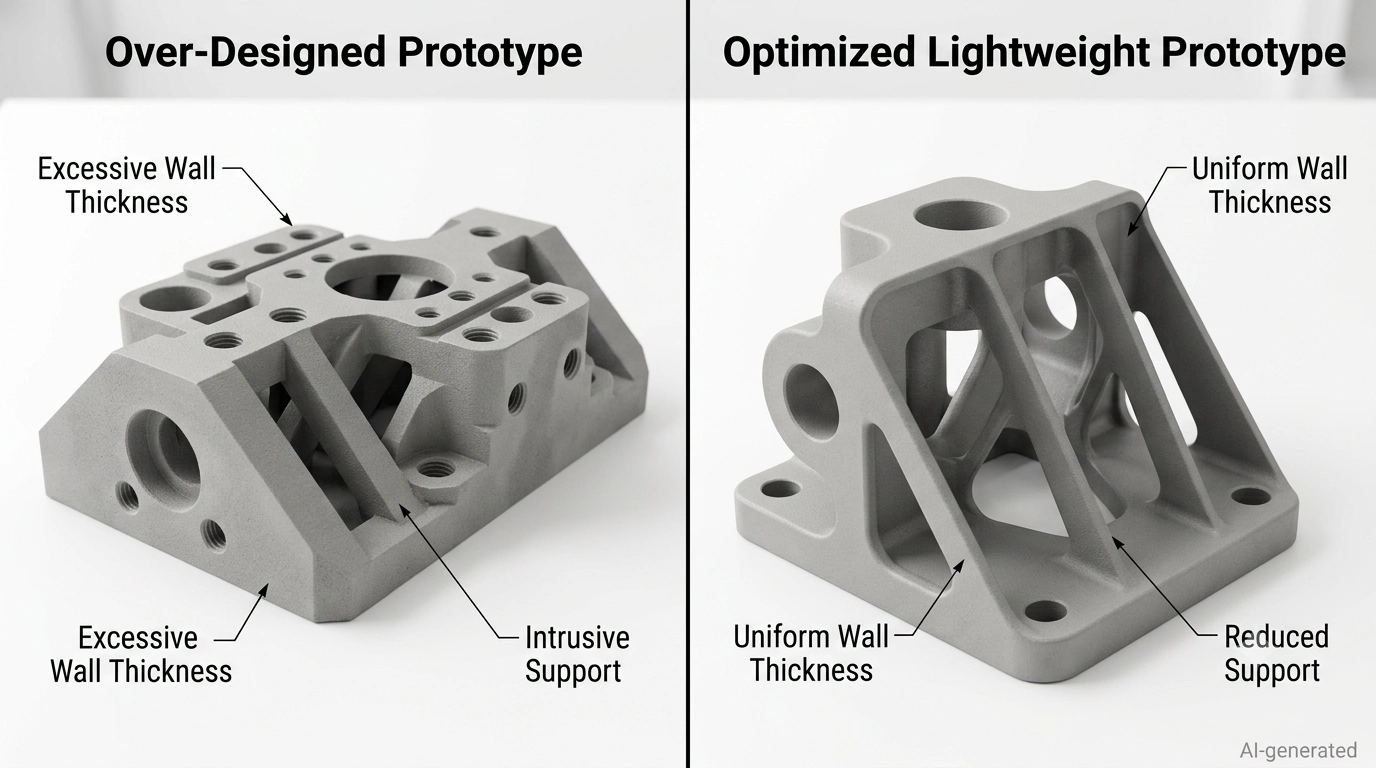
Walls thicker than the structural minimum increase material consumption and build time without improving prototype function. Review minimum wall thickness for your chosen process, typically 1.2-2mm for FDM, 0.5-1mm for SLA, 0.7-1mm for SLS, and remove unnecessary material above those minimums. A 30% reduction in material volume can produce 20-25% reduction in prototype pricing on material-dominated builds.
3Reduce Support Structures
Orient prototypes to minimize support requirements in FDM and SLA. Add chamfers at 45 degrees or less instead of horizontal overhangs. Split complex models into orientable sub-components and assemble post-print. Reducing support structures cuts material consumption, print time, and post-processing labor from the total prototype cost.
4Combine Multiple Parts in One Build
For 3D printing prototypes, combining multiple small parts in a single build cycle significantly reduces per-part prototype pricing by sharing the fixed cost of the build cycle. If you need prototypes of three different components, ordering them simultaneously, potentially in the same build, is more cost-effective than three separate orders on three separate days.
5Standardize Materials Within a Project
Using multiple exotic materials for different components when one standard material would serve all of them adds complexity and cost to prototype manufacturing. Where function permits, standardize on one or two materials across a prototype batch rather than specifying the theoretically optimal material for each individual component.
Find out the best 3D printing materials for every application in detail
6Avoid Unnecessary Finishing for Functional Prototypes
As-built surfaces from SLS and MJF are adequate for most functional testing without any post-processing. As-built FDM surfaces are adequate for form and fit checking. Surface finishing, painting, polishing, bead blasting, adds meaningful cost to prototype pricing without adding to the prototype's ability to deliver mechanical test data. Reserve finishing investment for prototypes that will be shown to customers or used for final appearance validation.
7Reduce Prototype Costs Without Guesswork
Many expensive prototype iterations come from choosing the wrong manufacturing process or material, not from the design itself.
Upload your CAD file to JLC3DP and our engineers will recommend the most cost-effective process. You'll receive fast pricing, material recommendations, and manufacturing feedback before production begins.
Typical Prototype Cost Comparison
Rather than fixed prices that become outdated or mislead due to quantity and geometry variation, relative cost comparisons give a more honest picture of rapid prototyping pricing:
| Prototype Type | Relative Cost | Typical Factors |
|---|---|---|
| Small FDM plastic part | $ | Cheap, limited finish quality |
| SLA appearance model | $$ | Better finish, moderate material cost |
| Vacuum cast small-batch part | $$ | Mold cost amortized, good material properties |
| Nylon SLS functional prototype | $$$ | Engineering properties, support-free geometry |
| MJF engineering validation part | $$$ | Production-intent properties, better surface than SLS |
| CNC machined aluminum prototype | $$$$ | Tight tolerance, material certification, precision |
| Metal SLM prototype | $$$$ | Complex metal geometry, high material cost |
The rapid prototyping pricing principle these comparisons illustrate: cost doesn't correlate simply with part size or quantity alone, process and material dominate the prototype manufacturing cost equation.
When Is 3D Printing More Cost-Effective Than CNC Machining?
3D printing prototype cost is lower than CNC prototype cost in specific scenarios, and higher in others. The comparison is situation-dependent.
| Situation | Better Choice | Why |
|---|---|---|
| One-off prototype, complex geometry | 3D Printing | No setup cost, complexity doesn't add much to cost |
| Tight dimensional tolerances | CNC Machining | CNC holds ±0.025mm; 3D printing typically ±0.1-0.5mm |
| Internal channels or lattice structures | 3D Printing | Machining can't access internal geometry |
| Large flat surfaces | CNC Machining | CNC produces better surface finish more economically |
| Fast iteration, multiple design changes | 3D Printing | File revision is free; CNC re-programming adds cost |
| Material certification required | CNC Machining | From certified wrought stock; 3D printing material traceability varies |
| Metal part, simple geometry | CNC Machining | Often faster and cheaper than metal SLM for simple shapes |
| Metal part, very complex geometry | Metal 3D Printing | SLM enables geometry machining can't produce at any price |
The 3D printing prototype cost advantage grows with geometric complexity. The CNC prototype cost advantage grows with dimensional precision requirements. Understanding which factor dominates your prototype requirement tells you which process minimizes prototype manufacturing cost for your specific situation.
For a detailed breakdown of 3D printing pricing factors, including material selection, process choice, part geometry, and post-processing costs, see our complete guide to 3D printing cost.
Common Cost Estimation Mistakes
1Comparing only unit price across processes
FDM looks cheapest per part until you add support removal labor, surface finishing time, and post-processing. A proper prototype cost comparison includes all costs, material, process, post-processing, shipping, not just the quoted part price.
2Ignoring surface finishing requirements in the initial cost estimate
Painting a prototype adds $20-100 depending on size. Anodizing an aluminum CNC prototype adds $30-80. Bead blasting adds surface preparation cost. When rapid prototyping pricing comes back below budget, verify whether it includes the required finishing or quotes only as-built parts.
3Ignoring shipping in prototype budget planning
Express international shipping on a metal prototype can cost $80-200, comparable to the part cost for small components. Factor shipping into the total cost to make a prototype, not as an afterthought when the invoice arrives.
4Choosing expensive materials unnecessarily
Ordering a concept model in engineering resin when standard resin or FDM would validate the design equally well wastes prototype budget. The cost of rapid prototyping in expensive materials is only justified when the prototype genuinely needs those material properties for its test objective.
5Ordering production-grade quality for early-stage prototypes
Tight tolerances, full surface finishing, material certification, and comprehensive inspection are appropriate for late-stage engineering validation prototypes. Applying the same quality requirements to first-concept models inflates prototype manufacturing cost for a stage where rough form and fit validation is the actual goal.
6Ignoring DFM recommendations
When a supplier provides DFM (design for manufacturability) feedback suggesting a wall is too thin or a feature requires redesign, ignoring that feedback and printing anyway produces a failed prototype at full prototype cost. DFM recommendations are free cost reduction, acting on them is part of low cost prototype strategy.
Making Smarter Rapid Prototyping Cost Decisions
Rapid prototyping cost is influenced by decisions made before a CAD file is uploaded. Process selection, material choice, part geometry, quantity, and finishing requirements all contribute to the final prototype price in ways engineers can control.
Choose your rapid prototyping method based on your prototype goals:
- Lowest prototype cost and basic form checking → FDM
- Best appearance and presentation models → SLA
- Small-batch production-like parts → Vacuum Casting
- Functional mechanical testing → SLS or MJF
- Tight-tolerance precision components → CNC Machining
- Complex metal geometries → Metal 3D Printing
The cost of making a prototype is never just the per-part price. It also includes material, process selection, post-processing, shipping, and the potential cost of incorrect design decisions.
FAQ about Rapid Prototyping Cost
Q: How much does rapid prototyping cost?
Rapid prototyping cost ranges from $10-50 for simple FDM plastic parts to $500-5,000+ for complex metal prototypes. Prototype pricing depends primarily on manufacturing process, material, part geometry, quantity, and finishing requirements. Upload your CAD file for an instant cost estimate specific to your prototype.
Q: What is the cheapest rapid prototyping method?
FDM is the cheapest rapid prototyping method for most plastic parts, with prototype cost typically ranges from $10-30 for small simple parts. For small batches where cost per piece matters more than single-piece price, vacuum casting often produces the lowest cost to make a prototype for 10-30 pieces.
Q: Is 3D printing cheaper than CNC machining for prototypes?
Usually yes for complex geometry, single pieces, and fast iteration cycles. CNC prototype cost is lower for simple geometry requiring tight tolerances, or when production material certification is required. The cost of rapid prototyping with 3D printing beats CNC most clearly for geometric complexity and low quantity; CNC wins for precision and simple shapes.
Q: How much does a prototype cost to manufacture?
Prototype manufacturing cost varies significantly by process: FDM prototypes typically cost $10-100, SLA $20-200, SLS/MJF $40-500, CNC aluminum $80-2,000, metal 3D printing $200-5,000+. Part size, complexity, quantity, and finishing all affect the final prototype pricing within each process.
Q: Why do prototype quotations vary between suppliers?
Rapid prototyping pricing varies because different suppliers have different machine types, labor costs, material sourcing costs, and overhead structures. A supplier with older equipment and higher labor costs quotes differently from an automated facility with newer machines. The same design can legitimately produce very different prototype cost quotes from different suppliers.
Q: What affects prototype pricing most?
Manufacturing process and material are the two biggest rapid prototyping cost drivers for most projects. Within a given process, part size, geometric complexity, and quantity significantly affect prototype pricing. Post-processing and shipping are often underestimated in total prototype manufacturing cost.
Q: How can I reduce prototype costs?
Choose the lowest-cost process that meets the prototype's test requirements. Design for minimum wall thickness and minimum support structures. Batch multiple parts in single build orders. Accept as-built surface finish for functional prototypes. Avoid expensive materials when standard materials test the same characteristics. Plan ahead to avoid rush fees.
Q: Is rapid prototyping suitable for low-volume production?
Yes. SLS, MJF, and metal 3D printing are used for low-volume manufacturing cost-effective production of parts that don't justify tooling investment. When volumes are below the breakeven point for injection molding or casting tooling, typically 200-2,000 parts depending on the process, rapid prototyping often delivers lower total cost including no tooling investment.
Keep Learning
How Much Does 3D Printing Cost? A Complete Breakdown
We get this question a lot at JLC3DP: “How much does 3D printing cost?” And here’s the truth: Some projects can be surprisingly cheap, while others cost more than you’d expect. There’s a myth floating around that 3D printing is basically free once you own a printer. (If only it were that simple, right?) The reality is, whether you’re printing at home or outsourcing to a service like ours, the cost depends on a handful of important factors, machine type, materials, design complexity, and even how much ......
Top 5 3D Printer Tables of 2026: Boosting Your 3D Printing Experience
Choosing the right table for your 3D printer that enhances printing stability, reduces noise, and provides organized storage space is important for achieving high-quality prints and optimizing your workflow. In this guide, we'll look at what makes a good 3D printer table and recommend the best 3D printer tables on the market in 2026. Below are our top five 3D printer tables and stands for 2026, highlighting their features, benefits, and why they might be perfect for your printing space. Best 3D Printe......
Recommended Best Resin 3D Printers in 2024
In recent years, resin 3D printers have developed rapidly in the home 3D printer market. Compared with traditional FDM printing, resin printers can provide higher precision and more delicate printing details. The improvement of printing technology allows users to easily complete the production of high-precision models at home. This article will recommend several of the most competitive resin 3D printers in the 3D printing market in 2024 to help you choose the most suitable equipment and the factors to......
How Much is a 3D Printer? A Comprehensive Guide for Every Budget
3D printing is becoming more and more popular, bringing countless creative and practical possibilities. So how much is a 3D printer? 3D printers have a very wide price range, depending on the printing process, materials, and complexity of the 3D printing solution. This article will analyze the cost of 3D printers based on their type and intended use, helping you find a model that fits your budget. Types of 3D Printers and Their Costs 1. Entry-level 3D Printers ($100 - $500) Entry-level 3D printers are......
Best 3D Printers for Beginners
Embarking on your journey into the world of 3D printing can be both exciting and daunting. With a plethora of options available, choosing the right 3D printer as a beginner is crucial for a smooth transition into additive manufacturing. To simplify your decision-making process, we've curated a list of the top 10 beginner-friendly 3D printers that offer a perfect balance of affordability, ease of use, and quality output. Creality Ender 3 V2 Neo Price: $379.00 Features: Full-metal integrated design, CR ......
Recommended and Purchase Guide for Small 3D Printers in 2024
In previous blog posts, we have introduced many excellent 3D printers on the market. If you are a beginner and want to enter the field of 3D printing, but don’t want to spend too much money or need a large workspace, a small 3D printer is a suitable purchase option. In this article, we will introduce the most recommended small 3D printers in 2024, focusing on their functions and technical features. If you are still in the watch-and-wait stage for 3D printer consumption, it is recommended to use JLC3DP......