Is PETG Food Safe? PETG Filament & 3D Printing Food Safety Guide
19 min
- Is PETG Food Safe?
- Food-Safe PETG Filament vs. 3D-Printed PETG
- What Affects PETG Food-Contact Safety?
- How to Choose Food-Safe PETG Filament
- What Does Food-Contact Safety Actually Mean?
- How to 3D Print PETG for Food Contact
- Does Food-Safe Coating Make PETG Food Safe?
- How Do Food Type, Temperature, and Contact Time Affect PETG Safety?
- PETG Food-Contact Applications: What Is Suitable?
- FAQ About PETG Food Safety
- Is PETG Food-Safe? Final Considerations and Best Practices
Key Takeaways
- Whether PETG is food safe depends on more than the material itself.
- Some PETG filaments are formulated with food-contact applications in mind, but even those don't automatically produce food-safe 3D prints.
- The finished part's safety depends on the filament formulation, what additives and pigments were used, how the part was printed, the nozzle material, the surface texture from the printing process, the type of food involved, how long it's in contact, what temperature it reaches, and how the part gets cleaned afterward.
- This guide works through each of those factors so you can make an informed decision for your specific application, not just a blanket yes or no that doesn't hold up when you look at the details.
Is PETG Food Safe?
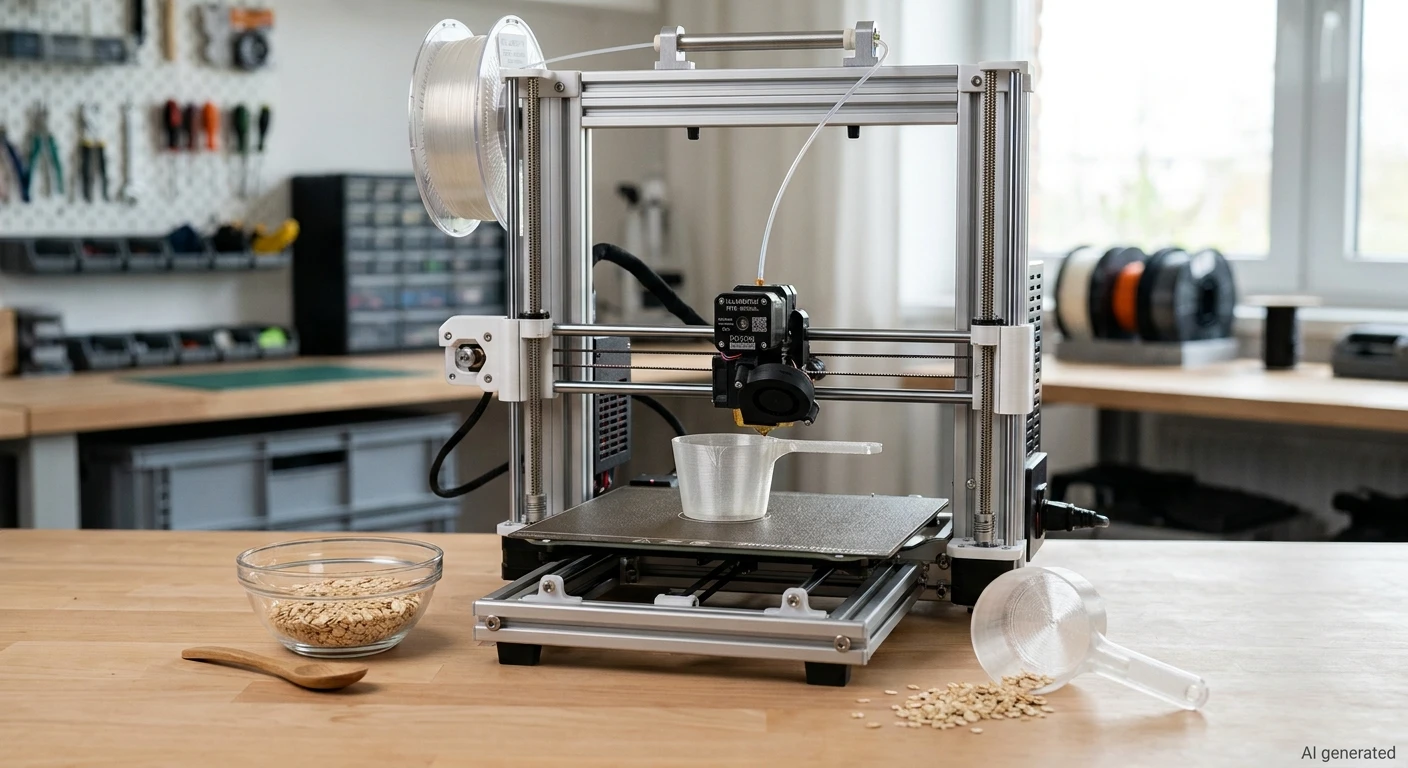
Short answer: PETG is not automatically food safe. Some PETG filaments may be suitable for food-contact applications when the specific formulation is documented for that use. However, the finished 3D-printed part also depends on the printing equipment, nozzle, surface, design, cleaning process, and intended conditions of use.
Some PETG is potentially suitable for certain food-contact applications. Most isn't, not because the base polymer is inherently dangerous, but because the filament formulation, the printing process, and the finished surface introduce variables that standard food-safety assessments don't account for.
PETG plastic itself has a reasonable food-contact track record. PET, the parent polymer, is widely used in food and beverage packaging. The glycol modification that creates PETG changes some processing characteristics but not the fundamental chemistry. So there's a reasonable starting point here.
But here's where it gets complicated: is PETG filament food safe in a general sense? No, not categorically. Most standard PETG filaments contain additives, colorants, pigments, and processing aids that aren't documented or tested for food contact. The filament that prints beautifully in your printer and produces great mechanical results may contain compounds that have no business being in contact with food.
If you're also concerned about PETG fumes, emissions, and general printing safety, see our guide on Is PETG Toxic guide for a closer look.
And even when the filament is specifically formulated and documented for food-contact use, is 3D printed PETG food safe? Not automatically. The printing process introduces its own set of variables, surface texture, potential contamination from previous materials in the hotend, nozzle material, that sit between "food-contact compliant filament" and "food-safe finished part."
So the real answer: it's conditional. And what it's conditional on is what the rest of this guide covers.
Food-Safe PETG Filament vs. 3D-Printed PETG
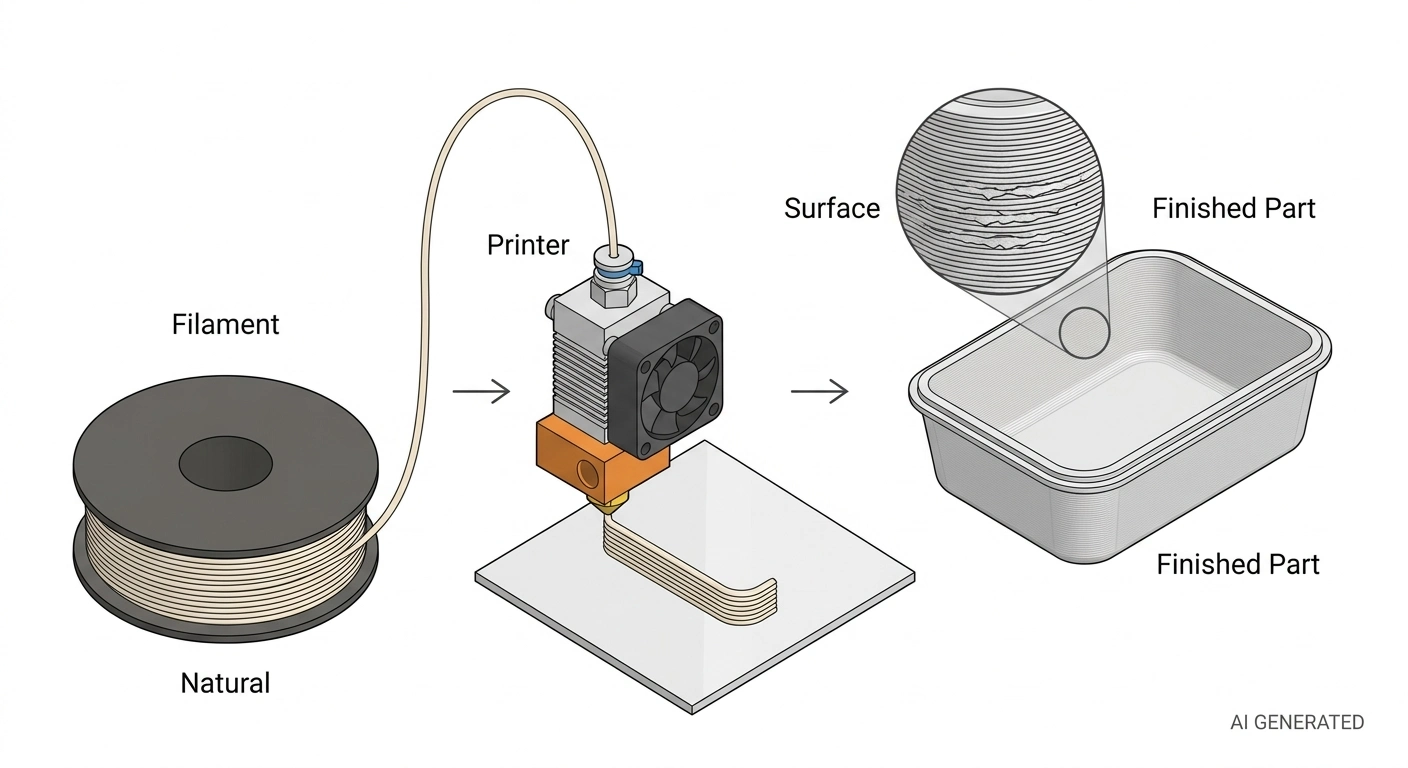
This distinction is the most important one in this entire guide, and it's the one that most "is PETG food safe" searches gloss over.
Food-safe PETG filament ≠ food-safe 3D printed part.
They're different things. One is a raw material with certain documented properties. The other is a finished object that was produced through a process with its own variables, by a piece of equipment with its own contamination potential, with a surface that looks one way in CAD and another way under a microscope.
Why Filament Formulation Matters
The base PETG polymer, polyethylene terephthalate glycol, is the starting point. What gets added to it is where formulations diverge significantly.
Colorants and pigments are perhaps the most variable element. The same natural (undyed) PETG from a manufacturer might be formulated with food-contact applications in mind, while the same manufacturer's blue or red variant uses pigments that haven't been tested or documented for food contact. This is product-specific, not category-wide.
Stabilizers, processing aids, release agents, and other additives are present in most filaments and vary between manufacturers and even between product runs. A manufacturer that documents their natural PETG for food-contact use may not extend that documentation to other colors or specialty formulations.
"Food-safe PETG filament" isn't a category you can safely generalize across. It's a specific product, from a specific manufacturer, with specific documentation covering specific conditions of use. If you need to confirm whether a filament is suitable for food contact, you need the manufacturer's actual documentation, not their marketing page.
Why the Printing Process Matters
Even with an appropriately documented filament, the printing process introduces variables that the filament's food-contact documentation doesn't cover.
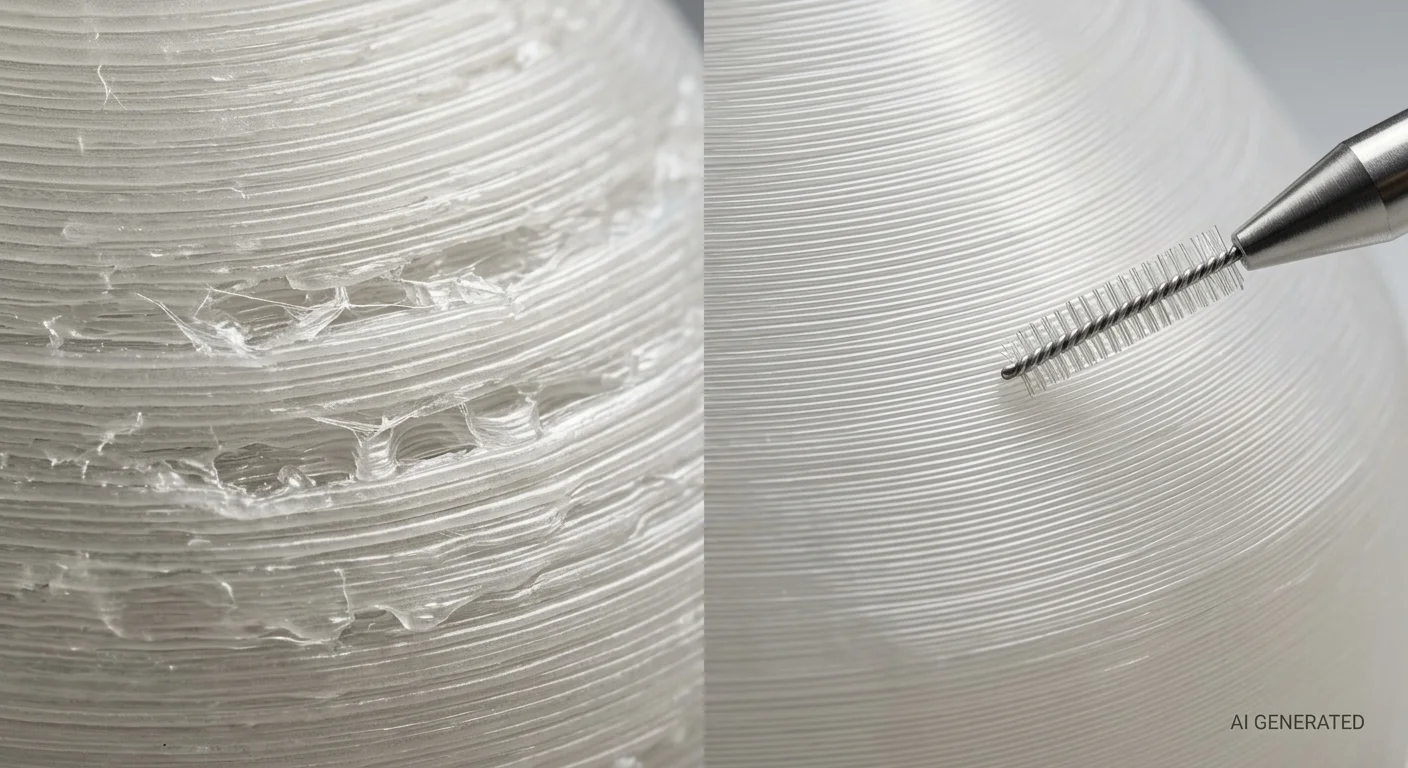
FDM printing builds parts layer by layer, and the surface that results is textured at a microscopic level, the layer lines create ridges, valleys, and occasional voids even in what looks like a smooth print. This texture matters for food-contact applications because it affects whether the surface can be thoroughly cleaned and kept clean.
The nozzle and hotend are another variable. If the printer has been used with other filaments, particularly ABS, nylon with additives, or specialty materials, residue from those materials can contaminate a PETG print even after what appears to be a thorough purge. A printer that's been running random filaments for two years has a different cleanliness profile than a dedicated machine.
Post-processing decisions also matter. How the part was removed from the build plate, whether it was sanded, whether it was chemically treated, all of these change the surface that will be in contact with food.
What Affects PETG Food-Contact Safety?
| Factor | Why It Matters |
|---|---|
| Filament formulation | Additives and pigments vary; not all are documented for food contact |
| Manufacturer documentation | The only reliable basis for food-contact claims |
| Printer cleanliness | Previous filament residue can contaminate prints |
| Nozzle material | Brass nozzles can introduce trace metals; stainless reduces this risk |
| Layer lines and surface texture | Affect whether the surface can be thoroughly cleaned |
| Part geometry | Crevices, internal channels, and narrow gaps trap food and moisture |
| Surface finish | Rougher surfaces are harder to clean effectively |
| Coating | Can create a barrier, but introduces its own durability questions |
| Food type | Dry, wet, acidic, fatty foods interact differently with surfaces |
| Temperature | Heat affects material properties and can affect coatings |
| Contact duration | Brief contact vs. repeated or prolonged contact are different situations |
| Cleaning method | Repeated washing, dishwasher exposure, and abrasive cleaning all degrade surfaces over time |
The practical concern with layer lines specifically isn't simply that they exist, it's whether the finished surface can be thoroughly cleaned and kept clean through the part's intended life. A cookie cutter with brief contact time and thorough washing after each use is a different situation from a drinking vessel used daily for months. The same surface texture presents different risk profiles in those two applications.
How to Choose Food-Safe PETG Filament
The word "food-safe" on a product page doesn't tell you much. Manufacturers use it loosely, inconsistently, and sometimes without any documentation behind it. If you need a PETG filament that's genuinely suitable for food-contact applications, here's what to actually look for:
What you actually need from the manufacturer:
A specific food-contact statement covering the exact product you're buying, not the product line, the specific SKU and color you intend to use.
Documentation of the formulation or at least confirmation that the colorants and additives used are documented for food-contact use.
The conditions of use the food-contact claim applies to, temperature limits, contact duration, food types covered, cleaning conditions.
Reference to applicable regulations or standards, FDA 21 CFR, EU Regulation 10/2011, or equivalent depending on your market.
Any testing or compliance documentation if available, rather than just a marketing claim.
What to be skeptical of:
"Made with food-safe materials" without specific documentation.
Food-contact claims that apply to natural/undyed versions but are extended without documentation to colored variants.
Claims that reference PET or PET packaging approvals as if they automatically apply to the filament formulation.
Any claim that doesn't specify the conditions of use it applies to.
If the manufacturer can't provide clear documentation when you ask directly, that's your answer about whether to use it for food contact.
What Does Food-Contact Safety Actually Mean?
Food-Safe vs. Food-Grade
These terms get used interchangeably and they don't mean the same thing. Food-grade generally refers to whether a material meets purity or composition standards that make it potentially suitable for food-contact use. Food-safe implies it's actually safe for the intended application, which depends on far more than just the material composition. A material can be food-grade without being food-safe in a particular application.
What Is a Food-Contact Material?
A food-contact material is a material or article intended to come into contact with food under specified conditions of use. The "specified conditions" part is doing a lot of work in that definition. Food-contact suitability isn't a blanket property, it's determined relative to the type of food, temperature, contact duration, and cleaning conditions involved.
What Does FDA Food-Contact Compliance Mean for PETG?
The FDA regulates food-contact materials in the US primarily through 21 CFR, specific regulations covering different material categories and intended uses. Some components of PETG formulations appear on FDA-recognized lists for food-contact use under specific conditions.
What this does not mean: "PETG is FDA approved" as a general statement. FDA food-contact compliance is specific to a formulation, the specific substances in it, and the intended conditions of use. A manufacturer needs to demonstrate compliance for their specific product, not just the base polymer category.
This is why claims like "PETG is FDA approved for food contact" are incomplete to the point of being misleading. The approval, if it exists, applies to a specific formulation under specific conditions, not to PETG filament as a category.
For broader context on food-safe 3D printing materials and practices, including how PETG fits into the wider picture of food-contact 3D printing, see our dedicated guide.
Manufacturing Note
For food-contact applications, material selection should be evaluated together with the manufacturing process. In professional 3D printing, the material specification alone does not establish the suitability of the finished part. Equipment cleanliness, process control, surface condition, and intended use must also be considered.
At JLC3DP, food-contact projects are reviewed as a complete manufacturing system rather than a single material choice. This includes verifying that the selected filament is documented for food contact, controlling the print path to avoid cross-contamination from previous materials, and evaluating surface finish and part design for cleanability. In practice, parts that pass material checks but fail on process control, contaminated hotends, or designs with unreachable crevices are the most common source of food-contact issues we see. Matching material, process, and design together is what makes a food-contact part reliable.
How to 3D Print PETG for Food Contact
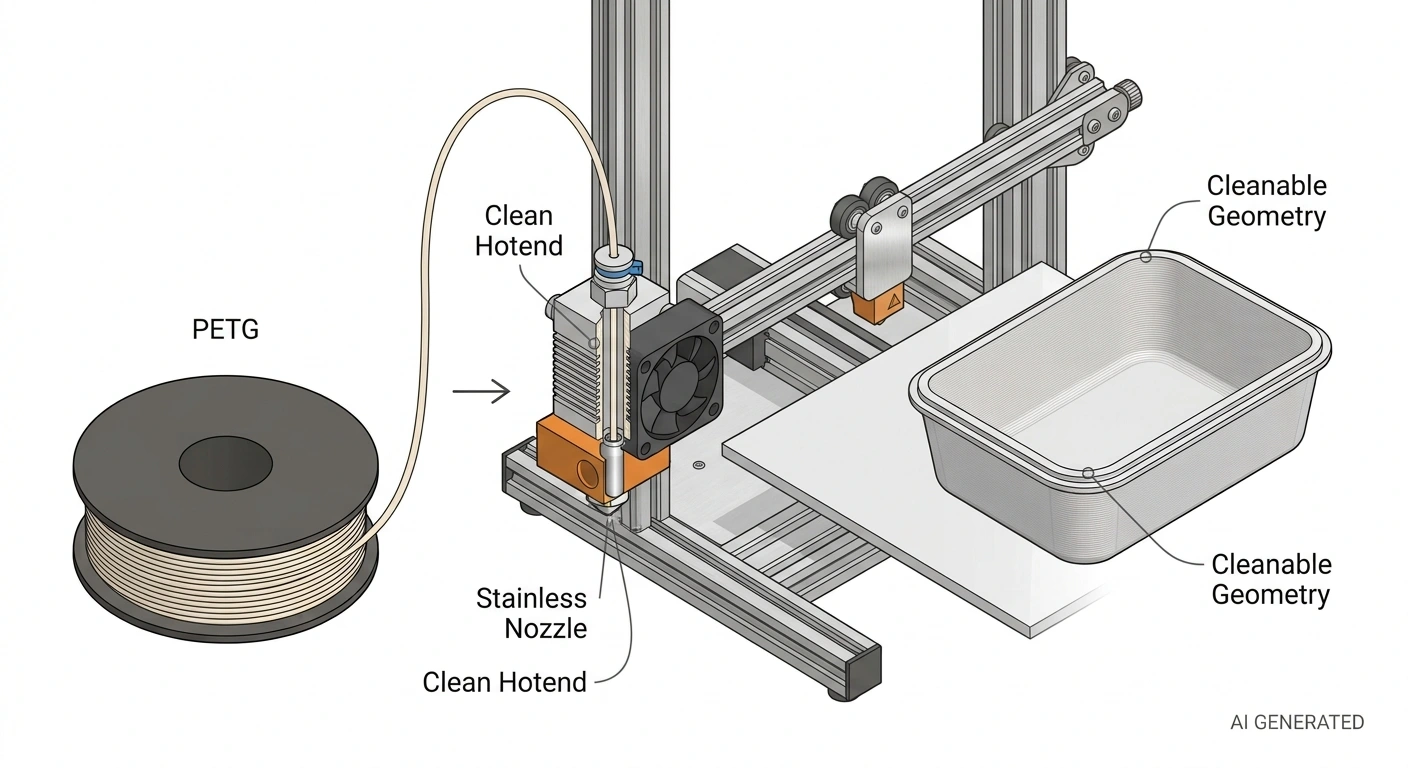
Assuming you have a filament that's genuinely documented for food-contact use, how you print it matters too.
1Start With the Right Filament, and Only That
Don't mix filaments in the same print session without a thorough purge. If your printer has been running ABS, ASA, or other materials with potentially problematic additives, the residue risk is real. Consider dedicating a printer or at minimum a full hotend assembly to food-contact printing if you do this regularly.
2Keep the Print Path Clean
The nozzle, hotend, and feed path should be clean of previous filament residue before starting a food-contact print. This doesn't just mean purging until the color changes, it means ensuring there's no degraded material sitting in dead zones of the hotend that can contaminate the extrusion.
3Nozzle Material
Brass nozzles, which are the most common, can introduce trace amounts of lead (from the brass alloy) and other metals into prints through direct contact with the filament. Stainless steel nozzles reduce this specific contamination risk. This is worth doing for food-contact applications.
A stainless steel nozzle reduces one source of potential contamination. It doesn't make a print food-safe on its own or compensate for other factors, an unsuitable filament, a contaminated hotend, or a surface that can't be cleaned properly.
For a detailed breakdown of nozzle types and their implications, see our 3D printing nozzle guide.
4Optimize the Surface
For food-contact printing specifically, surface quality matters beyond aesthetics. Finer layer heights produce smoother surfaces with less pronounced layer line texture. Consistent extrusion and good layer bonding reduce voids and surface irregularities. Minimize seams on surfaces that will contact food. The goal isn't a perfect mirror finish, it's a surface that can be thoroughly cleaned and that doesn't create hidden spaces where food residue accumulates.
5Design for Cleanability
The design decisions that seem unrelated to safety actually matter significantly. Parts designed for food contact should avoid deep cavities and internal channels that can't be reached during cleaning, narrow gaps where moisture sits after washing, overly complex geometry that creates crevices, and any feature where you genuinely couldn't get a brush or cleaning solution to reach.
Prefer smooth accessible surfaces, designs that drain rather than pool liquid, simple geometry where the entire food-contact surface is visible and reachable, and wall thickness that won't flex and crack under repeated washing.
Does Food-Safe Coating Make PETG Food Safe?
Food-safe epoxy coatings, and similar products, are sometimes recommended as a way to seal 3D printed PETG surfaces for food contact. What they can and can't do deserves an honest look.
What a Coating Can Do
A properly applied food-safe coating seals the surface layer lines, reduces surface texture irregularities, creates a barrier between the printed material and food, and makes the surface smoother and potentially easier to clean. For some low-contact applications where the coating stays intact, this meaningfully changes the food-contact situation compared to an uncoated print.
What a Coating Cannot Do
A coating doesn't fix an underlying filament that isn't suitable for food contact. It doesn't compensate for contamination that occurred during printing. It doesn't automatically make the part food-safe regardless of the contact conditions. And it doesn't guarantee the coating itself is food-safe under all conditions, the coating material needs its own food-contact documentation.
How Long Does the Coating Last?
This is the part of the coating conversation that often gets left out. Coatings scratch. They can delaminate under repeated washing, particularly in a dishwasher. Acidic foods can attack certain coating chemistries over time. Heat can cause cracking or degradation. A coating that was intact when you finished the part may not be intact after six months of daily use and washing.
The practical implication: coatings are not a long-term food-safe solution for parts subjected to regular use and washing. They're more appropriate for low-contact, infrequent-use applications where the coating is unlikely to be significantly degraded by the time of use.
How Do Food Type, Temperature, and Contact Time Affect PETG Safety?
| Condition | Key Consideration |
|---|---|
| Dry food | Lower moisture exposure; surface cleanability still matters |
| Cold water | Repeated contact and cleaning cycles the primary concern |
| Warm/hot food | Thermal exposure affects material and any coating |
| Acidic food/drinks | Chemical exposure; some coatings are vulnerable to acidic environments |
| Fatty or oily food | Migration considerations; oils can penetrate surface irregularities |
| Brief single contact | Limited exposure duration; lower concern than repeated use |
| Repeated daily contact | Cleaning durability and surface integrity become critical |
| Long-term food storage | Prolonged contact with food is a higher-concern application |
Temperature deserves specific attention. PETG has decent thermal properties that make it suitable for warmer applications compared to PLA. But thermal performance of the material and food-contact safety at elevated temperatures are different assessments. The question for food contact isn't just whether the material maintains its shape at a temperature, it's whether the full combination of material, surface, and any coating remains appropriate for food contact at that temperature, for that contact duration, with that type of food.
For background on PETG's thermal properties, see our PETG temperature resistance guide, but note that the thermal performance information there addresses the material's physical properties, not a food-contact safety assessment at elevated temperatures.
If you're also comparing PETG with PLA for food-contact applications, see our guide to PLA food safety which covers similar considerations for that material.
PETG Food-Contact Applications: What Is Suitable?
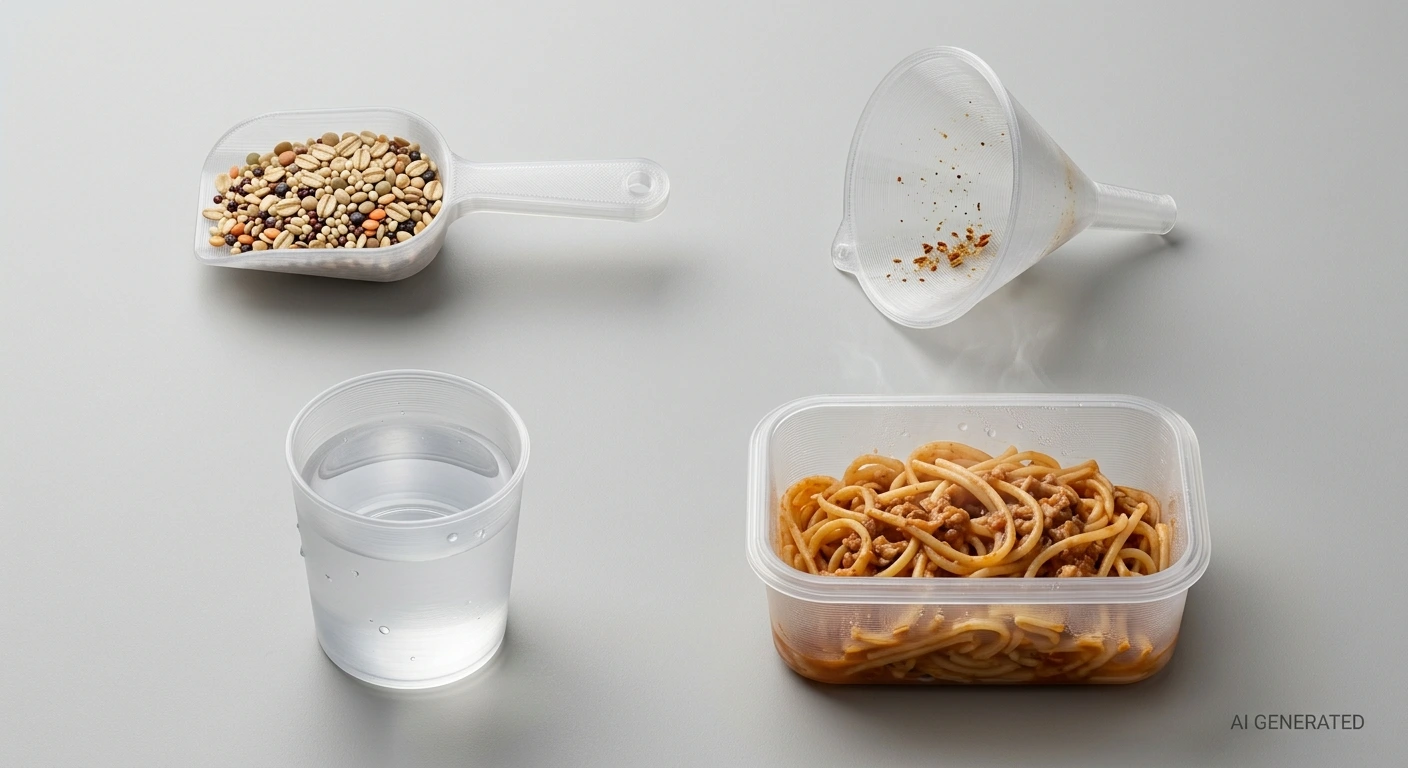
Rather than a blanket answer, it's more useful to think about specific applications and what the actual concerns are.
| Application | Contact Pattern | Main Concern | Guidance |
|---|---|---|---|
| Cookie cutter | Brief direct contact with dough | Cleanability, brief exposure | Conditional, appropriate filament, clean surface, thorough washing |
| Dry food funnel | Short direct contact | Surface texture | Conditional, infrequent contact with dry food is lower concern |
| Food scoop | Repeated direct contact | Surface durability through cleaning | Conditional, depends on filament documentation and cleaning routine |
| Storage container lid | Repeated contact | Washing durability, surface integrity | Conditional, appropriate filament and surface quality needed |
| Kitchen organizer | Food-adjacent, not direct food contact | Limited direct contact | Lower concern than direct food-contact applications |
| Drinking cup | Repeated direct liquid contact | Cleaning, liquid exposure, surface degradation | Higher concern, requires carefully documented filament and design |
| Hot beverage container | Repeated contact plus heat exposure | Temperature plus cleaning | Not preferred, heat exposure adds variables that are harder to control |
| Long-term food storage | Prolonged food contact | Extended exposure duration | Not preferred, prolonged contact is the highest-concern scenario |
"Conditional" in this table means: it may be appropriate with the right filament documentation, appropriate printing, adequate surface quality, and suitable cleaning and use, not that it's automatically fine. "Not preferred" doesn't mean categorically unsafe in every instance, but the combination of variables makes it hard to make a confident case for those applications.
FAQ About PETG Food Safety
Q: Is PETG food safe?
PETG plastic has food-contact history in packaging applications, and some PETG filaments are formulated and documented for food-contact use. But most standard PETG filaments aren't specifically documented for food contact, and even those that are don't automatically produce food-safe 3D printed parts, the printing process, surface quality, nozzle material, and conditions of use all affect the food-contact suitability of the finished part.
Q: Is food-safe PETG filament enough to make a 3D print food safe?
No, it's a necessary starting point, not a complete answer. The filament formulation is one factor among several. The printing equipment needs to be free of contamination from previous materials, the nozzle material matters, the surface quality affects cleanability, and the part design needs to support thorough cleaning. A food-contact-documented filament printed on a contaminated printer through a brass nozzle with previous ABS residue doesn't produce a food-safe part.
Q: Is 3D-printed PETG safe to drink from?
This depends on the filament formulation, printing conditions, and what the vessel will be used for. Drinking vessels are higher-concern food-contact applications because they involve repeated liquid contact and regular washing, conditions that test surface durability over time. For drinking vessels specifically, the case for using 3D printed PETG without a food-safe epoxy coating is weak even with appropriate filament. With a coating, durability of that coating through repeated dishwasher or hand washing cycles becomes the limiting factor.
Q: Does food-safe epoxy make PETG food safe?
A properly applied food-safe epoxy can seal the surface and create a barrier that changes the food-contact situation meaningfully. But it doesn't fix unsuitable underlying filament, doesn't compensate for print contamination, and isn't a permanent solution for parts subjected to regular use and washing. Coatings scratch, delaminate, and degrade, particularly with dishwasher exposure, acidic foods, and heat. They're more useful for infrequent, low-contact applications than for daily-use items.
Q: How can I tell if PETG filament is suitable for food contact?
Look for manufacturer documentation that specifically addresses food contact for the exact product and color you're considering. The documentation should reference applicable regulations (FDA 21 CFR, EU 10/2011, or equivalent), specify the conditions of use it covers, and address the colorants and additives used, not just the base polymer. If the manufacturer can't provide this documentation when you ask, don't assume the product is suitable for food contact regardless of what the product page says.
Is PETG Food-Safe? Final Considerations and Best Practices
PETG food safety isn't a yes or no question, it's a framework for thinking through a specific application with specific materials, printed in specific conditions, for a specific use.
The starting point is the filament: not all PETG is formulated or documented for food contact, and most standard products aren't. From there, the printing process, equipment cleanliness, nozzle material, surface quality, and part design all contribute to whether the finished part is actually appropriate for food contact. The type of food, temperature, contact duration, and cleaning method determine the specific concern level for the intended application.
For most 3D printing applications involving food, the practical advice is: use appropriately documented filament if you can find it, print with a clean setup and stainless steel nozzle, design for surface cleanability, be realistic about which applications are lower or higher concern, and consider whether a food-safe coating makes sense for your specific use case while understanding its durability limitations.
If you're developing a 3D-printed part for a specific application, material selection should start with the part's functional and manufacturing requirements—not just the name of the plastic. JLC3DP offers multiple 3D printing technologies and engineering materials to help you match material properties with your application.

- Starting From $0.3 per part · No Minimum Order Quantity
- 24-Hour Lead Time · Up to $123 Welcome Coupons
Popular Articles
Keep Learning
ABS vs PLA: Which Filament Should You Print?
Key Takeaways The ABS vs PLA choice is a trade between certainty and headroom: PLA prints easily, precisely, and cheaply; ABS survives heat, absorbs impact, and can be smoothed with acetone, but it makes you earn every print. Warping is the deciding pain: ABS parts curl as layers shrink unless you print in a heated, enclosed chamber; PLA barely warps on the same machine. "Stronger" splits into three answers: ABS is stiffer and tougher, but well-printed PLA holds layer-to-layer more consistently — pick......
ABS vs PC vs PC-ABS: Which Is Best for 3D Printing?
Key Takeaways The ABS vs PC vs PC-ABS decision comes down to one trade: PC gives you roughly 35–40°C more heat resistance and higher stiffness; ABS prints more easily and costs less; PC-ABS trades a little of each extreme for the most balanced printing experience. PC leads on heat resistance (~125–130°C vs ~85–95°C for ABS) and stiffness, with impact resistance as its signature trait — "strongest" depends on which property and grade you compare — but it demands the hottest, most enclosed, least forgiv......
Polycarbonate Filament: Properties, Printing, and Uses
Key Takeaways Polycarbonate filament — the spool form of the polymer most people simply call PC — is an engineering-grade fused deposition modeling (FDM) material that pairs high impact resistance with heat resistance well above what ABS or PETG reach. PC prints hot: typical starting points are a nozzle at 260–310°C and a bed at 100–120°C, confirmed against the spool's datasheet. An all-metal hotend is recommended, because PC printing temperatures can exceed the continuous-temperature limits of many P......
Is PETG Food Safe? PETG Filament & 3D Printing Food Safety Guide
Key Takeaways Whether PETG is food safe depends on more than the material itself. Some PETG filaments are formulated with food-contact applications in mind, but even those don't automatically produce food-safe 3D prints. The finished part's safety depends on the filament formulation, what additives and pigments were used, how the part was printed, the nozzle material, the surface texture from the printing process, the type of food involved, how long it's in contact, what temperature it reaches, and ho......
MJF 3D Printing Materials Guide 2026: Types & How to Choose
MJF Materials are the driving force behind Multi Jet Fusion's rapid ascent into a cornerstone of the modern 3D printing landscape. The true potential of this technology lies in its diverse and robust material portfolio. Do you know which powder is best for your application? Are you maximizing the unique properties of materials like PA12, PA11, TPU, PP, or PA12S? This comprehensive guide provides the definitive answers. Let’s dive in and master MJF material selection. If you have gained a clear underst......
Choosing the Right 3D Printing Material: A Guide to Making the Best Material Selection
To get the intended outcomes from your 3D printing projects, selecting a suitable material is fundamental. Given the variety of materials that are accessible, it's critical to take into account attributes like strength, flexibility, durability, heat resistance, and aesthetics etc. Which kind of material works best for your project? Although it's difficult to tell for sure, your parts will turn out better the more you understand the available possibilities and the characteristics of different materials......