Is PETG Toxic to Print? Fumes, Risks & Safety Guide
18 min
- Is PETG Toxic to Print? The Short Answer
- What Is PETG Made Of?
- PETG vs PLA vs ABS
- PETG Fumes and VOC Emissions
- Does PETG Smell When Printing?
- Is PETG Safe for Indoor 3D Printing?
- Is PETG Food Safe?
- How to Print PETG Safely
- PETG Safety FAQs
- Is PETG Toxic? What You Need to Know
Key Takeaways
- PETG is generally considered a lower-emission 3D printing material compared to ABS and ASA, but it does produce VOCs and ultrafine particles during printing.
- The odor during PETG printing is typically mild, some people barely notice it, others describe a faint warm-plastic smell.
- Low odor doesn't mean zero emissions.
- Ventilation is still a sensible precaution.
- PETG food safety is complicated, the material itself may be food-grade in some formulations, but the printing process introduces variables that make most 3D printed PETG parts unsuitable for direct food contact without additional consideration.
- PETG is not the most concerning filament category for indoor printing, but it's not something to print in a sealed room without airflow and assume everything's fine.

PETG has a reputation as one of the "safer" 3D printing filaments. As demonstrated in the study "Emission Profiles of Volatiles during 3D Printing", PETG generally produces far lower emissions than ABS under comparable printing conditions, resulting in a milder odor and far less demanding ventilation requirements. But "safer than ABS" and "completely safe" aren't the same thing, and PETG isn't emission-free.
This guide goes through what PETG actually releases during printing, what the evidence says about health risk, whether the smell is something to be concerned about, what the food safety situation actually is, and what you should do differently (if anything) when printing PETG at home or in a workspace.
Is PETG Toxic to Print? The Short Answer
PETG is generally considered a low-emission material, but heating and extruding it can still produce VOCs and ultrafine particles. Printing with it doesn't produce the kind of emissions that would make it comparable to ABS or resin in terms of air quality concerns. In the context of 3D printing materials, PETG sits toward the lower-concern end of the spectrum.
That said, lower concern isn't no concern. PETG printing does release volatile organic compounds and ultrafine particles. The quantities and specific compounds depend on the formulation, printing temperature, and ventilation, among other factors. The research on PETG emissions is less extensive than on ABS or PLA, but what exists suggests PETG generally produces fewer emissions than higher-concern materials under comparable conditions.
| Question | Answer |
|---|---|
| Is PETG toxic to print? | Generally considered a relatively low-emission material, with lower emissions than ABS under comparable printing conditions. |
| Does PETG smell when printing? | Usually mild, warm plastic, sometimes barely noticeable |
| Does PETG release VOCs? | Yes, in lower quantities than ABS typically |
| Is PETG safe indoors? | Generally manageable with basic ventilation |
| Is PETG food safe? | Complicated, formulation and print process both matter |
| Is PETG safer than ABS? | Generally yes, but neither is emission-free |
PETG Printing Safety: What the Evidence Shows
| Finding | What the evidence suggests |
|---|---|
| VOC emissions | PETG can emit VOCs during FDM printing |
| Ultrafine particles | PETG printing can generate UFPs |
| Compared with ABS | Generally lower emissions under comparable conditions |
| Effect of temperature | Higher temperatures can increase emissions |
| Formulation | Additives and pigments can change emission profiles |
| Ventilation | Reduces indoor exposure |
| Food contact | Material certification alone does not guarantee printed-part safety |
Evidence note: Emission rates vary significantly between filament formulations, printers, and operating conditions, so PETG should not be treated as a single standardized emission category.
What Is PETG Made Of?
PETG is polyethylene terephthalate glycol, PET with a glycol modification that improves flexibility and reduces brittleness compared to standard PET. You're probably already familiar with PET from water bottles and food packaging. The glycol modification changes the processing characteristics but the base chemistry is similar.
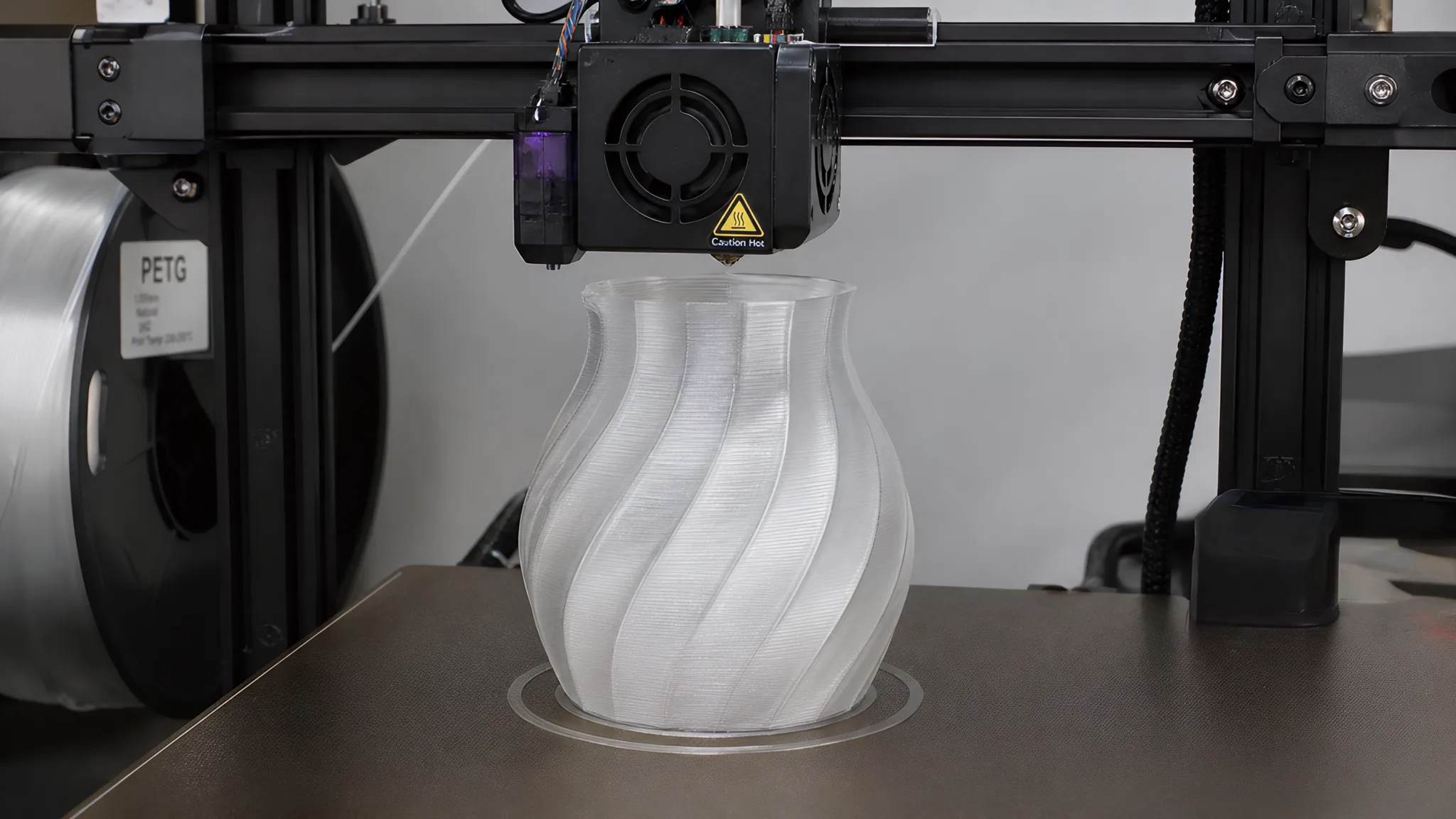
The glycol in PETG is typically cyclohexanedimethanol (CHDM), added during polymerization to disrupt the crystal structure and make the material more suitable for 3D printing. PETG is thermoplastic, it melts and re-solidifies cleanly, which is why it works well in FDM printers.
Most commercial PETG filaments also contain additives, colorants, stabilizers, processing aids, that vary by manufacturer and can affect the emission profile. The base polymer is one part of the picture; what else is in the filament matters too.

PETG vs PLA vs ABS
| Material | Typical Emissions | Odor Level | Primary Concern |
|---|---|---|---|
| PLA | Lower | Mild, sometimes sweet | UFP generation; not emission-free |
| PETG | Low–Moderate | Mild | VOC and UFP emissions; formulation-dependent |
| ABS | Higher | Moderate–Strong | Styrene emissions; UFP generation |
In general, PETG tends to produce fewer emissions than ABS under comparable printing conditions, while comparisons with PLA are less consistent and can vary by formulation and printing parameters. Don't assume all PETG behaves identically.
PETG Fumes and VOC Emissions

difference between odor, VOCs, and ultrafine particles
1Does PETG Release VOCs When Printing?
Yes. When PETG is heated and extruded, it releases volatile organic compounds into the air. The specific VOCs depend on the formulation and printing conditions. Research on PETG VOC emissions is less extensive than for ABS or PLA, but studies on FDM printing emissions generally find that PETG produces lower VOC concentrations than ABS under comparable printing conditions.
One compound that's been identified in PETG printing emissions research is acetaldehyde, a VOC that's also produced during PET processing in food packaging manufacturing and is regulated in that context. The detection of a VOC does not by itself mean that exposure is harmful. The quantities detected during 3D printing vary significantly between studies and conditions, and what this means in terms of health risk depends on concentration, exposure duration, room ventilation, and the specific compound involved.
PETG is lower-emission than ABS, probably comparable to or slightly higher than PLA in some emission categories, but the research base for confident specific claims is limited. What's established is that PETG printing produces emissions, and those emissions are worth addressing through ventilation rather than dismissing.
2Ultrafine Particles From PETG Printing
Ultrafine particles, under 100 nanometers, are generated during FDM printing regardless of material. PETG is no exception. You can't see or smell UFPs, which is one reason odor is an incomplete guide to what's actually in the air during printing.
Important Note: Odor is not a reliable indicator of 3D-printing emissions. Some emissions are odorless, while a noticeable smell does not necessarily indicate a dangerous concentration.
UFP generation from PETG printing has been studied in various research contexts. The findings generally place PETG in a similar or slightly higher range than PLA for particle emissions, and below ABS. But particle counts vary significantly with temperature, print speed, and material formulation, so these rankings aren't fixed.
The concern with UFPs in general, not PETG-specific, is that very small particles can penetrate deeper into the respiratory system than larger particles. This is the category of 3D printing emissions that supports ventilation even for lower-odor materials.
3What Affects PETG Fume Emissions?
Several things shift where PETG sits on the emissions spectrum:
Printing temperature is significant. PETG typically prints between 220–250℃. Higher temperatures within (and especially above) that range increase emission rates. There's no benefit to printing hotter than needed for good layer adhesion. For more information on how temperature affects PETG performance, see our PETG temperature resistance guide.
Filament formulation matters more than most people realize. Two different PETG products from different manufacturers printed at the same temperature can have meaningfully different emission profiles depending on additives, pigments, and manufacturing processes. Colorants in particular can introduce compounds that aren't part of the base polymer chemistry.
Print volume and duration. A three-hour print uses more material than a twenty-minute one. More material processed means more cumulative emissions. This is relevant for how you think about ventilation during long prints.
Room size and airflow determine concentration. The same printer producing the same emissions in a small sealed room versus a large workshop with open windows creates completely different exposure situations. Ventilation is where you have the most control.
Does PETG Smell When Printing?
What Does PETG Smell Like?
Most people find PETG has a very mild odor, noticeably less than ABS, broadly comparable to PLA but sometimes described as slightly different. The most common descriptions are a faint warm-plastic smell, sometimes vaguely sweet, sometimes barely perceptible at all.
Some PETG filaments smell more than others. Darkly pigmented products, specialty formulations, and certain additives can produce more noticeable odors than natural or lightly colored versions. If you've used one PETG brand and formed an expectation about smell, that might not hold for a different product.
The smell during PETG printing is generally not considered offensive or overwhelming by most users. It's not the kind of sharp chemical odor that makes you want to leave the room, which is part of why PETG has a reputation as one of the more comfortable materials to print with indoors. But the mild smell shouldn't be read as an absence of emissions.
Odor can vary significantly. If you want to understand the broader causes of 3D printer odors, the types of fumes involved, and practical ways to reduce them, see our 3D Printing Smell guide.
How to Reduce PETG Printing Odor
If you notice a smell during PETG printing and want to reduce it:
Print at the lower end of the recommended temperature range rather than the higher end. The manufacturer's recommended range exists for a reason — you don't need to push the upper limit unless you're having adhesion issues.
Improve airflow through the room. Moving air out of the space rather than around it is more effective than just having a fan running.
Use an enclosure. Containing the emissions at the source is more effective than diluting them after they've spread into the room. Enclosure air should be exhausted somewhere rather than just contained.
Check your filament condition. Old, absorbed-moisture PETG can print differently and sometimes produce more noticeable emissions or smell. Dry filament before printing if it's been stored in humidity.
Some PETG products are specifically marketed as low-odor formulations. Whether they live up to that claim varies, but if odor is your primary concern, it's worth looking at.
Is PETG Safe for Indoor 3D Printing?
Generally, yes. PETG is one of the more manageable materials for indoor printing. It doesn't have the same ventilation requirements that ABS or resin does. That said, "manageable" doesn't mean "no considerations required."
Ventilation Requirements
You don't need industrial extraction ventilation for PETG. But you do need airflow. A window open in the room, or a simple exhaust fan moving air out, is the minimum sensible precaution for regular printing. Running PETG in a room with no ventilation at all, sealed windows, no airflow, isn't a setup most people would recommend, even for lower-emission materials.
The difference between PETG and ABS here is one of degree. ABS generates higher emissions and has more evidence behind stricter ventilation requirements. PETG generates lower emissions but some ventilation still makes sense. Cross-ventilation, or an exhaust setup that moves room air outdoors, is better than a recirculating fan.
Should You Use an Enclosure?
For PETG specifically, an enclosure is less critical than for ABS. Many PETG users print on open-frame printers without issues. Some actually prefer open-frame printing for PETG because the material doesn't require elevated ambient temperature the way ABS does, and aggressive cooling can improve PETG surface quality.
If you're printing large volumes of PETG regularly, or in a small space, an enclosure with exhaust adds a useful layer of source control. For occasional PETG prints in a normally ventilated room, an enclosure is helpful but not essential.
Children and Pet Safety
Research on children's and pets' exposure to FDM printing emissions is limited. The general principle that smaller bodies and developing respiratory systems have different exposure dynamics than healthy adults is well-established in environmental health contexts.
For families with young children or pets regularly in the printing space: applying the same basic precautions more consistently makes sense. Print in a well-ventilated area, don't let PETG prints run in a sealed bedroom or playroom overnight, and apply reasonable precautions rather than assuming lower-emission automatically means no concern. For resin printing around children and pets, the considerations are more significant, but that's a different category than PETG.
Is PETG Food Safe?
"PETG is food safe" and "PETG prints are safe for food contact" are not the same claim.
Food-Safe PETG Filament
PET and PETG are used extensively in food packaging. The base polymer is approved for food contact in various regulatory frameworks. Some PETG filament manufacturers produce food-grade formulations specifically designed for food-contact applications, using colorants and additives that meet food safety standards.
However, food-grade PETG filament doesn't automatically make a 3D printed part suitable for food contact. The printing process itself introduces variables: surface porosity from the layer structure creates microscopic spaces where bacteria can accumulate, the brass nozzles used in most printers can introduce trace heavy metals (such as lead and other alloying elements) into the print, and additives in most standard filaments aren't certified for food contact.
Best Practices for Food-Contact Prints
If you need PETG parts for food contact applications:
Use filament specifically certified for food contact applications from a manufacturer who can provide documentation, not just marketing claims.
Use a stainless steel or hardened steel nozzle to avoid brass contamination.
FDM layer lines and surface roughness can make printed parts more difficult to clean thoroughly, which is an important consideration for repeated food-contact use.
Consider food-safe coatings or using the print as a mold rather than direct food contact.
For detailed information on food-safe 3D printing, see our food-safe 3D printing guide which covers material certification, printing requirements, and application-specific guidance.
PETG vs Other Filaments: Which Is Safer?
| Material | Emissions | Odor | Indoor Use | Food Contact | Main Safety Concern |
|---|---|---|---|---|---|
| PLA | Low | Mild | Good with basic ventilation | Complicated (same porosity issue) | UFP generation; not emission-free |
| PETG | Low–Moderate | Mild | Good with ventilation | Complicated; food-grade formulations exist | VOCs and UFPs; formulation-dependent |
| ABS | Higher | Moderate–Strong | Requires good ventilation + enclosure | Not recommended | Styrene emissions; UFP generation |
| ASA | Higher | Moderate–Strong | Similar to ABS | Not recommended | Similar to ABS |
| Nylon | Low–Moderate | Mild–Moderate | Ventilation recommended | Not recommended | Emissions present despite mild odor |
| Resin | Variable | Noticeable–Strong | Requires careful ventilation and containment | Not for food contact | Reactive compounds; handling and curing requirements |
The broad picture: PLA and PETG are the more manageable options for indoor printing among common filaments. ABS and ASA require more careful setup. Resin is in its own category in terms of handling requirements. None of these are emission-free; the differences are in degree and in what specific compounds are involved.
If you're looking for professional printing or want to explore higher-performance alternatives for your application, JLC3DP offers a full range of FDM 3D service with consistent quality and engineering support.
How to Print PETG Safely

3D printer enclosure connected to a two-stage air filtration system
-
Use the Recommended Printing Temperature
PETG typically runs between 220℃ and 250℃ nozzle temperature. Stay within the manufacturer's recommended range for your specific filament. Higher temperatures don't automatically produce better prints, they increase the energy input and can degrade the material in ways that affect both print quality and emissions. If your print is sticking well at 230℃, there's no reason to run at 250℃.
Different colors of the same brand may have slightly different optimal temperatures. Darker colors often print slightly differently. Check the specific product's recommended settings.
-
Ventilation and Airflow
The most effective thing you can do for PETG printing safety is maintain good airflow through the printing space. This means air moving through and out of the room, not just a desk fan recirculating the same air. Options:
Open a window on the side where the printer is located, with another opening on the far side of the room for cross-ventilation.
An exhaust fan moving air out of the room is more effective than passive ventilation alone.
If you're using an enclosure, route the enclosure exhaust outdoors or through appropriate filtration rather than back into the room.
For comprehensive ventilation guidance, see our 3D printing ventilation guide.
-
HEPA vs Activated Carbon Filters
These two filter types do different things and shouldn't be confused.
HEPA filters capture airborne particles, including ultrafine particles from 3D printing, depending on filter efficiency and system design. They don't address gaseous VOCs at all. For particle reduction, HEPA is effective and relevant.
Activated carbon filters adsorb some gaseous compounds including some VOCs and odor compounds. Effectiveness varies significantly with the amount of carbon, the specific compounds present, airflow rates, and how recently the carbon was replaced. A thin layer of carbon in a cheap consumer air purifier isn't equivalent to a properly designed activated carbon filtration system.
An air purifier that combines both HEPA and activated carbon filtration addresses both categories. But filtration is a supplement to ventilation, not a replacement. Moving contaminated air out of the space is more effective than filtering it in place.
PETG Safety FAQs
Q: Is PETG toxic to breathe?
"Can breathing PETG fumes pose a health risk?" Actually, not. PETG is generally considered a lower-emission FDM material than ABS, but heating and extruding it can still release VOCs and ultrafine particles. The potential risk depends on factors such as emission concentration, exposure duration, ventilation, and material formulation. Appropriate ventilation is recommended.
Q: Does PETG smell when printing?
Usually mildly. Most people describe it as a faint warm-plastic smell, if they notice anything at all. It's significantly less noticeable than ABS. The odor varies by formulation, color, and temperature. Low odor doesn't mean zero emissions.
Q: Is PETG food safe?
The base polymer has food-contact approvals in packaging contexts, but 3D printed PETG parts aren't automatically food safe. Standard filament additives may not meet food-contact standards, brass nozzles can contaminate prints, and the layer structure creates porosity that harbors bacteria. Food-grade certified filaments with stainless steel nozzles and appropriate design reduce these concerns but don't eliminate them entirely.
Q: Is PETG safer than ABS?
Generally yes. PETG produces fewer emissions, has milder odor than ABS under comparable printing conditions, and doesn't have the same styrene emission concerns associated with ABS printing. It doesn't require the same aggressive ventilation that ABS does. That said, PETG isn't emission-free, and both materials benefit from ventilation during printing.
Q: Can I print PETG indoors without ventilation?
It's not ideal. PETG is manageable indoors, but running any 3D printer in a completely sealed, unventilated space means emissions accumulate rather than disperse. For routine indoor printing, provide adequate room ventilation or, preferably, source capture through a ventilated enclosure or local exhaust system. Occasional short prints in a large room are different from running the printer continuously in a sealed bedroom.
Q: Is printing PETG toxic?
Not in the sense that printing a PETG part is going to cause acute harm in a normally ventilated space. But printing PETG does produce emissions, and printing it regularly in poorly ventilated conditions without any source control isn't a practice most safety guidance would support. The reasonable approach is ventilation and sensible precautions, not either dismissing the concern or treating PETG like industrial solvent fumes.
Q: Does PETG emit VOCs?
Yes. The specific compounds and quantities depend on the formulation and printing conditions. Research suggests lower VOC emissions than ABS under comparable conditions. The evidence base for PETG specifically is less extensive than for ABS or PLA, but emissions are confirmed. Ventilation addresses this more effectively than any other single measure.
Is PETG Toxic? What You Need to Know
PETG is one of the more practical materials for indoor 3D printing. It produces fewer emissions than ABS, smells less, and doesn't require the same strict ventilation setup. For most home and office printing situations with basic airflow, PETG is a manageable material that a lot of people use without issues.
PETG isn't emission-free. PETG releases VOCs and ultrafine particles during printing. Low odor isn't the same as no emissions. And the food safety situation is genuinely more complicated than "PETG is used in water bottles, so it's fine."
In practice, use appropriate ventilation, don't overthink it for occasional use in a normally ventilated space, be more deliberate about airflow if you're running the printer heavily or in a small room, and treat food-contact applications as requiring more careful consideration than decorative or mechanical parts.
If PETG doesn't meet your application's requirements, consider a material and manufacturing process designed for those requirements. JLC3DP offers multiple 3D printing technologies and engineering materials for prototypes, functional parts, and production applications.
Keep Learning
PLA vs PETG vs ASA: Best 3D Printing Filament for Outdoor Use
If you've ever watched a 3D printed garden hook sag in the sun or a cold snap crack your custom outdoor fixture, you already know: not all filaments are built for the elements. Choosing the best 3D printing filament for outdoor use isn't just about surviving the occasional drizzle. It's about UV exposure, temperature swings, moisture resistance, and long-term strength. And let's be real, most people don't want to reprint every few months just because they picked the wrong plastic. In this guide, we'll......
ABS Temperature Resistance: How Hot Can ABS Withstand?
Key Takeaways ABS heat resistance is defined by Tg and HDT, not melting point. Typical ABS grades have a Tg around 100–110℃ and HDT around 85–95℃. JLC3DP ABS reaches 98°C HDT under its published test conditions, but actual part performance depends on load, geometry, orientation, and exposure time. ABS offers higher heat resistance than PLA and PETG, while ASA provides similar heat performance with better outdoor durability. PC-ABS and PC are options when ABS is not enough. PC-ABS balances heat resista......
Is PETG Toxic to Print? Fumes, Risks & Safety Guide
Key Takeaways PETG is generally considered a lower-emission 3D printing material compared to ABS and ASA, but it does produce VOCs and ultrafine particles during printing. The odor during PETG printing is typically mild, some people barely notice it, others describe a faint warm-plastic smell. Low odor doesn't mean zero emissions. Ventilation is still a sensible precaution. PETG food safety is complicated, the material itself may be food-grade in some formulations, but the printing process introduces ......
Top 5 Heat-Resistant 3D Printing Filaments Compared
When Regular Filament Just Doesn’t Cut It You’ve 3D printed a functional bracket for a car engine bay. It fits perfectly, looks great, and then warps into a banana-shape after a week under the hood. That’s the danger of underestimating heat. If you're building automotive components, enclosures near motors, molds, or even kitchenware, using the wrong filament can lead to deformation, brittleness, or outright failure when exposed to heat. So, you already know the solution: Choosing the right heat-resist......
PLA Temperature Resistance: Heat Resistance, Softening & Melting Point
Key Takeaways PLA typically starts losing rigidity around 55–65℃ (Tg) and melts at approximately 150–180℃. PLA can deform and creep long before it melts, so melting point is not a practical service-temperature limit. Actual PLA deformation depends on temperature, load, geometry, print orientation, and exposure time. Standard PLA becomes increasingly risky above 50–60℃ and is generally unsuitable for sustained 70–80℃ applications. PLA+ heat resistance varies by formulation. For higher-temperature appli......
PETG Temperature Resistance: Limits & Comparison with PLA/ABS/ASA
Key Takeaways Standard PETG is best suited for continuous use below ~60℃; performance can decline as temperatures approach 70℃. PETG typically has a Tg of ~75–85℃ and an HDT of ~65–75℃, depending on the material grade and test conditions. HDT is not a maximum service temperature—load, print orientation, wall thickness, geometry, and exposure time all affect real-world performance. PETG offers better heat resistance than PLA but lower heat resistance than ABS, ASA, PA12-CF, PC, and PEEK. For sustained ......