3D Printed Heat Sinks: Design, Materials & Manufacturing
18 min
- What Is a 3D-Printed Heat Sink?
- How Does Metal 3D Printing Improve Heat Sink Design?
- Best Metal Materials for 3D-Printed Heat Sinks
- Which Metal 3D Printing Processes Can Make Heat Sinks?
- 3D-Printed vs. CNC Machined vs. Extruded Heat Sinks
- What Post-Processing Do 3D-Printed Heat Sinks Need?
- What Affects the Cost of 3D-Printed Heat Sinks?
- Manufacturing Considerations for 3D Printed Heat Sinks
- 3D Printed Heat Sinks FAQs
- Creating New Possibilities in Heat Sink Design
Key Takeaways
- 3D printed heat sinks enable complex fins, lattice structures, and internal cooling channels that are difficult for traditional manufacturing.
- 3D printing does not improve cooling performance; simple designs are often better suited to extrusion or CNC machining.
- Copper provides maximum thermal conductivity; aluminum balances performance, weight, and cost, with customizable anodized colors.
- Choose the manufacturing process based on design complexity, precision, and production volume.
- Post-processing, especially machining the contact surface, is essential for effective heat transfer.
- 3D printed heat sink cost depends on geometry, build time, finishing, and production quantity—not just material weight.
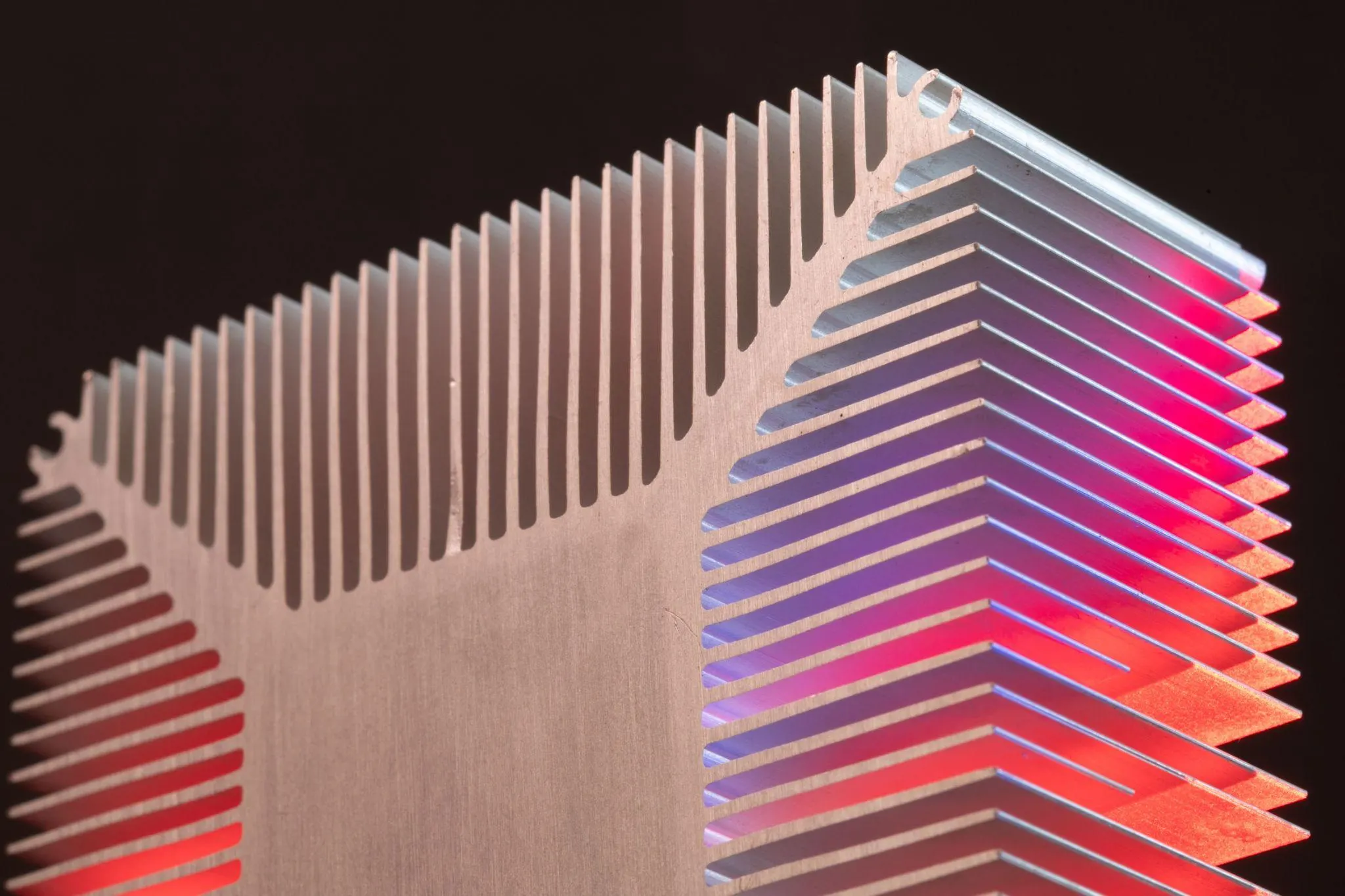
The majority of heat sinks in the marketplace are cut to length, drilled and extruded from aluminum alloy. They are inexpensive and they work! Why print one then? Some products do not permit use of a straight-fin profile. A laser module squeezed side by side with optics, a power converter with airflow that has to bend around the corners: these are the things that happen when geometry is the constraint.
(Pexels) Heat sink
This guide explains what a printed heat sink is, where printing helps, which metals are available to use, the difference between printed heat sinks and CNC heat sinks/extrusions, and what to expect when it comes to finishing and costs.
What Is a 3D-Printed Heat Sink?
(Pexels)
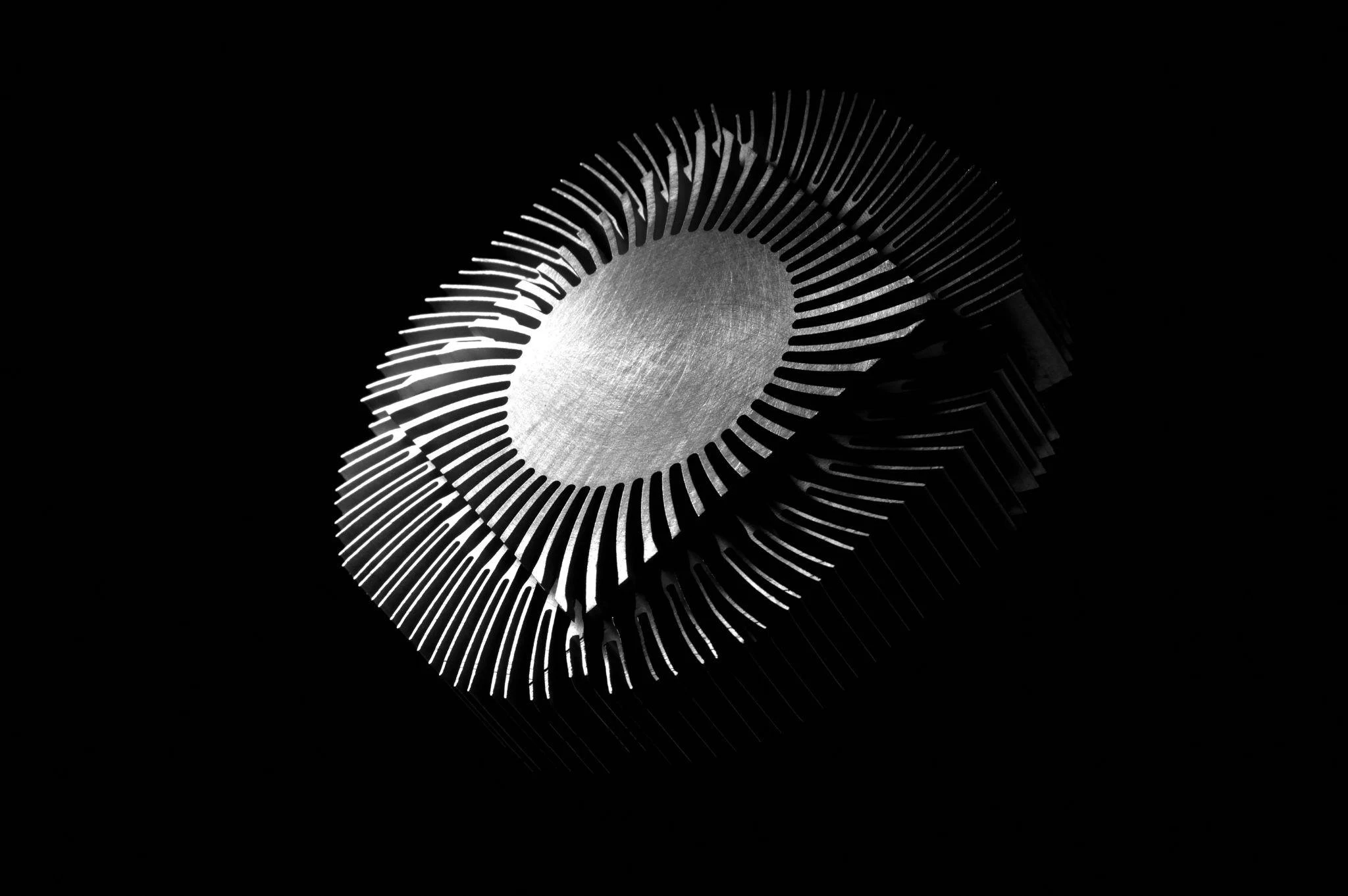
A heat sink removes heat from the object and dissipates it in a large surface area into surrounding air, through a body of metal.
Fins, pins and lattices are made for this purpose, to increase the surface area available to the moving air. Don't confuse it with a heat exchanger. A heat exchanger is used to transfer heat between two fluids and a heat sink to dissipate heat into the environment.
In metal AM, the part is fabricated layer by layer from powder. Laser powder bed fusion involves a laser that melts the cross-section of each layer to be fused into a bed of fine metal powder which then drops, fresh powder is spread, and the process is repeated until the part is built.
You then cut it off the plate and give it a finish. Typical homes for printed heat sinks include power electronics, LED and laser modules, aerospace avionics, EV components and custom prototypes where tooling for a new extrusion die isn't worth it.
How Does Metal 3D Printing Improve Heat Sink Design?
(ResearchGate)
Printing earns its keep in a few specific places. It is worth saying early that none of this guarantees better cooling than a conventional part, and the sections below show where it actually does.
1Complex Fin Geometries
Extrusion pushes material through a die to create one fixed shape. That is why all its fins run straight and parallel. CNC machining allows more shapes, such as pockets and angled cuts, but the cutting tool must be able to reach each area.
3D printing has fewer shape limits. Fins can curve to direct airflow around nearby parts, split into branches, or be thicker at the base and thinner at the tips. Topology optimization software can help design these complex shapes, which are often difficult or impossible to make with extrusion or CNC machining.
This is especially useful in compact enclosures. The heat sink can fit around nearby components instead of taking up a simple rectangular space.
2Lattice and Lightweight Structures
A lattice structure is an interconnected network of thin metal struts or walls. They help to lower weight and increase heat escape surface area. The heat from the base also is transferred to the rest of the heat sink through the metal structure.
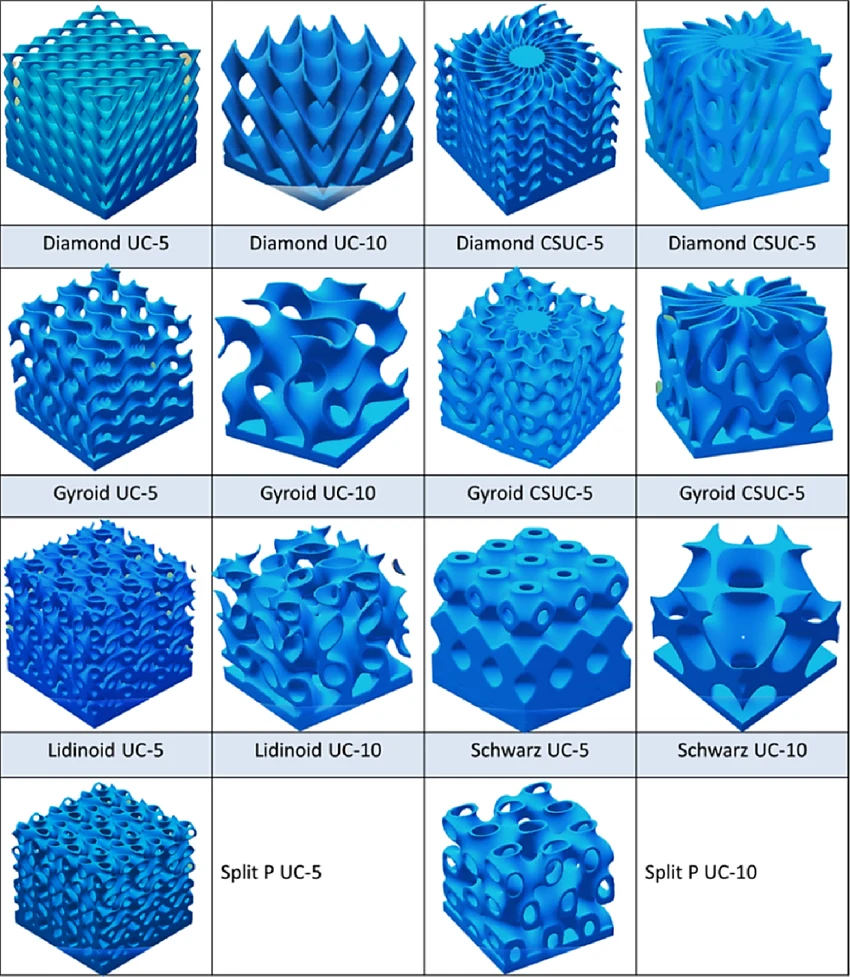
A popular form of lattice is called a TPMS (triply periodic minimal surface). Some examples are Gyroid, Diamond, Schwarz and Split P. Smooth and continuous walls are used in these designs. The heat passes through the metal walls, and the air passes through the spaces. The walls are also linked together, providing multiple ways for heat to flow through the building.
However, the more surface area added, the better the cooling does not always work. A really tight lattice can block the air, and reduce the amount of air flowing through. The thin struts can also snap easily and very small features might be hard to print or completely free of loose powder.
There are published studies that have compared these lattices to the more traditional pin-fin style TPMS heat sinks. The overall conclusion is: the different lattice structures will show different performances, depending on their porosity, wall thickness, tortuosity and pressure drop, and the best one will depend on the airflow and the available pumping power.
Siemens has also written a worked example on designing a heat sink for additive manufacturing, which is worth reading for the simulation workflow: how to design a heat sink for additive manufacturing. Treat any single headline improvement figure with caution, since it rarely transfers to a different heat load or flow condition.
3Integrated Cooling Channels
A printed body can have hollow spaces to pass the liquid or forced air that is located closer to the heat source than any possible drilled hole. A channel can bend, split and rejoin. The practical limit is the powder. The unfused powder must be shaken out, blown out or flushed out after the fuse has been melted, therefore the channel must have an exit, adequate diameter to flush and a form that will not create pockets. Channels with sharp turns or long thin bores are where designs fail at the cleaning stage, not the printing stage.
4Part Consolidation
A traditional cooling device could consist of a base plate, individual fin stack, heat pipe, bracket, and a few fasteners. Thermal resistance is added at each joint. Printing can combine some of these attributes into one and eliminate interfaces, reduce assembly time and reduce number of locations where a joint can become loose or leak. Not everything should be merged, though. Parts that need different materials, such as a copper base under an aluminum fin stack, can't come out of a single aluminum print.
5Custom and Application-Specific Designs
A 3D-printed heat sink doesn't require tooling. Perfect for the hobbyist who is creating their own custom cooler for a weird board, for small teams who are designing their prototype enclosure, and anyone who requires a mounting pattern that is not available in a catalog.
Best Metal Materials for 3D-Printed Heat Sinks
The table gives a rough comparison. Conductivity for printed parts shifts with alloy, build parameters and heat treatment, so use it for ranking, not for calculation.
| Material | Thermal Conductivity | Density | Main Consideration |
|---|---|---|---|
| Copper alloys | Very high | High | Excellent conduction, heavier, harder to print |
| Aluminum alloys | Good | Low | Lightweight, suited to complex AM designs |
| Nickel alloys | Low to moderate | High | High-temperature and corrosion-resistant service |
| Stainless steel | Low | Medium-high | Corrosion resistance rather than heat dissipation |
| Titanium alloys | Low | Medium | High strength and low weight, limited conductivity |
Copper Alloys
Copper conducts about twice as well as aluminium so is the obvious choice for the highest heat flux (Pure copper is around 390–400 W/m·K; 6061 aluminum is around 167 W/m·K in a typical wrought condition. Printed alloys can differ).
However, copper is heavier, more expensive, and more challenging to process than aluminum. The process window is narrow, more power or a different laser is required as a lot of the infrared laser light used in many machines reflects from the copper. In use, it is frequently found at the bottom of a hybrid design.
Aluminum Alloys
Aluminum alloys are a practical choice for lightweight metal heat sinks, particularly when weight reduction and appearance matter. Common alloy 3d printing options include AlSi10Mg and 6061 aluminum.
Although aluminum has good thermal conductivity (wrought 6061 is approximately 167 W/m·K), its suitability for heat sink applications also depends on the operating temperature and the properties of the printed alloy. For applications with operating temperatures above 150℃, aluminum alloy selection and thermal stability require careful evaluation. Aluminum is better suited for low- and moderate-temperature thermal management solutions.
One of aluminum's key advantages is its compatibility with anodizing. Anodized aluminum can be finished in colors such as black, red, silver, and yellow, while the anodized layer also provides additional surface protection. This makes it suitable for lightweight heat sink components used in lower-temperature environments where both functional design and appearance are important, such as electronic enclosures and consumer electronics. For more information, see our aluminum 3D printing guide.
Stainless Steel
Stainless is a poor conductor, so it rarely makes a good heat sink on its own. It earns a place when the part has to survive corrosive or washdown conditions and the heat load is modest. For a direct comparison of the two metals, see aluminum vs stainless steel.
Other Metal Alloys
Titanium and nickel alloys conduct heat poorly. They appear in heat sinks only where temperature, strength or chemical attack rules out the easy options, such as aerospace hardware near an engine.
What Is the Best Metal for a Heat Sink?
There isn't a single winner. Aluminum is the practical choice because it offers a good balance of thermal conductivity, low weight, and cost. Choose copper when heat spreading is the priority and the added weight and cost are acceptable. Stainless steel, nickel alloys, and titanium are better reserved for specialized applications where their mechanical or environmental properties outweigh their thermal disadvantages.
For 3D-printed heat sinks, material selection should also account for process compatibility and the properties of the finished part. Thermal conductivity alone does not determine cooling performance; fin geometry, airflow, contact resistance, and the overall thermal design matter as well.
Which Metal 3D Printing Processes Can Make Heat Sinks?
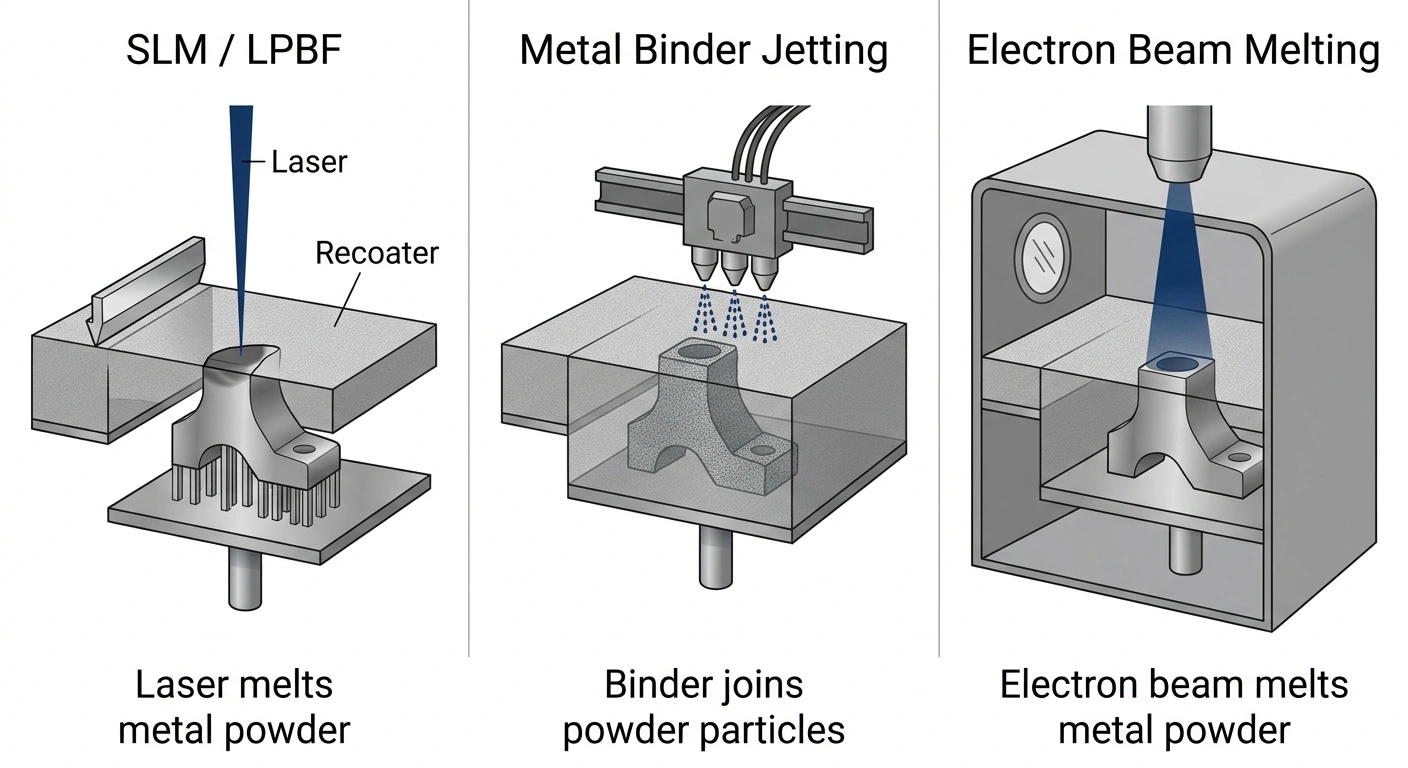
Different processes offer different advantages and limitations. SLM / LPBF is suitable for complex fin geometries, lightweight lattices, and integrated cooling channels. Metal BJ offers potential for batch production, while EBM is used for applications involving specific high-performance alloys.
The following table compares their capabilities and suitability.
SLM vs BJ vs EBM
| Process | Advantages | Limitations | Suitable Heat Sink Designs | Best for |
|---|---|---|---|---|
| SLM / LPBF | High feature resolution; suitable for complex fins, lattices and integrated channels | Residual powder in enclosed channels; support removal; thermal distortion | Complex fin structures, lightweight lattices and custom cooling channels | EV power electronics, compact electronic devices |
| Metal Binder Jetting (BJ) | No laser melting; supports complex geometries; suitable for batch production | Sintering shrinkage; dimensional variation; green-part fragility; internal powder removal | Relatively large, less delicate heat sink structures and batch-produced components | metal cooling components, industrial electronics |
| Electron Beam Melting (EBM) | High-temperature powder-bed process; suitable for reactive alloys such as titanium | Coarser surface finish; relatively limited fine-feature capability; powder removal challenges | Larger, robust heat sink structures where fine fins and surface finish are less critical | Aerospace and specialized high-temperature applications |
Note: The application types listed here reflect general process characteristics and do not imply that all three processes are offered by JLC3DP.
Selective Laser Melting (SLM / LPBF)
The primary path for printed heat sinks is known as SLM or laser powder bed fusion. Works well with thin fins, lattices and internal passages, as well as aluminum alloys. Parts require supports to hold them in place on the build plate and to limit thermal distortion of the parts, which are subsequently removed. As said above, design internal channels so the powder can leave.
Limitations:
- Support requirements: Supports help anchor the part to the build plate and reduce thermal distortion. They must be removed after printing, which can be difficult in inaccessible areas.
- Residual powder in internal channels: Unfused metal powder can become trapped in narrow passages, curved channels, and enclosed lattice structures. This is particularly challenging for microchannel heat sinks, where residual powder can restrict airflow or coolant flow.
- Thermal distortion: Localized heating and cooling can cause residual stress and deformation, especially in thin fins and large, delicate structures.
Design Tips: Provide enough openings for powder removal and optimize channel orientation to ensure easy post-print cleaning and inspection.
Metal Binder Jetting
Binder jetting involves printing a binder onto a powder bed and the printed part is subsequently debound and sintered. The part will shrink during sintering, so designs should be made to accommodate shrinkage and avoid sagging features in the furnace. Long, thin fins are dangerous. It is not universally faster or cheaper than laser melting, and results depend on the part and the batch. The comparison is covered in our binder jetting vs SLM guide.
Limitations:
Sintering causes dimensional shrinkage. Thin fins and delicate structures deform, while unbound powder can be difficult to remove.
Design Tips:
- Account for shrinkage: Apply dimensional compensation based on the material and sintering process.
- Avoid fragile features: Use sufficiently thick fins and robust connections to reduce the risk of deformation.
- Design for depowdering: Provide accessible openings for removing unbound powder before sintering.
Electron Beam Melting (EBM)
EBM is a powder-melting process which utilises an electron beam to melt the powder in a heated vacuum chamber. Titanium and some nickel alloys have a higher incidence than in the case of aluminium heat sinks, and the surface has a coarser finish. It is not the first choice for a typical aluminum or copper cooler.
Limitations:
EBM produces rougher surfaces and has limited capability for fine features. This makes it less suitable for heat sinks with very thin fins or narrow cooling channels.
Design Tips:
- Avoid overly fine features: Use relatively thick fins and larger channel openings.
- Consider surface roughness: Account for the as-printed surface condition when designing airflow or coolant passages.
- Plan for powder removal: Ensure internal cavities and channels have accessible openings for removing residual powder after printing.
3D-Printed vs. CNC Machined vs. Extruded Heat Sinks
| Factor | CNC machining | Metal 3D printing | Aluminum extrusion |
|---|---|---|---|
| Geometry | Limited by tool access | Complex shapes, lattices and changing geometries | Constant cross-section along the length |
| Internal channels | Possible with drilling and machining, but complex paths are difficult | Complex channels are possible if powder can be removed | Hollow channels are possible in the extruded profile |
| Surface finish | Smooth on machined surfaces | Often needs finishing | Generally consistent |
| Material waste | Produces chips, which can often be recycled | Unused powder may be reused, depending on the process | Efficient material use |
| Best suited to | Custom parts and precise features | Complex or consolidated designs | Standard profiles and high-volume production |
CNC machining is ideal for custom heat sinks requiring precise mounting features, flat contact surfaces, and tight dimensional tolerances.
Metal 3D printing excels at producing complex fins, lattice structures, and integrated cooling channels—justifying its premium cost when conventional machining is infeasible or when part consolidation yields critical performance gains.
For high-volume production of standard fin profiles, aluminum extrusion remains the most practical choice, though it cannot accommodate custom internal geometries.
What Post-Processing Do 3D-Printed Heat Sinks Need?
CNC Machining
Almost always for the face that touches the heat source. A printed surface has texture, and a rough contact patch leaves microscopic air gaps that add thermal resistance, even with paste. Machining the base flat and drilling mounting holes to size fixes that cheaply, and many printed heat sinks have no other finishing.
Sandblasting
It removes loose powder and surface particles left after printing. It also gives the part a more even, matte finish. It is useful for cleaning and appearance, but it does not replace machining when a surface needs to be flat or meet a tight tolerance.
Anodizing
Anodizing adds a protective oxide layer to aluminum. It improves surface hardness and corrosion resistance, and the surface can be dyed in colors such as black, red, blue or gold.
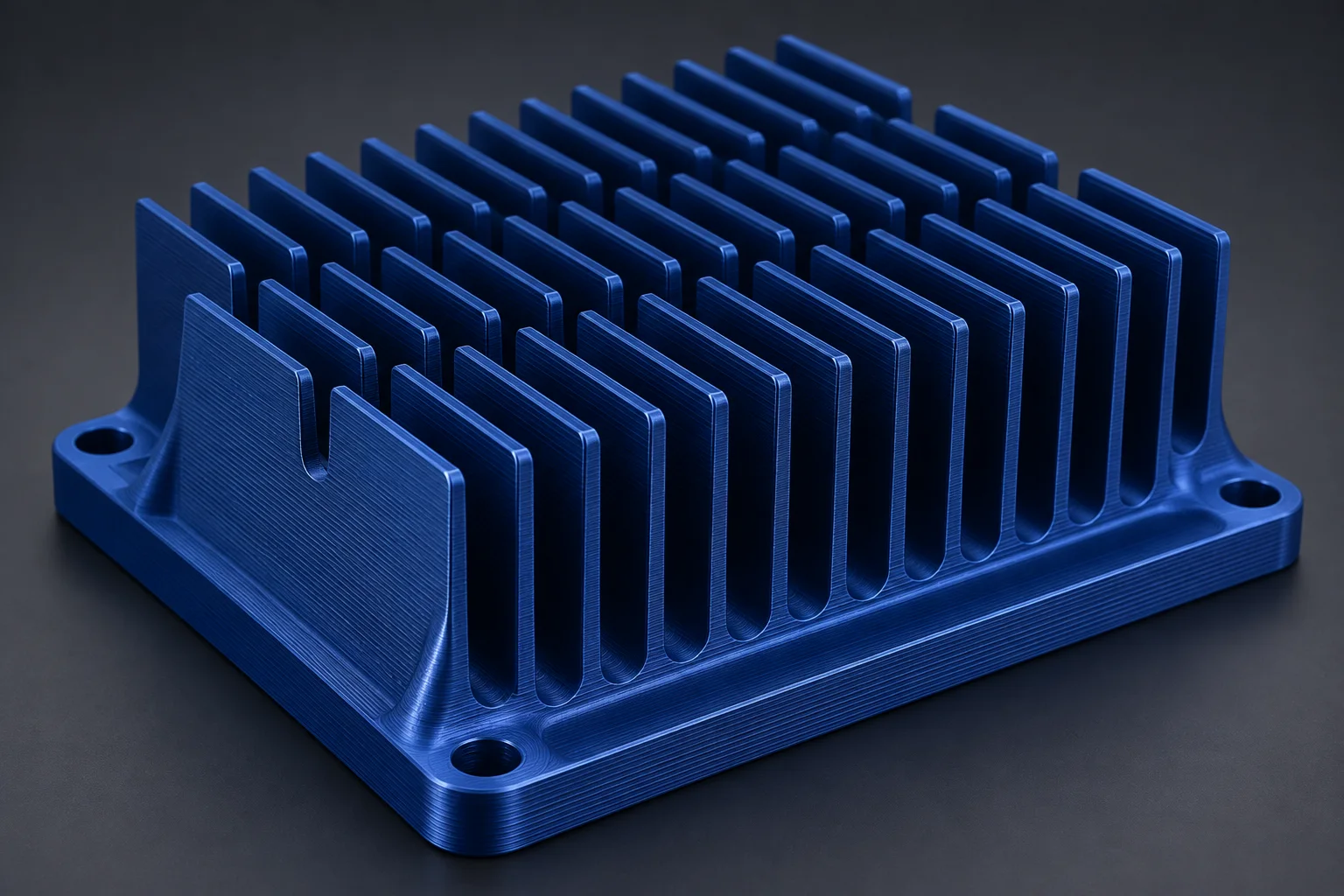
Black anodizing can also increase the surface's ability to release heat through radiation. This can help in applications where radiation is a meaningful part of the cooling process. The effect is usually less important when forced airflow does most of the cooling.
The oxide layer is less conductive than the aluminum underneath it, so avoid anodizing contact surfaces where heat needs to pass directly between two components. Anodizing also adds a small amount of thickness, which should be considered when specifying mating features.
The printed part may need several finishing steps before it is ready for assembly. JLC3DP offers options such as sandblasting, polishing for metal 3D-printed parts. Check which finishes are available for your selected material and process.
See the metal 3D printing post-processing guide.
What Affects the Cost of 3D-Printed Heat Sinks?
Powder cost depends on the alloy. Part dimensions and how well they fill the build volume decide how many parts share a plate. Geometry complexity drives print time, support structures add removal labor, and heat treatment and finishing add steps. Quantity and nesting then spread the fixed costs. Weight alone can't predict a quote, because a small, intricate heat sink can cost more than a larger plain one. So an aluminum heat sink price for a printed part can't be read off a catalog. Our metal 3D printing cost guide covers it.
Manufacturing Considerations for 3D Printed Heat Sinks
Manufacturing considerations involve prices, manufacturing capabilities, material options, quality control, and ability to handle your part from prototyping to production.
1Available Technologies and Materials
Select a metal alloy and printing process based on the heat sink's operating temperature, thermal conductivity, weight, and mechanical requirements. Check whether the provider offers the required material and ask for property data from printed parts in the relevant condition.
2Build Size and Design Constraints
Confirm that the heat sink fits within the printer's build envelope. Also consider minimum feature sizes, fin thickness, support requirements, and powder removal when designing lattices or internal cooling channels.
For example, JLC3DP's SLM Aluminum 6061 service supports parts up to 420 × 380 × 400 mm. Actual printable dimensions may also depend on part geometry and build orientation.
3In-House Production and Post-Processing
Consistent heat sink production requires more than reliable printing. Powder handling, build preparation, process control, and post-processing all affect part quality and lead time. Managing these steps across multiple suppliers can also increase coordination and delivery risks.
JLC3DP operates a large-scale manufacturing facility with in-house metal 3D printing, sandblasting, and polishing capabilities. Integrated production helps reduce external supplier reliance and supports the transition from prototypes to mass production.
4Quality and Inspection Requirements
Define the requirements before ordering, including dimensional tolerances, contact surface flatness, material properties, and inspection needs. For batch production, also consider material traceability and consistency between parts.
3D Printed Heat Sinks FAQs
Q: Are 3D printed heat sinks better than extruded ones?
Only in the right cases. Complex geometry and consolidation can help, but a simple fin shape usually cools about the same as an extrusion at a higher price.
Q: What is the best aluminum for a heat sink?
Conductivity favors softer, purer alloys, while printing favors AlSi10Mg or 6061 that the provider has validated. Ask for printed-material data.
Q: Does anodizing hurt heat dissipation?
Slightly in conduction, and it can help radiation. Black anodizing is the usual choice for that reason. The net effect is small and depends on airflow.
Q: Can you print copper heat sinks?
Yes, with more difficulty and cost than aluminum, because copper reflects laser energy.
Creating New Possibilities in Heat Sink Design
The real value of 3D printed heat sinks lies not in lower costs, but in design freedom. Metal 3D printing enables complex fins, lightweight lattice structures, and integrated cooling channels—geometries that are nearly impossible with traditional methods.
This flexibility lets engineers rethink thermal structures and build custom solutions for tight spaces or demanding cooling needs.
These design freedoms allow engineers to rethink heat sink structures and develop application-specific thermal management solutions, especially where space is limited or conventional designs cannot meet cooling requirements.
While extrusion and CNC machining remain ideal for standard, simpler heat sink parts, 3D printing opens a powerful new path for complex, highly integrated heat sinks.
Keep Learning
3D Printed Heat Sinks: Design, Materials & Manufacturing
Key Takeaways 3D printed heat sinks enable complex fins, lattice structures, and internal cooling channels that are difficult for traditional manufacturing. 3D printing does not improve cooling performance; simple designs are often better suited to extrusion or CNC machining. Copper provides maximum thermal conductivity; aluminum balances performance, weight, and cost, with customizable anodized colors. Choose the manufacturing process based on design complexity, precision, and production volume. Post......
3D Printing for Rapid Prototyping: Pick the Right Tech, Material & Budget
Rapid prototyping with 3D printing lets engineers turn a CAD file into a physical part in days instead of weeks. No tooling. No minimum order quantities. No waiting for a machine shop to fit your job into the schedule. Just a design file and a printed part you can hold, test, and iterate on before committing to expensive production tooling. That's the core value proposition. But additive manufacturing prototyping isn't a single process, it's a family of technologies, each suited to different prototype......
Functional 3D Printing for Real Parts: Design Rules, Materials & Uses
Functional 3D Printing for Real Parts: Design Rules, Materials & Uses Key Takeaways Functional 3D printing is used for real, load-bearing parts, not just prototypes. Design matters more than material — poor geometry or orientation causes most failures. SLS and MJF PA12 offer the most reliable performance for production-grade polymer parts. Metal 3D Printing (SLM/BJ) is essential when requirements exceed the thermal or mechanical limits of polymers. Success depends on the "Triple Threat": orientation, ......
Mass Customization Manufacturing: Benefits, Costs & 3D Printing
Key Takeaways Mass customization lets manufacturers produce unique or personalized products at near-mass-production costs. Unlike traditional manufacturing that requires expensive tooling upfront, mass customization, especially through 3D printing, skips that entirely. You get flexibility without the usual price penalty. The technology making this possible today includes parametric CAD design, 3D printing farms, and digital supply chains that can handle thousands of different configurations without re......
3D Printed Houses: the future of residential construction?
In recent years, 3D printed houses, as a new type of housing, have attracted a lot of attention. The news mentioned that this technology can complete the construction of houses in less than 24 hours, and it is more economical and environmentally friendly than traditional construction methods. What is the actual effect of 3D printed houses? This article will analyze the current status of this emerging construction technology and the problems it faces from multiple perspectives. Source: TODAY.com 1. The......
CES 2026 Hardware Trends: How Manufacturing Is Shaping AI and Robotics
CES 2026 Hardware Innovation Trends: From Prototypes to Industrial-Grade Manufacturing CES is widely regarded as the world’s leading technology showcase—and a real indicator of where global hardware innovation is heading. In 2026, CES revealed a clear shift: innovation is no longer about impressive demos. It’s about building products that can survive real-world environments, pass functional testing, and move toward scalable manufacturing. According to official data from the CES 2026 Innovation Awards:......