Micro 3D Printing Explained: Technologies, Materials and Applications
19 min
- Introduction
- What Is Micro 3D Printing?
- How Small Can Micro 3D Printing Actually Print?
- Which Micro 3D Printing Technology Should You Choose?
- What Materials Can Be Used for Micro 3D Printing?
- What Can Micro 3D Printing Be Used For?
- What Are the Biggest Challenges in Micro 3D Printing?
- FAQ About Micro 3D Printing
Introduction
Standard 3D printing builds parts you can hold in your hand. Micro Printing — and more precisely Micro 3D printing builds parts you need a magnifying glass to see, and sometimes a microscope. A microneedle array for drug delivery. A microfluidic chip with channels thinner than a human hair. A miniature optical lens with surface accuracy measured in microns. These aren't just smaller versions of parts you'd make on a standard FDM printer. They're a different category of manufacturing entirely, requiring different technologies, different materials, and a completely different approach to what "precision" means.
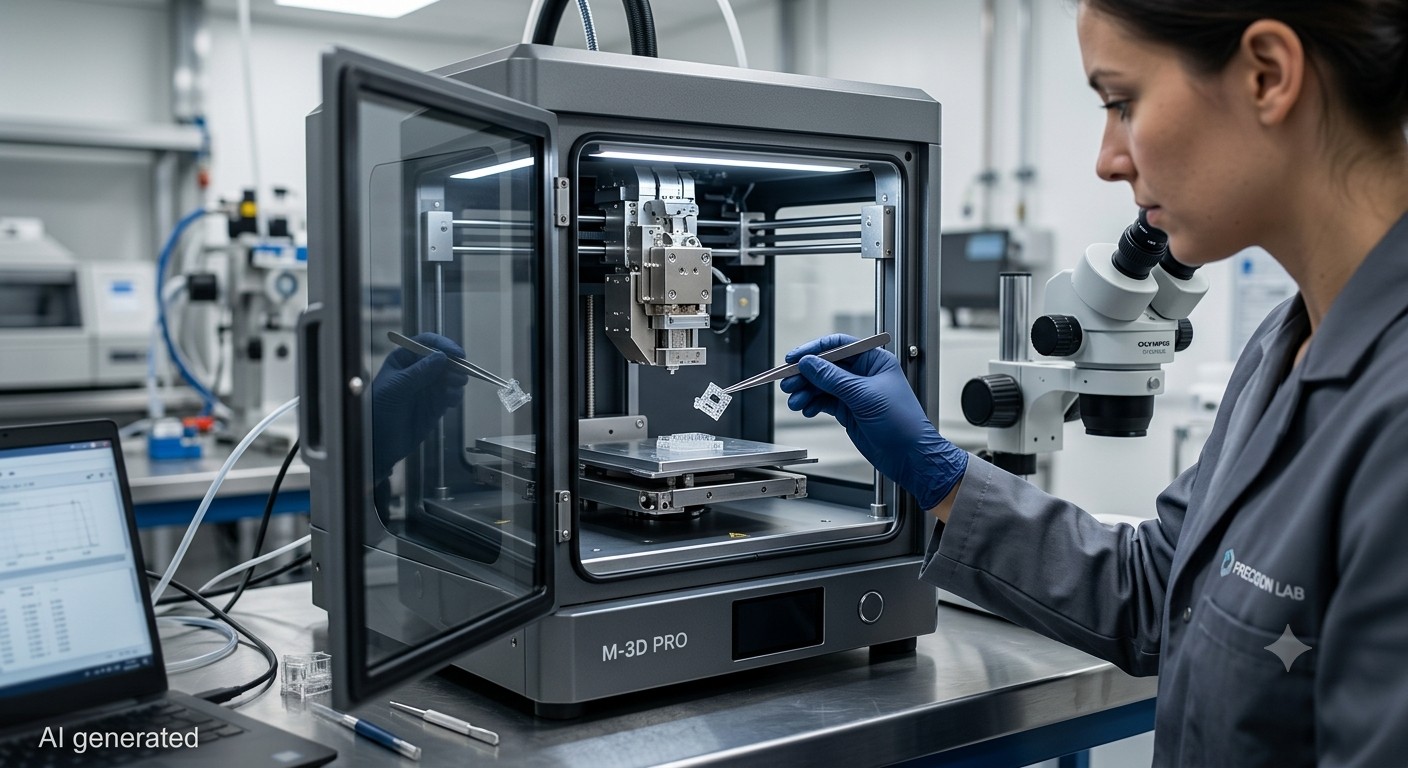
This guide covers what micro 3D printing actually is, how small it can realistically go, which technology suits which application, and where this whole field is heading.
What Is Micro 3D Printing?
Micro 3D printing is additive manufacturing at microscale resolution, producing parts with features measured in microns (µm) rather than millimeters, where the printing technology and process are specifically optimized for precision at that scale rather than adapted from larger-format equipment.
The "micro" designation isn't a marketing term for a small printer. It describes a genuine technical category where the resolution, the physics of the process, and the applications involved are fundamentally different from conventional additive manufacturing.
What Makes Micro 3D Printing Different from Conventional 3D Printing?
Feature size is the primary distinction. A standard SLA printer might achieve 50–100 µm feature resolution. Micro SLA and dedicated micro 3D printing technologies achieve 10–25 µm, and specialized processes like Two-Photon Polymerization (TPP) go below 1 µm, producing features smaller than a red blood cell.
Resolution in micro 3D printing is controlled more tightly because the applications demand it. A microfluidic chip with channels at 50 µm doesn't work if the channel comes out at 80 µm — the flow behavior changes, the device fails. A microneedle intended to penetrate skin without causing pain has a tip geometry tolerance measured in a few microns. Conventional 3D printing tolerances of ±0.1–0.5mm are irrelevant in these applications. Micro additive manufacturing operates at tolerances that make standard 3D printing look coarse.
The voxel, the three-dimensional pixel of material deposited or cured in each micro print cycle, is correspondingly smaller in micro 3D printing. Where a standard FDM extruder deposits material in strands 0.4mm wide, micro printing technologies work with voxels at 1–25 µm scale. This smaller fundamental build unit is what enables feature resolution that conventional printing can't approach.
Key Advantages of Micro 3D Printing
The precision that micro printing enables is what makes it valuable, but that precision opens up applications that would be impossible any other way. Micro 3D printing produces complex internal geometry — channels, lattices, hollow structures, undercuts — that micromachining can't reach and traditional microfabrication requires multiple costly process steps to achieve.
Miniaturization without assembly is perhaps the biggest practical advantage. Conventional manufacturing of a microfluidic chip requires photolithography, etching, bonding of multiple layers — each step adding cost and failure opportunity. Micro additive manufacturing can produce the entire chip geometry in one build, including the internal channels, inlet ports, and surface features, without assembling separate layers.
Design freedom at microscale is genuinely broader than at any other manufacturing scale. Features that would require EDM or focused ion beam machining to produce can come directly off a micro 3D printing system in hours rather than days.
How Small Can Micro 3D Printing Actually Print?
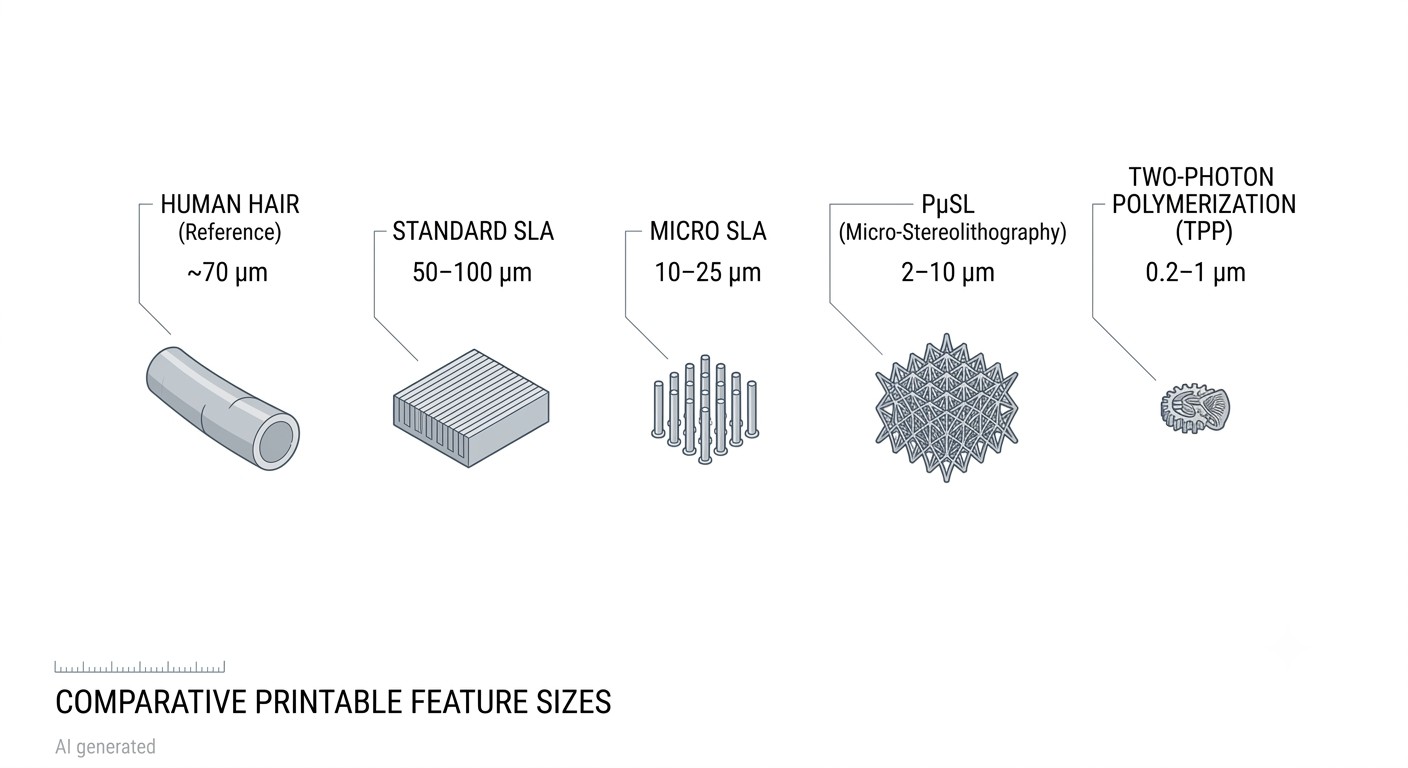
The straightforward answer: the best micro 3D printing technologies today achieve minimum feature sizes around 0.2–2 µm with TPP, 5–25 µm with micro SLA and PµSL systems, and 20–50 µm with standard DLP platforms pushed toward high resolution.
To put that in context: a human hair is roughly 70 µm in diameter. TPP micro printing can produce features smaller than 1/70th of a hair's width.
What Determines the Minimum Printable Feature Size?
Three things control minimum feature size in micro 3D printing:
Laser spot size or pixel size. In laser-based micro printing (SLA, TPP), the laser beam's focused spot size defines the minimum cure area in the X-Y plane. Smaller spot size equals smaller possible feature. High-end micro SLA systems use optical systems that focus the laser to a spot below 10 µm. Conventional SLA uses spots of 100–300 µm.
Voxel dimensions. Each cured unit of resin in photo-based micro printing is a voxel, a three-dimensional zone of solidified material. The voxel's width and depth set the fundamental resolution limit. TPP systems achieve voxels at sub-micron scale because the two-photon absorption process only occurs at the precise focal point of the laser, not throughout the beam path.
Material photosensitivity. The resin's response to light exposure affects how precisely the curing zone can be controlled. Resins formulated for micro printing have tightly controlled photoinitiation responses that minimize cure spread beyond the intended voxel, which is essential for maintaining resolution at small feature scales.
Micro 3D Printing vs Nano 3D Printing
Micro printing and nano printing describe different resolution regimes, and the distinction matters when specifying which technology you actually need.
Micro 3D printing produces features in the range of 1–1000 µm (one micron to one millimeter). The majority of microfluidic, MEMS, micro optics, and precision engineering applications fall in this range — features visible under a standard optical microscope.
Nano 3D printing operates below 1 µm, producing features in the nanometer range that require electron microscopy to observe. TPP at its finest settings approaches nano-scale capability, but true nano 3D printing at scale remains largely in research territory. The applications — nanophotonics, quantum device fabrication, nanoscale drug delivery structures — are more specialized than even typical micro additive manufacturing.
For most engineering applications described in this guide, micro 3D printing is the relevant technology. Nano printing is a more specialized subset that requires dedicated nanoscale equipment and materials.
Which Micro 3D Printing Technology Should You Choose?
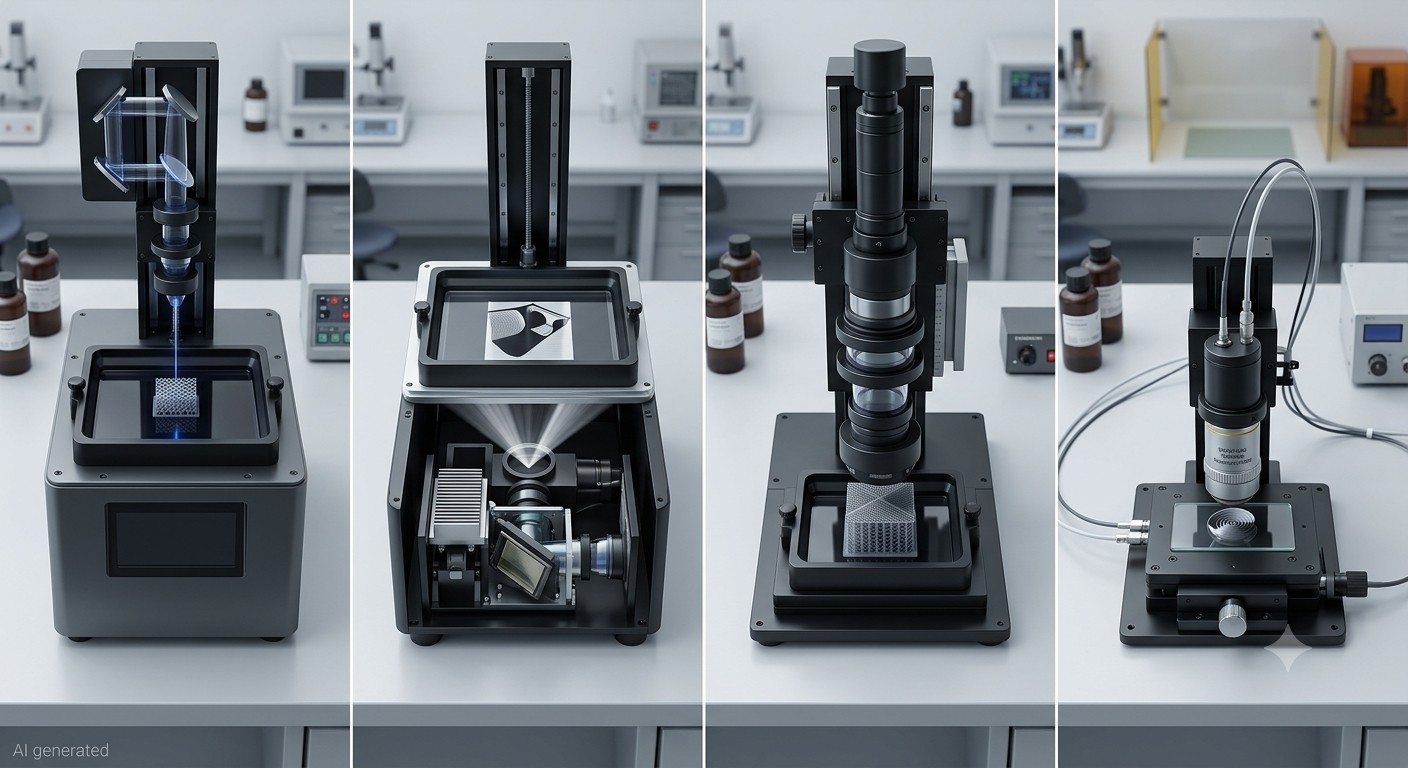
This is the decision that actually matters for application engineers. Different micro 3D printing technologies occupy different positions on the resolution-speed-material tradeoff, and picking the right one determines whether the application is feasible, affordable, and scalable.
SLA and Micro SLA
Standard industrial SLA systems are designed for high-precision engineering parts rather than true micro-scale fabrication. While they can produce fine details for many engineering applications, they generally do not achieve the micron-level feature sizes required for dedicated micro 3D printing.
Standard SLA uses a laser to cure liquid photopolymer resin point by point across each layer. Dedicated micro SLA systems employ tighter beam focusing optics, specialized optical systems, and finer layer thicknesses to achieve feature resolutions of approximately 10–25 μm, significantly finer than conventional industrial SLA.
Micro SLA is an established technology for applications requiring higher resolution than conventional 3D printing but not the extreme sub-micron capability of Two-Photon Polymerization (TPP). Typical applications include connector housings, miniature precision components, dental devices, and highly detailed prototypes.
Compared with more advanced micro 3D printing technologies, the primary limitation of micro SLA is throughput. Because the laser scans each feature sequentially, build times increase as part size and complexity grow.
For most engineering prototypes and functional parts, however, industrial SLA offers an excellent balance of accuracy, surface finish, cost, and production speed without requiring dedicated Micro 3D Printing equipment.
Digital Light Processing (DLP)
DLP cures an entire layer at once by projecting a pattern of light through a digital micromirror device (DMD) — instead of scanning point by point, the whole layer is exposed simultaneously. This makes DLP significantly faster than laser-scanning approaches at equivalent resolution.
The resolution in DLP-based micro 3D printing is determined by the pixel size of the projected image, which depends on the DMD chip resolution and the optical magnification system. High-resolution DLP systems achieve 10–20 µm pixel size with appropriate optics.
DLP is the preferred technology when throughput matters alongside resolution — dental production, hearing aid housings, small electronics components, and other applications where multiple parts need to be printed at micro scale economically.
Projection Micro Stereolithography (PµSL)
PµSL is a specialized development of DLP optimized specifically for micro 3D printing applications. Where standard DLP uses relatively large projection areas with moderate resolution, PµSL uses high-magnification optics to project very small images at very high pixel density, achieving 2–10 µm feature resolution across a build area that might be only 5–20mm across.
PµSL is the technology of choice for microfluidic chip production, MEMS prototyping, micro optics fabrication, and any application that needs better resolution than micro SLA but doesn't require TPP's sub-micron capability. It occupies the practical precision sweet spot for most engineering micro 3D printing applications.
Two-Photon Polymerization (TPP)
TPP is in a different class from every other micro additive manufacturing technology in terms of resolution. Where SLA, DLP, and PµSL cure resin through single-photon absorption across a finite zone, TPP uses a focused femtosecond laser where polymerization only occurs at the precise focal point where photon density is high enough to trigger simultaneous two-photon absorption. This nonlinear process creates a curing voxel of 0.2–1 µm, fundamentally smaller than any single-photon process can achieve.
The result is micro 3D printing capable of producing structures smaller than the wavelength of visible light. Woodpile photonic crystal lattices. Three-dimensional waveguide structures. Scaffold geometries for tissue engineering with pore sizes calibrated to cell dimensions. Microneedle arrays with tip radii below 1 µm. These are applications where no other manufacturing process competes with TPP.
The practical limitations: TPP is slow, because the sub-micron voxel must be scanned across every cubic micron of the part. Build volumes are typically small — a few cubic millimeters to a cubic centimeter at most. And TPP systems are expensive, which is why most access to this technology comes through service providers rather than in-house equipment.
Which Technology Is Best for Your Application?
| Technology | Resolution | Speed | Build Volume | Best For | Cost |
|---|---|---|---|---|---|
| Micro SLA | 10–25 µm | Moderate | Small-Medium | Detailed prototypes, small precision parts | $$ |
| DLP | 10–50 µm | Fast | Medium | Multi-part production, dental, housings | $$ |
| PµSL (BMF printing) | 2–10 µm | Moderate | Small | Microfluidics, MEMS, micro optics | $$$ |
| TPP | 0.2–1 µm | Slow | Very Small | Nanoscale research, microneedles, photonics | $$$$ |
| Micro LPBF/SLM | 20–50 µm | Slow | Small | Micro metal 3D printing, metallic MEMS | $$$$ |
What Materials Can Be Used for Micro 3D Printing?
Photopolymer Resins
Resins formulated for micro 3D printing need tighter photosensitivity control than standard resins — the curing zone must be confined precisely to the intended voxel without spreading into adjacent areas. Standard 3D printing resins often have cure depth and width that exceed the voxel by an amount that's irrelevant at millimeter scale but catastrophic at 10 µm scale.
Micro printing resins divide into rigid engineering resins for structural components, biocompatible resins for medical device and tissue engineering applications, optically clear resins for micro optics and imaging components, and flexible resins for membrane structures and soft microfluidic devices. Material choice at micro scale is more application-driven than at conventional scale — the combination of feature resolution and material property requirements narrows the options significantly for any given application.
Metals for Micro Additive Manufacturing
Micro metal 3D printing is technically achievable but remains a highly specialized manufacturing process. Micro LPBF (Laser Powder Bed Fusion), sometimes referred to as micro SLM, uses ultra-fine metal powders — typically 5–15 μm compared with 15–45 μm in conventional LPBF systems — together with tightly focused laser beams to produce metallic features in the 50–200 μm range.
Most commercially available metal additive manufacturing systems are optimized for feature sizes above approximately 100 μm. Dedicated micro LPBF systems remain largely limited to research institutions and specialized manufacturers rather than mainstream commercial production.
Applications include metallic MEMS sensors, microelectrode arrays, miniature surgical instruments, and medical implants where both metallic material properties and micro-scale geometries are essential. Although feature sizes of around 50 μm are impressive for a metal additive manufacturing process, they remain significantly larger than the 2–10 μm achievable with PµSL or the sub-micron resolution of TPP. Consequently, resin-based micro 3D printing technologies remain the preferred solution for applications requiring the highest level of geometric precision.
Are Engineering Plastics Like Nylon Used in Micro 3D Printing?
Not typically. Engineering plastics like nylon are processed by SLS and MJF, which provide excellent mechanical properties and isotropy but can't approach the resolution of resin-based micro 3D printing — minimum feature sizes for SLS are in the 0.5–1mm range, which is orders of magnitude coarser than PµSL or TPP.
Research into micro-scale powder bed fusion is ongoing, and selective laser sintering systems at finer parameter settings have demonstrated features below 200 µm in specialized academic applications. But this hasn't translated into commercial micro 3D printing services for engineering plastics at anything approaching the resolution of resin-based micro printing. For now, if an application needs both micro-scale resolution and engineering plastic properties, the design typically needs to be adapted for resin materials, or the resolution requirement reconsidered.
What Can Micro 3D Printing Be Used For?
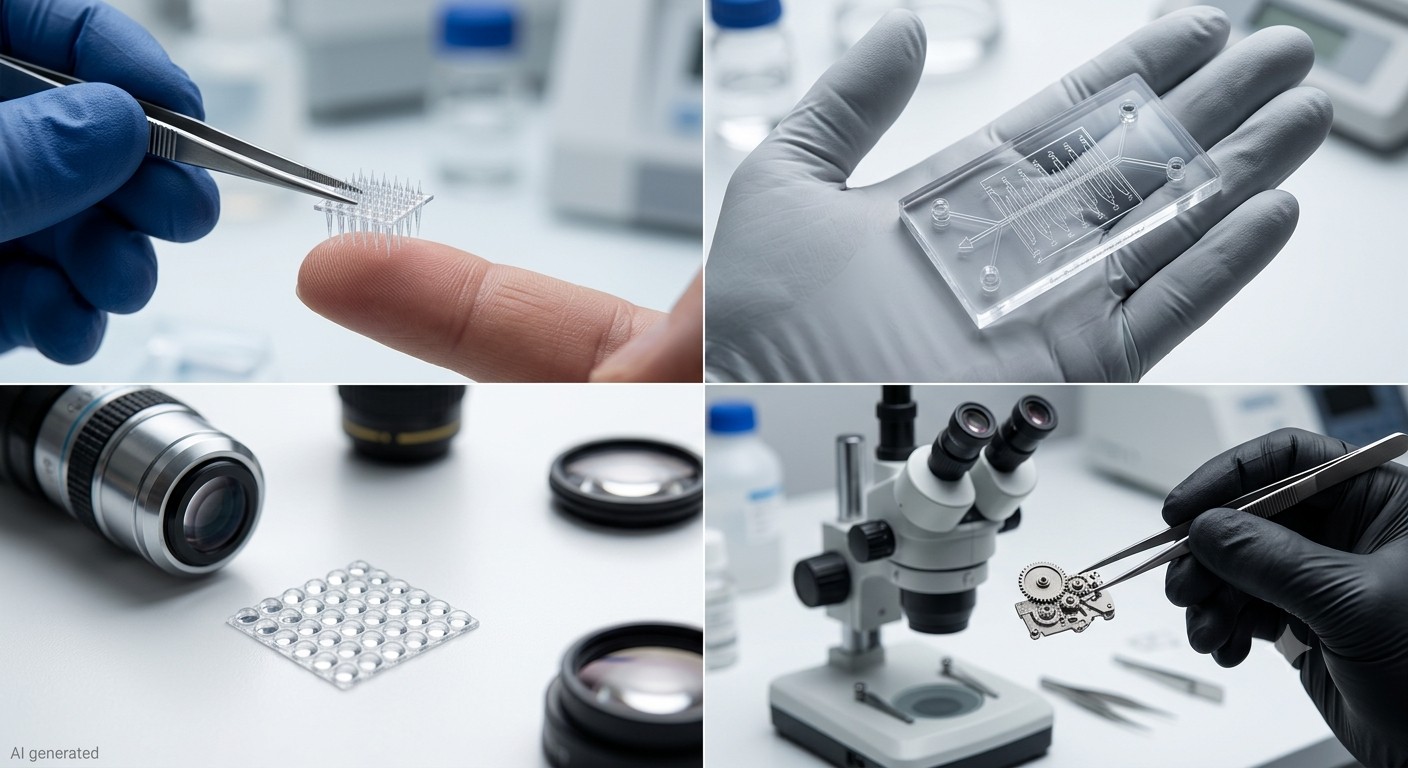
Micro 3D printing solves manufacturing problems that either don't have another solution or have solutions significantly more expensive and complex than micro additive manufacturing provides. The application areas cluster around a few industries where miniaturization and geometric complexity intersect.
Biomedical Devices
Microneedle arrays for transdermal drug delivery are one of the most compelling micro 3D printing applications. A microneedle array creates microscale needle structures that penetrate the stratum corneum without reaching pain receptors — painless injection or sampling. The tip radius and shaft geometry directly affect skin penetration behavior, which makes the dimensional precision of micro 3D printing critical rather than incidental. TPP can produce microneedle tips below 1 µm radius with shaft aspect ratios that standard manufacturing can't achieve.
Tissue engineering scaffolds printed at micro scale use lattice geometries with pore sizes and interconnect dimensions calibrated to the cell types being cultured. The scaffold's micro-architecture controls cell adhesion, proliferation, and differentiation, which means the micro printing resolution directly determines the biological outcome rather than just the cosmetic appearance.
Microfluidics and MEMS
Microfluidic chips integrate fluid handling at micro scale — mixing, separation, reaction, and analysis of tiny fluid volumes in channels 10–500 µm wide. Lab-on-chip devices, diagnostic platforms, and chemical synthesis microsystems all use microfluidic architecture that micro 3D printing can produce in single integrated structures.
PµSL and micro SLA are the dominant micro 3D printing technologies for microfluidic chip production because they combine sufficient resolution (channels to 10–20 µm), transparent or translucent materials (important for optical detection), and moderate throughput for prototype and small-batch production.
MEMS (microelectromechanical systems) traditionally require photolithographic fabrication in semiconductor clean rooms — a multi-step, capital-intensive process. Micro additive manufacturing offers a complementary path for MEMS prototyping and custom low-volume MEMS structures where the semiconductor fab process isn't economically justifiable.
Electronics and Micro Optics
Miniature connector housings, EMI shield features, micro-scale antenna structures, and circuit board components push toward dimensions where conventional injection molding can't maintain feature quality. Micro 3D printing produces these features directly from CAD without tooling cost, which suits the low-to-medium volumes and frequent design iterations of electronics development.
Micro optics fabrication using TPP and PµSL produces lens arrays, beam splitters, light guides, and diffractive optical elements at scales where the optical performance depends on surface geometry accuracy at the micron level. Freeform micro optics — lens shapes that aren't simple spheres or cylinders, optimized for specific optical functions — are particularly well-suited to micro 3D printing because their geometry can't be produced economically by any other method.
| Industry | Typical Parts | Recommended Technology |
|---|---|---|
| Biomedical | Microneedles, scaffolds, implants | TPP |
| Microfluidics | Lab-on-chip devices, diagnostic chips | PµSL |
| MEMS | Sensors, actuators, membrane structures | PµSL |
| Electronics | Miniature connectors, housings | Micro SLA, DLP |
| Micro Optics | Lenses, waveguides, optical elements | TPP, PµSL |
| Precision Engineering | Miniature mechanisms, micro parts | Micro SLA, Micro SLM |
What Are the Biggest Challenges in Micro 3D Printing?
Resolution and Material Limitations
Getting resolution down to the micron level requires sacrificing build volume — there's an inherent tradeoff in micro 3D printing between how small features can go and how large the printable area is. PµSL at 2 µm resolution might offer a 20mm × 20mm build area. Scaling up the build area reduces resolution. This means micro additive manufacturing isn't the answer for large parts with micro-scale features — the geometry needs to genuinely be small overall.
Material options at micro scale remain more limited than at conventional scale. The resins formulated for highest resolution often compromise on mechanical properties compared to engineering-grade standard resins. Micro metal 3D printing materials are limited compared to standard metal powder bed fusion. Expanding the material library for micro 3D printing, particularly for biocompatible and high-temperature applications, is an active research area.
Post-Processing and Quality Inspection
Removing micro-scale support structures without damaging the part they supported requires specialized tools and methods — features at 10–50 µm scale break under the mechanical force that would easily remove supports from a standard-scale print. Chemical dissolution of support materials is often the only viable approach for micro 3D printing applications with delicate internal structures.
Inspecting micro 3D printing results requires optical microscopy for features above ~2 µm and electron microscopy for sub-micron features. Neither is a quick shop-floor check — inspection of micro printed parts adds significant time and cost compared to conventional part inspection, particularly for dimensional verification that requires calibrated measurements rather than visual confirmation.
Cost and Production Scalability
Micro 3D printing services cost more per part than standard 3D printing — the equipment is more expensive, throughput is lower, yield rates are more sensitive to process variation, and inspection requirements are higher. For prototype applications where the alternative is a semiconductor fab process or precision micromachining, micro additive manufacturing is often cost-effective despite these factors. For high-volume production of micro-scale parts, the economics are less clear, and hybrid approaches combining micro printing for prototypes with microfabrication for production are common.
Future Trends in Micro 3D Printing
Multi-material micro 3D printing — depositing different materials within a single micro-scale build — is moving from laboratory demonstrations toward commercial availability, which enables functional gradient structures, integrated conductors and insulators, and biological constructs combining cells with structural polymers.
Continuous liquid interface production (CLIP) applied at micro scale promises speed improvements that address the throughput limitation of TPP, maintaining the resolution advantages while enabling faster production.
Micro SLM refinement continues to push metal feature resolution lower, potentially closing some of the gap between resin-based micro printing resolution and what's achievable with metallic materials. Micro metal 3D printing at 20–30 µm feature size with reliable process control would open aerospace and medical implant applications that current micro SLM can't consistently serve.
AI-driven process control for micro additive manufacturing is being actively developed — real-time monitoring of the cure process at micron scale and automatic parameter adjustment to maintain dimensional accuracy across a build addresses the yield variability that currently limits micro 3D printing services for production applications.
FAQ About Micro 3D Printing
Q: Is micro 3D printing the same as nano printing?
No. Micro 3D printing produces features in the 1–1000 µm range. Nano 3D printing operates sub-micron and, under laboratory conditions, approaching hundreds of nanometers. TPP at its finest settings approaches nano printing capability, but most commercial micro 3D printing services operate in the micro rather than nano regime. For most engineering applications in microfluidics, MEMS, and biomedical devices, micro 3D printing is the relevant technology.
Q: Which micro 3D printing technology offers the highest resolution?
Two-Photon Polymerization (TPP) achieves the highest resolution of any commercial micro additive manufacturing technology, producing features at 0.2–1 µm scale. PµSL (including BMF 3D printing systems) achieves 2–10 µm, which is sufficient for most engineering micro 3D printing applications without the throughput limitations of TPP.
Q: Can metal be used for micro 3D printing?
Yes, through micro metal 3D printing processes including micro LPBF and micro SLM. These technologies use very fine metal powders and tightly focused laser systems to produce metallic features in the 50–200 µm range. Micro metal 3D printing capability continues to improve but currently doesn't match the resolution of resin-based micro printing technologies.
Q: Is micro 3D printing suitable for production?
For low-to-medium volume production of small, high-value parts — medical devices, micro optics, specialized electronics components — micro 3D printing services are viable production methods. For high-volume production of simpler micro-scale geometry, traditional microfabrication processes often make more economic sense once volumes justify the tooling investment. The production viability of micro additive manufacturing improves as throughput increases and yield rates improve with process maturity.
Q: Is micro SLA the same as PµSL?
Related but distinct. Micro SLA uses a laser scanning approach with tight beam focus to achieve micro-scale resolution. PµSL (Projection Micro Stereolithography) uses a projected image through high-magnification optics to cure an entire layer simultaneously, which enables faster build speeds at comparable or better resolution. BMF 3D printing systems are the best-known commercial implementation of PµSL. Both are laser or light-based micro additive manufacturing technologies operating on photopolymer resins, but the optical delivery method and resulting throughput characteristics differ.
Conclusion: Do You Really Need Micro 3D Printing?
Not necessarily. While micro 3D printing enables features measured in microns, many engineering applications only require high dimensional accuracy rather than true micro-scale fabrication. Industrial SLA, DLP, and other high-precision 3D printing technologies can often deliver the required accuracy, surface quality, and detail at a significantly lower cost and with faster lead times.
If your application does not require dedicated micro-scale technologies such as PµSL or TPP, industrial 3D printing may be the more practical choice. JLC3DP offers online SLA, SLS, FDM, and metal 3D printing services with 30+ engineering materials, instant quoting, and fast production for functional prototypes and end-use parts.
Popular Articles
Keep Learning
The Limits of 3D Printing: Comparison with Traditional Manufacturing
3D printing technology provides new solutions for the manufacturing industry in rapid prototyping, customized production and manufacturing complex geometric structures. So can 3D printing replace traditional manufacturing? Compared with traditional manufacturing processes, 3D printing still has some obvious limitations in terms of scale speed, material selection, cost efficiency, size and accuracy. This article explores the main limitations of 3D printing from several key perspectives and makes a deta......
3D Printed Articulated Animals: Design & Print Guide
Key Takeaways Design for movement first: Define how the animal should bend or move, then design joints before building the body around them. Critical dimensions matter: For FDM print-in-place joints, start with 0.2-0.3 mm clearance per side (0.4-0.6 mm total gap). Keep walls at 1.2-1.6 mm minimum, and 1.6-2.0 mm around stressed joints. Never scale functional geometry proportionally: A 0.6 mm joint gap scaled to 50% becomes 0.3 mm, falling below reliable manufacturing limits. Scale visual details, but ......
3D Printing vs CNC Service: How to Choose the Right Manufacturing Method
3D printing and CNC (Computer Numerical Control) service are two popular manufacturing methods that have gained widespread attention in recent years. 3D printing, also known as additive manufacturing, involves building 3D objects layer by layer from a digital model, while CNC service, also known as subtractive manufacturing, involves cutting away material from a solid block to create a desired shape. Both methods offer unique capabilities and advantages, and understanding their key characteristics is ......
Micro 3D Printing Explained: Technologies, Materials and Applications
Introduction Standard 3D printing builds parts you can hold in your hand. Micro Printing — and more precisely Micro 3D printing builds parts you need a magnifying glass to see, and sometimes a microscope. A microneedle array for drug delivery. A microfluidic chip with channels thinner than a human hair. A miniature optical lens with surface accuracy measured in microns. These aren't just smaller versions of parts you'd make on a standard FDM printer. They're a different category of manufacturing entir......
Future of 3D Printing 2026: Trends, Technologies & Applications
What Is the Future of 3D Printing? The future of 3D printing is defined by a structural transition from prototyping-centric workflows to production-integrated manufacturing systems. Rather than replacing conventional processes such as CNC machining or injection molding, additive manufacturing is increasingly positioned as a complementary production method for geometrically complex, low-to-medium volume, and highly customized components. This transition is being driven by concurrent improvements in pro......
PolyJet Alternatives: Compare Full Color 3D Printing Technologies
What Is PolyJet 3D Printing? PolyJet, commercialized by companies like Stratasys, is one of the most widely recognized material jetting technologies for high-resolution, multi-material 3D printing. PolyJet usually enters the conversation when a project demands a level of detail that standard FDM or SLS just can't touch (Here’s a comparison of FDM vs SLS vs SLA if you want to look into that). Unlike other additive processes that extrude a bead of plastic or melt a bed of powder, PolyJet operates more l......