ASA Filament: Properties, Print Settings & vs ABS
11 min
- What Is ASA Filament?
- ASA Filament Properties: UV, Heat and the Numbers
- Printing ASA: Settings and What Differs from ABS
- ASA vs ABS: When the Upgrade Pays
- Smoothing and Finishing ASA
- Matching ASA to the Job
- FAQ about ASA Filament Guide
Key Takeaways
- ASA filament is ABS's outdoor cousin: the same toughness and printing discipline, with a weatherproof shell that shrugs off the UV that yellows and embrittles other plastics indoors-out.
- The material case rests on numbers: a glass transition around 100–105°C, heat deflection in the 90–95°C class, and chemical resistance that covers most household and workshop exposure.
- ASA 3D printing runs on nearly the same settings as ABS, nudged slightly upward: a 240–260°C nozzle, a 100–110°C bed, the fan off, and an enclosure as the default rather than the upgrade.
- Most people report ASA smells milder than ABS, but ventilation stays on the checklist; the practical rule about airflow does not relax because the odor does.
- Choose ASA when parts live outside or near windows; stay with ABS when they live indoors and cost matters. The printing skills you already have carry over almost one-to-one.
ASA filament is the material you reach for when a printed part has to live in the sun. Chemically it is acrylonitrile styrene acrylate, a close relative of ABS in which the rubbery butadiene phase is swapped for an acrylic one, and that one substitution is where the weather resistance comes from. Everything else feels familiar: similar strength, similar print discipline, a similar willingness to be sanded, glued, and vapor-smoothed. If your parts live indoors, our ABS vs PLA comparison probably settles the decision already; this page is about the material for the parts that don't.
What Is ASA Filament?
Start with the name, because it is the whole story: acrylonitrile styrene acrylate. ABS and ASA share the acrylonitrile (stiffness and chemical resistance) and styrene (processability) halves; they differ in the third. ABS uses butadiene, a rubbery phase that makes it tough but leaves it vulnerable to UV, which attacks the double bonds in that phase and gradually yellows and embrittles the part. ASA replaces butadiene with an acrylate rubber that UV finds far less appetizing. Same family behavior, different outdoor survival.
That substitution shapes what asa material is used for, and the use list reads like a catalogue of things that live outside: automotive exterior trim and grilles, garden-tool housings, sign faces, electrical enclosures mounted on walls rather than inside cabinets, jigs and fixtures that sit on a sunny workbench by a window for years. The working question is simple: will the part see daylight for its whole service life? If yes, ASA earns its price premium over ABS. If the part lives in a drawer, the premium buys nothing.
Two entries on that list explain the pattern better than the rest. Automotive exterior trim is the flagship: grilles, mirror housings, and wheel-arch trim have been injection-molded in ASA-class compounds for decades because an exterior part has to survive years of parking-lot sun without yellowing or chalking, and ASA is the commodity polymer that meets those weathering requirements. Sign faces tell the same story from the other direction: a sign is sold on holding its color through full sun exposure, which is precisely the property ASA has over ABS.
One division of labor worth noting: this page covers what the material does and how to print it. Composition details, grade naming, and datasheet-level specs live on the ASA plastic spec page, and the selection-level question of which filament suits an outdoor project at all is covered in our outdoor filament comparison.
ASA Filament Properties: UV, Heat and the Numbers
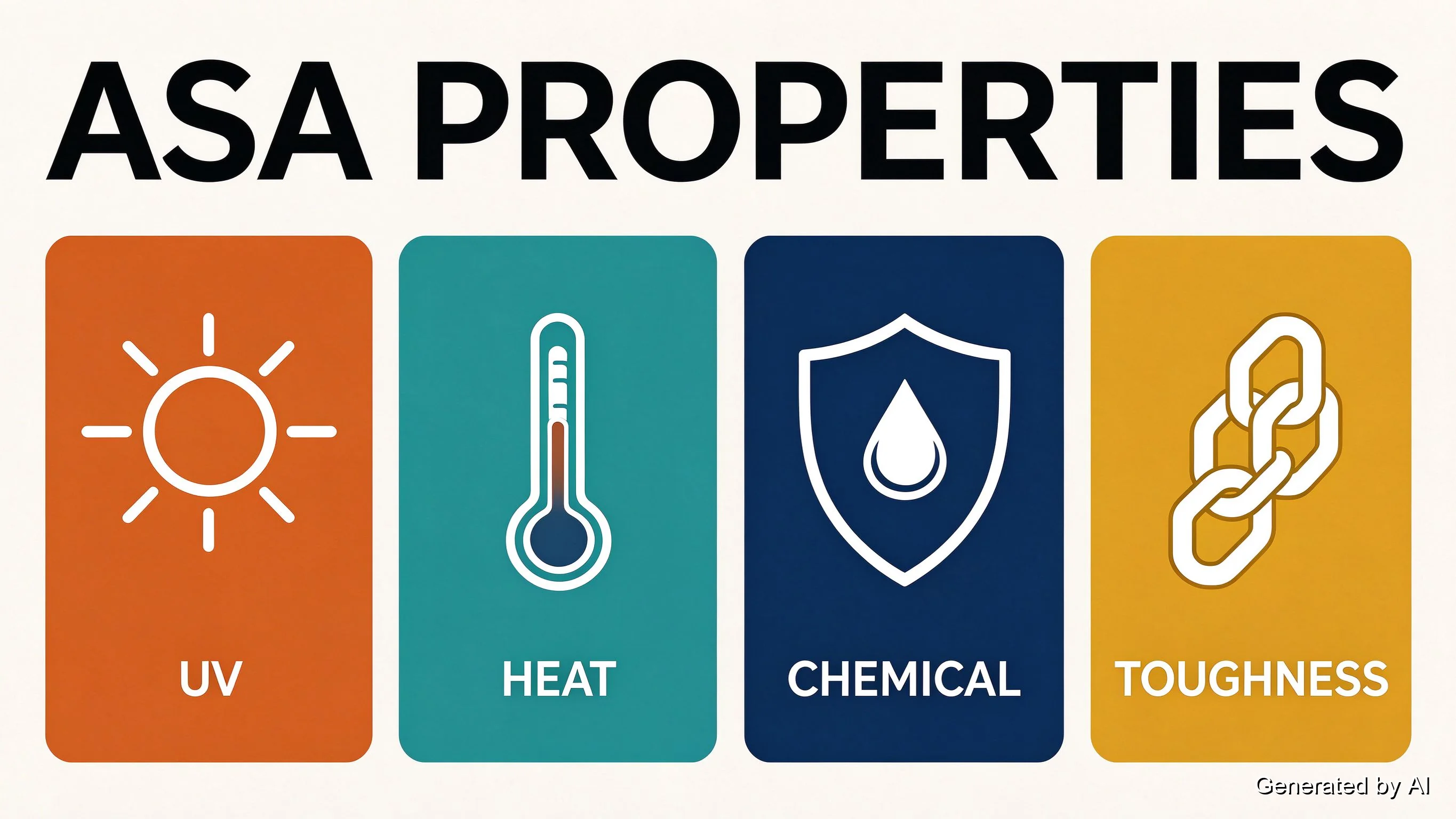
The properties worth knowing split into three groups, and the first is the reason ASA exists.
UV and weather resistance. The acrylate phase does not carry the UV-sensitive bonds that butadiene does, so an ASA part kept outdoors keeps its color and its mechanical properties for far longer than an ABS twin in the same spot. Hedged as that sounds, it is the honest way to say it: service life depends on pigment, thickness, and how much direct sun a part actually takes, so claims in years are not useful. What is useful is the direction and the gap: ABS degrades measurably outdoors, ASA mostly doesn't, within the horizons that matter to a hobbyist or a small shop.
Heat numbers. ASA's glass transition sits around 100–105°C, in the same band as ABS, and heat deflection at the standard 1.82MPa test runs in the 90–95°C class for unfilled grades. Translated: a printed part handles hot-car-interior summers and dishwasher-adjacent duty without slumping, though "heat resistant" never means cooking-tray duty. And the usual distinction applies with extra force here: printing temperature is a processing number, not a service number. A part extruded at 250°C still has the heat limits of the solid material, which are far lower.
| Property | Typical behavior (unfilled grades) |
|---|---|
| Glass transition | Around 100–105°C |
| Heat deflection (1.82MPa) | 90–95°C class |
| Melting point | None sharp; amorphous, softens gradually above Tg |
| Chemical resistance | Good against most household and workshop exposure; attacked by some solvents (which is what makes vapor smoothing possible) |
| Density | Around 1.07g/cm³ |
| Strength | Close to ABS; the upgrade is weatherability, not raw strength |
The rest of the card. ASA is amorphous, so it has no sharp melting point, it softens progressively as it passes its glass transition. Chemical resistance covers water, many acids and alkalis, and the usual household culprits; ketones and esters (acetone among them) are the famous exceptions, and that exception is a feature when smoothing day arrives. Strength is roughly ABS's: stiff, tough, functionally strong in thin walls. Nobody switches from ABS to ASA for strength numbers.
Printing ASA: Settings and What Differs from ABS
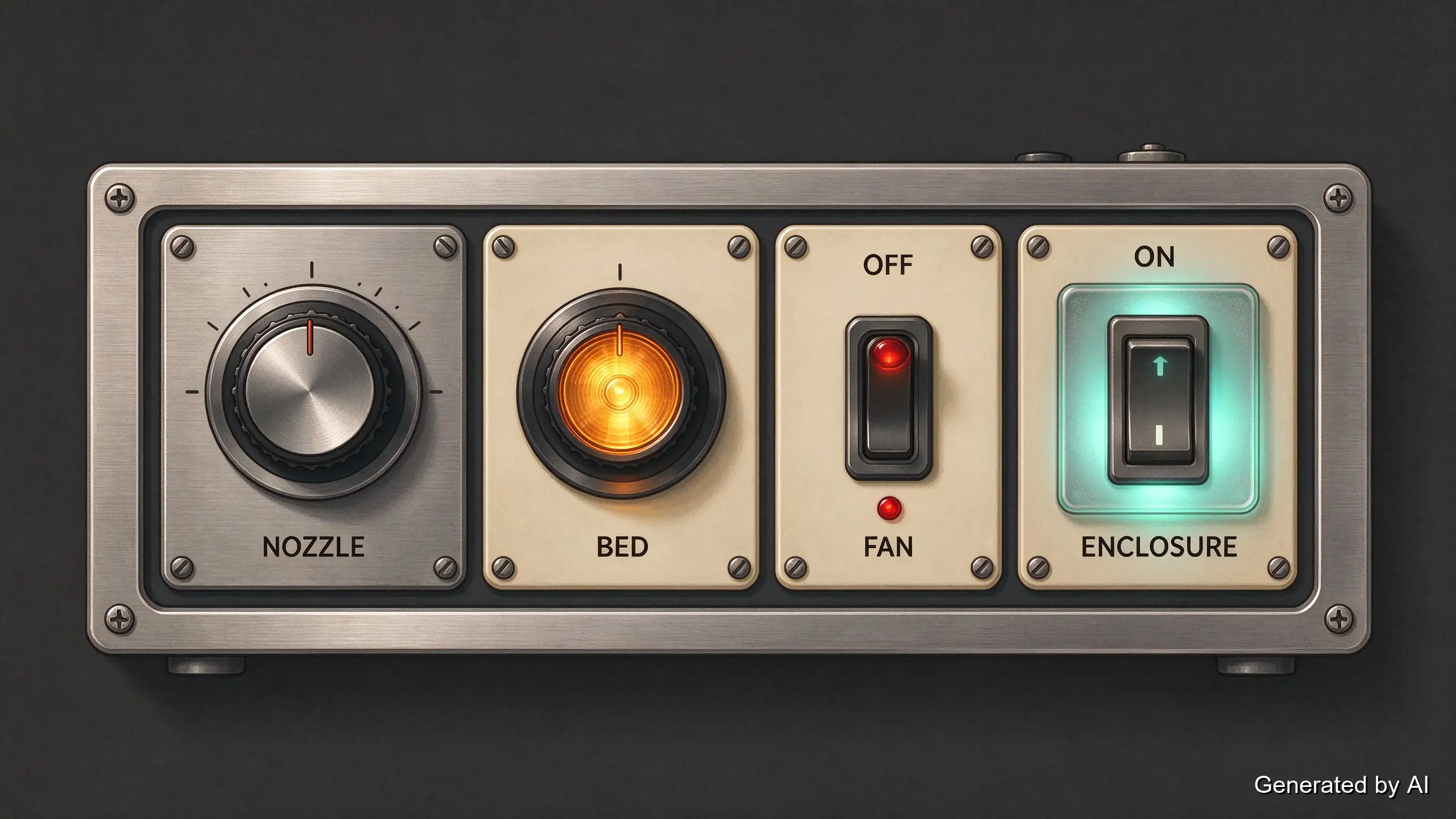
If you print ABS already, you know most of this material already. The settings table for ASA 3D printing is ABS's table with every number nudged slightly upward:
| Setting | Typical ASA range | Note |
|---|---|---|
| Nozzle temperature | 240–260°C | Start near the middle, step in 5°C increments |
| Bed temperature | 100–110°C | Hotter than ABS's floor |
| Cooling fan | Off to very low | Same logic as ABS |
| Enclosure | Strongly advised | Treat as default, not upgrade |
| Print speed | 40–60mm/s | First layer slow |
What actually differs is smaller than the internet makes it sound, and it is worth getting straight:
The smell. Most people report ASA smells milder than ABS in the same room and the same session. Milder is relative, not harmless: the part of your brain that says "this is fine" after twenty minutes is not a gas sensor. Ventilation stays on the checklist, scaled the same way as for ABS, by room size and session length.
The shrinkage. ASA warps a little less than ABS and curls a little less aggressively at corners, and people sometimes read that as "no enclosure needed." The honest version: an open-frame machine will occasionally produce a good ASA part, and will more often produce a curled one. The enclosure remains the default because the cost of adding one is trivial next to the cost of failed eight-hour prints.
The drying. Same story as ABS: the spool absorbs moisture, wet ASA pops and froths and layers come out weak. A few hours in a filament dryer before a long print, sealed storage with desiccant between sessions.
Warping, splitting, stringing, and the full countermeasure ladder are the same discipline as ABS and are covered in depth in our ABS printing guide; nothing about ASA changes that playbook, it just runs it with a slightly longer fuse.
ASA vs ABS: When the Upgrade Pays
The two materials are close enough that the comparison comes down to a short list:
| Dimension | ASA | ABS |
|---|---|---|
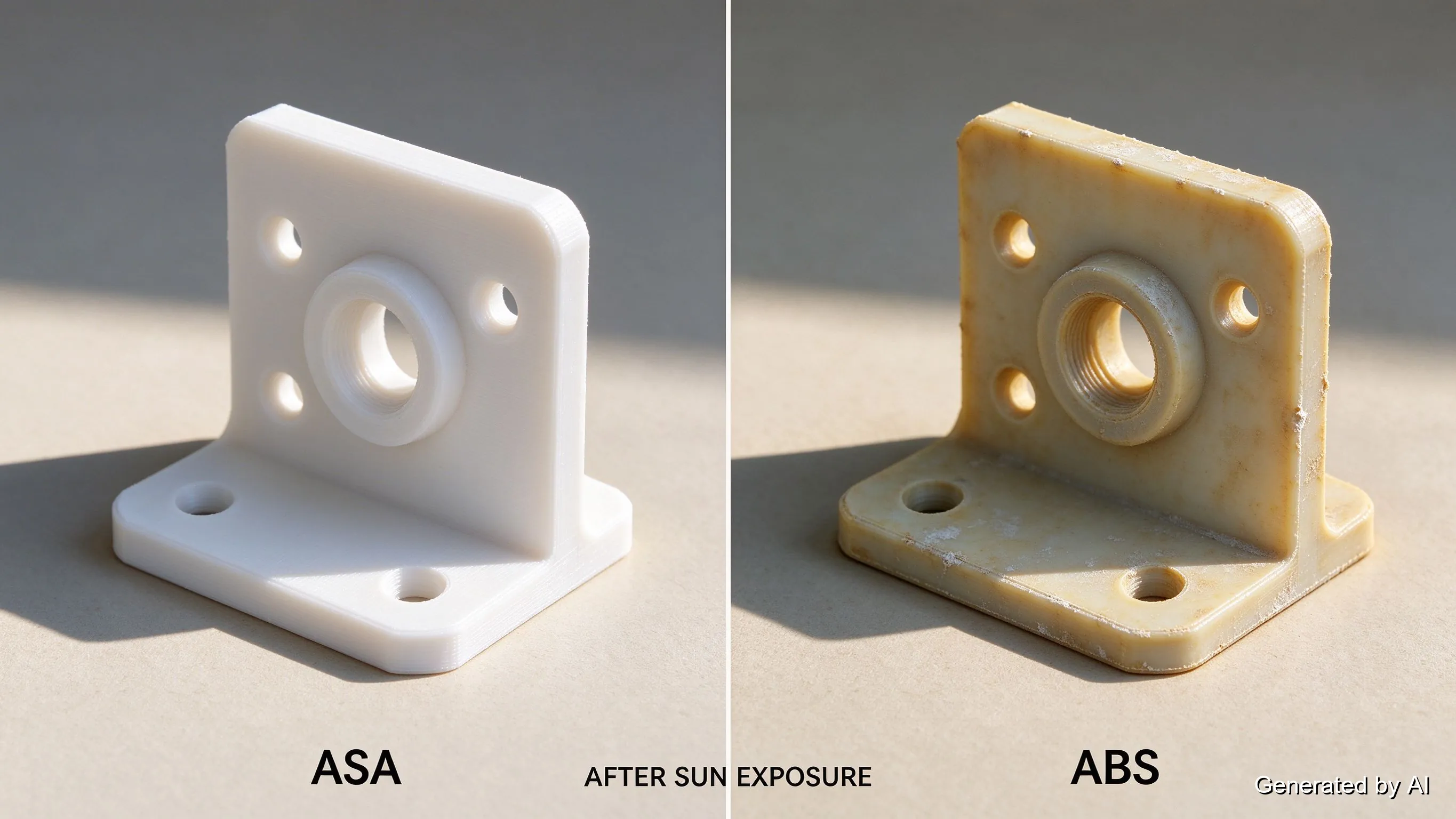
| Outdoor / UV life | Far longer; retains color and properties | Yellows and embrittles measurably |
| Heat deflection | Slightly higher class | Slightly lower |
| Printing difficulty | Similar; marginally less warp-prone | The reference case |
| Odor during printing | Often reported milder | The stronger smell |
| Cost | Typically a few dollars more per kg | Cheaper and everywhere |
The decision rule that falls out of the table: outdoor or long-daylight duty pays for ASA; indoor duty usually doesn't. A camera mount on a garden wall, a replacement car-interior clip that bakes every summer, a mailbox bracket, these are ASA jobs. Brackets, clips, and enclosures that live on a shelf or inside a machine are ABS jobs, and the money saved on filament is real: at retail, ASA commonly lands a few dollars per kilogram above ABS (roughly $30–45 versus $20–30 for widely available spools), so a heavy ABS workload is where the premium compounds fastest. Blended needs (a part that mostly lives indoors but travels) fall in between, and price usually settles them toward ABS.
One boundary keeps the table honest: UV is the headline difference, not the only outdoor enemy. Driving rain finds unsealed perimeters, freeze-thaw cycles work on layer interfaces, and a metal fastener seated in an ASA hole behaves differently through a summer of thermal cycling than one in a climate-controlled box. For hardware that has to survive seasons rather than weekends, print orientation and sealing choices matter as much as filament choice, which is true for ABS too but becomes urgent the moment a part actually stays outside.
The wider material comparison (PLA, PETG, and where each lands) is its own topic, covered in the comparisons already on the blog; this page stays with the ASA-versus-ABS decision because that is the fork most people actually stand at.
Smoothing and Finishing ASA
The acetone trick that makes ABS famous works on ASA too, for the same chemical reason the UV resistance works: swap the rubber phase, keep the styrene-acrylonitrile matrix that ketones dissolve. Vapor smoothing in a sealed jar, the same suspend-and-check-every-15-minutes routine, takes ASA layer lines glossy; wiping acetone onto seams handles local cleanup. Mechanical finishing works as always: sanding, primer, paint, and ASA takes paint well enough to be a favorite for cosplay-grade armor that has to survive a convention weekend outdoors.
Bonding follows the same chemistry: acetone-based slurry and the same solvent cements that join ABS parts work on ASA, and cyanoacrylate works for quick fixes. Annealing a finished part below its glass transition can relax print stresses and nudge heat deflection upward, with the usual trade that dimensions shift, so test on a sacrificial piece first.
Matching ASA to the Job
ASA is the answer to one question: does this part spend its life in the sun? Properties within a hair of ABS, a printing discipline you already know, and weatherability ABS cannot offer, priced a step above. When the answer is yes, print it and stop second-guessing; when the volume or the consistency demands outrun a desktop setup, the same material runs on production machines. JLC3DP supports ASA via FDM among its engineering filaments, with tuned profiles and an engineer reviewing every uploaded model before production; upload your model for an instant quote and compare the per-part number against a spool budget.
FAQ about ASA Filament Guide
Q: What temperature do you print ASA at?
A nozzle around 240–260°C and a bed around 100–110°C are the typical working ranges, with the cooling fan off and an enclosure strongly advised. Start from your ABS profile and nudge upward, verifying against the spool's datasheet.
Q: Does ASA need an enclosure?
Strongly advised, yes. ASA warps a little less than ABS, which tempts people into open frames, but the margin is thin and the cost of an enclosure is small next to failed long prints. Treat it as the default.
Q: Is ASA UV resistant?
Yes, and it is the material's defining upgrade: the acrylate rubber phase lacks the UV-sensitive bonds that make ABS yellow and embrittle outdoors. An ASA part keeps its color and properties far longer in the same sunlight, though "far longer" depends on pigment, thickness, and exposure.
Q: Is ASA stronger than ABS?
Roughly equal. The upgrade from ABS to ASA is weatherability, not strength; stiffness and toughness land close enough that print settings, not the datasheet, decide most strength differences between the two.
Q: How do you smooth ASA prints?
Acetone vapor smoothing works, the same sealed-jar routine as ABS: suspend the part above the liquid, check every 10–15 minutes, stop at the gloss. Wiping acetone onto seams covers local cleanup, and sanding-plus-primer remains the mechanical fallback.
Q: Does ASA smell less than ABS?
Usually reported milder, yes, but milder is not nothing: ventilate the same way you would for ABS, scaled to the room and the session length. Comfort is not a gas sensor.
Keep Learning
ASA Filament: Properties, Print Settings & vs ABS
Key Takeaways ASA filament is ABS's outdoor cousin: the same toughness and printing discipline, with a weatherproof shell that shrugs off the UV that yellows and embrittles other plastics indoors-out. The material case rests on numbers: a glass transition around 100–105°C, heat deflection in the 90–95°C class, and chemical resistance that covers most household and workshop exposure. ASA 3D printing runs on nearly the same settings as ABS, nudged slightly upward: a 240–260°C nozzle, a 100–110°C bed, th......
PLA vs PETG vs ASA: Best 3D Printing Filament for Outdoor Use
If you've ever watched a 3D printed garden hook sag in the sun or a cold snap crack your custom outdoor fixture, you already know: not all filaments are built for the elements. Choosing the best 3D printing filament for outdoor use isn't just about surviving the occasional drizzle. It's about UV exposure, temperature swings, moisture resistance, and long-term strength. And let's be real, most people don't want to reprint every few months just because they picked the wrong plastic. In this guide, we'll......
ABS Temperature Resistance: How Hot Can ABS Withstand?
Key Takeaways ABS heat resistance is defined by Tg and HDT, not melting point. Typical ABS grades have a Tg around 100–110℃ and HDT around 85–95℃. JLC3DP ABS reaches 98°C HDT under its published test conditions, but actual part performance depends on load, geometry, orientation, and exposure time. ABS offers higher heat resistance than PLA and PETG, while ASA provides similar heat performance with better outdoor durability. PC-ABS and PC are options when ABS is not enough. PC-ABS balances heat resista......
Is PETG Toxic to Print? Fumes, Risks & Safety Guide
Key Takeaways PETG is generally considered a lower-emission 3D printing material compared to ABS and ASA, but it does produce VOCs and ultrafine particles during printing. The odor during PETG printing is typically mild, some people barely notice it, others describe a faint warm-plastic smell. Low odor doesn't mean zero emissions. Ventilation is still a sensible precaution. PETG food safety is complicated, the material itself may be food-grade in some formulations, but the printing process introduces ......
Top 5 Heat-Resistant 3D Printing Filaments Compared
When Regular Filament Just Doesn’t Cut It You’ve 3D printed a functional bracket for a car engine bay. It fits perfectly, looks great, and then warps into a banana-shape after a week under the hood. That’s the danger of underestimating heat. If you're building automotive components, enclosures near motors, molds, or even kitchenware, using the wrong filament can lead to deformation, brittleness, or outright failure when exposed to heat. So, you already know the solution: Choosing the right heat-resist......
PLA Temperature Resistance: Heat Resistance, Softening & Melting Point
Key Takeaways PLA typically starts losing rigidity around 55–65℃ (Tg) and melts at approximately 150–180℃. PLA can deform and creep long before it melts, so melting point is not a practical service-temperature limit. Actual PLA deformation depends on temperature, load, geometry, print orientation, and exposure time. Standard PLA becomes increasingly risky above 50–60℃ and is generally unsuitable for sustained 70–80℃ applications. PLA+ heat resistance varies by formulation. For higher-temperature appli......