What Is 3D Printer Filament? Types and How to Choose
13 min
- What Is 3D Printer Filament?
- The Main Filament Types
- Filament Properties That Actually Matter
- Specialty Filaments
- Moisture: The Filament Killer
- Choosing Filament for the Job
- FAQ about 3D Printer Filament Types
Key Takeaways
- 3D printer filament is the thermoplastic strand an FDM printer melts and deposits layer by layer. Two diameters dominate: 1.75mm mainstream, 2.85mm second.
- The main types of 3D printer filament sort into five practical groups — easy and rigid (PLA), tough and balanced (PETG), heat-resistant (ABS/ASA), flexible (TPU), engineering-grade (nylon, PC, PEEK) — plus composites and soluble support materials.
- Choosing comes down to four properties: strength versus stiffness, heat resistance, flexibility, and outdoor weatherability.
- Moisture is the top filament killer. Popping sounds, heavier stringing, and brittle snaps are the three symptoms of a wet spool; drying and sealed storage fix it.
- Food safety is not decided by the material alone — layer lines leave gaps and coatings vary, so "PLA is food safe" is an oversimplification.
Filament is to an FDM printer what ink is to a pen, except the ink decides how your part turns out: its stiffness, its heat tolerance, whether it survives a summer outdoors. Yet most people pick their first spool on price and never think about the choice again until a print fails.
This page is the map. It covers what filament physically is, the full type list from PLA to PEEK with a table you can scan in a minute, the four properties that actually drive material selection, the moisture problem nobody warns beginners about, and a chooser for matching material to job. Each type links to a deeper guide where we have one.
What Is 3D Printer Filament?
A 3D printer filament is a continuous strand of thermoplastic, wound on a spool, that an FDM printer pulls through a heated nozzle, melts, and deposits layer by layer until a part exists. The word covers the material and the product form at once: a 1kg spool of PLA is as much "filament" as the strand currently melting inside the hotend.
Diameters are standardized to two options. 1.75mm is the mainstream choice — most desktop machines and most material varieties are built around it — and 2.85mm (once sold as 3mm) holds a smaller share. The number matters more than it looks: a printer's extruder is designed for one of them, and feeding the wrong diameter starves the nozzle.
That tolerance point deserves a second look when you buy. Cheap spools advertise the nominal diameter but hold it loosely; a strand that wanders between 1.65mm and 1.85mm produces under-extrusion that no slicer setting fully fixes. Reputable manufacturers print the tolerance on the spool — ±0.02mm or ±0.03mm — and holding them to it is the simplest quality check in the hobby.
Filament also implies a process. It feeds extrusion-based printing; resin printers use liquid photopolymer vats and powder systems use beds of nylon or metal instead. If you're weighing that fork, our resin vs filament comparison covers it in detail.
The Main Filament Types
Every common material fits somewhere in the table below. The "best at" column is where each type earns its place; the "watch out" column is why people switch away.
| Type | Best at | Watch out | Typical cost | Deep dive |
|---|---|---|---|---|
| PLA | First prints, rigid decorative parts, fine detail | Softens around 60℃ (Tg); degrades in sun and heat | $ | — |
| PETG | Tough, printer-friendly all-rounder; outdoor OK | Stringing; softer than PLA under load | $ | Guide |
| ABS | Heat resistance, smoothable with acetone | Warps without an enclosure; fumes indoors | $ | — |
| ASA | Like ABS but UV-stable — exterior parts | Same enclosure demands as ABS | $$ | — |
| TPU / TPE | Flexible parts: grips, seals, gaskets, cases | Slow printing; direct-drive extruders preferred | $$ | Guide |
| Nylon | Engineering toughness, wear, living hinges | Extremely hygroscopic — see moisture section | $$$ | Guide |
| Polycarbonate (PC) | Stiff, heat-resistant structural parts | High nozzle and bed temperatures needed | $$$ | — |
| PEEK | Extreme heat and chemical resistance; semi-crystalline | Several hundred dollars per kg; high-temperature chamber required | $$$$ | Guide |
| PEI (ULTEM) | Flame-resistant aerospace polymer; high strength-to-weight | Amorphous — prints differently than PEEK; not interchangeable | $$$$ | — |
| Carbon / glass fiber composites | Maximum stiffness per gram | Abrasive — hardens nozzle wear | $$$ | — |
| Silk, glow, wood-fill | Appearance: shine, luminosity, texture | Strength and detail trade away; wood nozzles wear | $$ | — |
| PVA / HIPS | Dissolvable support material | Storage-sensitive; dissolved away after printing | $$$ | — |
> Cost tiers are relative ($ = cheapest commodity spools → $$$$ = PEEK territory); the FAQ below gives the actual dollar ranges behind them.
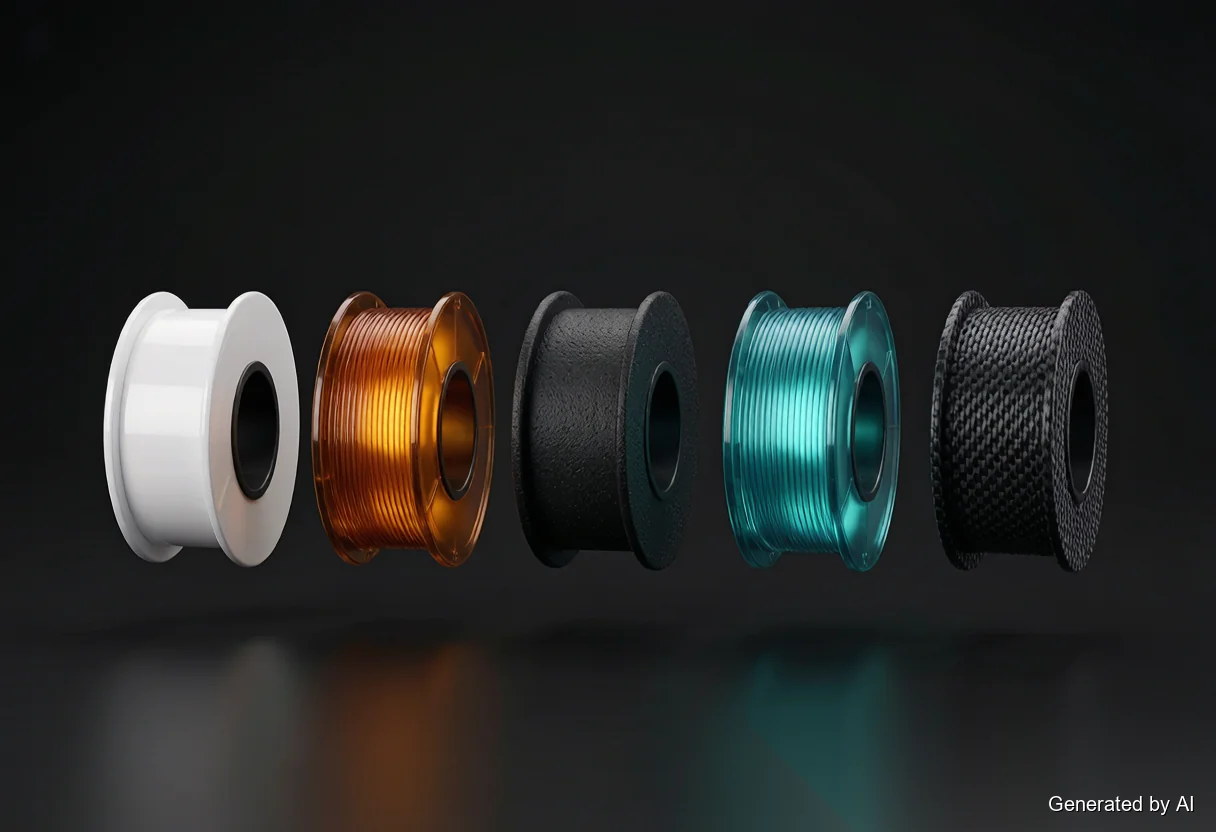
Three of these deserve the commentary.
PLA is a rigid, easy-print thermoplastic made from plant-derived starches — the default first spool, and with reason: it prints at low temperatures with no enclosure, holds detail, and costs the least of any option. The weaknesses are just as real. It softens around 60℃ (its glass transition), which rules out a car dashboard in summer, and it embrittles under prolonged UV exposure. For desk objects, jigs, and prototype iterations it remains the correct default.
PETG is a glycol-modified polyester that trades a little of PLA's stiffness for real toughness — the pragmatic middle for functional parts that get handled: brackets, clips, enclosures. Where PLA snaps, PETG bends; where PLA clouds outdoors, PETG weathers. The price is stringing that needs tuning and a surface that reads slightly softer.
ABS is the classic heat-resistant workhorse — smoothable with acetone — and ASA is its UV-stable sibling for parts that live outdoors. Both want a heated chamber to behave; on an open-frame printer they curl at the corners and crack at layer lines. If the part lives in a hot engine bay or outdoors, they are the answer — printed on hardware that can hold temperature.
The engineering tier deserves its own word because the jump is qualitative, not incremental. Nylon is the engineering workhorse — toughness, wear resistance, and fatigue performance for parts that move: bushings, gears, living hinges. It prints hot, warps mid-print if it cools, and pulls water out of the air faster than any commodity material. Polycarbonate takes structural loads at temperatures where PETG has long since softened, at the cost of nozzle temperatures near 260–290℃ and a chamber that means it. PEEK (polyether ether ketone) and PEI (polyetherimide, better known as ULTEM) are both high-performance thermoplastics used in aerospace, medical, and industrial parts — when their specific thermal, chemical, or regulatory properties are what the job demands. They are distinct materials, often wrongly lumped together: PEEK is semi-crystalline with extreme heat and chemical resistance; PEI is amorphous and earns its aerospace seat through flame resistance. Both are priced by the hundreds of dollars per kilogram, and both sit outside most desktop hardware's reach entirely. The honest framing: these materials reward machines and operators built for them, which is why so much engineering-grade work ends up outsourced.
Filament Properties That Actually Matter

Material selection goes wrong when strength is treated as one number. It is at least four.
Strength versus stiffness. A stiff material resists bending but snaps when it does; a tough one absorbs impact by giving. PLA is stiff; PETG and nylon are tough. Neither is "stronger" — they win different tests.
Heat resistance. The glass transition temperature (Tg) — where a polymer turns leathery under load — sets the practical ceiling: PLA around 60℃, PETG near 80℃, ABS and ASA around 100–105℃, polycarbonate higher still. How hot a finished part can actually run sits below its Tg and depends on load, geometry, and print orientation; a loaded PLA bracket gives up well before an unloaded decorative print does. A dashboard in a parked car clears 70℃, which quietly eliminates PLA.
Flexibility. Elongation determines whether a clip snaps shut a thousand times or cracks on the tenth. That is TPU territory, and the strongest filament guide ranks the load-bearing options by actual use case.
Outdoor weatherability. UV and moisture together kill PLA and plain ABS over months. PETG, ASA, and the specialty outdoors compounds survive years — the heat-resistant filament comparison covers where the temperature and UV requirements overlap.
All four properties vary by brand and batch, so treat any single datasheet number as indicative rather than guaranteed.
Specialty Filaments
A few materials earn their category by doing one job unusually well.
ESD-safe compounds hold electrical conductivity in a controlled range, so static drains instead of building — essential for fixtures that handle circuit boards. The ESD filament guide covers the selection logic.
LW-PLA foams in the nozzle, printing at a fraction of the weight of solid plastic. RC aircraft wings and cosplay props are its territory.
Soluble supports (PVA in water, HIPS in limonene) dissolve away after a print, leaving overhangs clean where breakaway supports would scar them. They cost more and absorb moisture aggressively, so storage discipline is not optional.
Wood-fill, metal-fill, and glow materials change surface character more than mechanics. All specialty spools are fussier about temperature than the commodity ones — first run, follow the manufacturer's table exactly, then tune.
Moisture: The Filament Killer
Moisture is one of the most common causes of filament-related print failures — the first suspect when quality drops, especially with hygroscopic materials like nylon, PETG, and PVA. They absorb water from the air within days; PLA absorbs slower but is not immune. The water does its damage at the nozzle: it flashes to steam inside the melt, and the symptoms are audible and visible.
Three signs to learn: popping or crackling from the nozzle during a print; stringing and oozing worse than the same spool used to produce; brittleness, where a strand that once coiled snaps when bent. Any one of them means the spool has taken on water.
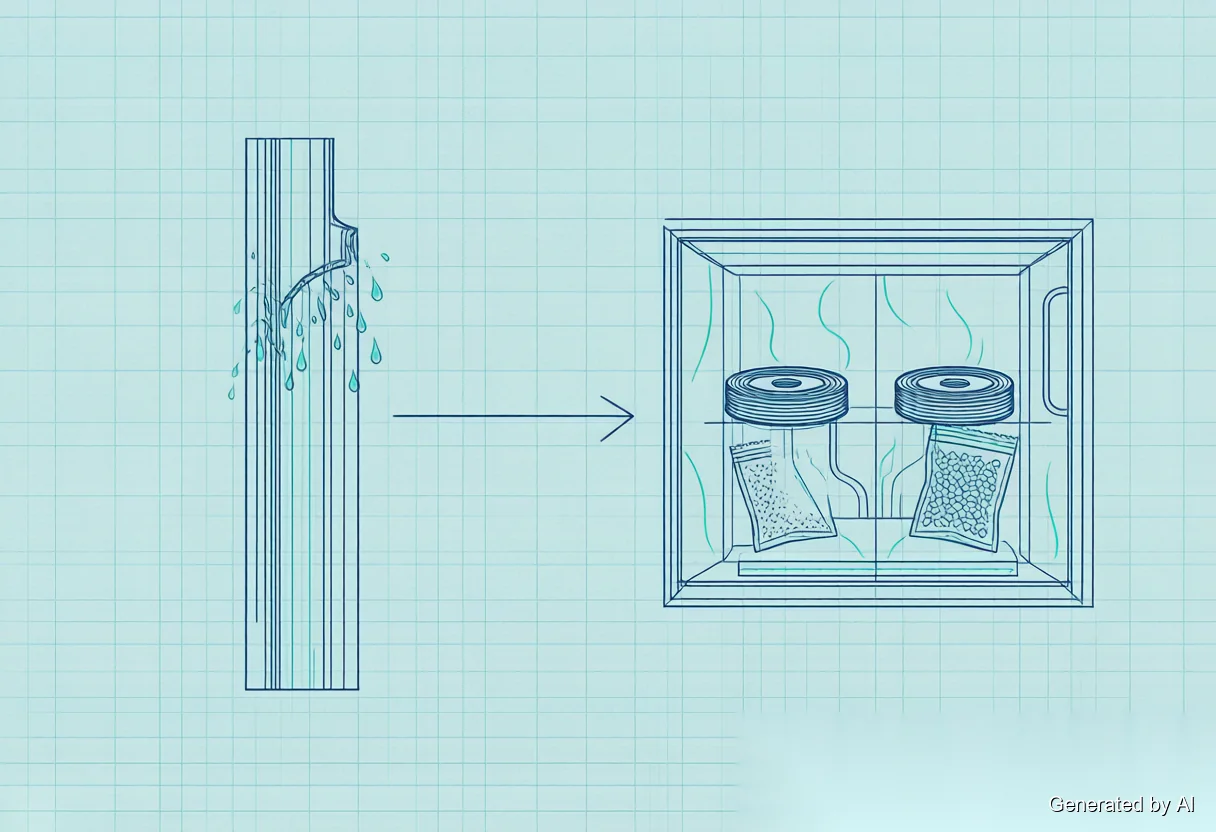
The fixes are cheap relative to the prints they save. A drying cycle in a filament dryer or a low-temperature oven restores a wet spool, and sealed storage with desiccant keeps a dry one dry — the storage and drying guide covers temperatures and times per material. Dedicated dry-boxes that print straight from a sealed chamber solve it permanently for hygroscopic materials.
Choosing Filament for the Job
| The job | The material |
|---|---|
| First spool, desk objects, prototypes | PLA |
| Functional parts that get handled | PETG |
| Hot environments, outdoors | ASA (or ABS with care) |
| Living hinges, snap fits under load | Nylon |
| Flexible, grippy, shock-absorbing | TPU |
| Stiff structural parts in heat | Polycarbonate |
| Food contact | Read below before deciding |
The progression most people follow runs PLA to PETG to ASA or nylon as parts get more serious, then PC and PEEK when requirements turn industrial. There is no prize for skipping grades — each step adds printing difficulty.
Not every material on this table is a desktop proposition, and that is worth knowing before you buy hardware around one. PLA and PETG almost always are; nylon, PC, and PEEK reward machines and enclosures most desks never have. There is a process axis, too: the same polymer family that prints as spooled nylon at home runs as PA12 powder in industrial MJF and SLS systems, where consistency and cost per part behave differently. Geometry, wall thickness, build orientation, and production volume shift the answer as much as the polymer does — a material decision and a process decision are one decision. Our engineering team reviews every uploaded model against 7 industrial processes and 30+ materials before quoting. The practical split: print the friendly materials yourself, and send the engineering-grade ones — or the jobs that need real volumes — to machines that already run them daily.
Food contact is the row that needs a caveat. Material choice matters, but so do layer-line gaps that harbor bacteria and any coating applied after printing; the PLA food safety guide walks the actual decision. And once the spool is chosen and the part designed, uploading the model to JLC3DP gets you automatic manufacturability checks and a quote across 7 industrial processes — sometimes the material decision is easier outsourced to machines that already run it daily.
FAQ about 3D Printer Filament Types
Q: What is 3D printer filament made of?
Thermoplastics: PLA from plant-derived starches, PETG and ABS from petroleum polymers, nylon and PC from engineering polymer families. Additives tune color, stiffness, and print behavior.
Q: What are the main types of 3D printer filament?
Five working groups: easy and rigid (PLA), tough and balanced (PETG), heat-resistant (ABS/ASA), flexible (TPU), and engineering-grade (nylon, PC, PEEK), plus composites and soluble supports. Nearly all of them come on 1.75mm spools (2.85mm second); the table above covers each in one line.
Q: How much does 3D printer filament cost?
Typically $15–30 per kilogram for commodity spools (PLA, PETG, ABS), $25–60 for engineering materials like nylon and PC, and several hundred dollars per kilogram for PEEK. Prices move with resin markets, so treat those as ranges rather than quotes.
Q: Which filament is easiest for beginners?
PLA, by a wide margin: low printing temperature, no enclosure, no warp, and forgiving of imperfect bed leveling. Move to PETG when parts need to survive handling.
Q: What is the difference between PLA and PETG?
PLA is stiffer, prints cleaner, and holds detail better; PETG is tougher, weathers outdoors, and takes impacts that would snap PLA. PETG strings more and prefers a slightly hotter nozzle.
Q: Does 3D printing filament go bad?
Yes — mostly through moisture, which degrades print quality long before the polymer itself ages. Nylon and PVA can degrade in days of humid air; sealed storage with desiccant extends spool life by years.
Q: What is the strongest 3D printing filament?
There is no single strongest filament — the question is which property wins your test. Carbon-fiber-reinforced polymers (PA-CF, PET-CF, and friends) dominate stiffness-to-weight; nylon and PC take impact; PEEK holds load at temperatures the others have left. The strongest filament guide ranks them by use case.
Q: Is any 3D printing filament food safe?
Partly a material question and partly not. Food-grade pellets, unblemished surfaces, and suitable coatings together make a part food-contactable; layer-line gaps and unknown additives keep it from being automatic. There is no safe default for uncoated prints — treat food contact as a certification question, not a material question.
Conclusion: 3D Printer Filament Types
Filament is the smallest decision in 3D printing that changes everything downstream: the same model, printed in PLA versus ASA versus nylon, is three different parts. Learn the five material groups, weigh the four properties against the actual job, keep the spool dry, and the choice collapses to a table row. When the job outruns desktop materials — or you would rather skip the tuning entirely — the industrial route is one upload away.
Keep Learning
PLA vs PETG vs ASA: Best 3D Printing Filament for Outdoor Use
If you've ever watched a 3D printed garden hook sag in the sun or a cold snap crack your custom outdoor fixture, you already know: not all filaments are built for the elements. Choosing the best 3D printing filament for outdoor use isn't just about surviving the occasional drizzle. It's about UV exposure, temperature swings, moisture resistance, and long-term strength. And let's be real, most people don't want to reprint every few months just because they picked the wrong plastic. In this guide, we'll......
ABS Temperature Resistance: How Hot Can ABS Withstand?
Key Takeaways ABS heat resistance is defined by Tg and HDT, not melting point. Typical ABS grades have a Tg around 100–110℃ and HDT around 85–95℃. JLC3DP ABS reaches 98°C HDT under its published test conditions, but actual part performance depends on load, geometry, orientation, and exposure time. ABS offers higher heat resistance than PLA and PETG, while ASA provides similar heat performance with better outdoor durability. PC-ABS and PC are options when ABS is not enough. PC-ABS balances heat resista......
Is PETG Toxic to Print? Fumes, Risks & Safety Guide
Key Takeaways PETG is generally considered a lower-emission 3D printing material compared to ABS and ASA, but it does produce VOCs and ultrafine particles during printing. The odor during PETG printing is typically mild, some people barely notice it, others describe a faint warm-plastic smell. Low odor doesn't mean zero emissions. Ventilation is still a sensible precaution. PETG food safety is complicated, the material itself may be food-grade in some formulations, but the printing process introduces ......
Top 5 Heat-Resistant 3D Printing Filaments Compared
When Regular Filament Just Doesn’t Cut It You’ve 3D printed a functional bracket for a car engine bay. It fits perfectly, looks great, and then warps into a banana-shape after a week under the hood. That’s the danger of underestimating heat. If you're building automotive components, enclosures near motors, molds, or even kitchenware, using the wrong filament can lead to deformation, brittleness, or outright failure when exposed to heat. So, you already know the solution: Choosing the right heat-resist......
PLA Temperature Resistance: Heat Resistance, Softening & Melting Point
Key Takeaways PLA typically starts losing rigidity around 55–65℃ (Tg) and melts at approximately 150–180℃. PLA can deform and creep long before it melts, so melting point is not a practical service-temperature limit. Actual PLA deformation depends on temperature, load, geometry, print orientation, and exposure time. Standard PLA becomes increasingly risky above 50–60℃ and is generally unsuitable for sustained 70–80℃ applications. PLA+ heat resistance varies by formulation. For higher-temperature appli......
PETG Temperature Resistance: Limits & Comparison with PLA/ABS/ASA
Key Takeaways Standard PETG is best suited for continuous use below ~60℃; performance can decline as temperatures approach 70℃. PETG typically has a Tg of ~75–85℃ and an HDT of ~65–75℃, depending on the material grade and test conditions. HDT is not a maximum service temperature—load, print orientation, wall thickness, geometry, and exposure time all affect real-world performance. PETG offers better heat resistance than PLA but lower heat resistance than ABS, ASA, PA12-CF, PC, and PEEK. For sustained ......